2015 AUDI Q5 fuel
[x] Cancel search: fuelPage 105 of 302

M N
co
a:
co
,...., \!) 1.1'1
N 1.1'1 ,....,
Driving situa-
tions
Constant driving
and coasting
(glid ing)
Energy recovery
(recuperation)
Driving in city
traffic
Driving on high-
ways and ex- pressways
Driving in cold
weather
Conditions
- Cautious driving and reserved ac-
celeration .
- Release the accelerator pedal early
and entirely .
- Brake early and evenly with shor t
pedal movements.
- Reserved acce leration and early
and even braking with short pedal
movements.
- Use the
!<=!VI button sparingly.
- Intentionally take your foot off of
the gas pedal to allow for lengthy
coast ing .
- Reduce the veh icle speed by
re-
leasing the acce lerato r pedal and
not by braking.
- Avoid vehicle speeds above approx-
imately 99 mph (160 km/h).
- Use the S selec tor lever position
and tiptronic mode sparingly .
- Do not run the combustion erngine
while the veh icle is parked to warm
the engine.
- Use the rear window/exterior mir-
ror defroster and the seat heat ing
sparingly .
- Park the vehicle in a garage over-
night. Hybrid
Vehicle behavior
The kinetic energy of the vehicle
is used to
move the vehicle .
When you release the accelerator pedal en-
tirely, the combustion eng ine turns off auto-
matically and is disengaged. The veh icle
g lid es without being propelled.
The electric motor brakes the vehicle. By do- ing this, a large amount of the kinetic energy
is recovered and may be stored in the high
voltage battery in the form of electric energy .
The kinetic energy of the vehicle is used to
move the vehicle .
T he battery drains quickly when the
!<=!VI but-
ton is turned on, which can increase fuel con-
sumpt ion because electric driv ing is given
priority, even if driving with the combustion
engine on wo uld be more efficient.
When you release the accelerator pedal en-
tirely, the combustion engine turns off auto- matically and is disengaged . The vehicle
g lid es without being propelled.
Fu el consumption can be reduced by coast-
ing .
It is possible to coast up to a vehicle speed of
approximately 99 mph (160 km/h).
A sporty dr iving style increases fuel con-
sumpt ion .
The temperature of the combustion engine
rises very slowly and the fue l consumption
increases considerably.
This conserves the energy in the high voltage
bat tery so that it is available to run the veh i-
cle in electr ic mode .
This reduces exposure of the high voltage
battery to cold temperatures. The required
temperature range for the high voltage bat-
tery will then be reached more quickly after
you start driving.
103
Page 200 of 302

Driving and the environment
Driving and the
environment
Breaking in
New engine
The engine needs to be run-in during the first
1,000 miles (1,500 km).
For the first 600 miles (1,000 kilometers ):
.,. Do not use full throttle.
.,. Do not drive at engine speeds that are more
than 2/3 of the maximum permitted RPM .
From 600 to 1,000 miles (1,000 to 1,500
kilometers ):
.,. Speeds can gradually be increased to the maxi
mum perm issib le road or engine speed.
During and after break-in period
.,. Do not rev the engine up to high speeds when it
is cold. This applies whether the transmission is
in N (Neutral) or in gear .
After the break•in period
.,. Do not exceed maximum engine speed under
any circumstances.
.,. Upshift into the next higher gear
before reach
ing the red area at the end of the tachometer
scale
¢page 10.
During the first few hours of driving, the engine's
internal friction is higher than later when all the
moving parts have been broken in. How well this
break-in process is done depends to a cons idera
b le extent on the way the vehicle is driven dur ing
the first 1,000 miles (1,500 kilometers).
{[) Note
Extremely high engine speeds are automati
cally reduced. However, these rpm limits are
prog rammed fo r an engine well run-in, not a
new engine.
@ For the sake of the environment
Do not drive with unnecessarily high engine
speeds -upshifting early saves fuel, reduces
noise and protects the environment.
198
· New tires
If your vehicle is running on new tires, drive very
ca refully for the first 350 m iles (500 k ilometers)
after fitting.
_& WARNING
New tires tend to be slippery and must a lso
be "broken-in" . Be sure to remember this dur
ing the first 350 m iles (500 k ilometers).
Brake gently. Avoid following closely behind
other vehicles or other situations that might
require sudden, hard brak ing.
Catalytic converter
App lies to vehicles : wit h gasoli ne e ngi ne
It is very important that your emission control
system (catalytic converter) is functioning prop
erly to ensure that your vehicle is running in an
environmentally sound manner .
.,. Always use lead-free gasoline ¢page 213,
Gasoline .
.,. Never run the tank down all the way to empty.
.,. Never put too much motor oil in your engine
¢ page 22 5, Adding engine oil 9::r..
.,. Never try to push- or tow-start your vehicle .
The catalytic converter is an efficient "clean-up"
device b uilt into the exhaust system of the vehi
cle. The cata lytic converter burns many of the
po llutants in the exhaust gas before they are re
l eased into the atmosphere.
-
The exclusive use of unleaded fuel is c ritica lly im
portant for the life of the catalytic converter and
proper functioning of the engine.
A WARNING
The temperature of the exhaust system is
high, both when driv ing and after stopping
the eng ine.
-
- Never touch the exhaust tail pipes once they
have become hot. This could result in burns.
- Do not park or operate the vehicle in areas
where the hot exhaust system may come in
contact with dry grass, brush, fuel spill or
other material which can cause a fire.
Page 201 of 302

M N
co
a:
co
,...., \!) 1.1'1
N 1.1'1 ,....,
-Do not apply additional undercoating or
rustproofing on or near the exhaust man i
fold, exhaust pipes, catalytic converter or heat shields. During driving, the substance
used for undercoating could overheat and
cause a fire.
Q) Note
- Be aware that just one tank filling with lead
ed
fuel will already seriously degrade the
performance of the catalytic converter .
- Do not exceed the correct engine oil level
¢page 225.
-Do not drive until the fuel tank becomes
completely empty . The engine could misfire.
Unburned fuel could also get into the ex
haust system and this could cause the cata
l ytic converter to overheat.
- Do not turn off the ignit ion while the veh icle
i s mov ing .
- Do not continue to operate your vehicle un
der these cond it ions, as otherwise fuel can
reach the catalyt ic converte r. This cou ld re
su lt in overheating of the converter, requir
i ng its replacement.
- To assure efficient operat ion of the Emission
Control System:
- Have your veh icle maintained properly and
in accordance with the service recommen
dations in your Warranty
& Maintenance
booklet.
- Lack of proper maintenance as well as im
proper use of the vehicle will impair the
function of the em ission control system
and could lead to damage.
@) For the sake of the environment
Even when the Em ission Control System is op
erating properly, the exhaust gas can have a
sulfur-like exhaust gas smell under some op
erating states. This depends on the sulfu r
content of the fuel being used. Using a differ
ent brand of fuel may help, or filling the tank
wit h lead-free super grade gasoline.
Dri ving and th e en vir onm ent
Diesel particulate filter
Applies to veh icles: w ith diesel en gine
The diese l particu late filter filters nearly all of
the soot particles out of the exhaust. The filter
cleans itself automatica lly under norma l driving
conditions. If the filter cannot clean itself (for ex
ample, because you are only driving short distan
ces), the filter becomes clogged with soot and
the
II symbol for the diese l particulate filter il
luminates
¢ page 34 .
_&. WARNING
-Do not park your veh icle over flammab le
materia ls such as grass or leaves because
the high temperature of the diesel particu
late filter could start a fire .
-
-Do not app ly an underbody protectant in the
exhaust system area or a fire cou ld start.
Avoid damaging the
vehicle
When you are driving on poor roads, or over
curbs, steep ramps, etc., make certain that low
lying parts such as spoilers and exhaust system
parts do not bottom out and get damaged.
This is especially true for vehicles with low-slung
chassis (sports chassis)* and fully loaded
vehicles.
Economical and environ
mentally-friendly driving
General
Your personal style of driving will determine the
economy of your vehicle, as well as exhaust and
noise levels.
Fuel economy, environmenta l impact, and wear
on your engine, brakes and tires largely depend
on three factors:
- your pe rsonal d riving style
- operating conditions
- technical limitat ions
If you ant icipate what you need to do next and
drive economically, you can easily cut your fuel
199
Page 202 of 302

Driving and th e environment
consumption by 10-15 percent. This section will
give you some tips on how you can help the envi ronment and your pocketbook.
(D Tips
The consumption estimates as published by ENVIRONMENTAL PROTECTION AGENCY (EPA)
and Transport Canada may not correspond to
your actual consumption on the road, wh ich
w ill vary depend ing upon vehicle load and
speed, road and weather conditions, trip
length, etc .
Drive smoothly and keep a lookout ahead
Vehicles use the most fuel when they are acceler
ating .
"'Avoid unnecessary accelerating and braking.
Vehicles use the most fuel when they are acceler
ating . If you anticipate what is going to happen
next, you will need to brake less and, thus, accel
erate less. Let the vehicle coast whenever possi
ble -for example when you see that the next traf
fic light is red .
Avoid full throttle
Driving at moderate speeds saves fuel and im
proves your mileage.
"' Try and keep well be low your car's max imum
speed.
Accelerating gently reduces fuel consumption,
engine wear, and does not disturb the environ
ment.
Fue l consumption, exhaust emissions and engine
noise increase disproportionately at high speeds.
If you drive at approximately three quarters of
top speed, fuel consumpt ion w ill be reduced by
one half. Never dr ive faster than the posted
speed lim it and weather conditions permit .
200
· Reducing unnecessary idling
Even when your car is just idling it burns up fuel .
"'Shut the engine off when you are not driving
the vehicle.
"' Do not warm up the vehicle by letting the en-
gine run at idle .
The idling phase is automatically reduced for
vehicles with the Start-Stop-System*. It is effi c ient to sw itch off the eng ine in vehicles w ithout
the Start-Stop-System* when stopped at railroad
crossings and long red lights. Turn ing the engine
off for just 30-40 seconds saves more fuel than is
burned by start ing the eng ine again.
It takes a long t ime for the engine to warm up
fully when it is runn ing at id le . However, wear
and noxious emissions are especia lly high when
the engine is warming up. So you sho uld drive
away as soon as you start the eng ine and avoid
running at high rpms whi le the engine is s till
warming up.
Q) Note
Do not leave engine id ling unattended after
starting. If warning lights should come on to
indicate improper operation, they would go
unheeded. Extended idling also produces
heat, which could result in overheating or oth
er damage to the veh icle or other property.
· Regular maintenance
A badly tuned engine unnecessarily wastes a lot
of fuel.
"' Have your vehicle serviced at regu lar intervals.
By having your veh icle reg ularly serv iced by an
authorized Aud i dea le r helps to ensure that i t
runs proper ly and economica lly. The condition of
your vehicle not on ly affects its safety and ability
to hold its value, it also affects
fuel consump
t ion .
Chec k your oil ea ch t ime y ou fill your tank.
The amount of o il used is re lated to engine load
and speed. .,.
Page 203 of 302

M N
co
a:
co
,...., \!) 1.1'1
N 1.1'1 ,....,
It is normal for the oil consumption of a new en
gine to reach its lowest va lue after a certain mile
age has been driven.
You must d rive yo ur vehicle about 3,000 miles
(5,000 kilometers) before you can properly as
sess oi l consumption.
This also applies to fuel consumption and engine
output.
(y Note
- Have you r vehicle maintained properly and
in accordance with the service recommenda
tions in your Warranty
& Maintenance book
l et. Lack of proper maintenance as well as
improper use of the vehicle will impair the
funct ion of the emission control system and
could lead to damage.
- Do not alter or remove any component of
the Emission Contro l System unless ap
proved by the manufacturer.
- Do not alter or remove any device, such as
heat shields, switches, ign it ion w ires,
valves, wh ich are designed to protect your
vehicle's Emission Control System and other i mportant vehicle components.
Fewer short trips
Fuel consumption will always be relatively high
on short trips .
.. Try to avoid driving short distances with a cold
engine.
The engine and catalytic converter have to reach
their optimal
operating temperature to reduce
fuel consumption and noxious emissions effec
tively.
Just after starting, a cold engine in a mid-size car
only achieves a fuel economy of 6-8 miles per
gallon (30-40 l/100 km). After about a half a
mile, fuel economy cl imbs to 12 mpg (20 l/100
km) . After about
2.5 miles (4 km), the engine is
at its proper operating temperature and fuel
economy has reached a normal level. So you can
see that you should avoid short trips whenever
possib le.
Driving and the environment
The outside temperature is also critical in this re
gard. Your car consumes more fuel in the winter
than in the summer.
201
Page 212 of 302
Care and cleaning
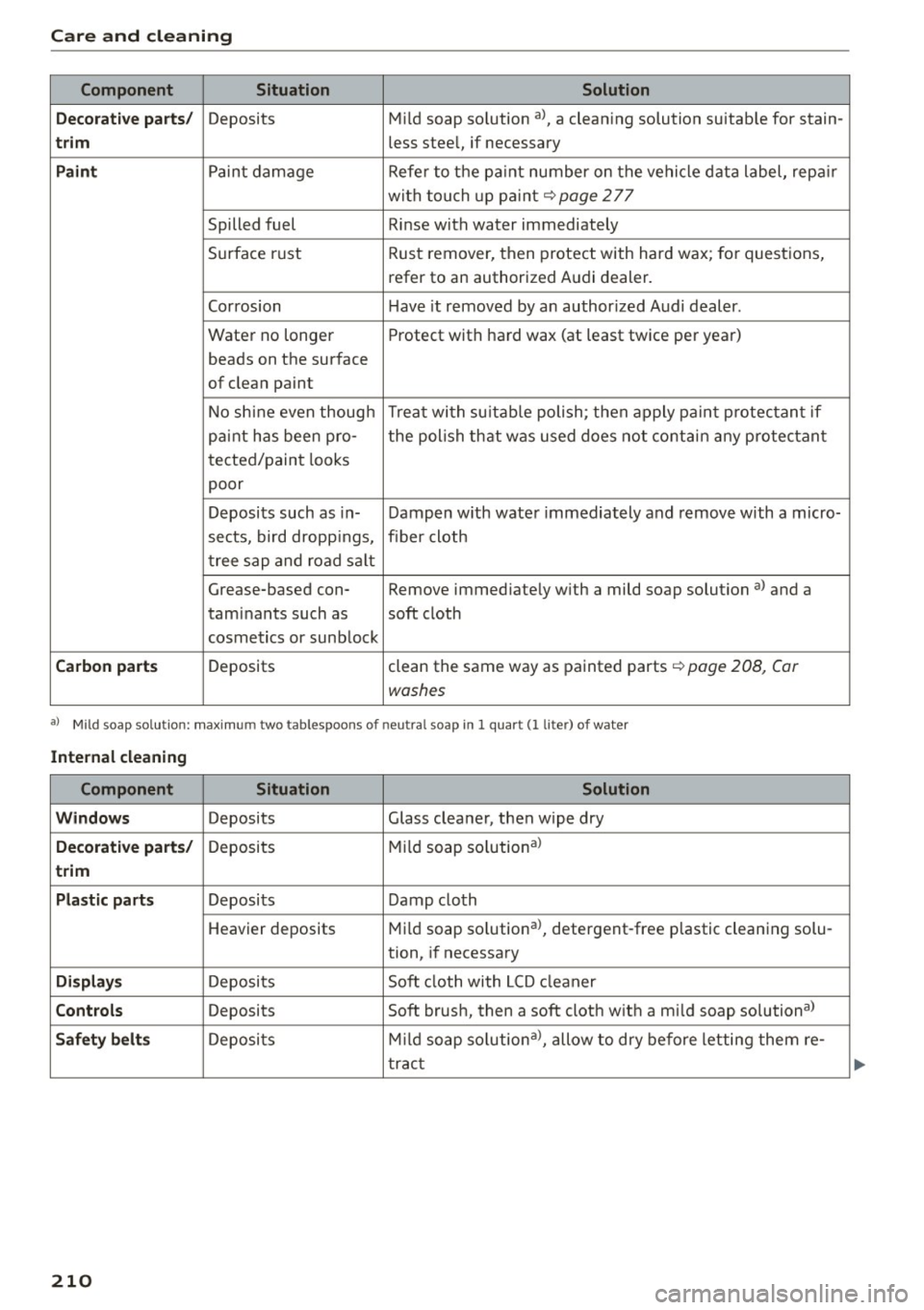
Component Situation Solution
Deco ra ti ve part s/
Deposits Mild soap solution al, a cleaning solution suitable for stain-
trim less stee l,. if necessary
P ain t Paint damage Refe r to the pa int number on the vehicle data label, repair
with touch up pa int
r=;, page 277
Spilled fuel Rinse with water immediately
Surface rust Rust remover, then protect with hard wax; for questions,
refer to an authorized A udi dealer.
Corrosion Have it removed by an author ized Audi dealer .
Water no longer Protect w ith hard wax (at least twice per year)
beads on the surface
of clean paint
No shine even though Trea t wi th su itab le polish; then apply paint p rotectant if
paint has been pro- the polish that was used does not conta in any protectant
tected/paint looks
poor
Deposits such as in- Dampen w ith water immediately and remove with a micro-
sects, bird dropp ings, fiber cloth
t ree sap and road sa lt
Grease-based con-Remove immediate ly w ith a mild soap solution a) and a
taminants such as soft cloth
cosmetics or sunblock
Carb on part s Deposits clean
the same way as painted parts r=;, page 208, Car
washes
aJ Mild soa p solut ion: maxim um two tablespoons of neutral soap in 1 quar t (l liter) of water
Internal cleani ng
Component Situation Solution
W indows
Deposits Glass cleaner, then wipe dry
Decorati ve parts / Deposits M
ild soap so lution al
trim
Pla stic part s
Deposits Damp clo1th
Heavier deposits Mild
soap solution a>, detergent-free plastic cleaning solu-
tion, if necessary
Di sp lay s Deposits Soft cloth with LCD cleaner
Cont ro ls Deposits Soft brush, then a soft cloth with a mi ld soap solutional
Safet y belt s Deposits Mild soap solutiona >, allow to dry before letting them re-
tract
210
Page 215 of 302

M N
co
a:
co
,...., \!) 1.1'1
N 1.1'1 ,....,
Fuel and Refueling
Fuel
Gasoline
Applies to vehicles: with gasoline engine
Using the right fuel helps keep the environment
clean and prevents engine damage .
Fuel recommendation
The fuel recommended for your vehicle is unlead
ed premium
grade gasoline. Audi recommends
using TOP TIER Detergent Gasoline with a mini
mum octane rating of 91 AKI (95 RON). For more
information on TOP T IER Detergent Gasoline ,
please go to the official website
(www.toptiergas.com).
The recommended gasoline octane rating for
your engine can also be found on a label located
on the inside of the fuel filler flap. This rating
may be specified as AKI or RON .
Your vehicle may also be operated using unlead
ed regular gasoline with a minimum octane rat
ing of 87 AKl/91 RON . However , using 87 AKl/91
RON octane fue l wi ll slight ly reduce engine per
formance.
Use unleaded gasoline only. Unleaded gasoline
is available throughout the USA, Canada, and in
most European countries. We recommend that
you do not take your vehicle to areas or countries
where unleaded gasoline may not be available.
For more informat ion on refueling your vehicle,
see
~ page 215.
Octane rating
Octane rating indicates a gasoline's ability to re
sist engine damaging "knock" caused by prema
ture ignition and detonation . Therefore, buying
the correct grade of gasoline is very important to
help prevent possible engine damage and a loss
of eng ine performance.
Gasoline most commonly used in the United
States and Canada has the following octane rat
ings that can usually be found on the filler pump:
- Prem ium Grade : 91- 96 AKI
Fuel and Refueling
- Regular Grade: 87 -90 AKI
Ex planation of the abbreviations:
AKI =
Anti Knock Index = (R +M)/2 = (RON+MON)/
2
RON= Research Octane Number
MON = Motor Octane Number.
(D Note
- Do not use any fuel w ith octane ratings low
er than 87 AKI or 91 RON otherwise expen
sive engine damage wi ll occur.
- Do
not us e leaded gasoline. The use of lead
ed gasoline will severely damage your veh i
cle's catalytic converter and its ability to
contro l exha ust emissions.
Blended gasoline
App lies to vehicles: wit h gasoli ne e ngi ne
Use of gasoline containing alcohol or MTBE
(methyl tertiary butyl ether)
You may use unleaded gasoline blended with al
cohol or MTBE (commonly referred to as oxygen
ates) if the blended mixture meets the following
criteria:
Blend of gasoline methanol (wood alcohol or
methyl alcohol)
-Anti -knock index must be 87 AKI or higher.
- Blend must contain no more than 3% metha-
nol.
- Blend must contain more than 2% co-solvents.
Blend of gasoline and ethanol (grain alcohol or
ethyl alcohol)
- Anti-knock index must be 87 AKI or higher.
- Blend must not contain more than 15% etha-
nol.
- Vehicles w ith flexible fuel* engine: blend must
not contain more than 85% ethanol.
Blend of gasoline and MTBE
-Anti-knock index must be 87 AKI or higher.
- Blend must contain not more than 15% MTBE.
Seasonally adjusted gasoline ..,.
213
Page 216 of 302
Fuel and Refu elin g
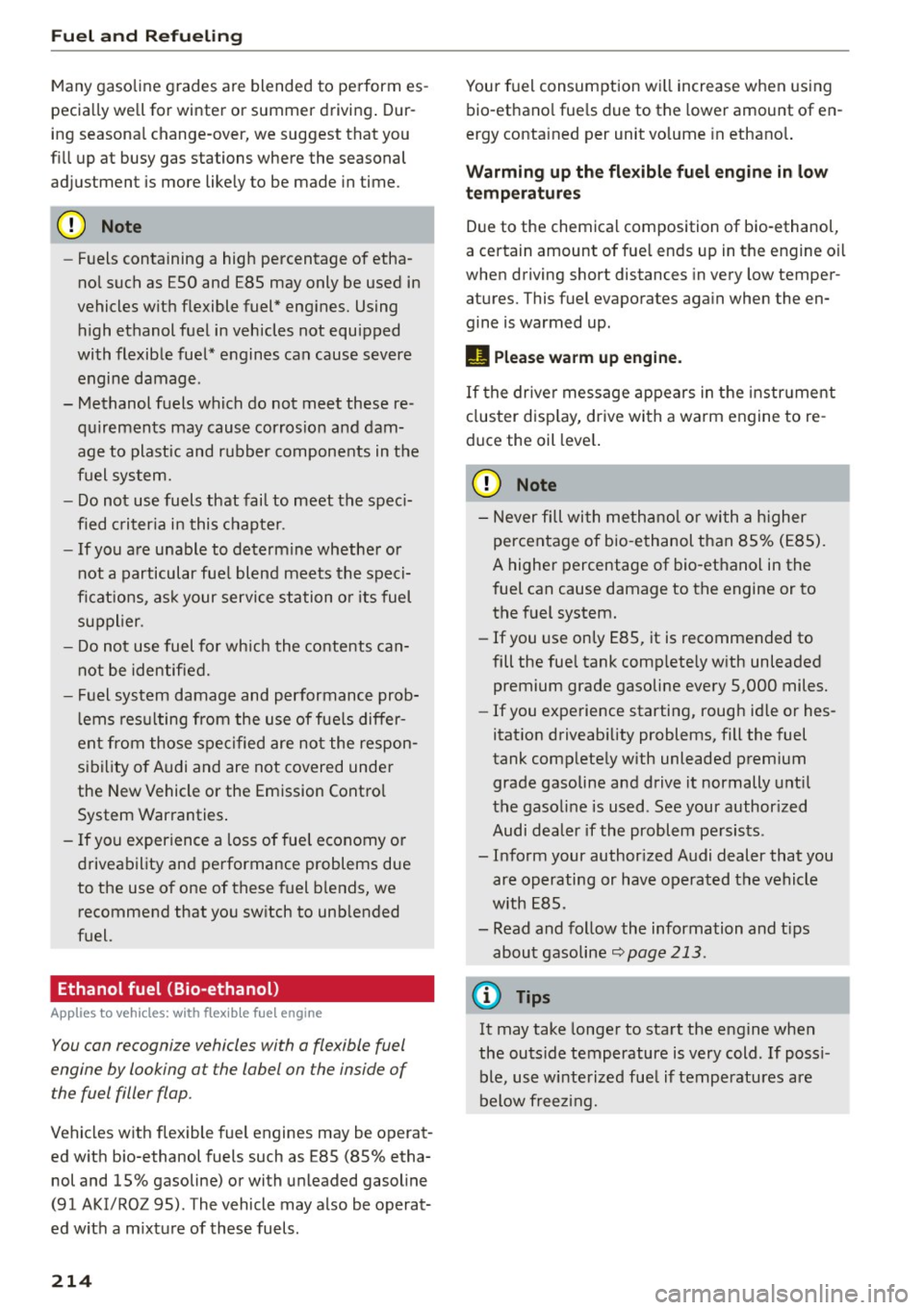
Many gasoline grades are blended to perform es
pecially we ll for winter or summer driving . Dur
ing seasona l change-over, we suggest that you
fill up at busy gas stations where the seasonal
adjustment is more likely to be made in time.
@) Note
-Fuels containing a high percentage of etha
nol such as ESO and E85 may only be used in
vehicles with flexible fuel* engines. Using
high ethanol fuel in vehicles not equipped
with flexible fuel* engines can cause severe
engine damage.
- Methanol fuels which do not meet these re quirements may cause corros ion and dam
age to plastic and rubber components in the
fuel system.
- Do not use fuels that fail to meet the spec i
fied criter ia in this chapter.
- If you are unable to determine whether or
not a particular fue l blend meets the speci
ficat ions, as k your service station o r its fuel
supplier.
- Do not use fuel for wh ich the contents can
not be identified.
- Fuel system damage and performance prob
lems resu lting from the use of fue ls differ
ent from those specified are not the respon
sibility o f Audi and are not covered unde r
the New Vehicle or the Emission Control
System Warranties .
- If you experience a loss of fue l economy or
driveability and performance problems due
to the use of one of these fuel b lends we
'
recommend that you switch to unblended
fuel.
Ethanol fuel (Bio -ethanol)
App lies to vehicles: with flex ible fuel engine
You con recognize vehicles with a flexible fuel
engine by looking at the label on the inside of
the fuel filler flop.
Vehicles with flexible fuel engines may be operat
ed with bio-ethanol fuels such as E85 (85% etha
nol and 15% gasoline) or with unleaded gasoline
(91 AKI/ROZ 95). The vehicle may also be operat
ed w ith a m ixture of these fuels.
214
Your fuel consumption wi ll increase when using
bio -ethano l fue ls due to the lower amount of en
ergy contained per unit volume in ethano l.
Warming up the fle xible fuel engin e in low
t e mperatu res
Due to the chemical composition of bio -ethanol,
a certain amount of fuel ends up in the engine oil
when driving short distances in very low temper
atures. This fuel evaporates again when the en
gine is warmed up.
II Please war m up e ngi ne .
If the driver message appears in the instrument
cluster disp lay, drive with a warm engine to re
duce the oil leve l.
(D Note
-Never fill with methanol or with a h igher
percentage of bio-ethanol than 85% (E85).
A higher percentage of bio-ethanol in the
fuel can cause damage to the engine or to
the fuel system.
- If you use only E85, it is recommended to
fill the fue l tank comp lete ly with unleaded
premium grade gasoline every 5,000 miles.
- If you experience starting, rough id le or hes
itat ion driveab ility problems, fill the fuel
tank comp letely with unleaded premium
grade gasoline and drive it normally until
the gaso line is used. See your author ized
Audi dealer if the problem persists .
- Inform your author ized Audi dealer that you
are operating or have operated the vehicle
with E8S.
- Read and follow the information and t ips
about gasoline~
page 213 .
(D Tips
It may take longer to start the engine when
the outs ide temperature is very cold. If poss i
ble, use winterized fue l if tempe ratures are
below freezi ng.