2015 AUDI Q5 roof
[x] Cancel search: roofPage 75 of 302

M N
co ~ co
rl I.O
"' N
"' rl
Attach the roof rack only at the attachment
points on the roof railing. On the inside of the
roof railing there are two holes for attaching the
rear end of the roof rack. To prevent confusing
the front and rear roof rack attachments, there are three holes on the left and two holes on the
right for mounting the front part of the roof rack
q fig. 81.
The roof racks have a sticker on the left side un
derneath to identify front and rear.
A WARNING
When installing the roof rack, make sure the
st icker is on the left side of the vehicle and
faces the stamped arrow in the drive direc
tion.
Installing a roof rack
Fig. 82 Roof ra iling: pos it io ni ng the roof rack
Fig. 83 Roof ra iling: install ing a roof rack
The roof rack set consists of a front and rear roof
rack, the cover profi le and a socket wrench .
• Open the cap
(D q fig . 83 .
• Before mounting the roof rack, use the socket
wrench @and loosen the left and right screw
in the direction of@ .
Seats and storage
• Clean the attachment points on the roof railing
as well as the roof rack rubber washers @.
• Carefully place the roof rack over the holes in
the roof railing
q fig. 82.
• Place the pins @ into the holes. The claw ®
must engage into the edge of the roof railing .
"' Make sure the rubber washer@ lays flat on the
roof railing .
"' Tighten the left and right screws using the
socket wrench @ in direct ion @.
"' To reach the
4 ft lb (6 Nm) tightening specifi
cation needed, both arrows on the socket
wrench must align.
"' Repeat this procedure on the second roof rack.
A WARNING
Check all the roof rack connections each time
before each trip and re-tighten or re-adjust if
necessary. If you are going to be driving or
rough terrain, you will have to check the at
tachments more often. If you do not do this,
the risk of you r luggage coming loose and
falling off is greater.
(D Note
The pins and the roof rack claws must engage
securely into the holes and into the edge of
the roof railing when you tighten the screws!
(0 Tips
You can adjust the width of the roof rack by
using a hexagon wrench and turning the
screws on the top. Let you r authorized Audi
dealer help you with this.
Installing the attachments
Fig. 84 Roof railing : insta lling cove r profi le into th e roof
rack
a)
"' 9 a: a) m
73
Page 76 of 302
Seats and storag e
Install ing th e attachm ent s
.. Remove the cap @¢ fig. 84.
.. Slide the attachment into the T -groove (V .
.. Tighten the attachment accord ing to the roof
rack installation instructions.
.. Close the cap .
Inst a lling th e cov er p ro fil e
.. Seal the openings in the T-groove 0 with the
cover profile @ after having installing the at
tachments .
.. If you not want to use the attachment, seal the
whole T-groove
0 with the cover profile @.
.. Cut the cover profile to the length needed, if
necessary .
Roof load
The cargo on the roof must be securely attached.
Handling characteristics change when cargo is transported .
The permissible roof load for your vehicle is
165 lbs (75 kg ). The roof load is the total of the
weight of the roof rack, the attachments and the
cargo you are carry ing .
.,&. WARNING
-The cargo must be secure ly attached on the
roof rack, otherwise you r is k an acc ident .
- Distribute the load as evenly as possible and
do not make the roof rack wider than the
maximum permitted.
- You must under no circumstances exceed
the permiss ible roof load, the permissib le
axle loads and the permissib le overall
weight of your vehicle - risk of an accident.
- Mount the attachments to the roof rack on ly
afte r you have placed the roof rack on the
vehicle.
- Cons ider tha t when transport ing heavy ob
jects or one wi th a la rge surface, the han
dling characteristics change due to shift in
the center of gravity or the greater surface
exposed to the wind. So adapt your driving
and your speed to prevailing condit ions . We
recommend that you do not drive faster
than 80 mph (130 km/h) .
74
- Mounting a roof rack changes the height of
your veh icle. Keep this in mind when parking
your veh icle in your garage, or when driving
through a tunnel or under an overpass .
(D Note
-Make sure the rear lid does not hit the cargo
on the roof rack when you open it. On
vehicles with automat ic rear lid/trunk lid
operation* you may have to adjust the open
posit ion of the rear lid ¢
page 44 .
-Remove the roof rack and attachment be
fore taking your vehicle through an auto
matic car wash to avoid damage .
@ For the sake of the environment
As a result of the increased wind resistance
created by a roof rack, your vehicle is using
fuel unnecessarily. So remove the roof rack af
te r using it .
Beverage holders
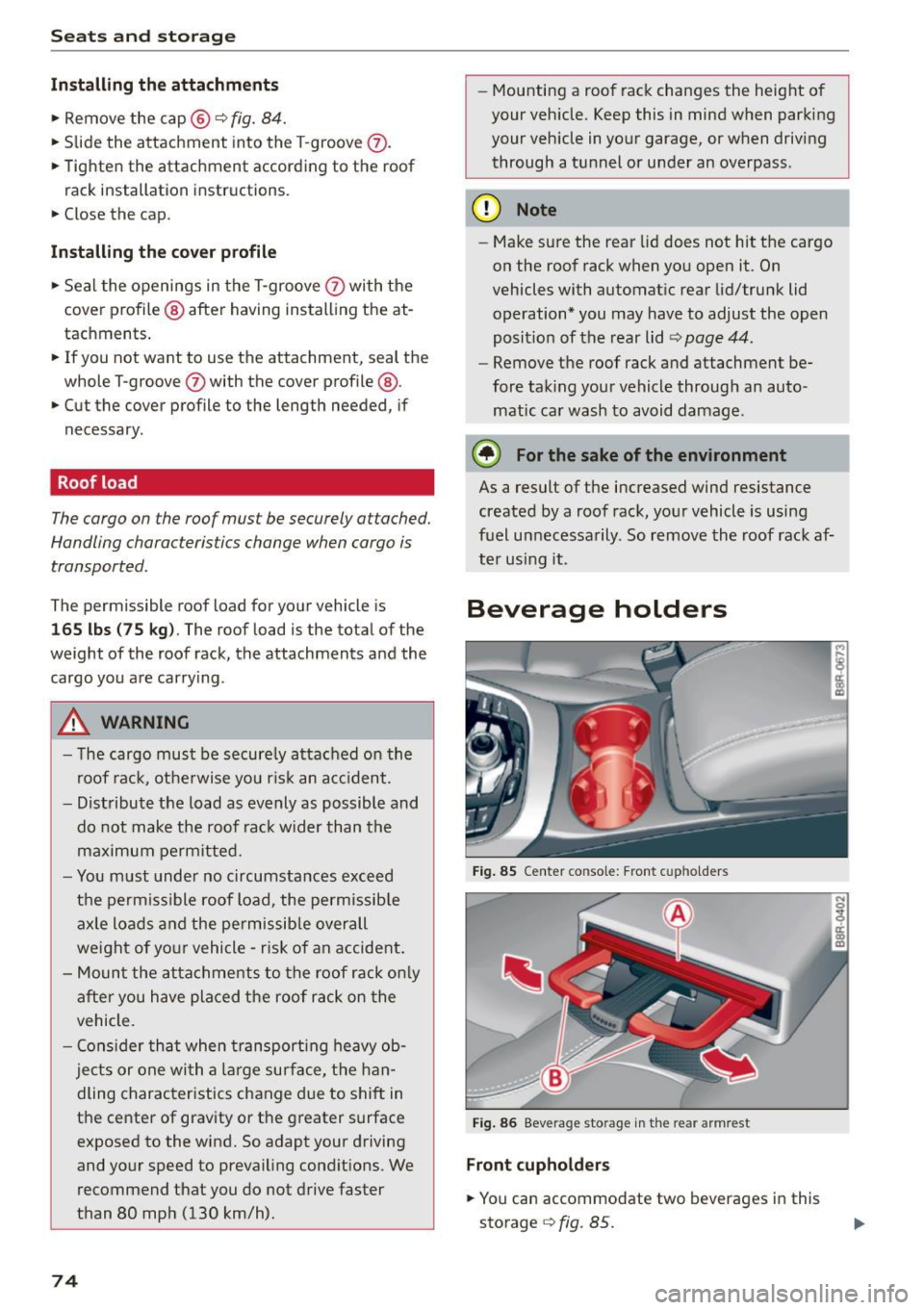
Fig. 85 Center co nsole: F ront c upholder s
Fig . 86 Beverage sto rage in the re ar a rm rest
Front cuphol der s
.. You can accommodate two beverages in this
storage
<=> fig . 85.
Page 79 of 302

M N
co ~ co
rl I.O
"' N
"' rl
.. Remove the cigarette lighter when it pops out.
The c igarette lighter should only be used as a
power source for the compressor from the i nflat
able spare tire/tire repair kit* when absolutely
necessary.
A WARNING
The cigarette lighter only works when the ig
nition is switched on. Incorrect usage can lead
to serious injuries or burns. For this reason,
children should never be left unattended in
the vehicle because this increases the risk of
injury .
12-volt sockets
Electrical accessories can be connected to every
12-volt socket.
Fig . 91 Sect io n of the trim panel of t he luggage com part·
ment : 12-vo lt socket
Fig. 92 Ce nter console: 12-volt socket
.. Open the socket cover¢ fig. 91 or¢ fig. 92.
.. Insert the plug of the electrical device into the
socket.
The 12-volt sockets can be used for electrical ac
cessories . The power input must not exceed 120
watts .
Seats and storage
There is an additional 12 -volt socket in the center
console .
Before you purchase any accessories, always read
and follow the information in¢
page 283, Addi
tional accessories and parts replacement.
A WARNING
The power outlets and therefore the electrical
accessories connected to them operate only
with the ignition on . Improper use of the out
lets or of electrical accessories can lead to se
rious injuries or cause a fire . For this reason,
children should never be left unattended in
the veh icle -they could be injured!
(D Note
To avoid damaging the socket, only use plugs
that fit properly.
(D Tips
When the engine is off and accessories are
still plugged in and are on, the vehicle battery
can still be drained .
Storing
General overview
There are numerous places to store items in your
vehicle .
Glove compartment ¢page 78
Cooling box in glove compart-¢page 78
ment
Storage compartment in the roof
¢page 79
Coat hooks ¢page 79
Storage in the door panels
Storage net in footwell
Storage net in the front seat- backs
Storage net in luggage com part- ment
77
Page 81 of 302

M N
co ~ co
rl I.O
"' N
"' rl
Storage compartment in the roof
""'
11111
'~-
8 G
o . . o
~
Fig. 95 Storage pocket in the roof
.. To open the lid you have to touch the bar
Q fig. 95 (Arrow) . The lid opens automatically .
.. To close the lid, push it up until it engages .
.&, WARNING
Always keep the lid closed while driving to re
duce the risk of injury dur ing a sudden brak
ing maneuver or in the event of an accident.
Coat hook s
Fig. 96 Coat hooks at rear doors
_& WARNING
-Hang clothes in such a way that they do not
impair the driver's vision.
- The coat hooks must only be used for light
weight clothing. Do not leave any heavy or
sharp edged objects in the pockets which
may interfere with the s ide curtain airbag
deployment and can cause personal injury in
a crash.
- Do not use coat hangers for hanging cloth
ing on the coat hooks as this can interfere
Seats and storage
with proper deployment of the side curtain
airbags in an accident.
- Do not hang heavy objects on the coat
hooks, as they could cause personal injury in
a sudden stop.
79
Page 82 of 302

Warm and cold
Warm and cold Climate control system
Description
The climate control system warms, cools and
adds humidity to the air in the vehicle interior. It
is the most effective when the windows and pan
oramic sliding sunroof* are closed . If there is a
build-up of heat inside the vehicle, ventilation
can help to speed up the cooling proc ess.
In all heating mode functions except
defrost, the
blower only switches to a higher speed once the
engine coolant has reached a certain tempera
ture.
Condensation from the cooling system can drip
and form a puddle of water under the vehicle.
This is normal and does not mean there is a leak.
Pollutant filter
The pollutant filter removes pollutants such as
dust and pollen from the air.
The air pollutants filter must be changed at the
intervals specified in your Warranty & Mainte
nance booklet, so that the air conditioner can
properly work.
If you drive your vehicle in an area with high air pollution , the filter may need to be changed
more frequently than specified in your Audi War
ranty
& Maintenance booklet. If in doubt, ask
your authorized Audi Service Advisor for advice.
Key coded settings
The climate control settings are automatically
stored and assigned to the remote control key
that is in use .
.8, WARNING
Reduced visibility is dangerous and can cause
accidents.
- For safe driving it is very important that all
windows be free of ice, snow and condensa
tion.
80
- Completely familiarize yourself with the
proper use and function of the heating and
ventilation system and especially how to de
fog and defrost the windows .
- Never use the windshield wiper/washer sys
tem in freezing weather until you have
warmed the windshield first, using the heat
ing and ventilation system . The washer solu
tion may freeze on the windshield and re
duce visibility .
(D Note
-If you suspect that the air conditioner has
been damaged, switch the system off to
avoid further damage and have it inspected
by a qualified dealership.
- Repairs to the Audi air conditioner require
special technical knowledge and special
tools. Contact an authorized Audi dealer for
assistance.
@ For the sake of the environment
By reducing the amount of fuel you use, you
also reduce the amount of pollutants emitted
into the air.
(D Tips
-Keep the air intake slots (in front of the
windshield) free from ice, snow and debris
in order to maintain the proper function of
the climate control system.
- The energy management system may switch
the seat heating* or rear window defroster
off temporarily. These systems are available
again as soon as the energy balance has
been restored.
- The air flowing out of the vents and
throughout the vehicle's entire interior is
discharged at the rear of the vehicle. Make
sure that the outlet slots are not covered by clothing, etc.
Page 143 of 302

M N
co
a:
co
,...., \!) 1.1'1
N 1.1'1 ,....,
-Always put objects, for examp le, luggage or
other heavy items in the luggage c ompart
ment.
- Always secure objects in the luggage com
partment us ing the tie-down eye lets and
suitable straps.
A WARNING
Heavy loads will influence the way your vehi
cle handles. To help reduce the risk of a loss
of control leading to ser ious personal injury:
- Always keep in m ind when transporting
heavy objects, that a change in the center of
gravity can also cause changes in vehicle
hand ling:
- Always distribute the load as even ly as
possible.
- Place heavy objects as far forward in the
luggage compartment as possible.
- Never exceed the G ross Ax le Weight Rating
or the Gross Vehicle Weight Rating specified
on the safety compliance sticker on the left
doo r jamb. Exceeding permissible weight
standards can cause the vehicle to s lide and
hand le different ly.
- Please observe information on safe driving
r=>page 135.
A WARNING
To help prevent poisonous exhaust gas from
being drawn into the vehicle, always keep the
rear lid closed while driv ing.
- Never transport objects larger than those
fitt ing completely into the luggage a rea be
cause the rea r lid cannot be fully closed .
- If you absolutely must drive w ith the rear lid
open, observe the following notes to reduce
the risk of poisoning:
- Close a ll windows,
- Close the Panoramic sliding sunroof*,
- Open al l air outlets in the instrument pan-
el,
- Sw itch off the air recircu lation,
- Set the fresh ai r fan to the h ighest speed.
Dr ivin g s afet y
A WARNING
Always make sure that the doors, all windows,
the Panoramic sliding sunroof * and the rear
lid are securely closed and locked to reduce
the r is k of injury when the vehicle is not being
used.
- After closing the rear lid, always make sure
that it is p roperly closed and locked.
- Never leave your vehicle unattended espe
cially with the rea r lid left open . A child
could crawl into the ve hicle through the lug
g age compartmen t and clo se the re ar lid be
coming trapped and unable to get out. Be
ing trapped in a vehicle can lead to serious
pe rsonal injury .
- Never let children play in or around the vehi
cle.
- Never let passengers ride in the luggage
compa rtment . Vehicle occupants must al
ways be properly restrained in one of the ve
hicle's seating positions.
(D Tips
- Air circul ation helps to reduce window fog
ging . Stale ai r escapes to the outs ide
through vents in the t rim panel. Be sure to
keep these slots free and open.
- The tire pressure m ust correspond to the
load. The tire pressure is shown on the tire
pressure label. The t ire p ress ure label is lo
cated on the dr iver's side B-pillar. The tire
pressure label lists the recommended cold
t ire inflation pressures fo r the veh icle at its
maximum ca pac ity weight and the tires that
we re on your vehicle at the t ime it was man
ufac tured. For recommended tire pressures
for normal load condi tions, please see chap
ter
r=> page 246.
Tie-downs
The luggage compar tment is equipped wi th four
tie-downs to se cure luggage and other items .
Use the t ie-downs to secu re your cargo prope rly
r=> page 140, Loading the luggage compar tment. lliJ,
141
Page 157 of 302

M N
co
a:
co
,...., \!) 1.1'1
N 1.1'1 ,....,
A WARNING ,~
A child in a rearward-facing child safety seat
installed on the front passenger seat will be
seriously injured and can be killed if the front
airbag inflates - even with an Advanced Airbag
System.
- The inflating airbag will hit the child safety
seat or infant carrier with great force and
will smash the child safety seat and child
against the backrest, center armrest, door
or roof.
- Always install rear-facing child safety seats
on the rear seat.
- If you must install a rearward facing child
safety seat on the front passenger seat be
cause of exceptional circumstances and the
PASSENGER AIR BAG OFF light does not
come on and stay on, immediately install
the rear-facing child safety seat in a rear
seating position and have the airbag system inspected by your authorized Audi dealer.
- Forward-facing child safety seats installed
on the front passenger's seat may interfere
with the deployment of the airbag and cause serious personal injury to the child .
A WARNING
If, in exceptional circumstances, you must in
stall a forward-facing child restraint on the
front passenger's seat:
-Always make sure the forward-facing seat
has been designed and certified by its man
ufacturer for use on a front seat with a pas
senger front and side airbag.
- Never put the forward-facing child restraint
up against or very near the instrument pan
el.
- Always move the passenger seat into its
rearmost position in the seat's fore and aft
adjustment range, as far away from the air
bag as possible before installing the for
ward-facing child restraint. The backrest must be adjusted to an upright position.
- Make sure that the
PASSENGER AIR BAG
OFF
light comes on and stays on all the time
whenever the ignition is switched on.
Airbag system
A WARNING
To reduce the risk of serious injury, make sure
that the
PASSENGER AIR BAG OFF light will
be displayed whenever a child restraint is in
stalled on the front passenger seat and the ignition is switched on .
- If the
PASSENGER AIR BAG OFF light does
not stay on, perform the checks described
~ page 162, Monitoring the Advanced Air
bag System.
- Take the child restraint off the front passen
ger seat and install it properly at one of the
rear seat positions if the
PASSENGER AIR
BAG OFF
light does not stay on.
- Have the airbag system inspected by your
authorized Audi dealer immediately.
-Always carefully follow instructions from
child restraint manufacturers when instal
ling child restraints.
A WARNING
If, in exceptional circumstances, you must in
stall a forward or rearward-facing child re
straint on the front passenger's seat:
- Improper installation of child restraints can
reduce their effectiveness or even prevent
them from providing any protection.
- An improperly installed child restraint can
interfere with the airbag as it deploys and
seriously injure or even kill the child -even
with an Advanced Airbag System.
-Always carefully follow the manufacturer's
instructions provided with the child safety
seat or carrier.
- Never place additional items on the seat that can increase the total weight registered by the weight-sensing mat and can cause in
jury in a crash.
155
Page 160 of 302
Airbag syste m
-a small adu lt or teenager is on the front pas
senger seat
- a passenger who is not sitting upright with
their back against a non -reclined backrest with
their feet on the vehicle floor in front of the
seat is on the front passenger seat.
I f the front passenger airbag deploys, the Federal
Standard req uires the airbag to meet the " low
risk" deployment criteria to help reduce the risk
of injury through interaction with the airbag .
"Low risk" deployment occurs in those crashes
that take place at lower decelerations as defined in the electron ic control unit . ¢ page
162
Alw ays re member: Even though your vehicle is
equ ipped w ith Advanced Airbags, the safest place
for children is properly restrained on the back
seat . Please be sure to read the important infor
mat ion in the sections that follow and be sure to
heed a ll of the WARNINGS.
_& WARNING
To reduce the ris k of injury when an airbag in
fla tes, always wear safety belts proper ly.
- If you are unrestrained, leaning fo rward, s it
t ing s ideways or out of position in any way,
your risk of injury is much higher .
- You w ill also receive serious inju ries and
could even be killed if you are up against the
airbag or too close to it when it inflates -
even with an Advanced Airbag ¢page
152.
_& WARNING
A child in a rearward-facing child safety seat
installed on the front passenger seat will be
ser iously injured and can be killed if the front
airbag inflates - even w ith an Advanced Airbag
System.
- Although the Advanced Airbag System in
your vehicle is designed to turn off the front
airbag when a rearward -facing child re
straint has been installed on the front pas
senger seat, nobody can absolutely guaran
tee that deployment is impossible in al l con
ceivable s ituations that may happen dur ing
the usef ul life o f your vehicle .
- The inflating a irbag w il l hit the child safety
seat or infant carrier wi th great force and
158
w ill smash the child safety seat and child
aga inst the backrest, center armrest, door,
or roof.
- Always install rearward-facing chi ld re
straints in the back seat.
- If you must insta ll a rearward fac ing ch ild
safety seat on the front passenger seat be
cause of exceptional circumstances and the
PAS SENGER AIR BAG OFF light does not
come on and stay on, immediately install
the rear-facing child safety seat in a rear
seating position and have the airbag system
inspected by your au thorized Aud i dealer .
_& WARNING
If, in exceptiona l circumstances, you must in
stall a forwa rd-facing child restra int on the
front passenger's seat:
- Always ma ke sure the forward-facing sea t
has been des igned and certif ied by its man
ufacturer for use on a front seat with a pas
senger front and s ide a irbag .
- Never p ut the fo rward-facing child restraint
up against or very near the instrument pan
el.
-Always move the passenger seat into its
rearmost position in the seat's fore and aft
ad justment range, as far away from the a ir
bag as poss ible, before insta lling the for
ward-facing child restraint. The backrest
must be adjusted to an upr ight position .
- Make sure that the
PASSENGER AIR BAG
OFF
li ght comes on and stays on all the time
whenever the ign it ion is switched on.
Advanced Airbag System components
The front passenger seat in your vehicle has a lot
of ve ry impo rtant parts of the Advanced A irbag
System in it. These pa rts include the we ight
sensing mat, senso rs, w iring, bracke ts, and more.
The function of the system in the front passenge r
seat is checked by the e lectronic control unit
when the ignition is on. The control unit mon itors
the Advanced Airbag System and turns the airbag i ndicator light on when a malfunct io n in the sys
tem components is detected. The function of the
a irbag indicator light is described in greate r