2015 AUDI Q5 maintenance
[x] Cancel search: maintenancePage 208 of 302

Trailer mode
Weight distribution
Towing a loaded trai ler with an empty car res ults
in a high ly unstable distribution of weight. If this
cannot be avoided , drive at very low speeds only
to avoid the risk of losing steering contro l.
A "balanced" rig is easier to operate and control.
This means that the tow vehicle should be loaded
to the extent possible and permissible, while
keeping the trailer as light as possible under the
circumstances. Whenever possible, transfer
some cargo to the luggage compartment of the
tow vehicle while observing tongue load require
ments and vehicle loading considerations .
Speed
The higher the speed, the more difficult it be
comes for the driver to control the rig . Do not
drive at the maximum permiss ible speed. Reduce
your speed even more if load, weathe r or wind
conditions are unfavorable - particularly when
going downhill.
Reduce vehicle speed
immediately if the trailer
shows the s lightest sign of swaying .
Do not try
to stop the swaying by accelerating.
Observe speed limits. In some areas, speeds for
veh icles towing trailers are lower than for regular
ve hicles .
A lways app ly brakes ear ly. When driving down
hill, shift into a lower gear to use the engine
brak ing effect to slow the vehicle. Use of the
brakes alone can cause them to overheat and fa il.
Coolant temperature
The coolant temperature gauge c::> page 10 must
be observed carefully.
If the need le moves close
to the upper end of the scale, reduce speed im
mediately and/or turn off the a ir condit ioner.
If the coo lant temperature warning light in the
instr ument cluster starts flashing •• pu ll off
the road, stop and let the engine
idle for about
two minutes to prevent heat build-up.
A WARNING
Anyone not properly restrained in a moving
vehicle is at a much greater r isk in an acc i-
206
-
dent. Never let anyone ride in your car who is
not properly wearing the restraints provided
by Audi.
Trailer mode notes
Important to know
Your vehicle handles differently when towing a
trai ler because of the additiona l weight and dif
ferent we ight distribution . Safety, performance
and economy will greatly depend on how careful
l y you load your trailer and operate your rig.
Before you actua lly tow your trai ler, practice
turning, stopping and backing up in an area away
from traffic . Keep practicing until you have be
come comp lete ly familiar with the way your vehi
cle-trailer comb inat ion behaves and responds.
Backing up is difficult and requires practice. Back
ing up with a trai ler generally requires steering
action opposite to that when backing up your ve
hicle without a tra iler.
Maintain a greater distance between your vehicle
and the one in front of you. Yo u will need more
room to stop. To compensate for the trailer, you
will need a larger than normal turn ing radius.
When passing, remember that you cannot accel
erate as fast as you norma lly wou ld because of
the added load. Make sure you have enough room
to pass. After passing, allow plenty of room for
your tra iler before changing lanes again.
Avoid jerky starts , sharp t urns or rapid lane
changes.
@ Tips
- Do not tow a trailer during the break-in peri
od of your vehicle.
- If you tow a trailer, your Audi may requi re
more frequent maintenance due to the ex
tra load
c::> page 281.
Page 214 of 302

Care and cleaning
avoid scratches, move the scraper on ly in
one direction and not back and forth.
- Never remove snow or ice from door win
dows and mirrors using warm or hot water
because this could cause cracks to form.
- To avoid damage to the rear window de fogger, do not apply any stickers on the
heating wires on the inside of the window .
- Decorati ve p art s/ trim
- Never use chrome care or clean ing prod-
ucts .
- Paint
- To reduce the ris k of sc ratches, the veh icle
must be free of d irt and dust befo re po l
ishing or waxing .
- T o prevent paint damage, do not polish o r
wax the veh icle in direct sun light.
- To reduce the ris k of paint damage, do not
polish away rust spots.
- Remove cosmet ics and sunscreen immedi
ately -these could damage the paint.
- Di spla ys
- To avoid scratches, do not use dry cleaning
methods on displays.
- Control s
- Make sure that no flu ids enter the con-
tro ls, because this cou ld cause damage.
- Safety belt s
- Do not remove the safety be lts to clean
them.
- Never clean safety belts or the ir compo
nents chemically or wi th cor rosive f luids
or so lvents and never al low sha rp objects
t o come into con ta ct w ith the safe ty belts.
T his could cause damage to the belt web
bing .
-If there is damage to the webbing, the
connections, the retractors or the b uckles,
have them replaced by an autho rized deal
er.
- Textiles /artificial le athe r/Alcantara
- Never treat artificia l leather/Alcantara
w ith leather care products, solvents, floor
polish, shoe polish, spot remove or simi lar
products.
- Have a specialist remove stubborn stains
to prevent damage.
212
- Neve r use steam cleaners, brushes, hard
sponges, etc . when cleaning .
- D o not turn on the seat heating* to dry
the seat.
- Objects w ith sharp edges s uch as zippe rs,
rivets on clothing or be lts can cause dam
age to the surface.
- Open hook and loop fasteners, for exam
p le on clothing, can damage seat covers .
Make sure hook and loop fasteners are
closed.
- Natu ral leathe r
- Never treat leather w ith solvents, floor
polish, shoe polish, spot remover or simi
lar p roducts .
- Objects w ith sharp edges such as zippers,
rivets on clothing or be lts can cause dam
age to the surface .
- Neve r use steam cleaners, brushes, hard
sponges, etc. when cleaning .
- Do not turn on the seat heating * to dry
the seat.
- To help prevent the leather from fad ing,
do not leave the vehicle in d irect sunlight
for long periods of time . If leaving the ve
h icle parked for long periods of t ime, you
should cove r the leathe r to protect it from
d irect sunlight.
{D Tips
- Insects are easier to remove from paint that
has been fresh ly waxed.
- Regular waxing can prevent rust spots from
forming.
Placing your vehicle out
of service
If you would like to take your vehicle out of serv
ice for a longer time, contact your authorized
A udi dealer or qualified repair facility. They will
advise you of important measures, such as corro
s ion protection, maintenance and storage proce
dures. Also follow the information about the bat
tery~
page 230 .
Page 226 of 302

Checking and F ill in g
Audi oil quality standard
Gas oline VW 502 00 or
engi ne
vw 504 00
Die sel
vw 50 7 00
e n g in e
Using the proper engine o il is important for the
functionality and serv ice life of the engine. Your
engine was facto ry-filled with a high-qua lity oil
which can usually be used throughout the entire
year.
(D Note
Your Limited New Vehicle Warranty does not
cover damage or malfunctions due to failure
to follow recommended maintenance and use
requirements as set forth in the Audi Owner's Manual and Warranty
& Ma intenance booklet.
- Use only a high qua lity eng ine oil that ex-
pressly complies w ith the Audi o il quality
standard specified for your vehicle's engine.
Using any other oil can cause serious engine
damage.
- Do not mix any lubricants or other additives
into the engine oil. Doing so can cause en
gine damage.
(D Tips
If you need to add oil and there is none availa
ble that meets the Audi o il quality standard
your eng ine requires, you may add a total of
no more than 0.5 quart/liter of a h igh-quality
"synthe tic"oil that meets the followi ng speci
fications.
- Vehicles with gasoli ne engine: AC EA A3 o r
API SM wi th a viscosity g rade of SAE OW-30,
SA E SW-30 or SAE SW-40 .
- Vehicles wi th d iesel engine: AC EA C3 o r
API CF wi th a v iscosi ty grade of SA E OW-30
or SAE SW-30.
- Fo r more information abo ut eng ine oil t hat
has been approved for your vehicle, please
contact eithe r your a uthorized Audi dea le r
or A udi Customer Relations at
1 (800) 822-2834 or visit our web site at
www.aud iusa.com or www .aud icanada.ca.
224
· Eng ine oil consumption
The engine in your vehicle depends on an ade
quate amount of oil to lubricate and cool all of
its moving parts.
In order to prov ide effective lubrication and coo l
i ng of internal engine components, all internal
combust ion engines consume a certa in amount
of oil. Oil consumpt ion va ries from engine to en
gine and may change sig nificantly over the life of
the engine. Typically, eng ines wi th a specified
break -in period (see¢
page 198) consume mo re
o il during t he b reak-in period than they co nsume
after oil consumption has stabilized .
Un der normal cond itions, the rate o f oi l con
sumption depends on the q uality and viscos ity o f
the oil, the RPM (revolutions per min ute) at
which the engine is operated, the ambient tem perature and road condit ions. Further factors are
the amount of o il dilution from water condensa
tion or fuel residue and the ox idat ion leve l of the
o il. As any engine is subject to wear as mileage
builds up, the oil consumption may inc rease over
time unt il rep lacement of worn compone nts may
become necessary.
With a ll these variab les coming into p lay, no
standard rate of oil consumpt ion can be estab
li shed or spec ified. There is no alte rnative to reg
u lar and frequent checking of the oil leve l, see
Note .
If the yellow engine oil leve l warning symbo l in
the i nstrument cluster
II lights up, you should
c h ec k t he o il level as soon as poss ible
cf> page 2 25. Top off the oil at your ear liest con
venience
r:!> page 225.
A WARNING
Before you check anything in the engine com
partment, always read and heed a ll WARN
INGS¢ .&.
in Working in the engine compart
ment on page 221.
(D Note
Driving wit h an insufficient oi l level is likely to
cause severe damage to the engine.
liJJ,
Page 232 of 302

Checking and F ill in g
The brake fluid reservoir is located at the rear
partition of the engine compartment on t he left
side ¢
page 223.
The fl uid level may drop slightly after some time
due to the automatic adjustment of the brake
pads. This is not cause for alarm.
If the b ra ke fluid level fal ls considerably below
the "MIN" mark, the brake warn ing/indicator
light (U.S. models:
1111 , Canadian models: . )
will come on¢
page 18 and ¢ page 28 . Do not
continue to operate the vehicle . The complete
brake system shou ld be thoroughly checked by an
author ized Audi dealer or qualif ied workshop and
the cause corrected. If the brake fluid level is too low, the brake warning/indicator light will illum i
nate. Contact an authorized Aud i dealer
immedi
a tel y.
Changing brake fluid
Have the brake fluid changed by an experienced technician.
Brake flu id abso rbs moisture from the a ir . If the
water content in the brake fluid is too high, cor rosion in the b rake system may result after a pe ri
od of time. The boiling point of the bra ke fluid
will also decrease conside rably and decrease
b ra ki ng per fo rmance .
Therefore, th e brake flu id must be changed
ev ery
tw o years .
Always use new b rake fluid w hich con
forms to Fede ra l Motor Vehicle Standa rd " FMVSS
1 16 DOT 4".
The brake fluid rese rvoir can be difficult to reach,
therefo re, we recommend that yo u have the
b rake fluid changed by your authori zed
Audi
dealer .
Your dealer has the cor rect too ls, the
right brake f luid and the know -how to do t his for
you.
A WARNING
- Brake fluid is po isonous. It must be stored
only in the closed orig inal container out of
the reach of children!
- Brake fai lure can result from old or inappro
pr iate brake fluid . Observe these precau
t ions:
230
- Use only brake fluid that meets SAE spec i
ficat io n
J 1703 and conforms to Federal
Motor Vehicle Sta ndard 116 . Always check
with your aut horized Aud i dea ler to make
su re you are using the correct brake fl uid .
The co rrect type of brake f lu id is also ind i
cated on t he b rake fluid reservoir.
- The brake fl uid must be new. Heavy use of
the b rakes can cause a vapor lock if the
brake fluid is left in t he system too long.
This can se riou sly affec t the efficiency of
the b rakes as well as yo ur sa fety. This
could result in an acc ident .
(D Note
Bra ke fluid will damage the pai nt of you r vehi
cle.
@ For the sake of the environment
B ecause of the prob lem of prope r disposal of
b rake fluid as well as the spe cial tools re
q ui red and the necessary ex pert ise, we rec
ommend that you have the brake f lu id
cha nged by yo ur autho rize d Aud i dea le r.
Battery
General information
U nder normal operat ing conditions , the battery
i n you r Aud i does not need any maintenance.
With
high outside tem pera tures or long d aily
drives we recommend that you have the e lectro
l yte level checked by an a utho rized Audi dea le r or
qualified workshop. The electrolyte leve l should
a lso be checked each time the battery is charged
¢ page 232.
Have the battery checked when yo u take your ve
hicle in for service. You a re well advised to re
place a battery that is older than 5 years.
With cer tain types of airbag deployment, t he bat
tery is disconnected from the vehicle elect rical
system for safety reasons
Q &. in Repair, care
and disposal of the airbags on page 165.
Hybrid drive *: yo u can find important information
abo ut the high voltage battery under ¢
page 98 . ..,.
Page 255 of 302

M N
co
a:
co
,...., \!) ..,.,
N ..,., ,....,
also reduces fuel efficiency and tire tread life,
and may affect the vehicle's handling and stop
ping ability .
Please note that the TPMS is not a substitute for
proper tire maintenance, and it is the driver's re
sponsibility to maintain correct tire pressure,
even if under-inflation has not reached the level
to trigger illumination of the TPMS low tire pres
sure telltale.
Your vehicle has also been equipped with a TPMS malfunction indicator to indicate when the sys
tem is not operating properly. The TPMS mal
function indicator is combined with the low tire pressure telltale . When the system detects a
malfunct ion, the telltale will flash for approxi
mately one minute and then remain continuously
illuminated. This sequence will continue upon
subsequent veh icle start-ups as long as the mal
function exists.
When the malfunction indicator is illuminated,
the system may not be able to detect or signal
low tire pressure as intended. TPMS malfunctions
may occur for a variety of reasons, including the
installation of replacement or alternate tires or
wheels on the vehicle that prevent the TPMS
from functioning properly. Always check the
TPMS malfunction telltale after replacing one or more tires or wheels on your vehicle to ensure
that the replacement or alternate tires and
wheels allow the TPMS to continue to function properly.
Wheels
If the Tire Pressure Monitoring System
indicator appears
Appl ies to vehicles : wi th t ir e p ress ure mo nito rin g system
The tire pressure indicator in the instrument
cluster informs you if the tire pressure is too low
or if there is a system malfunction.
Fig. 208 Instrument cluster: i ndicator light with message
Using the ABS sensors, the tire pressure monitor
ing system compares the tire tread circumference
and vibration characteristics of the individual
tires .
If the pressure changes in one or more
tires, this is indicated in the instrument cluster
display with an indicator light
RIJ and a message
¢fig. 208. If only one tire is affected, the loca
tion of that tire will be indicated.
The tire pressures must be stored in the Infotain
ment system again each time the pressures
change (switching between partial and full load
pressure) or after changing or replacing a tire on
your vehicle ¢
page 254. The tire pressure moni
toring system only monitors the tire pressure you have stored. Refer to the tire pressure label for
the recommended tire pressure for your vehicle
¢ page 245, fig . 207.
Tire tread circumference and vibration character
istics can change and cause a tire pressure warn
ing if:
- the tire pressure in one or more tires is too low .
- the tire has structural damage.
- the tir e was replaced or the tire pressure
changed and it was not stored again
c:!;> page 254.
-the collapsible spare* tire is installed.
253
Page 283 of 302

M N
co
a:
co
,...., \!) 1.1"1
N 1.1"1 ,....,
Consumer information
Warranty coverages
Your Audi is covered by the following warran
ties:
- New Vehicle Limited Warranty
- Limited Warranty Against Corrosion Perfora-
tion
- Emissions Control System Warranty
- Emissions Performance Warranty
- California Emissions Control Warranty (USA
vehicles only)
- California Emissions Performance Warranty
(USA vehicles only)
Detailed information regarding your warranties
can be found in your
Warranty & Maintenance
booklet .
Operating your vehicle
outside the U.S.A. or
Canada
Government regulations in the United States and
Canada require that automobiles meet specific
emission regulations and safety standards.
Therefore, vehicles built for the U.S.A. and Cana
da differ from vehicles sold in other countries.
If you plan to take your vehicle outside the conti
nental limits of the United States or Canada,
there is the possibility that:
- unleaded fuels for vehicles with catalytic con
verter may not be available;
- fuel may have a considerably lower octane rat
ing . Improper fuel may cause engine damage;
- serv ice may be inadequate due to lack of proper
serv ice faci lities , tools or testing equipment;
- replacement parts may not be readily available .
- Nav igat ion systems for vehicles built for the
U.S.A. and Canada will not necessar ily work in
Europe , and may not work in other countries
outside of North America.
Consumer information
(D Note
Audi cannot be responsible for mechanical
damage that could result from inadequate
fuel, service or parts availability.
Audi Service Repair
Manuals and Literature
Audi Official Factory Service Manuals and Litera
ture are published as soon as possible after mod el introduction . Service Manuals and literature
are available to order from the Audi Technical Lit
erature Ordering Center at:
www.audi.techliterature.com
Maintenance
General
Your vehicle has been designed to help keep
maintenance requirements to a minimum. How
ever, a certain amount of regular maintenance is
still necessary to assure your vehicle's safety,
economy and reliability. For detailed vehicle
maintenance consult your Warranty & Mainte
nance booklet .
Under difficult operating conditions, for exam
ple at extremely low outside temperatures, in
very dusty regions, when towing a trailer very fre
quently, etc., some serv ice work should be per
formed between the intervals specified. This ap
plies particularly to:
- oil changes, and
- cleaning or replacing the air filter .
(® For the sake of the environment
By regularly maintaining your vehicle, you
help make sure that emission standards are
maintained, thus min imizing adverse effects
on the environment.
Important considerations for you and your
vehicle
The increasing use of electronics, sophisticated
fuel injection and emission control systems, and
the generally increasing technical complexity of
lllJ,,
281
Page 284 of 302

Consumer information
today's automobiles, have steadily reduced the
scope of maintenance and repairs which can be
carried out by vehicle owners.
Also, safety and
environmental
concerns place very strict limits
on the nature of repairs and adjustments to en
gine and transmission parts which an owner can perform .
Maintenance, adjustments and repairs usually re
quire special tools , testing devices and other
equipment available to specially trained work
shop personnel in order to assure proper per
formance, reliability and safety of the vehicle and its many systems.
Improper maintenance, adjustments and repairs
can impair the operation and reliability of your
vehicle and even
void your vehicle warranty .
Therefore, proof of servicing in accordance with
the maintenance schedule may be a condition for
upholding a possible warranty claim made within
the warranty period .
Above all, operational safety can be adversely af
fected, creating unnecessary risks for you and
your passengers.
If in doubt about any servicing, have it done by
your authorized Audi dealer or any other properly equipped and qualified workshop. We strongly
urge you to give your authorized Audi dealer the
opportunity to perform all scheduled mainte nance and necessary repairs. Your dealer has the
facilities, original parts and trained specialists to keep your vehicle running properly.
Performing limited maintenance yourself
The following pages describe a limited number of
procedures which can be performed on your vehi
cle with ordinary tools, should the need arise and
trained personnel be unavailable. Before per
forming any of these procedures, always thor
oughly read all of the applicable text and carefully follow the instructions given . Always rigorously
observe the
WARNINGS provided.
Before you check anything in the engine com
partment, always read and heed all WARNINGS
c::> & and c::> & in Working in the engine compart
ment on page 221 .
282
A WARNING
-
-Serious personal injury may occur as a result
of improperly performed maintenance, ad
justments or repairs.
- Always be extremely careful when working
on the vehicle . Always follow commonly ac
cepted safety pract ices and general com
mon sense. Never risk personal injury.
- Do not attempt any of the maintenance,
checks or repairs described on the following
pages if you are not fully familiar with these
or other procedures with respect to the vehi
cle, or are uncertain how to proceed.
- Do not do any work without the proper tools
and equipment. Have the necessary work
done by your authorized Audi dealer or an
other properly equipped and qualified work
shop.
- The engine compartment of any motor vehi cle is a potentially hazardous area. Never
reach into the area around or touch the radi
ator fan. It is temperature controlled and
can switch on suddenly - even when the en
gine is off and the ignition key has been re
moved. The radiator fan switches on auto
mat ically when the coolant reaches a certain
temperature and will continue to run until
the coolant temperature drops.
- Always remove the ignition key before any
one gets under the vehicle.
-Always support your vehicle with safety
stands if it is necessary to work underneath
the vehicle. The jack* supplied with the vehi
cle is not adequate for this purpose and
could collapse causing serious personal in
jury.
- If you must work underneath the vehicle
with the wheels on the ground, always make
sure the vehicle is on level ground, that the
wheels are always securely blocked and that
the engine cannot be started.
- Always make sure the transmission selector
lever (automatic transmission) is in P (Park
position) and the park brake is applied.
Page 294 of 302
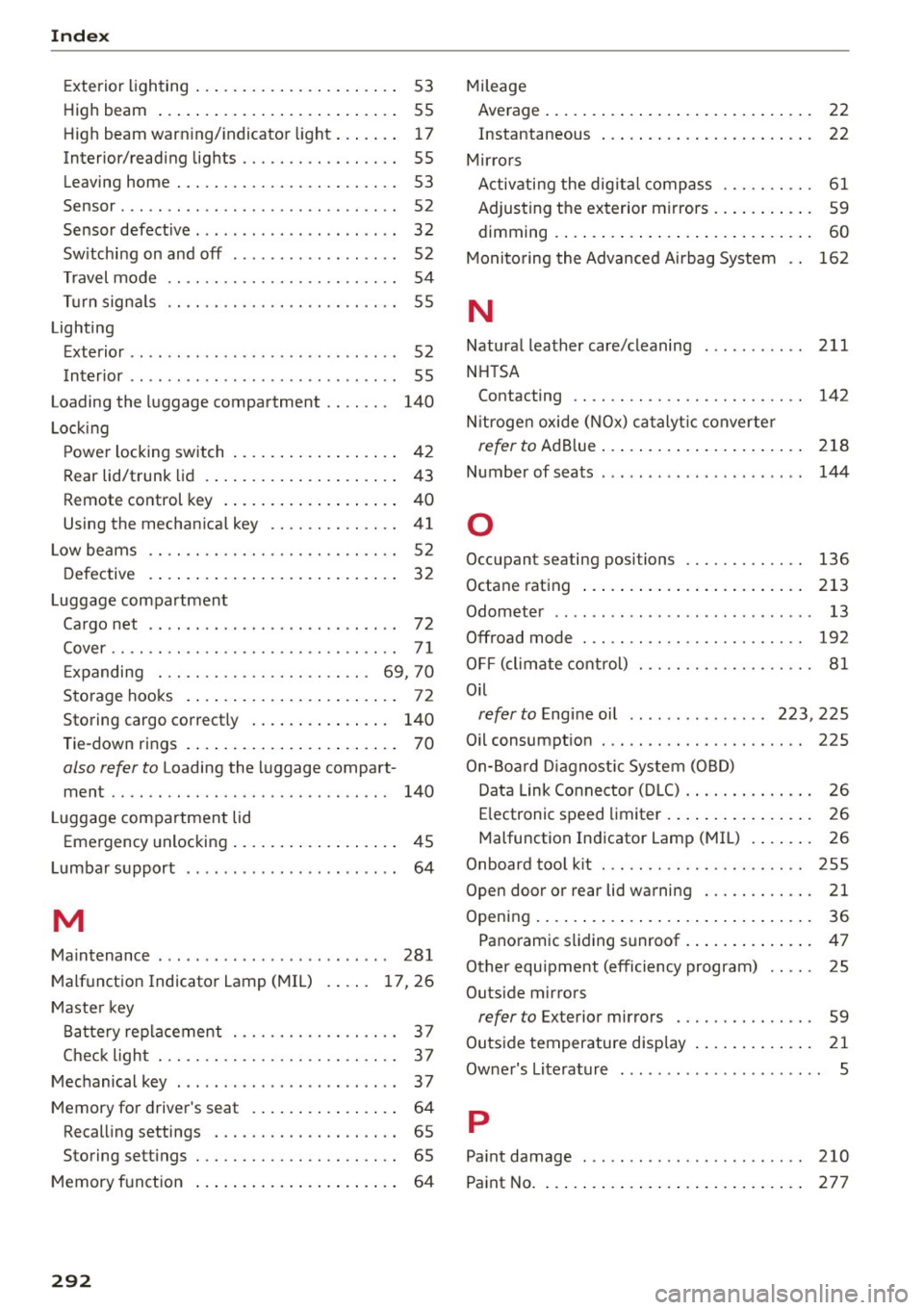
Index
Exterior lighting . . . . . . . . . . . . . . . . . . . . . . 53
High beam . . . . . . . . . . . . . . . . . . . . . . . . . . 55
High beam warn ing/ indicator light. . . . . . . 17
Interior/reading lights . . . . . . . . . . . . . . . . . 55
Leaving home . . . . . . . . . . . . . . . . . . . . . . . . 53
Sensor ....... .. ................ ... .. 52
Sensor defective . . . . . . . . . . . . . . . . . . . . . . 32
Switching on and off . . . . . . . . . . . . . . . . . . 52
Travel mode . . . . . . . . . . . . . . . . . . . . . . . . . 54
Turn signa ls . . . . . . . . . . . . . . . . . . . . . . . . . 55
Lighting
Exterior . . . . . . . . . . . . . . . . . . . . . . . . . . . . .
52
Interior . . . . . . . . . . . . . . . . . . . . . . . . . . . . . 55
Loading the luggage compartment . . . . . . . 140
Locking
Power locking switch . . . . . . . . . . . . . . . . . .
42
Rear lid/trunk lid . . . . . . . . . . . . . . . . . . . . . 43
Remote control key . . . . . . . . . . . . . . . . . . . 40
Using the mechanical key . . . . . . . . . . . . . . 41
Low beams . . . . . . . . . . . . . . . . . . . . . . . . . . . 52
Defective . . . . . . . . . . . . . . . . . . . . . . . . . . . 32
Luggage compartment
Cargo net . . . . . . . . . . . . . . . . . . . . . . . . . . .
72
Cover...... ......................... 71
Expanding . . . . . . . . . . . . . . . . . . . . . . . 69, 70
Storage hooks . . . . . . . . . . . . . . . . . . . . . . . 72
Storing cargo correct ly . . . . . . . . . . . . . . . 140
Tie-down rings . . . . . . . . . . . . . . . . . . . . . . .
70
also refer to Loading the luggage compart -
ment .. .. .. .. ............... .. .. ... 140
L uggage compartment lid
Emergency unlocking . . . . . . . . . . . . . . . . . .
45
Lumbar support . . . . . . . . . . . . . . . . . . . . . . . 64
M
Maintenance . . . . . . . . . . . . . . . . . . . . . . . . . 281
Malfunction Indicator Lamp (MIL)
Master key 17,26
Battery replacement . . . . . . . . . . . . . . . . . . 3 7
Check light . . . . . . . . . . . . . . . . . . . . . . . . . . 3 7
Mechanical key . . . . . . . . . . . . . . . . . . . . . . . .
37
Memory for driver's seat . . . . . . . . . . . . . . . . 64
Recall ing settings . . . . . . . . . . . . . . . . . . . . 65
Storing settings . . . . . . . . . . . . . . . . . . . . . . 65
Memory function . . . . . . . . . . . . . . . . . . . . . . 64
292
Mileage
Average...... ... .. .. ................ 22
Instantaneous ... .. .. .............. .. 22
Mirrors Activating the digital compass . . . . . . . . . .
61
Adjusting the exterior mirrors . . . . . . . . . . . 59
dimming ... ..... .. .. .............. .. 60
Monitoring the Advanced Airbag System . . 162
N
Natural leather care/cleaning
NHTSA 211
Contacting . . . . . . . . . . . . . . . . . . . . . . . . . 142
N itrogen oxide (NOx) catalyt ic converter
refer to Ad Blue. . . . . . . . . . . . . . . . . . . . . . 218
Number of seats . . . . . . . . . . . . . . . . . . . . . . 144
0
Occupant seating posi tions 136
Octane rating . . . . . . . . . . . . . . . . . . . . . . . . 213
Odometer . . . . . . . . . . . . . . . . . . . . . . . . . . . . 13
Offroad mode . . . . . . . . . . . . . . . . . . . . . . . . 192
OFF (climate control) . . . . . . . . . . . . . . . . . . . 81
Oil
refer to Engine oil . . . . . . . . . . . . . . . 223, 225
Oil consumption . . . . . . . . . . . . . . . . . . . . . . 225
On-Board Diagnostic System (OBD)
Data Link Connector (DLC) . . . . . . . . . . . . . .
26
Electronic speed limiter . . . . . . . . . . . . . . . . 26
Malfunction Indicator Lamp (MIL) . . . . . . . 26
Onboard tool kit . . . . . . . . . . . . . . . . . . . . . . 255
Open door or rear lid warning . . . . . . . . . . . . 21
Opening..... ..... .. .................. 36
Panoramic sliding sunroof . . . . . . . . . . . . . . 47
Other equipment (efficiency program) . . . . . 25
Outside mirrors
refer to Exterior mirrors . . . . . . . . . . . . . . . 59
Outside temperature display . . . . . . . . . . . . . 21
Owner's Literature 5
p
Paint damage 210
Paint No. . . . . . . . . . . . . . . . . . . . . . . . . . . . .
277