2015 AUDI Q5 fold seats
[x] Cancel search: fold seatsPage 69 of 302

M N
co ~ co
rl I.O
"' N
"' rl
Head restraints
Front head restraints
Fig. 68 Front se ats head restraints : adj usting t he heig ht
The head restraints on the front seats can be ad
justed to provide safe support to head and neck
at the optimum heig ht. W hen optimally ad just
ed, the top of the restra int should be level w ith
the top of the head . If that is not possible, t ry to
ad just t he head res tra in t so that i t is as cl ose to
this posit ion as poss ible ¢
page 138 , Proper ad
justment of head restraints .
• Grasp the sides of the head restra int wit h both
hands and slide it upward/dow nw ard un til you
f eel it cli ck into place ¢
fig. 68.
Refe r to ¢ page 138, Proper adjustment of head
res traint s
fo r guide lines on how to adj ust t he
h e igh t of the fron t head re st ra in ts to suit t he oc
cupa nt's body size .
A WARNING
-Driv ing without hea d restra ints or with hea d
restraints that are not properly adjusted in
c reases the r isk of serious or fata l neck in
jury dramatically.
- Read and heed all WARNINGS¢
page 138,
Proper adjustment of head restraints.
(D Tips
Cor rectly adjusted head restraints and safety
be lts are a n ext reme ly effective combination
of sa fety fea tures .
Seats and storage
Rear head restraints
Fig. 69 Rea r seat : head rest ra in ts
Fig. 70 Rea r sea t: o ute r head rest ra in t
If there is a passenger on t he rear center seating
pos ition, slid e the center head restraint upward
a t le ast to the next notch¢
A.
Adju sting the head restraint s
• To move t he head rest raint up, ho ld it at the
sides with both hands and s lide it upward unt il
you feel it cl ick into p lace .
• To move the head rest rain t down, press the
button @and slide t he head rest raint down
ward .
Removing the outer head restraints
• Fold the backrest forward¢ page 69.
• Move the head restraint upwa rd as fa r as it ca n
go.
• Press the re lease @¢
fig. 70 with the mechan
ical key ¢
page 3 7 and the button @¢ fig. 69 .
Pull the he ad restrai nt ou t of the bac krest at
the same ti me
c:::> A .
Installing the outer head restraints
• Slide the posts on the head rest raint down into
the guides until you feel the posts click into
p lace . .,.
67
Page 71 of 302
Luggage compartment
Expanding the passenger compartment
The rear seat backrests can be folded forward
separately or together.
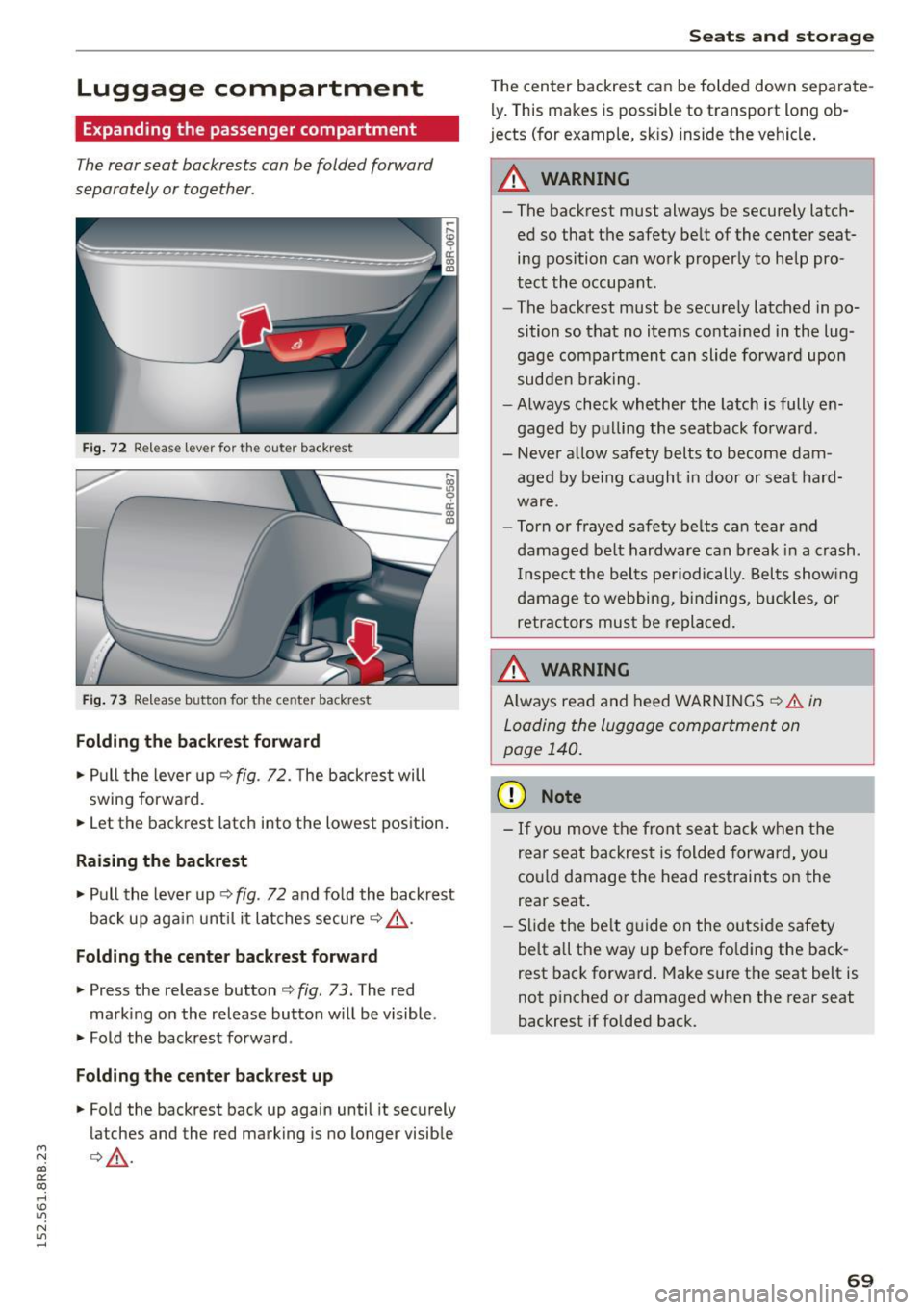
Fi g. 72 Re lease lever for the outer bac krest
....
ill 9
~ ----1:i ID
Fi g. 73 Re lease button for the ce nter backrest
Folding the backrest forward
... Pull the lever up ¢ fig. 72. The backrest will
swing forwa rd .
... Let the backrest latch into the lowest position.
Raising the backrest
... Pull the lever up Q fig . 72 and fold the backrest
back up aga in until it latches secure ¢ ,&. .
Folding the center back rest forw ard
... Press the release button ¢ fig. 73. The red
mark ing on the release button w ill be visible.
... Fold the backrest forward .
Folding the center back re st up
... Fold the backrest back up again until it securely
latches and the red marking is no longer visible
~ ¢.&, . co ~ co
rl I.O
"' N
"' rl
Seats and storage
The center backrest can be folded down separate
ly . This makes is possible to transport long ob
j ects (for example, sk is) inside the vehicle .
A WARNING
--The backrest must always be secure ly latch-
ed so that the safety be lt of the center seat
i n g position can work proper ly to help pro
tect the occupant.
- The backrest must be securely latched in po
sition so that no items contained in the lug
gage compartment can slide forward upon
sudden b raking.
- Always check whether the latch is fully en
gaged by p ulli ng the seatback fo rward .
- Never allow safety belts to become dam aged by be ing caught in door or seat hard
ware .
- Torn or frayed safety belts can tear and
damaged be lt hardware can break in a crash .
I nspect the belts periodically. Belts show ing
dam age to webbing, b indings, buckles, or
retractors mus t be replaced.
A WARNING ~
Always read and heed WARNINGS¢ & in
Loading the luggage compartment on
page 140 .
(D Note
- If you move the front seat back when the
rear seat backrest is folded forward, you
co uld damage the head restraints on the
rear seat.
-
- Slide the be lt guide on the outside safety
belt all the way up befo re fo lding the back
rest back forward . Make sure the seat belt is
not pinched or damaged when the rear seat
backrest if folded back .
69
Page 72 of 302
Seats and storag e
Expanding the luggage compartment
The rear seat backrests can be folded forward
separately or together.
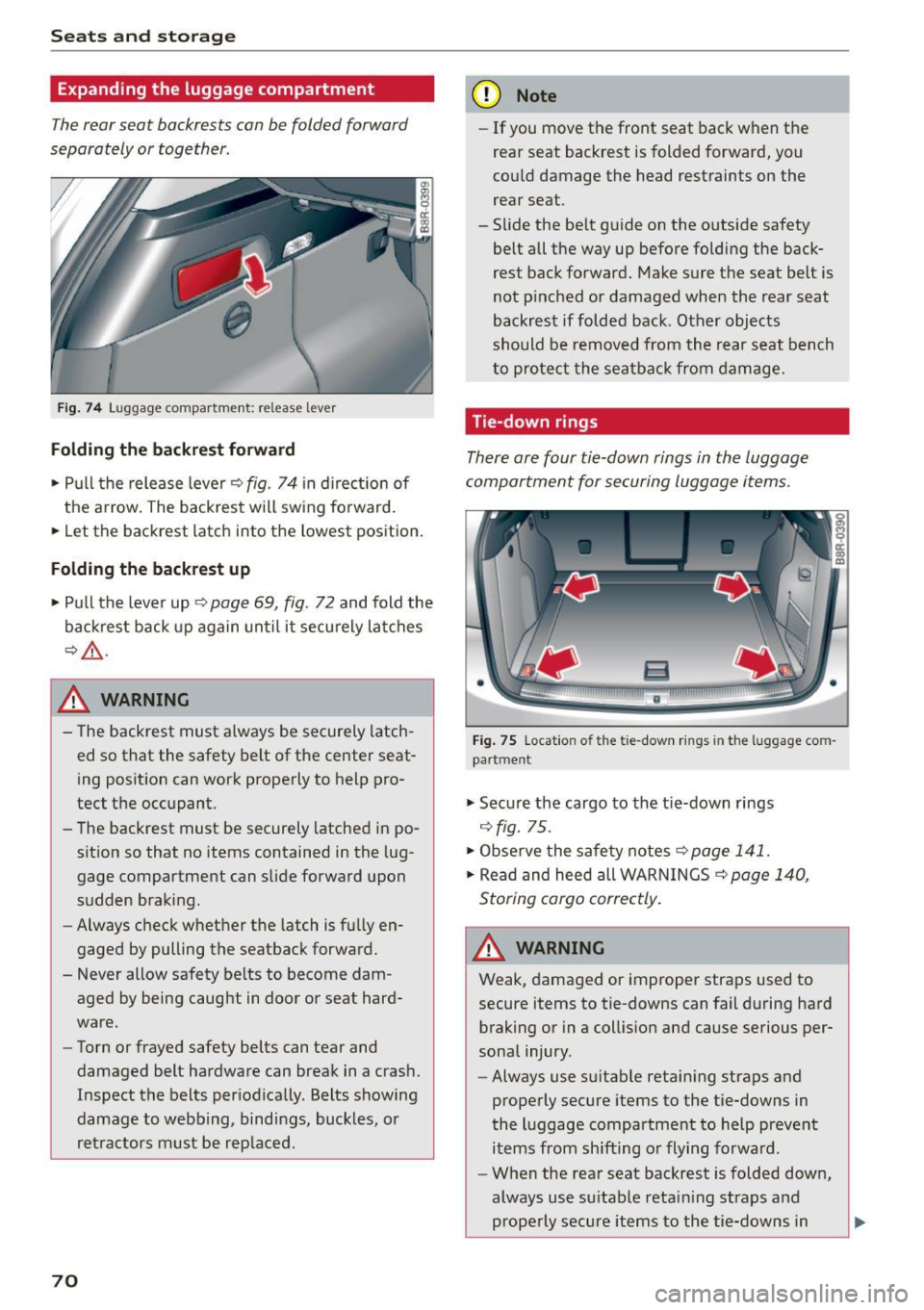
Fig . 74 Luggage compartment: re lease lever
F olding the backre st forward
• Pul l the release lever ¢fig . 74 in d irect ion of
the a rrow . The backrest will sw ing fo rward.
• Let the backrest latch into the lowest position.
Folding the backres t up
• Pull the lever up ¢ page 69, fig. 72 and fold the
backrest back up again until it securely latches
¢ _& .
& WARNING
- The backrest must always be securely latch
ed so that the safety belt of the center seat
ing position can work properly to help pro
tect the occupant.
- The backrest must be securely latched in po
sition so that no items contained in the lug
gage compartment can slide forward upon
sudden brak ing.
- Always c heck w hether the latch is fu lly en
gaged by pulling the seatback forward.
- Never allow safety be lts to become dam
aged by being caught in door or seat hard
ware.
- Torn or frayed safety belts can tear and
damaged belt hardware can break in a cras h.
Inspect the belts per iod ica lly. Belts showing
damage to webbing, bindings, buckles, or
r e tractors must be rep laced .
70
(D Note
-If you move the front seat back when the
rear seat backrest is folded forward, you
cou ld damage the head restraints on the
rear seat.
- Slide the be lt guide on the outside safety
belt all the way up before folding the back
rest back forward. Make sure the seat belt is
not p inched or damaged when the rear seat
backrest if folded back . Other objects
should be removed from the rear seat bench
to protect the seatbac k from damage.
Tie-down rings
There are four tie-down rings in the luggage
compartment for securing luggage items.
Fig . 75 Locat io n of th e tie -down ring s in the lu ggage com
pa rtm en t
• Secure the cargo to the t ie-down rings
~ fig. 75.
• Obse rve the safety notes ¢ page 141.
• Read and heed all WARN INGS ¢ page 1 40,
Storing cargo correctly .
& WARNING
Weak, damaged or improper straps used to
secure items to tie-downs can fail d uring hard
braking or in a col lision and cause serious per
sona l injury .
- Always use su itable retain ing straps and
properly secure items to the tie-downs in
the luggage compartment to he lp prevent
items from shifting or flying forward .
- When the rea r seat backrest is folded down,
always use su itable retain ing straps and
properly secure items to the tie-downs in
-
Page 73 of 302

M N
co ~ co
rl I.O
"' N
"' rl
the lugg age compartment to help prevent
items from flying forward into the passen
ger compartment.
- Never attach a child safety seat tether strap
to a tie-down.
Luggage compartment cover
Fig. 76 Luggage compartment: cover attached
Fig. 77 Luggage compartment: storing the cover
Removing
"'Unhook the straps (!) c:> fig. 76.
"'Pull the cover @out of the reta iners @ in the
direction of the arrow.
Installing
"'Slide the cover into the retainers @.
"'Attach the straps
(D c:> ,&.
Storing
"' Slide the rear seat forward c:> page 66.
"' Fold the cover together and store it behind the
rear seat
c:> fig . 77.
A WARNING
- To prevent accidents, never install the lug
gage compartment cover unsecured.
-
Seats and storage
- Whenever driving, never place any hard or
heavy objects on the luggage compartment
or allow pets to sit on the luggage compart
ment cover . They could become a hazard to
vehicle occupants in the event of sudden
braking or in an accident .
(D Note
You could damaged a stored luggage com
partment cover when you move the rear seat
or rear seat backrest.
@ Tips
-You can use the luggage compartment cover
to store light weight clothing or articles but do not leave any heavy or sharp objects in
the pockets of the clothing .
- Remember that placing clothing or articles
on the luggage compartment cover can
block the driver's vision in the rear view mir
ror. This also applies especially when you
have to transport large objects.
- So that stale air can escape from the vehicle
be sure not to cover the ventilation slot be
tw een the rear lid and the luggage compart
ment cover.
Double cargo floor
You can store dirty or wet objects under the car
go floor.
Fig. 78 Luggage compartment: cargo floor folded togethe r
with protective tray
Folding the cargo floor together
"' Lift the cargo floor by the handle c:> fig. 78 (D
and fold it up .
"'Plac e your item in the protective tray. .,,.
71
Page 74 of 302
Seats and storage
Removing the cargo floor, installing
.. To remove, lift the cargo floor folded together
and pull it toward the rear lid.
.. To install, place the folded cargo floor into both
retainers and unfo ld it.
Grab the protective tray on the hand les and pull
it out. You can also install a divider to divide@
the storage area. Depending on the vehicle
equipment level, the protective tray can have dif
ferent si zes and shapes.
Cargo net and storage hooks
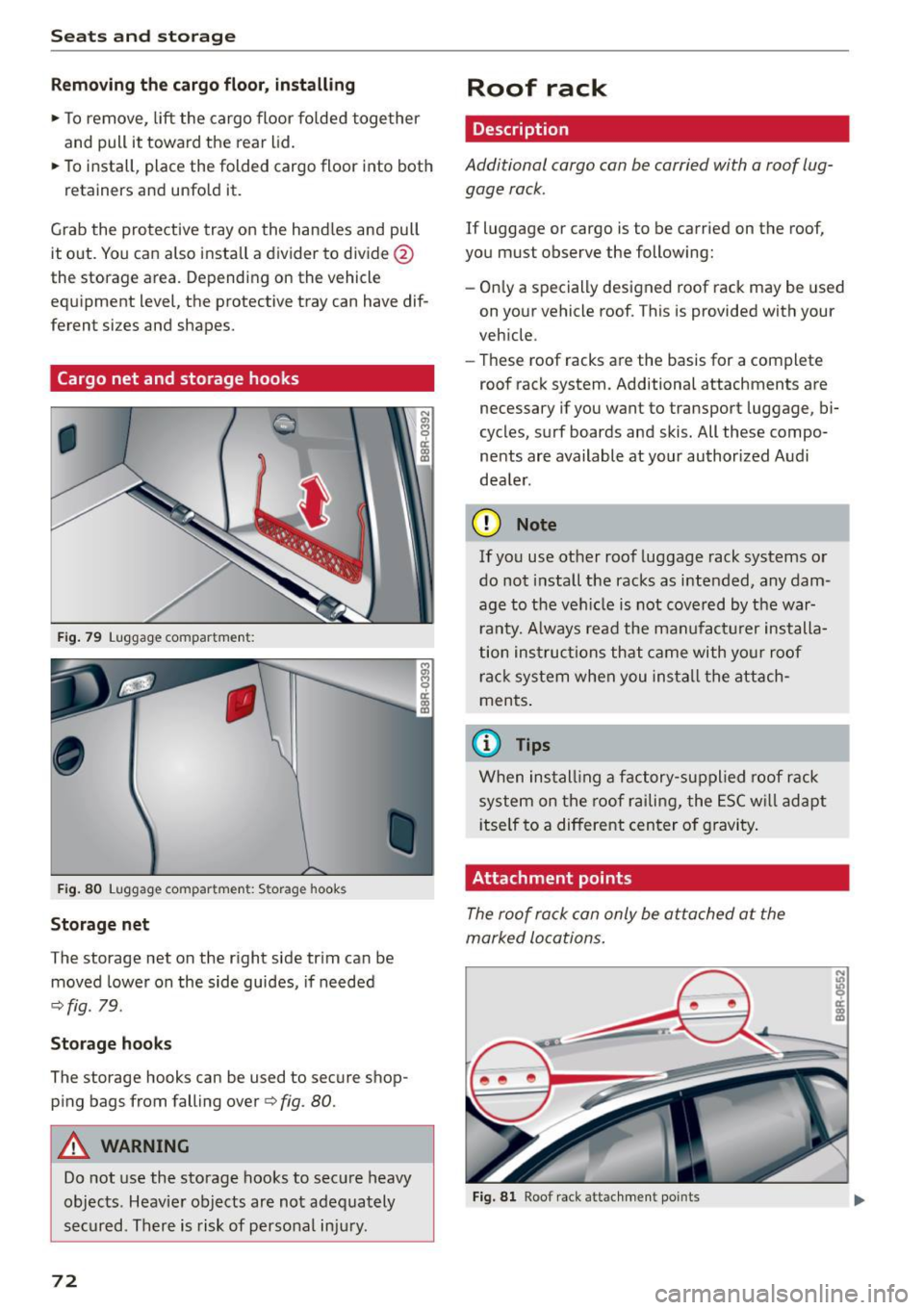
Fig. 79 Luggage co mpa rtm en t:
•
Fig. 80 Luggage co mpa rtment : S torag e hooks
Storage net
The storage net on the right side trim can be
moved lower on the side guides, if needed
-:;, fig . 79.
Storage hooks
The storage hooks can be used to secure shop
ping bags from falling over -:;,
fig. 80.
A WARNING
Do not use the storage hooks to secure heavy
objects . Heavier objects are not adequately
secured . There is risk of personal injury.
72
Roof rack
Description
Additional cargo can be carried with a roof lug
gage rack .
If luggage or cargo is to be carried on the roof,
you must observe the following:
- On ly a specially designed roof rack may be used
on your vehicle roof . This is provided with your
vehicle .
- These roof racks are the basis for a compl ete
roof rack system. Additional attachments are
necessary if you want to transport luggage, bi·
cycles, surf boards and skis. All these compo
nents are available at your authorized Audi
dea le r.
(D Note
If you use other roof luggage rack systems or
do not install the racks as intended, any dam
age to the veh icle is not covered by the war
r anty. Always read the manufacturer installa
tion instructions that came with your roof
rack system when you install the attach
ments.
(D Tips
When installin g a factory-supplied roof rack
system on the roof railing, the ESC will adapt
it self to a different center of gravity.
Attachment point s
The roof rack can only be attached at the
marked locations.
Fig. 81 Roof rack attachmen t po ints
Page 139 of 302

M N
co
a:
co
,...., \!) ..,.,
N ..,., ,....,
For detai led information on how to adjust the
driver's seat, see ¢
page 64.
A WARNING
Drivers who are unbelted, out of position or
too close to the airbag can be ser ious ly in
jured by an airbag as it unfolds. To help re
duce the risk of serious personal injury:
- Always adjust the driver's seat and the
steering wheel so that there are at least
10 inches (25 cm) between your breastbone
and the steering wheel.
- Always hold the steering wheel on the out
side of the steering wheel rim with your
hands at the 9 o'clock and 3 o'clock posi
tions to he lp reduce the risk of personal in
jury if the dr iver's a irbag inflates.
- Never hold the steer ing whee l at the
12 o'cloc k posit ion or with your hands at
other pos it ions inside the steering wheel
rim or on the steering wheel hub. Holding
the steering wheel the wrong way can cause
serious injuries to the hands, arms and head
if the driver's airbag deploys.
- Pointing the steering whee l toward your
face decreases the ability of the supp lemen
tal driver's a irbag to protect you in a colli
sion.
- Always s it in an upright position and never
lean against or place any part of your body
too close to the area where the airbags are located .
- Before driv ing, a lways adjust the front seats
and head restraints properly and make sure
that all passengers are properly restrained.
- Never adjust the seats while the vehicle is
moving . Your seat may move unexpectedly
and you could lose control of the vehicle.
- Never drive with the backrest recl ined or
t ilted far back! The farther the back rests are
t il ted back, the greater the ris k of injury due
to incorrect pos ition ing of the sa fety belt
and improper seating posit ion.
- Children must always ride in child safety
seats¢
page 172 . Special precautions ap
ply when installing a ch ild safe ty seat on the
front passenger seat ¢
page 152.
Drivin g s afet y
Proper seating position for the front
passenger
The proper front passenger seating position is
important for safe, relaxed driving.
Fo r yo ur own safety and to reduce the risk of in
jury in the event of an accident, we recommend
t h at you adjust the sea t for the front passenger
to the fo llow ing pos ition:
"' Adj ust the angle of the seatback so that it is in
an upright position and your back comes in full
contact w ith it wheneve r th e vehi cle is moving.
"' Ad just the head rest ra in t so the upper edge is
as even as possib le w ith the top of your head. If
that is not possib le, try to adj ust the head re
straint so that it is as close to this position as
possible
¢ page 138.
"' Keep both feet flat on the floor in front of the
front passenger seat.
"' Fasten and wear safety belts correct ly
¢ page 147.
For detailed information on how to adjust the
front passenger's seat, see ¢
page 63.
A WARNING
--
Front seat passengers who are unbelted, out
of position or too close to the airbag can be
se riously in ju red o r killed by the a irbag as i t
unfo lds. To help reduce the risk of serious per
sona l injury :
- Passenge rs must always si t in an upright po
sition and never le an aga inst or place any
pa rt of their body too close to the area
where the airbags are located .
- Passengers who are unbelted, ou t of posi
tion or too close to the airbag can be seri
ously injured by an airbag as it unfo lds with
great force in the blink of an eye.
- Always make sure that there are at least
10 inches (25 cm) between the front pas
senger's breastbone and the instrument panel.
- Each passenger must always sit on a seat of
their own and proper ly fasten and wear the
safety belt be long ing to that seat .
- Before driving, always adjust the front pas
senger seat and head restraint properly.
1 37
Page 152 of 302

Safe ty belt s
The shou lder belt should lie as close to the center
of the collar bone as possib le and should fit well
on the body
c::> A in Safety belt position on
page 148.
"' Push
the loop -around fittings up c::> fig. 164 @,
or
"'squeeze together the (D button, and push the
loop-around fittings
do wn @.
"'Pull the belt to make sure that the upper at
tachment is properly engaged.
A WARNING
Always read and heed all WARNINGS and oth
er important information
c::> page 146.
(D Tips
With the front seats, the height adjustment of the seat can also be used to adjust the po
sition of the safety belts .
Improperly worn safety belts
Incorrectly positioned safety belts can cause se
vere injuries.
Wearing safety belts improperly can cause seri
ous injury or death. Safety belts can only work
when they are correctly posit ioned on the body .
Improper seating pos it ions reduce the effective
ness of safety be lts and will even increase t he risk
of injury and death by moving the safety be lt to
cr itical areas of the body. Improper seating posi
tions a lso increase the risk of serious injury and
death when an airbag deploys and strikes an oc
cupant who is not in the correct seating posit ion.
A dr iver is responsible for the safety of all vehicle
occupants and espec ially for children. Therefore :
"' Never permit anyone to assume an incorrect sit -
ting position in the vehicle while traveling
c> _& .
A WARNING
Improperly worn safety belts increase the risk
of serious personal injury and death whenever
a vehicle is being used.
- Always make sure that all vehicle occupants
are correctly restrained and stay in a correct
150
seating position whenever the vehicle is being used.
- Always read and heed a ll WARNINGS and
other important information
c> page 146.
Belt tensioners
· How safety belt pretensioners work
In front, side and rear-end collisions above a
particular severity and in a rollover, safety belts
are tensioned automatically.
The safety belts are equipped with safety belt
pretensioners . The system is act ivated by sensors
i n front, side and rear-end coll is ions of great se
verity and in a rollover . This tightens the belt and
takes up belt s lack
c::> .&. in Service and disposal of
safety belt pretensioner on page 151.
T aking up
the slack helps to reduce forward occupant
movement during a collision.
(D Note
Neve r let the belt remain ove r a rear seatback
that has been folded forward .
(D Tips
The safety belt pretensioner can only be acti
vated once.
- In minor frontal and s ide collisions, in rear
end co llisions and in acc idents involving
very little impac t fo rce, the safety belt pre
tensioner are not activated.
- When the safety belt pretensione rs are acti
vated, a f ine dust is released. This is normal
and is not caused by a fi re in the vehicle.
- T he re levant safety requirements mus t be
observed when the vehicle or components
of the system are scrapped . An authorized
Audi dealer or qua lified wor kshop is familia r
with these regulations and will be pleased
to pass on the information to you.
- Be sure to observe all safety, env ironmental
and other regu lations if the veh icle or indi
vidual parts of the system, part icu larly the
safety belt or airbag, are to be disposed. We
recommend yo u have your author ized Audi
dea ler perform this service for you.
Page 162 of 302

Airbag system
restraints or occupants on the front passen
ger seat and prevent the side airbag in the
seat backrest from deploying properly.
- Never use cushions, pillows, blankets or
similar items on the front passenger seat.
The additional padding will prevent the
weight-sensing mat in the seat from accu rately registering the child restraint or per
son on the seat and prevent the Advanced
Airbag System from functioning properly.
- If you must use a child restraint on the front
passenger seat and the child restraint man
ufacturer's instructions require the use of a
towel, foam cushion or something else to
properly position the child restraint, make
certain that the
PASSENGER AIR BAG OFF
light comes on and stays on whenever the
child restraint is installed on the front pas
senger seat.
- If the
PASSENGER AIR BAG OFF light does
not come on and stay on, immediately in
stall child restraint in a rear seating position
and have the airbag system inspected by
your authorized Audi dealer.
How the Advanced Airbag System
components work together
The front Advanced Airbag System and the side
airbags supplement the protection offered by the
front three-point safety belts with pretensioners and load limiters and the adjustable head re
straints to help reduce the risk of injury in a wide
range of accident and crash situations. Be sure to
read the important information about safety and
heed the WARNINGS in this chapter.
Deployment of the Advanced Airbag System and
the activation of the safety belt pretensioners de
pend on the deceleration measured by the crash
sensors and registered by the electronic control
unit . Crash severity depends on speed and decel
eration as well as the mass and stiffness of the
vehicle or object involved in the crash.
On the passenger side, regardless of safety belt
use, the airbag will be turned off if the weight on
the passenger seat is less than the amount pro
grammed in the electronic control unit . The front
160
airbag on the passenger side will also be turned
off if one of the child safety seats that has been
certified under Federal Motor Vehicle Safety
Standard 208 has been recognized on the seat.
The
PASSENGER AIR BAG OFF light comes on
and stays on to tell you when the front Advanced
Airbag on the passenger side has been turned off
¢ page 153, Child restraints on the front seat
some important things to know .
.&_ WARNING
To reduce the risk of injury when an airbag in
flates, always wear safety belts properly.
- If you are unrestrained, leaning forward, sit
ting sideways or out of position in any way,
your risk of injury is much higher.
- You
will also receive serious injuries and
could even be killed if you are up against the
airbag or too close to it when it inflates -
even with an Advanced Airbag
r::!;> page 152.
More important things to know about front
airbags
Fig. 167 Inflated front airbags
0
0
M ~ ..!,
~
Safety belts are important to help keep front seat
occupants in the proper seated position so that
airbags can unfold properly and provide supple
mental protection in a frontal collision.
The front airbags are designed to provide addi
tiona l protection for the chest and face of the
driver and the front seat passenger when:
- safety belts are worn properly,
- the seats have been positioned so that the oc-
cupant is properly seated as far as possible
from the airbag, .,._