2015 AUDI Q5 air condition
[x] Cancel search: air conditionPage 156 of 302

Airbag system
safety seat. It can be a very dangerous place for
an infant or a child in a rearward-facing seat.
The Advanced Airbag System in your veh icle has
been ce rtified to comp ly w ith the Requirements
of United States Federal Motor Vehicle Safety
Standard 208 as applicable at the time your vehi
cle was manufactured.
The Standard requires the front airbag on the
passenger side to be turned off ("suppressed") if
a child up to about one year of age restrained in
one of the rear-fac ing or forward-facing infant re
straints listed in Federal Motor Vehicle Safety
Standard 208 w ith which the Advanced A irbag
System in your vehicle was certified has been in
stalled on the front passenger seat. Fo r a listing
of the ch ild restraints that were used to certify
comp liance with the US Safety Standard
¢page 174.
The PASSENGER AIR BAG OFF light in the instru
ment panel tells you when the front Advanced
Ai rbag on the passenger side has been turned off
by the electron ic control unit.
E ach t ime you turn on the ignition, the
PASSEN
GER AIR BAG OFF light will come on for a few
seconds and:
- will stay on if the front passenger seat is not
occupied,
- will stay on if there is a small child or child re
stra int on the front passenger seat,
- will go off if the front passenger seat is occu
pied by an adult as registered by the weight
sensing mat¢
page 162, Monitoring the Ad
vanced Airbag System.
The PASSENGER AIR BAG OFF light comes on
when the control un it detects a total weight on
the front passenger seat that requ ires the front
ai rbag to be turned off.
If the tota l weight on the front passenger seat is
more than that of a typical 1 year -old child but
less than the we ight of a small adult, the front
ai rbag on the passenger side can deploy (the
PASSENGER AIR BAG OFF light does not come
on). If the
PASSENGER AIR BAG OFF light does
not come on, the front airbag on the passenger
side has not been turned off by the electronic
154
control unit and can dep loy if the control unit
senses an impact that meets the conditions stor
ed in its memory .
For example, the airbag may deploy if:
-a small ch ild that is heavier than a typical 1
year-old chi ld is on the front passenger seat (re
ga rdl ess of whethe r the child is in one of the
child safe ty seats listed¢
page 174), or
- a child who has outgrow n chi ld restraints is on
the front passenger seat .
If the front passenger airbag is turned off, the
PASSENGER AIR BAG OFF light comes on in the
instr ument cluster and stays on.
The front airbag on the passenger side may
not
deploy (the PASSENGER AIR BAG OFF light does
not illuminate and stay lit) even if a sma ll adult
o r teenager, or a passenger who is not sitt ing up
r ight w ith their back against a non-reclined back
rest with their feet on the vehicle floor in front of
the seat is on the front passenger seat
¢ page 136, Proper seating position for the driv
er .
If the front passenger airbag deploys, the Federal
Standard requires the airbag to meet the "low
risk" deployment criteria to reduce the risk of in
ju ry through interaction with the airbag. "Low
risk" deployment occurs in those crashes that
take place at lower decelerations as defined in
the electronic control unit ¢
page 162, PASSEN
GER AIR BAG OFF light .
Always remember, a child safety seat or infant
carr ier installed on the front seat may be struck
and knocked out of position by the rapidly inflat
i ng passenger's airbag in a frontal collision . The
airbag could greatly reduce the effectiveness of
the child restraint and even seriously injure the
child during inflation.
For th is reason, and because the back seat is the
safest place for children - when prope rly restra in
ed accord ing to their age and size -we strong ly
recommend that children always sit in the back
seat ¢
page 172, Child safety. ..,.
Page 158 of 302
Airb ag syst em
Front airbags
Description of front airbags
The airbag system can provide supplemental
protection to properly restrained front seat occu
pants .
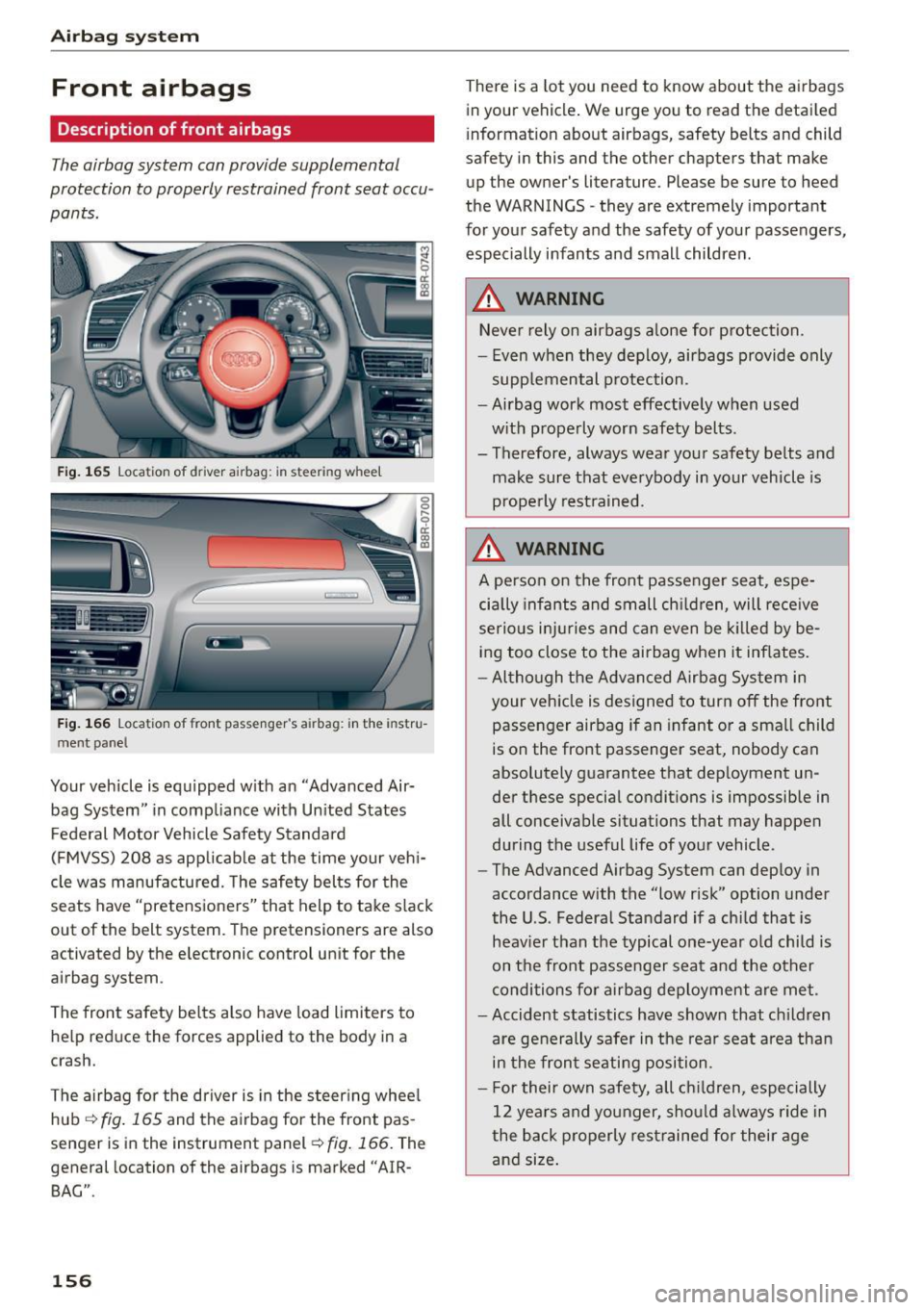
Fig. 165 Location of driver airbag : in steering whee l
Fig. 166 Location of front passenger's airbag: in the instru
ment panel
Your vehicle is equ ipped with an "Advanced Air
bag System" in compliance with Un ited States
Federal Motor Vehicle Safety Standard
(FMVSS) 208 as applicab le at the time your veh i
cle was manufactured. The safety belts for the
seats have "pretensioners" that help to take s lack
out of the belt system . The pretensioners are also
activated by the electronic control unit for the
airbag system .
The front safety belts a lso have load limiters to
help reduce the forces applied to the body in a
crash.
The airbag for the driver is in the steer ing wheel
hub ¢
fig. 165 and the airbag for the front pas
senger is in the instrument panel¢
fig. 166. The
general location of the airbags is marked "AIR
BAG".
156
There is a lot you need to know about the airbags
in your vehicle . We urge you to read the detailed
i nformation about airbags, safety belts and child
safety in this and the other chapters that make
up the owner's literature. Please be sure to heed
the WARNINGS -they are extremely important
for your safety and the safety of your passengers, especially infants and small children .
,&_ WARNING -
Never rely on airbags alone for protection.
- Even when they deploy, airbags provide only supp lemental p rotection.
- Airbag work most effectively when used with properly worn safety belts .
- Therefore, always wear your safety be lts and
make sure that everybody in your vehicle is
prope rly restrained.
,&_ WARNING
A person on the front passenger seat, espe
cially infants and small ch ild ren, will rece ive
serious i njur ies and can even be killed by be
ing too close to the airbag when it inf lates .
- Although the Advanced Airbag System in your vehicle is designed to turn off the front passenger airbag if an infant or a sma ll child
is on the front passenger seat, nobody can
absolutely guarantee that dep loyment un
der these special condit ions is impossible in
all conceivable situations that may happen
during the useful life of your vehicle .
- The Advanced Airbag System can dep loy in
accordance with the "low risk" option under
the U .S. Federal Standard if a chi ld that is
heav ier than the typical one-year old child is
on the front passenger seat and the other
conditions for airbag deployment are met.
- Accident statistics have shown that ch ildren
are generally safer in the rear seat area than
in the front seating position .
- F or their own safety, all ch ildren, especially
12 years and younger, sho uld a lways ride in
the back properly restrained for their age
and size .
-
Page 174 of 302
Child safety
Child safety
Important information
Introduction
The rear seat is generally the safest place in a
collision .
The physical principles of what happens when
your vehicle is in a crash apply also to children
¢ page 145, What happens to occupants not
wearing safety belts? .
But unlike adults and
teenagers, the ir muscles and bones are not fully
developed. In many respects children are at
g reater risk of serious injury in crashes than
adults.
Because children's bod ies are not fully deve loped,
they requ ire restra int systems especially de
signed for their size, weight, and body structure.
Many countr ies and all states of the United
States and provinces of Canada have laws requir
ing the use of approved c hild restraint systems
for infants and small children.
I n a fronta l crash at a speed of 20-35 mph
(30 -56 km/h) the forces acting on a 13 -pound
(6 kg) infant wi ll be more than 20 times the
weight of the child. This means the weight of the child would suddenly be more than 260 pounds
(120 kg). Under these conditions, only an appro
priate child restra int properly used can reduce
the r isk of serious injury . Ch ild restraints, like
adu lt safety be lts, must be used properly to be
effective. Used improperly, they can inc rease the
risk of serious injury in an accident.
Consult the child safety seat manufacturer's in
structions in order to be sure the seat is r ight for
your child's size¢
page 175, Important safety
instructions for using child safety seats .
Please
be sure to read and heed all of the important in
formation and WARNINGS about ch ild safety, Ad
vanced Airbags, and the installation of child re
straints in this chapter.
There is a lot you need to know about the Ad
vanced Airbags in your vehicle and how they work
when infants and children in child restraints are
on the front passenger seat. Because of the large
amount of important information, we cannot re-
172
peat it all here. We urge you to read the detailed
information in this owner's manua l about airbags
and the Advanced Airbag System in your vehicle and the very important information about trans
porting children on the front passenger seat.
Please be sure to heed the WARNINGS -they are
extremely important for your safety and the safe
ty of your passengers, especially infants and
small chi ld ren.
.&_ WARNING
- Accident statistics have shown that children
are generally safer in the rear seat area than
in the front seating position. Always restrain
any child age 12 and under in the rear.
- All vehicle occupants and especially children
m ust be restrained properly whenever riding
in a vehicle. An unrestrained or improperly restrained ch ild could be injured by striking
the inter ior or by be ing ejected from the ve
hicle dur ing a sudden maneuver or impact .
An unrestra ined or improperly restrained
child is a lso at greater risk of injury or death
through contact with an inflating airbag.
- A suitable ch ild restraint properly installed
and used at one of the rear seating posit ions
provides the highest degree of pro tect ion
for infants and small children in most acci
dent sit uations.
.&_ WARNING
Children on the front seat of any car even with
Advanced Airbags can be seriously injured or
even killed when an airbag inflates. A child in
a rearward-facing child safety seat installed
on the front passenger seat will be serious ly
injured and can be killed if the front airbag in
flates.
- The inflating airbag will h it the ch ild safety
seat or infant carr ier with great force and
w ill smash the child safety seat and child
aga inst the back rest, center armrest, or
door.
- Always install rear-fac ing ch ild safety seats
on the rear seat.
- If you must install a rearward fac ing ch ild
safety seat on the front passenger seat in
Page 192 of 302

Smart Technology
Smart Technology Notice about data
recorded by the Event
Data Recorder and
vehicle control modules
Event Data Recorder
This vehicle is equipped with an Event Data Re
corder (EDR) . The main purpose of an EDR is to
record, in certain crash or near crash-like situa
tions, such as an airbag deployment or hitting a
road obstacle, data that will assist in understand
ing how a vehicle 's systems performed . The EDR
is designed to record data related to vehicle dy
namics and safety systems for a short period of
time, typically 30 seconds or less . The EDR in this
veh icle is designed to record such data as:
- How various systems in your vehicle were oper
at ing;
- Whe ther or not the driver and passenger safety
belts were buckled/fastened;
- How far (if at all) the driver was depressing the
accelerator and/or brake pedal; and,
- How fast the vehicle was traveling.
These data can help provide a better understand
ing of the circumstances in which crashes and in
juries occur. NOT E: EDR data are recorded by your
vehicle only if a non-trivial crash situation occurs;
no data are recorded by the EDR under normal
driving conditions and no personal data (e.g .,
name, gender , age, and crash location) are re
corded. However, other part ies, such as law en
forcement, could combine the EDR data with the
type of personally identify ing data routinely ac
qui red during a crash investigation.
To read data recorded by an EDR, special equip
ment is requ ired, and access to the vehicle or the
E DR is needed. In addition to the vehicle manu
facturer, other parties, such as law enforcement,
that have the specia l equipment , can read the in
formation if they have access to the vehicle or the E DR.
Some state laws restrict the retrieval or down
loading of data stored by EDRs installed in a vehi
cle for the express purpose of retrieving data af-
190
ter an accident or crash event without the own
er's consent.
Audi will not access the EDR and/or similar data
o r g ive it to others -
- unless the veh icle owner (or lessee if the veh i
cle has been leased) agrees; or
- upon the official request by the police; or
- upon the order of a court of law or a govern-
ment agency; or
- for the defense of a lawsuit through the judicial
discovery process .
- Audi may also use the data for research about
veh icle operation and safety performance or
provide the data to a third party for research
purposes without identifying the spec ific vehi
cle or information about the ident ity of its own
er or lessee and only after the recorded vehicle
data has been accessed.
Vehicle control modules
Your vehicle is also equipped with a number of
electronic control modules for var ious vehicle
systems, such as engine management, emission
control, airbags, and safety belts .
These electronic control modules record data dur ing norma l vehicle operation that may be
needed by trained technicians for diagnostic and
repair purposes. The recording capabil ity of these
modules is lim ited to data (no sound is recorded).
Only a small amount of data is actua lly recorded
over a very limited period of time, or stored when
a system fau lt is detected by a contro l modu le.
Some of the data stored may relate to vehicle
speed, direction, or braking, as well as restraint
system use and performance in the event of a crash. Stored data can also only be read and
down loaded w ith specia l equipment that is di
rectly connected to the vehicle.
(D Tips
Your vehicle may be equipped with Audi con
nect . Your use of certain Audi connect fea
tures requires wireless serv ices that are p ro
v ided by a third party wireless telecommuni
cations provider . For details regarding how in
formation obtained through Audi connect is
collected, processed, transmitted, used, and ..,..
Page 201 of 302

M N
co
a:
co
,...., \!) 1.1'1
N 1.1'1 ,....,
-Do not apply additional undercoating or
rustproofing on or near the exhaust man i
fold, exhaust pipes, catalytic converter or heat shields. During driving, the substance
used for undercoating could overheat and
cause a fire.
Q) Note
- Be aware that just one tank filling with lead
ed
fuel will already seriously degrade the
performance of the catalytic converter .
- Do not exceed the correct engine oil level
¢page 225.
-Do not drive until the fuel tank becomes
completely empty . The engine could misfire.
Unburned fuel could also get into the ex
haust system and this could cause the cata
l ytic converter to overheat.
- Do not turn off the ignit ion while the veh icle
i s mov ing .
- Do not continue to operate your vehicle un
der these cond it ions, as otherwise fuel can
reach the catalyt ic converte r. This cou ld re
su lt in overheating of the converter, requir
i ng its replacement.
- To assure efficient operat ion of the Emission
Control System:
- Have your veh icle maintained properly and
in accordance with the service recommen
dations in your Warranty
& Maintenance
booklet.
- Lack of proper maintenance as well as im
proper use of the vehicle will impair the
function of the em ission control system
and could lead to damage.
@) For the sake of the environment
Even when the Em ission Control System is op
erating properly, the exhaust gas can have a
sulfur-like exhaust gas smell under some op
erating states. This depends on the sulfu r
content of the fuel being used. Using a differ
ent brand of fuel may help, or filling the tank
wit h lead-free super grade gasoline.
Dri ving and th e en vir onm ent
Diesel particulate filter
Applies to veh icles: w ith diesel en gine
The diese l particu late filter filters nearly all of
the soot particles out of the exhaust. The filter
cleans itself automatica lly under norma l driving
conditions. If the filter cannot clean itself (for ex
ample, because you are only driving short distan
ces), the filter becomes clogged with soot and
the
II symbol for the diese l particulate filter il
luminates
¢ page 34 .
_&. WARNING
-Do not park your veh icle over flammab le
materia ls such as grass or leaves because
the high temperature of the diesel particu
late filter could start a fire .
-
-Do not app ly an underbody protectant in the
exhaust system area or a fire cou ld start.
Avoid damaging the
vehicle
When you are driving on poor roads, or over
curbs, steep ramps, etc., make certain that low
lying parts such as spoilers and exhaust system
parts do not bottom out and get damaged.
This is especially true for vehicles with low-slung
chassis (sports chassis)* and fully loaded
vehicles.
Economical and environ
mentally-friendly driving
General
Your personal style of driving will determine the
economy of your vehicle, as well as exhaust and
noise levels.
Fuel economy, environmenta l impact, and wear
on your engine, brakes and tires largely depend
on three factors:
- your pe rsonal d riving style
- operating conditions
- technical limitat ions
If you ant icipate what you need to do next and
drive economically, you can easily cut your fuel
199
Page 213 of 302
M N
co
a:
co
,...., \!) 1.1"1
N 1.1"1 ,....,
Care and cleaning
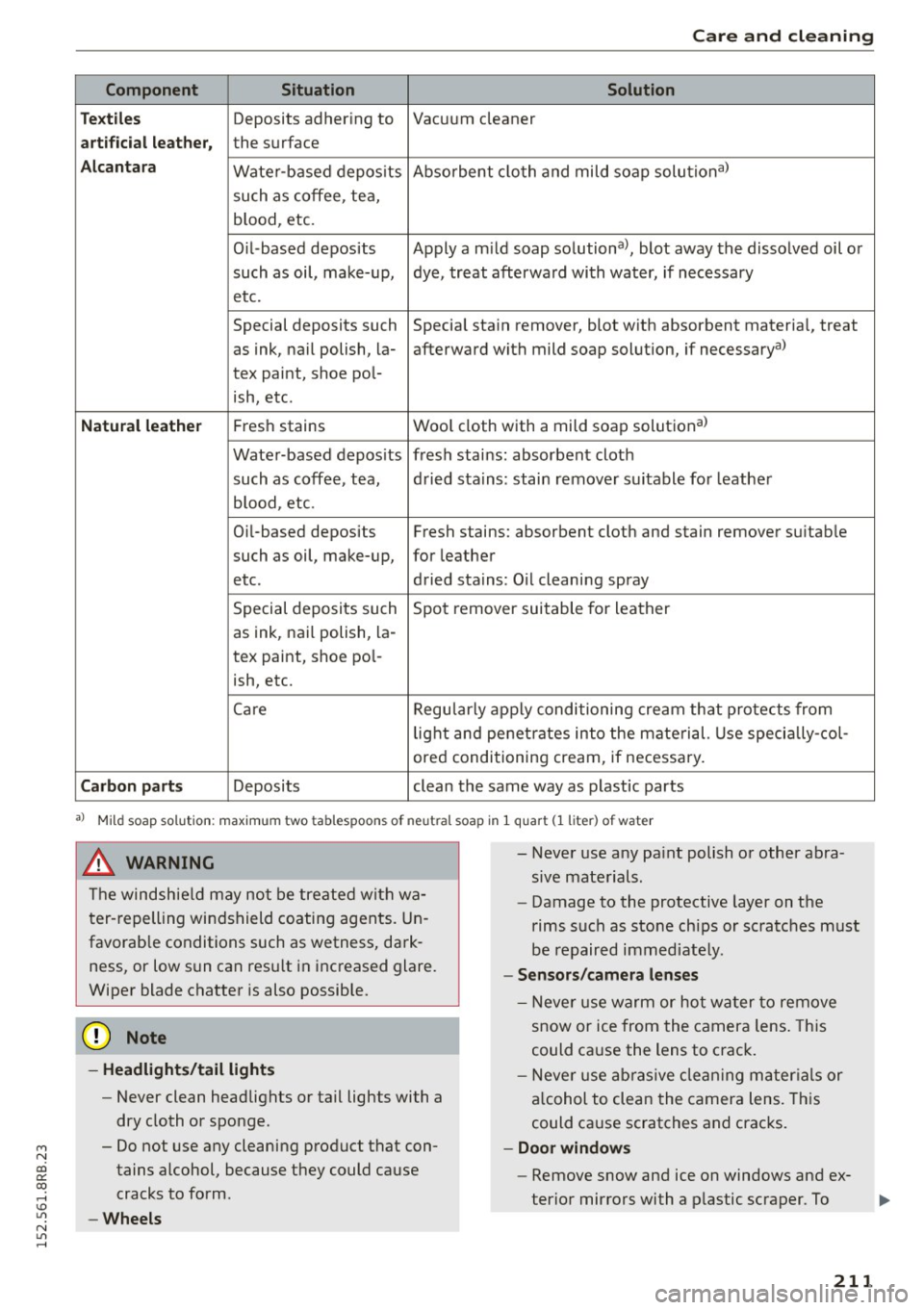
Component Situation Solution
Te xtile s
Deposits adhering to Vacuum cleaner
artificial leather, the surface
Alcantara Water-based depos its Absorbent
cloth and mild soap solutiona)
such as coffee, tea,
b lood, etc.
Oil-based deposits Apply a m ild soap solutiona>, blot away the dissolved oil or
such as oil, make-up, dye, treat afterward with water, if necessary
etc.
Special deposits such Specia l sta in remover, blot with absorbent material, treat
as ink, na il polish, la- afterward with mild soap solution, if necessarya>
tex paint, shoe pol-
ish, etc.
Natural leather Fresh stains Woo
l cloth with a mild soap solutiona>
Water-based deposits fresh stains : absorbent cloth
such as coffee, tea, dried stains: stain remover suitable for leather
blood, etc.
Oil-based deposits Fresh stains: absorbent cloth and stain remover sui tab le
such as oil, make-up, for leathe r
etc. dried stains: Oil cleaning spray
Special deposits such Spot remover suitable for leather
as ink, nai l polish, la-
t ex paint, shoe po l-
ish, etc.
Ca re Regularly apply conditioning cream that protects from
light and penetrates into the mate rial. Use specially-col-
ored conditioning cream, if necessary.
Carbon parts Deposits clean the same way as plastic parts
a) Mild soap sol ution : maximum two tablespoons of neutral soap in 1 quart (1 liter) of water
.8, WARNING
The windshield may not be treated with wa
ter-repelling windshield coating agents . Un
favorab le conditions such as wetness, dark
ness, or low sun can resu lt in increased glare.
Wiper blade chatter is also possible.
@ Note
- Headlights/tail lights
- Never clean headlights or tail lights with a
dry cloth or sponge.
- Do not use any cleaning product that con
tains alcohol, because they could cause
cracks to form.
- Wheels
-
- Never use any paint polish or other abra
sive materials.
- Damage to the protective layer on the
rims such as stone chips or scratches must
be repaired immediately.
- Sensors/camera lenses
-Never use warm or hot water to remove
snow or ice from the camera lens. This
could ca use the lens to crack.
- Never use abrasive cleaning materials or
alcohol to clean the camera lens. This
could cause scratches and cracks.
- Door windows
-Remove snow and ice on windows and ex-
terior mirrors with a plastic scraper. To
211
Page 231 of 302

M N
co ~ co
rl I.O
"' N
"' rl
-To avoid being burned, do not spi ll anti
freeze or coolant on the exhaust system or hot engine parts. Under certain condi
tions, the ethylene glycol in engine cool ant can catch fire.
- Antifreeze is poisonous. Always store anti
freeze in its original conta iner and well out
of the reach of ch ildren .
-If you drain the coolant, it must be caught
and safely stored in a proper container
clearly marked "poison" .
(D Note
-Do not add coolant if the expansion tank is
empty . Air could enter the cooling system
and damage the eng ine .
If this is the case,
do not continue driving. Seek profess ional
ass istance.
- Coolant pollutes the env ironment and could
cause an eng ine fire . Excess coolant will be
fo rced out through the pressure relief valve
i n the cap when the eng ine becomes hot.
- If, i n an emergency , only water can be add
ed, the correct ratio between wa ter and an
tifreeze
~ page 22 7 must be restored as
soon as possib le .
@) For the sake of the environment
Drained coolant should not be reused. Always
dispose o f used coolant while observ ing all
environmental regulations .
Radiator fan
The radiator fan switches on automatically by it
self.
The radiator fan is driven by the engine via the V
be lt . The viscous clu tch regulates the speed of
the fan ac cording to the temperature of the cool
ant.
An auxiliary e lectr ic rad iator fan* switches on and
off depend ing on coolant temperat ure and othe r
veh icle operating conditions.
Afte r you switch the engine off, the auxiliary fan
can continue runn ing for up to 10 minutes -even
Ch eck in g and Fillin g
with the ignition off . It can even switch on again
later by itself¢& , if
- the temperatu re of the engine coo lant rises due
to the heat build- up from the engine in the en
gine compartment, or
- the engine compartment heats up because the
veh icle is parked in intense sun light .
A WARNING
-To reduce the risk of persona l injury never
touch the radiator fan .
- The auxiliary electric fan is temperature con trolled and can switch on suddenly even
when the engine is not running.
- The a uxiliary radiator fan sw itches on auto
matica lly when the engine coolant reaches a
certain temperature and will continue to run
until the coolant temperature drops.
Brake fluid
Checking brake fluid level
The brake fluid level can be checked with a quick
glance .
Fig. 201 Engine compar tment : cov er on th e bra ke fluid
r e servoir
Before you check anyth ing in the engine compart
ment,
al way s read and h eed all WARNIN GS
¢ _.& in Working in the engine compartment on
page 221 .
.,. Read the brake fluid level from the b rake fluid
reservoir ¢
fig. 201, ¢ page 223, fig . 197 . The
brake fluid level must be between the
"MIN "
and "MAX " markings.
229
Page 232 of 302

Checking and F ill in g
The brake fluid reservoir is located at the rear
partition of the engine compartment on t he left
side ¢
page 223.
The fl uid level may drop slightly after some time
due to the automatic adjustment of the brake
pads. This is not cause for alarm.
If the b ra ke fluid level fal ls considerably below
the "MIN" mark, the brake warn ing/indicator
light (U.S. models:
1111 , Canadian models: . )
will come on¢
page 18 and ¢ page 28 . Do not
continue to operate the vehicle . The complete
brake system shou ld be thoroughly checked by an
author ized Audi dealer or qualif ied workshop and
the cause corrected. If the brake fluid level is too low, the brake warning/indicator light will illum i
nate. Contact an authorized Aud i dealer
immedi
a tel y.
Changing brake fluid
Have the brake fluid changed by an experienced technician.
Brake flu id abso rbs moisture from the a ir . If the
water content in the brake fluid is too high, cor rosion in the b rake system may result after a pe ri
od of time. The boiling point of the bra ke fluid
will also decrease conside rably and decrease
b ra ki ng per fo rmance .
Therefore, th e brake flu id must be changed
ev ery
tw o years .
Always use new b rake fluid w hich con
forms to Fede ra l Motor Vehicle Standa rd " FMVSS
1 16 DOT 4".
The brake fluid rese rvoir can be difficult to reach,
therefo re, we recommend that yo u have the
b rake fluid changed by your authori zed
Audi
dealer .
Your dealer has the cor rect too ls, the
right brake f luid and the know -how to do t his for
you.
A WARNING
- Brake fluid is po isonous. It must be stored
only in the closed orig inal container out of
the reach of children!
- Brake fai lure can result from old or inappro
pr iate brake fluid . Observe these precau
t ions:
230
- Use only brake fluid that meets SAE spec i
ficat io n
J 1703 and conforms to Federal
Motor Vehicle Sta ndard 116 . Always check
with your aut horized Aud i dea ler to make
su re you are using the correct brake fl uid .
The co rrect type of brake f lu id is also ind i
cated on t he b rake fluid reservoir.
- The brake fl uid must be new. Heavy use of
the b rakes can cause a vapor lock if the
brake fluid is left in t he system too long.
This can se riou sly affec t the efficiency of
the b rakes as well as yo ur sa fety. This
could result in an acc ident .
(D Note
Bra ke fluid will damage the pai nt of you r vehi
cle.
@ For the sake of the environment
B ecause of the prob lem of prope r disposal of
b rake fluid as well as the spe cial tools re
q ui red and the necessary ex pert ise, we rec
ommend that you have the brake f lu id
cha nged by yo ur autho rize d Aud i dea le r.
Battery
General information
U nder normal operat ing conditions , the battery
i n you r Aud i does not need any maintenance.
With
high outside tem pera tures or long d aily
drives we recommend that you have the e lectro
l yte level checked by an a utho rized Audi dea le r or
qualified workshop. The electrolyte leve l should
a lso be checked each time the battery is charged
¢ page 232.
Have the battery checked when yo u take your ve
hicle in for service. You a re well advised to re
place a battery that is older than 5 years.
With cer tain types of airbag deployment, t he bat
tery is disconnected from the vehicle elect rical
system for safety reasons
Q &. in Repair, care
and disposal of the airbags on page 165.
Hybrid drive *: yo u can find important information
abo ut the high voltage battery under ¢
page 98 . ..,.