2015 AUDI Q3 warning
[x] Cancel search: warningPage 214 of 258

212 Tire s and wheel s
driving a few yards and correct if neces
sary. Follow the instructions from the
snow cha in manufacturer when doing so.
(D Tips
Where snow chains are mandatory oncer
tain roads, this normally also applies to
veh icles with all wheel drive .
Wheel bolts
Wheel bolts must always be tightened to the
correct torque.
The design o f whee l bolts is matched to the
factory insta lled rims . If different rims are fit
ted, the correct wheel bolts with the right l ength and correctly shaped bolt heads must
be used. This ensures that wheels are f itted
securely and that the brake system functions
correctly .
In certain circumstances, you may not use
wheel bolts from a different vehicle -even if it
is the same model¢
page 239.
.&_ WARNING
Improperly tig htened or maintained wheel
bolts can become loose ca using loss of
cont ro l, a co llision and serious p ersona l in
Jury.
- Always keep the wheel bolts and the
threads in t he wheel hubs clea n so the
wheel bolts can tu rn easily and be prop
erly tigh tened.
- N ever grease or oil the wheel bo lts and
the threads in the wheel h ubs. They can
become loose w hile d riving if greased or
oiled, even if tightened to the specified
torq ue.
- O nly use wheel bo lts that be long to the
rim being installed.
- N ever use different whee ls bolts on your
vehicle.
- Alw ays mai nta in the co rrec t tighte ning
tor que fo r the wheel bo lts to reduce the
risk of a wheel loss . If the tightening tor
que of the wheel bo lts is too low, they
can loosen and come out when the veh i- cle is moving.
If the tig
hte ning torq ue is
too high, the wheel bolts and threads
can be damaged and the wheel can be
come loose.
(D Note
The specified torque for the whee l bolts is
105 ft lbs. (140 Nm) with a tolerance of
± 7,4 ft lbs. (± 10 Nm). Torque whee l bolts
diagonally . After changing a wheel, the
torque must be checked as soon as poss i
ble with a to rque wrenc h - preferab ly by an
a uthorized Aud i dea le r or qualified wor k
shop.
Low aspect ratio tires
Your A udi is factory -eq uipped w it h low aspect
ratio tires. These tires have been thoroughly
tested and been se lected specifically for your
model for their superb performance, road fee l
and handling under a variety of driving condi
t ions . Ask your authorized Audi dealer for
more details .
The low aspect ratio of these tires is ind icated
by a numeral of
55 or less in the tire's s ize
designation . The numeral represents the ratio
of the tire's sidewall height in relation to its
t read width exp ressed in percentage. Conven
tiona l tires have a he ight/w idth rat io of 60 or
more.
The performanc e of low-a spect-ratio tire s is
pa rticularly sen sitive to improp er inflation
pre ssure. It i s therefor e important that low
a spe ct ratio tir es are inflated to the spe cified
pre ssure and that the inflation pre ssure i s
regula rly checked and mainta ined. Tire pre s
sure s should be checked at lea st once a
month and always befo re a long trip
¢ page 201, Checking tire pressure.
What you can do to avo id tire and rim
damage
Low aspect ratio tires can be damaged mo re
easily by impact w ith potholes, curbs, gul lies
or ridges on the road, particularly if the tire is
underinflated . ..,.
Page 216 of 258

214 Tire s and wheel s
When the malfunction indicator is illuminat
ed, the system may not be able to det ect or
signal low t ire pressure as intended . TPMS
malfunct ions m ay occur for a variety of re a
sons, including the installa tion of replace
ment or a lternate tires or wheels on the vehi
cle that prevent the TPMS from funct ioning
properly . Always check the TPMS malfunct ion
tellta le afte r replacing one or more t ires or
wheels on your veh icle to ensure that the re
p lacement or a lternate tires and wheels allow
the TPMS to continue to function properly.
Tire pressure indicator appears
Applies to vehicles: with tire pressure monito ring system
The tire pressure indicator in the instrument
cluster informs you if the tire pressure is too
low or if there is a system malfunction.
F ig. 157 Display : under inflatio n warning
Using the ABS sensors, the tire pressure moni
toring system compares the t ire tread circum
ference and vibration characteristics of the in
d iv idual tires . If the pressure decreases in one
or more tires, th is is indicated in the instru
ment cluster w ith a warning symbo l
RE and a
message¢
fig. 157 . If on ly one ti re is affect
ed, the location of that tire will be indicated .
The t ire p ressu re monito ring system must be
reset each t ime the press ures a re adjusted (e.
g . when switching between partia l and full
l oad pressure) or after changing or replacing a
tire on your vehicle ¢
page 215. The TPMS in
dicator only monitors the tire p ressu re that
you have previously s tored. You can find the
recommended tire pressures for your vehicle
on the label on dr iver 's side B -pillar
¢ page 199.
Tire tread circumference and vibration charac
teristics can change and cause a tire pressure
warning if:
- t he t ire press ure in one or more tires is too
low,
- t he t ire has s tructural damage ,
- the t ire p ressure was changed, wheels rotat -
ed or replaced but the TPMS was not reset
¢ page 215,
-the spare t ire is mou nted.
Warning symbo ls
RE Loss of pressure in at least one tire¢.& .
Check the tire or tires and replace or repa ir if
necessary . Check/correct the pressures of all
four t i res and reset TPMS
¢ page 215 .
Ill (T ire Pressure Monitoring Sys tem) T ire
pr ess ure: S y ste m m alfun ction -If l!I ap
pears after switching the ignition on or wh ile
driv ing and the indicator light
RE in the in
strument cluster b links for app rox imately one
minute and then stays on , the re is a system
malfunction . Attempt to sto re the correct tire
pressure
¢ page 215 . If the indicator light
does not turn off or if it turns on shortly
thereafter, immediately drive yo ur vehicle to
an authori zed Aud i dea ler or authori zed repa ir
facility to have the malfunction corrected .
A WARNING
--- If the tire pressure indicator appears in
the instrument cluster display, one or mo re of your t ires is sign ifi cantly unde r
i n flated. Reduce yo ur speed immedi ately
and avoid any hard steer ing or b raking
maneuve rs. Stop as soon as possib le and
check the tires and their pressures. In
f late the tire pressure to the proper pres
sure as indicated on the vehicle's tire
pressure labe l
¢page 199. Driving on a
significantly under-i nflated tire causes
the t ire to overheat and can lead to ti re
fa ilu re. Unde r-inflation also is likely to
impair the vehicle's handling and stop
p ing ability.
Page 218 of 258
216 What do I do now?
What do I do now?
General information
.. Park the vehicle as far as possible from mov
ing traffic in the event of a flat tire. In the
event of a flat tire, park the vehicle on a lev
el surface . It you are on a steep incline, be
especially careful.
.. Set the parking brake .
.. Switch the emergency flashers on .
.. Put on a reflective vest, if ava ilable .
.. Set up the warning triang le, if available .
.. Have the passengers exit the vehicle. They
should move to a safe place, for example
behind a guard rai l.
A WARNING
Pay attention to the steps above. They are
for your protection and the for the safety
of other drivers.
A WARNING
Improper use of the vehicle jack can cause
serious personal injuries.
- Never use the screw driver hex head to
tighten wheel bolts, since the bolts can
not attain the necessary tightening tor
que if you use the hex head, potentially
causing an accident.
- The factory-suppl ied jack is intended on
ly for your vehicle model. Under no cir
cumstances should it be used to lift
heavy vehicles or other loads; you risk in
jur ing yourself.
- Never start the engine when the vehicle
is raised, which could cause an accident.
- Support the vehicle securely with appro
priate stands if work is to be performed
underneath the vehicle; otherwise, there
is a potential risk for injury.
- Never use the jack supplied with your
Audi on another vehicle, particularly on a
heavier one . The jack is only suitable for
use on the vehicle it came with .
Vehicle tool kit with
lifting jack
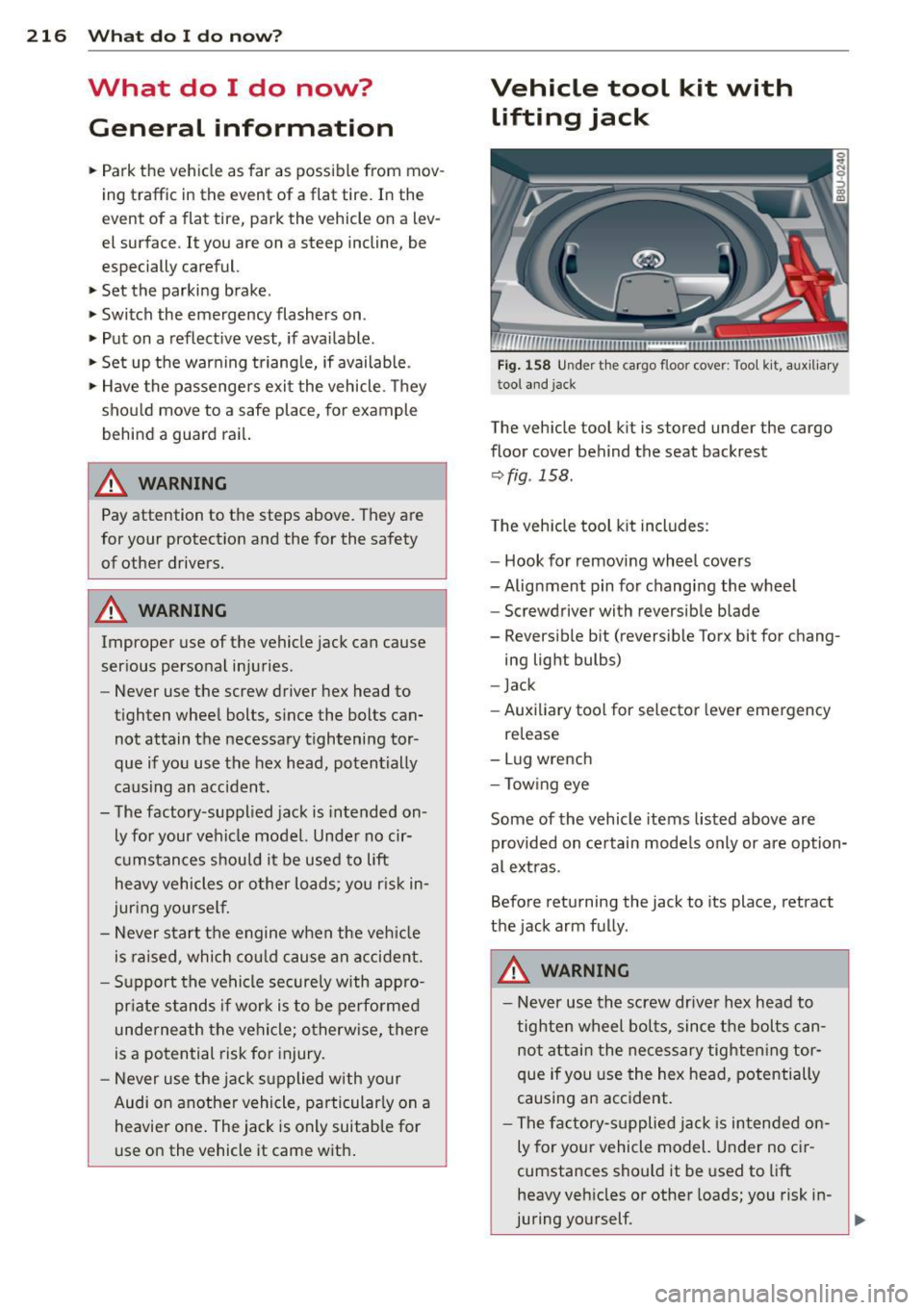
Fig. 158 Under the cargo floo r cover : Too l kit , auxiliary
too l and jack
The veh icle tool kit is stored under the cargo
floor cover behind the seat backrest
Q fig . 158 .
The vehicle tool kit includes :
- Hook for removing wheel covers
- Alig nment pin for changing the wheel
- Screwdriver with reversible blade
- Reversible bit (reversible Torx bit for chang-
ing light bulbs)
- Jack
- Auxil iary tool for selector lever emergency
release
- Lug wrench
-Towing eye
Some of the vehicle items listed above are
provided on certain models only or are option
al extras.
Before returning the jack to its place , retract
the jack arm fully .
A WARNING
-Never use the screw driver hex head to
tighten wheel bolts, since the bolts can
not attain the necessary tighten ing tor
que if you use the hex head, potentially
causing an accident.
- The factory-supplied jack is intended on
ly for your vehicle model. Under no cir
cumstances should it be used to lift
heavy veh icles or other loads; you risk in-
-
juring yourself. ~
Page 219 of 258

M N M N
0 ::i co
rl I.O
"' rl
"' rl
-Never start the engine when the veh icle
is raised, which cou ld cause an accident.
- Support the vehicle secure ly with appro
priate stands if work is to be performed
underneath the vehicle; otherwise, there
is a potential risk for injury.
Folding chocks
Applies to vehicles: with fold ing chocks
The folding chocks are part of the on board
tool kit.
------ - --
Fi g. 159 Opening foldi ng chocks
To use the chocks, you fi rst have to ra ise the
suppor t plate~
fig . 159 CD and then insert
the locking p late with the two "tabs" into the
e longated holes in the base plate@~&. .
&_ WARNING
-The chock cannot fulfil its function and
may lose its stability if the "tabs" on the
support plate are not inserted correctly into the elongated holes in the base
plate. If t his happens , the veh icle may
sta rt to move whi le a wheel is being
changed.
- Never use the folding chocks if they are
damaged or if they have not been assem
bled correct ly.
What do I d o now ? 217
Removing bass box
App lies to vehicles: wit h bass box
Before the spare tire can be taken out, the
bass box must be removed.
Fi g. 160 Spa re whee l well: Bass box
Removing bass box
.,. Lift up the cargo floor us ing the handle .
.,. Squeeze the locking tabs
CD ~ fig. 160 of
the connector .
.,. Disconnec t the conne ctor @and place the
le ad to one side .
.. Tur n the large screw counter-clockwise .
.. Carefully remove the bass box.
Installing bass box
.,. Carefully place the bass box in the wh eel.
The ins cription "FRO NT' ' on the bas s box
m ust face forward .
.. Reco nnect the connector that was removed .
.. Secure the bass box with the large screw.
.. Fold the cargo floor back down.
Space-saving spare tire
(compact spare tire)
.'II If Ill llf 1111 11
Fig . 16 1 Lu ggage compartme nt: Spa re tire
T he spare tire is on ly in tended for tempo rary
u se over short distances. After use, have it ...,
Page 220 of 258

218 What do I do no w?
checked as soon as possible and, if necessary,
replaced by an Audi dea ler or qualified work
shop.
P lease no te the following restr ictions when
using the spare tire . The spa re tire is designed
specifica lly for this model. For t his reason, do
not use a spare tire from a different type of
vehicle.
Re moving the spare tire
.. Take out the floor pane l.
.. Remove the wing screw ¢
fig. 161 and take
out the retainer underneath .
.. Remove the bass box* ¢
page 217.
.. Take out the spare tire.
Snow cha in s
For technica l reasons, snow chains must not
be used on the spare tire .
Should you have a flat tire on one of the front
wheels when using snow chains, fit the spare
tire in place of one o f the rear whee ls. You can
then attach the snow chains to the whee l tak
en from the rear and use this wheel to replace
the flat front twheel.
A WARNING
- Never use the spare tire if it is damaged
or if it is worn down to the tread wear in
dicato rs .
- If the spare tire is more than 6 years o ld,
use it only in an emergency and w ith ex
t reme caution and careful d riving .
- The spare tire is intended only for tem
porary and short-term use. It should be
replaced as soon as possib le w ith the
normal wheel and t ire.
- After mounting the compact spare tire,
the tire pressu re must be checke d as
soon as poss ible. The tire pressure of the
c om pac t spa re tire must be 4.2 bar; oth
erwise, you risk hav ing an accident .
- Do not drive faster than 50 mph (8 0 km/
h). You risk having an acc iden t.
- Avoid full-throttle acce le rat ion, heavy
braking, and fast corner ing . Yo u r isk hav
ing an ac ciden t. -
Never drive using more than one spare
wheel and tire. You r isk having an acci
dent.
- Normal summer or winter t ires must not
be mounted on the compact spare wheel
rim.
- For technical reasons, the use of tire
chains on the spare tire is not permitted.
If it is necessary to drive with tire chains,
the spare wheel must be mounted on the
front ax le in the event of a flat in a rear
tire. The new ly available front wheel
m ust then be installed in place of the
rea r whee l w ith the flat tire. Installing
the tire chain be fore mounting the whee l
and tire is recommended.
- Loose items in the passenger compart
ment can cause se rious personal injury
during hard braking or in an accident. Never store the spare tire or jack and
too ls in t he passenger compartment.
Changing a wheel
Before changing a wheel
Observe the following precautions for your
own and your passenger's safety when chang
ing a wheel.
.. After you experie nce a t ire failure, pull the
car well away from mov ing traffic and try to
reach
level ground before you stop
¢ page 216, ¢,& .
.. All passengers should leave th e car and
move to a safe location ( for ins tance, behind
the guardrail) ¢&, .
.. Engage the
pa rking brake to prevent your
veh icle from rolling unintentionally
c> &, .
.. Move the
selector lever to the P posit ion .
.. If you are towing a trailer : unhitch the trail
er from your vehicle.
.. Take the
jack ¢ page 216 and the spare tir e
¢page 217 out of the luggage compart-
ment. .,.
Page 221 of 258

M N
M N
0 ::i co ,...., \!) ..,.,
,...., ..,., ,....,
A WARNING 1=
You or your passengers could be injured
while changing a wheel if you do not fol
low these safety precautions:
- If you have a flat tire, move a safe dis
tance off the road. Turn off the engine,
turn the emergency flashers on and use
other warning devices to alert other mo
torists.
- Make sure that passengers wait in a safe
place away from the vehicle and well
away from the road and traffic.
- To help prevent the vehicle from moving
suddenly and possibly slipping off the
jack, always fully set the parking brake
and block the wheel diagonally opposite
the wheel being changed with the fold
ing chocks or other objects. When one
front wheel is lifted off the ground, plac ing the Automatic Transmission in "P"
(Park) will
not prevent the vehicle from
moving .
- Before you change a wheel, be sure the
ground is level and firm. If necessary,
use a sturdy board under the jack.
- Always store the vehicle tool kit, the jack
and the replaced tire in the luggage com
partment
¢ page 100.
(D Note
If you are changing the wheel on a steep
incline, use the folding chock¢
page 217
to block the opposite wheel to prevent the
vehicle from moving.
(!) Tips
Obey all laws.
Changing a wheel
When you change a wheel, follow the se
quence described below step-by-step and in
exactly that order .
-
1. Remove the decorative wheel cover* or
the
wheel bolt caps*. For more details see
also
¢ page 220.
2. Loosen the wheel bolts<=:> page 220 .
What do I do now? 219
3.
4.
5.
6.
7.
8.
Locate the proper mounting point for the
jack and align the jack below that point
¢ page 221.
Lift the car with the jack ¢ page 221.
Remove the wheel with the flat tire and
then install the
spare tire <=:>page 222.
Tighten all wheel bolts lightly.
Lower the vehicle with the jack .
Use the wheel bolt wrench and
firmly
tighten all wheel bolts in a crisscross pat
tern ¢
page 220.
9. Replace the decorative wheel cover* or
the
wheel bolt caps*.
A WARNING
Always read and follow all WARNINGS and information<=:>
A in Raising the vehicle on
page 221
and <=:> page 223.
After changing a wheel
A wheel change is not complete without the
doing the following.
.,. Always store the vehicle tool kit, the jack4
and the replaced tire in the luggage com
partment
¢ page 100.
.,. Check the tire pressure of the spare tire as
soon as possible .
.,. As soon as possible, have the
tightening
torques
on all wheel bolts checked with a
torque wrench. The correct tightening tor
que is 105 ft lbs. (140 Nm).
.,. Have the flat tire
replaced as soon as possi
ble.
(D Tips
- If you notice that the wheel bolts are
corroded and difficult to turn while
changing a tire, they should be replaced
before you check the tightening torque.
- Drive at reduced speed until you have the
tightening torques checked.
•
•
Page 222 of 258

220 What do I do now?
Removing the wheel covers/bolt caps
Fig. 162 Cha ng in g a w hee l: re mov ing the w heel cover
Fig. 163 Chan gin g a w hee l: re mov ing the w heel bo lt
c aps
Wheel cover*
• Insert the hook provided with the vehicle
tool kit in the hole in the hub
¢ fig. 162 .
• Pull off the decorative wheel cover .
Wheel bolt caps*
• Push the plastic clip provided with the vehi
cle tool kit over the wheel bolt cap until it
engages
¢ fig. 163 .
• Pull on the plastic clip to remove the cap.
Loosening and tightening the wheel
bolts
The wheel bolts must be loosened before rais
ing the vehicle.
Fig. 164 Chan ging a whee l: loosening th e wh eel b olts
Loosening
• Install the wheel bolt wrench over the
wheel bolt and push it down as far as it will
go .
.. Take tight hold of the
end of the wrench
handle and turn the wheel bolts
counter
clockwise
about one single turn in the direc
tion of arrow
¢ fig . 164.
Tightening
• Install the wheel bolt wrench over the
wh eel bolt and push it down as far as it will
go.
• Take tight hold of the
end of the wrench
handle and turn each wheel bolt
clockwise
until it is seated .
.&_ WARNING
=
-Do not use force or hurry when changing
a wheel - you can cause the vehicle to slip
off the jack and cause serious personal
injuries.
- Do not loosen the wheel bolts more than
one turn
before you raise the vehicle with
the jack. -You risk an injury.
(D Tips
- Never use the hexagonal socket in the
handle of the screwdriver to loosen or
tighten the wheel bolts.
-If a wheel bolt is very tight, you may find
it easier to loosen by carefully pushing
down on the end of the wheel bolt
wrench with
one foot only. As you do so,
hold on to the car to keep your balance
and take care not to slip.
Page 223 of 258

M N M N
0 ::i co
rl I.O
"' rl
"' rl
Raising the vehicle
The vehicle must be li~ed with the jack first
before the wheel can be removed .
Fig. 165 S ill pane ls: markings
Fi g. 166 Sill: posit ion ing th e vehicle jack
The location of the jack point is indicated by
a n in den ta ti on on the underside of the vehicle
c::> fig . 165.
"'Activate the parking b rak e to prevent the
vehicle from ro lling u ninten tionally.
"' Move the selector lever to the P position .
"' Find the
markin g (imprint) on the si ll that is
nearest the wheel that w ill be changed
c::>fig. 165 . Behind the marking, there is a
lifting po int on the sill for the vehicle jack .
"' Turn the
vehicle jack located under the lift
ing point on the sill to raise the jack until
the jaw
c::> fig . 166 @ covers the notch on
the vehicle
c::> .&_ c::>0 .
"'Align the vehi cle jack so the jaw @covers
the notch and the base p late @ is flat on
t h e f loor. The base p late @ must be
vertical
under the lifting point @.
"' Install the rod on the vehicle jack : Insert the
rod into the opening on the handwheel. Turn
the rod left or right to secure it.
"' Continue raising the jack with the rod until
the wheel lifts off the ground slightly .
What do I do now ? 221
Position the vehicle jack only under the desig
nated lifting po ints on the si ll
c::>fig. 165 .
There is exactly one locat ion for each wheel.
The jack must not be positioned at any other
location
c::> .&. c::> (D .
Soft g round under the jack can cause the ve
hicle to slip off the jack. A lways p lace the jack
on firm ground. Use a f lat, stable support if
necessary. Use a non-slip surface such as a
rubber mat o n a
slippery surface such as tile.
A WARNING
- You or your passengers co uld be inju red
while changing a wheel if you do not fo l
low these safety p re ca utions:
- Position the vehicle jack on ly at the
designated lifting points and align the
j ack. Otherw ise, the vehicle jack could
slip and cause an injury if it does not
have sufficient hold on the vehicle.
- Use only the jack* supplied with your
vehicle to raise the veh icle . If you use a
j ac k from a different veh icle, you r vehi
cle may slip off the jac k -ris k of injury !
- Do not use the jack* supplied with yo ur
vehicle to raise other vehicles, as these
may s lip off the jack -risk of injury!
- A soft o r unstable surface unde r the
j ac k m ay cause the veh icle to slip off
the jack . Always prov ide a fi rm base for
the jack o n the ground.
If necess ary,
u se a st urdy board under the jack.
- On hard, sl ippery su rface (such as t iles)
u se a r ubber mat or s imi lar to prevent
the jack from slipping .
- To help prevent injury to yo urself and
your p asse ngers:
- Do not ra ise the vehicle until you are
sure the jack is securely engaged.
- Passengers must not remain in the ve
hicle when it is jacked up.
- Make sure that passengers wait in a
safe place away from the veh icle and
well away from the road and traffic .
- Make sure jack position is correct, ad
j ust as necessary and then cont inue to
raise the jack .