2015 AUDI Q3 light
[x] Cancel search: lightPage 191 of 258

M N M N
0 ::i co
rl I.O
"' rl
"' rl
Brake fluid
Checking brake fluid level
The brake fluid level can be checked with a
quick glance.
N
N
;:;;
" 03
"'
Fi g. 149 Eng ine compartment: Cover on the brake flu
id reservoir
Before you check anything in the engine com
partment,
a lwa ys read and heed all WARN
ING S c:> .&.. in Working in the engine compart
ment on page 179 .
~ Read the brake fluid level from the brake
fluid reservoir
c:> fig. 149, <=> page 181,
fig . 145.
The brake flu id level must be be
tween the "MIN" and "MAX" markings.
The brake fluid reservoir is located at the rear
partition of the engine compartment on the
left side <::;>
page 181 .
The fluid level may drop slightly after some
time due to the automatic adjustment of the
brake pads . This is not cause for alarm .
If the brake fluid level falls
considerably be
low the "MIN" mark, the brake warning/indi
cator light (USA models: ., Canada models:
• will come on
<::;> page 13. Do not continue
to operate the vehicle . The complete brake
system should be thorough ly checked by an
author ized Audi dealer or qua lified workshop
and the cause corrected.
If the brake fluid lev
e l is too low, the brake warning/indicator ligh t
will illuminate . Contact an authorized A ud i
dealer
immediately.
@ Tips
The brake f luid reservoir is located under
neath the cover .
Checking and fillin g 189
Changing brake fluid
Have the brake fluid changed by on experi
enced technician.
Brake fluid absorbs moisture from the air. If
the water content in the brake fluid is too
high, corrosion in the brake system may result
after a period of time . The boiling point of the
brake flu id will also dec rease considerably and
decrease braking pe rformance.
Therefore, the brake fluid must be changed
ev ery two years. Always use new brake flu id
which conforms to Federal Motor Vehicle
Standard "F MVSS 116 DOT 4".
The brake fluid reservo ir can be d iff icult to
reach, the refore, we recommend that you
have the brake fluid changed by your author
i zed
Audi d ealer. Your dealer has t he correct
tools, the right brake fl uid and t he know-how
to do this for you .
A WARNING -.
-Brake fluid is poisonous . It must be stor
ed only in the closed original container
out of the reach of children!
- Brake failure can resu lt from o ld or inap
propriate brake f luid. Observe these pre
cautions:
- Use only brake fluid that meets SAE
spe cificat ion
J 1 7 03 and conforms to
Federa l Moto r Ve hicl e Standard 116.
Always check with yo ur authorized Audi
dealer to make sure yo u are using the
correct bra ke fluid. The correct type of
brake f luid is also indicated on the
brake f luid reservoir.
- The brake fluid must be new. Heavy use
of the brakes can cause a vapor lock if
the brake fluid is left in the system too
l ong . This can seriously affect the effi
c iency of the brakes as well as your
safety. This cou ld resu lt in an accident.
(D Note
Brake fluid will damage the paint of your
vehicle .
Page 192 of 258

190 Checking and filling
@ For the sake of the environment
Because of the problem of proper disposa l
of brake flu id as we ll as the special tools
req uired and the necessary expert ise, we
recommend that you have the b rake fluid
changed by your author ized Audi dealer.
Battery
General information
Unde r normal operating conditions, the bat
tery in your A udi does not need any mainte
nance. With
high outside temperatures or
long daily dr ives we recommend that you have
the elect ro lyte level checked by an authorized
Aud i dea ler o r qualified workshop . The elec
trolyte leve l sho uld a lso be c hecked each t ime
the battery is c harged
c::> page 192.
H ave the battery checked when you take your
ve hicle in for service . Yo u are well adv ised to
replace a bat tery that is older tha n 5 yea rs .
W ith certa in types of a irbag deployment, t he
battery is d isconnected from the vehicle elec
tr ica l system fo r safety reasons
c::> & in Re
pair, core and disposal of the airbags on
page 126.
Disconnecting the battery terminals
Some veh icle functions (power w indow regu
lato rs, for example) are lost if the battery ter
m inals a re discon nected. These functions have
to be re lea rned after the batte ry terminals a re
c onnec ted agai n. T o prevent this, the battery
should o nly be di sconnec ted from the vehicle
e lec trica l syste m when absolu tely necess ary
for repairs.
Vehicles not driven for long periods
I f yo u do not dr ive you r vehicle over a pe riod
of severa l days or weeks, elec trical co m po
n en ts are gr adually cu t back o r swi tched off .
T his reduces energy cons ump tion and main
tains sta rting capab ility over a lon ger perio d
c::> page 159 .
Some o f the conven ien ce f unct ions m ay no t
ope rate, su ch as the in ter ior lights o r the power seat adjus
tment . The convenience
funct ions wi ll be available again when yo u
tu rn on the ign ition and sta rt t he engine .
Winter operation
During the w inte r mon th s, batt ery c apac ity
tends to dec rease as tempera tures drop . This
is beca use more power is a lso consumed w hile
starting, and the headlights, rear win dow de
f ogger, etc., are used more often.
Avoid unnecessa ry powe r consumpt ion, pa r
ticu lar ly in ci ty traffic o r when traveling only
sho rt distances . Let yo ur autho rized A udi
dealer check the capacity of the vehicle bat
tery before w inter sets in
<=:> page 192. A well
charged battery will not on ly prevent starting
problems when the weather is cold, but w ill
also last longer .
@ Tips
If your vehicle is left standing for seve ral
w eeks at extremely low temperatures, the
vehicle battery s hou ld be removed and
s tored w her e it w ill not freeze. This will
preve nt i t fr om be ing d amaged and having
t o be repla ced .
Working on the battery
Be especially careful when working on or near
the battery.
T he battery is loc ated in the luggage compar t
ment under the floo r. B efo re you che ck any
t hi ng in the luggage co mpartmen t,
read and
heed all WARNINGS
c::> .&_ .
Always heed t he safety warnings , when work
i ng on the veh icle ba tte ry or the vehicle e le c
t ric al sys tem to p reven t inju ry.
The following WARNINGS are very
important when working on the battery:
Always heed the following WARNING SYM ·
BOLS and safety precautions when working
on the battery .
®
Always wear eye protection .
Page 193 of 258

M N
M N
0 ::i co ,...., \!) 1.1'1 ,...., 1.1'1 ,....,
&
Battery acid contain s sulfuric acid. Al ·
wa ys wear glove s and e ye protection .
@
No
· sparks
- flame s
- smoking .
~
When a battery i s ch arged, it p roduce s
. hy drogen g as whi ch i s exp losive and
could cau se per sonal inju ry.
®
Always keep the batt ery well out of
re ach of children .
A WARNING
Whenever working on the battery or on
the electrical system, there is the r isk of
injury, acc ident and even fire. Read and
heed the following WARNINGS :
- Always wear eye protection. Do not let
battery acid or any lead particles get on
your sk in or cloth ing. Sh ield your eyes .
Explosive gases can cause blindness o r
other injury.
- Battery acid contains sulfuric acid . Sulfu
ric acid can cause blind ness and severe
burns.
- Always wear gloves and eye p rotection.
Do not tilt the battery because ac id
could leak out of the vent ilation open
ings.
- If you get battery acid in yo ur eyes or
on your sk in, immed iately r inse with
cold water for severa l m inutes and get
medical attention.
- If you should ingest any battery acid,
seek med ica l attention immediately.
- Do not expose the battery to an open
flame, electric sparks or an open light.
- Do not smoke.
- Do not interchange the positive and neg-
ative cab les .
- When working on the battery, be sure
not to short-circuit the terminals with
tools or other metal objects. This would cause the battery to heat up very quickly,
wh ich could lead to damage or explosion
and personal injury.
-
Checkin g and fillin g
-When a battery is charged, it produces
hyd rogen gas which is explos ive and
could cause personal injury.
- Always keep the battery well out of the
reach of children.
- Before work is done on the elect rical sys
tem, disconnect the negative ground ca ble.
- Before performing any work on the e lec
trical system, switch
off the eng ine and
ignit ion as well as any electrical equip
ment. The negative cable on the battery
must be disconnected. If yo u are just go
ing to replace a light bulb, then it is
enough to switc h
off the lights.
- Before disconnecting the battery, switch
off the anti-theft alarm system! Other
wise you wi ll set
off the al arm.
- When disconnecting the battery, first
discon nect the negat ive cab le and then
the posit ive cab le.
- Before reconnecting the batte ry, ma ke
sure all e lectr ica l consumers are sw itch
ed off . Re connect the pos it ive cable first
and then the negative cable. Neve r in ter
change the cables -this could start a fire!
- Never cha rge a frozen or a thawed-out
battery.
It could exp lode! If a battery has
frozen, then it must be replaced . A dis
charged battery can freeze over at 32°F
(QOC).
- Make s ure the vent hose is always attach
ed to the opening on the side of the bat
tery.
- Never use batteries which are damaged.
There is the danger of an explosion! A l
ways rep lace a damaged batte ry.
A WARNING
Ca lifornia Proposition 65 Warning:
- Battery posts, terminals and related ac
cessories conta in lead and lead com
pounds, chemicals known to the State of
Ca lifornia to cause cance r and reproduc
tive problems. Wash hands after han- dling.
~
19 1
•
•
Page 202 of 258

200 Tires and wheels
you have stored. The system does not recog
nize the load condition of your vehicle.
The effectiveness of the tire pressure monito r
ing system* will be impaired if you store nor
mal load pressures but then operate the vehi
cle at its maximum load¢.&. .
See the illustration¢
fig. 152 for the location
of the label on driver's side 8-pillar (color of
the actua l label and exact location on the ve
hicle wi ll vary slightly).
Note that the following table is accurate at
the time of going to press and is subject to
Model Tire designation
Engine
Q3: 235/50
Rl8 97H
2.0 liter All Season
4 -cylinder
235/50 Rl8 97V
All Season
255/40 Rl9 96Y
High Performan ce
255/35 R20 97Y xl
High performance
change. In the event of discrepancies, the tir e
pressure label is located on the driver's side 8-
pillar always takes precedence.
T he table below lists the recommended cold
ti re inflation pressures for the Audi mode l
covered by your Owner's Literature at the vehi
cle's capacity weight and the t ire sizes instal
l ed on the respective models as original
equipment, or as a factory option.
Tire pressure
normal load condition full load condition (up to 3 occupants)
front rear front rear
PSI kPA PSI kPA PSI kPA PSI kPA
33 220 33 220 34 230 36 250
33 220 33 220 34 230 36 250
34 230 34
230 44
300 47
320
34 230 34 230 44 300 47 320
xl= reinforced or extra load tire. It may also appear as XL, EXTRA LOAD, or RF on the tire side-
wall.
The correct tire pressure for the spare wheel is
located on a label on the driver's side 8 -pillar.
Because technical changes may be made to
vehi cle equipment dur ing the model year, al
ways compare the tire size designation on the
tire pressure labe l on your vehicle with the
tires on your vehicle . Make sure that the tire
size information on the veh icle label is the
same as the size of the t ires on the vehicle.
This is especially important if the vehicle be
longs to someone else or you bought the vehi
cle with different rims/tires or you bought the
vehicle as a previously owned vehicle.
Remember, your safety and that of your pas
sengers also depends on mak ing sure that
load limits are not exceeded . Vehicle load in- eludes
everybody and everything in and on the
vehicle. These load limits are technically refer
red to as the vehicle's Gross Vehicle Weight
Rat ing ("GVWR"). The Gross Axle We ight Rat
ing ("GAWR") is the maximum load that can
be applied at each of the vehicle's two axles.
The Gross Vehicle Weight Rating and the
Gross Axle Weight Rating are listed on the
safety compliance sticker label located on the
dr ive r's side 8-pillar. The tire pressure labe l on
you r Audi lists the max imum combined
weight of all of the occupants and luggage or
other cargo that the ve hicle can carry. For the
location of the tire pressure label
~fig . 152. .,..
Page 216 of 258

214 Tire s and wheel s
When the malfunction indicator is illuminat
ed, the system may not be able to det ect or
signal low t ire pressure as intended . TPMS
malfunct ions m ay occur for a variety of re a
sons, including the installa tion of replace
ment or a lternate tires or wheels on the vehi
cle that prevent the TPMS from funct ioning
properly . Always check the TPMS malfunct ion
tellta le afte r replacing one or more t ires or
wheels on your veh icle to ensure that the re
p lacement or a lternate tires and wheels allow
the TPMS to continue to function properly.
Tire pressure indicator appears
Applies to vehicles: with tire pressure monito ring system
The tire pressure indicator in the instrument
cluster informs you if the tire pressure is too
low or if there is a system malfunction.
F ig. 157 Display : under inflatio n warning
Using the ABS sensors, the tire pressure moni
toring system compares the t ire tread circum
ference and vibration characteristics of the in
d iv idual tires . If the pressure decreases in one
or more tires, th is is indicated in the instru
ment cluster w ith a warning symbo l
RE and a
message¢
fig. 157 . If on ly one ti re is affect
ed, the location of that tire will be indicated .
The t ire p ressu re monito ring system must be
reset each t ime the press ures a re adjusted (e.
g . when switching between partia l and full
l oad pressure) or after changing or replacing a
tire on your vehicle ¢
page 215. The TPMS in
dicator only monitors the tire p ressu re that
you have previously s tored. You can find the
recommended tire pressures for your vehicle
on the label on dr iver 's side B -pillar
¢ page 199.
Tire tread circumference and vibration charac
teristics can change and cause a tire pressure
warning if:
- t he t ire press ure in one or more tires is too
low,
- t he t ire has s tructural damage ,
- the t ire p ressure was changed, wheels rotat -
ed or replaced but the TPMS was not reset
¢ page 215,
-the spare t ire is mou nted.
Warning symbo ls
RE Loss of pressure in at least one tire¢.& .
Check the tire or tires and replace or repa ir if
necessary . Check/correct the pressures of all
four t i res and reset TPMS
¢ page 215 .
Ill (T ire Pressure Monitoring Sys tem) T ire
pr ess ure: S y ste m m alfun ction -If l!I ap
pears after switching the ignition on or wh ile
driv ing and the indicator light
RE in the in
strument cluster b links for app rox imately one
minute and then stays on , the re is a system
malfunction . Attempt to sto re the correct tire
pressure
¢ page 215 . If the indicator light
does not turn off or if it turns on shortly
thereafter, immediately drive yo ur vehicle to
an authori zed Aud i dea ler or authori zed repa ir
facility to have the malfunction corrected .
A WARNING
--- If the tire pressure indicator appears in
the instrument cluster display, one or mo re of your t ires is sign ifi cantly unde r
i n flated. Reduce yo ur speed immedi ately
and avoid any hard steer ing or b raking
maneuve rs. Stop as soon as possib le and
check the tires and their pressures. In
f late the tire pressure to the proper pres
sure as indicated on the vehicle's tire
pressure labe l
¢page 199. Driving on a
significantly under-i nflated tire causes
the t ire to overheat and can lead to ti re
fa ilu re. Unde r-inflation also is likely to
impair the vehicle's handling and stop
p ing ability.
Page 218 of 258
216 What do I do now?
What do I do now?
General information
.. Park the vehicle as far as possible from mov
ing traffic in the event of a flat tire. In the
event of a flat tire, park the vehicle on a lev
el surface . It you are on a steep incline, be
especially careful.
.. Set the parking brake .
.. Switch the emergency flashers on .
.. Put on a reflective vest, if ava ilable .
.. Set up the warning triang le, if available .
.. Have the passengers exit the vehicle. They
should move to a safe place, for example
behind a guard rai l.
A WARNING
Pay attention to the steps above. They are
for your protection and the for the safety
of other drivers.
A WARNING
Improper use of the vehicle jack can cause
serious personal injuries.
- Never use the screw driver hex head to
tighten wheel bolts, since the bolts can
not attain the necessary tightening tor
que if you use the hex head, potentially
causing an accident.
- The factory-suppl ied jack is intended on
ly for your vehicle model. Under no cir
cumstances should it be used to lift
heavy vehicles or other loads; you risk in
jur ing yourself.
- Never start the engine when the vehicle
is raised, which could cause an accident.
- Support the vehicle securely with appro
priate stands if work is to be performed
underneath the vehicle; otherwise, there
is a potential risk for injury.
- Never use the jack supplied with your
Audi on another vehicle, particularly on a
heavier one . The jack is only suitable for
use on the vehicle it came with .
Vehicle tool kit with
lifting jack
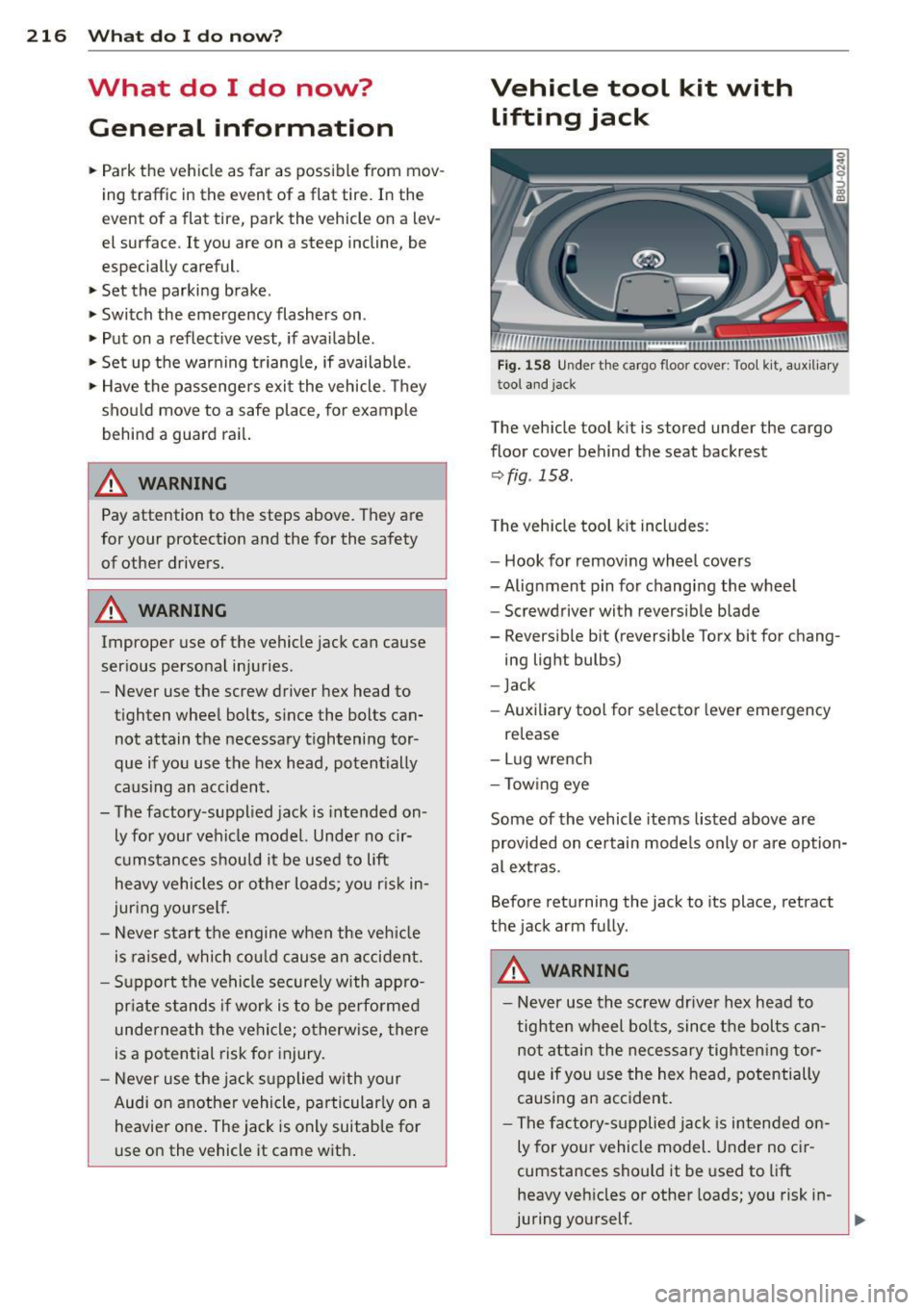
Fig. 158 Under the cargo floo r cover : Too l kit , auxiliary
too l and jack
The veh icle tool kit is stored under the cargo
floor cover behind the seat backrest
Q fig . 158 .
The vehicle tool kit includes :
- Hook for removing wheel covers
- Alig nment pin for changing the wheel
- Screwdriver with reversible blade
- Reversible bit (reversible Torx bit for chang-
ing light bulbs)
- Jack
- Auxil iary tool for selector lever emergency
release
- Lug wrench
-Towing eye
Some of the vehicle items listed above are
provided on certain models only or are option
al extras.
Before returning the jack to its place , retract
the jack arm fully .
A WARNING
-Never use the screw driver hex head to
tighten wheel bolts, since the bolts can
not attain the necessary tighten ing tor
que if you use the hex head, potentially
causing an accident.
- The factory-supplied jack is intended on
ly for your vehicle model. Under no cir
cumstances should it be used to lift
heavy veh icles or other loads; you risk in-
-
juring yourself. ~
Page 221 of 258

M N
M N
0 ::i co ,...., \!) ..,.,
,...., ..,., ,....,
A WARNING 1=
You or your passengers could be injured
while changing a wheel if you do not fol
low these safety precautions:
- If you have a flat tire, move a safe dis
tance off the road. Turn off the engine,
turn the emergency flashers on and use
other warning devices to alert other mo
torists.
- Make sure that passengers wait in a safe
place away from the vehicle and well
away from the road and traffic.
- To help prevent the vehicle from moving
suddenly and possibly slipping off the
jack, always fully set the parking brake
and block the wheel diagonally opposite
the wheel being changed with the fold
ing chocks or other objects. When one
front wheel is lifted off the ground, plac ing the Automatic Transmission in "P"
(Park) will
not prevent the vehicle from
moving .
- Before you change a wheel, be sure the
ground is level and firm. If necessary,
use a sturdy board under the jack.
- Always store the vehicle tool kit, the jack
and the replaced tire in the luggage com
partment
¢ page 100.
(D Note
If you are changing the wheel on a steep
incline, use the folding chock¢
page 217
to block the opposite wheel to prevent the
vehicle from moving.
(!) Tips
Obey all laws.
Changing a wheel
When you change a wheel, follow the se
quence described below step-by-step and in
exactly that order .
-
1. Remove the decorative wheel cover* or
the
wheel bolt caps*. For more details see
also
¢ page 220.
2. Loosen the wheel bolts<=:> page 220 .
What do I do now? 219
3.
4.
5.
6.
7.
8.
Locate the proper mounting point for the
jack and align the jack below that point
¢ page 221.
Lift the car with the jack ¢ page 221.
Remove the wheel with the flat tire and
then install the
spare tire <=:>page 222.
Tighten all wheel bolts lightly.
Lower the vehicle with the jack .
Use the wheel bolt wrench and
firmly
tighten all wheel bolts in a crisscross pat
tern ¢
page 220.
9. Replace the decorative wheel cover* or
the
wheel bolt caps*.
A WARNING
Always read and follow all WARNINGS and information<=:>
A in Raising the vehicle on
page 221
and <=:> page 223.
After changing a wheel
A wheel change is not complete without the
doing the following.
.,. Always store the vehicle tool kit, the jack4
and the replaced tire in the luggage com
partment
¢ page 100.
.,. Check the tire pressure of the spare tire as
soon as possible .
.,. As soon as possible, have the
tightening
torques
on all wheel bolts checked with a
torque wrench. The correct tightening tor
que is 105 ft lbs. (140 Nm).
.,. Have the flat tire
replaced as soon as possi
ble.
(D Tips
- If you notice that the wheel bolts are
corroded and difficult to turn while
changing a tire, they should be replaced
before you check the tightening torque.
- Drive at reduced speed until you have the
tightening torques checked.
•
•
Page 223 of 258

M N M N
0 ::i co
rl I.O
"' rl
"' rl
Raising the vehicle
The vehicle must be li~ed with the jack first
before the wheel can be removed .
Fig. 165 S ill pane ls: markings
Fi g. 166 Sill: posit ion ing th e vehicle jack
The location of the jack point is indicated by
a n in den ta ti on on the underside of the vehicle
c::> fig . 165.
"'Activate the parking b rak e to prevent the
vehicle from ro lling u ninten tionally.
"' Move the selector lever to the P position .
"' Find the
markin g (imprint) on the si ll that is
nearest the wheel that w ill be changed
c::>fig. 165 . Behind the marking, there is a
lifting po int on the sill for the vehicle jack .
"' Turn the
vehicle jack located under the lift
ing point on the sill to raise the jack until
the jaw
c::> fig . 166 @ covers the notch on
the vehicle
c::> .&_ c::>0 .
"'Align the vehi cle jack so the jaw @covers
the notch and the base p late @ is flat on
t h e f loor. The base p late @ must be
vertical
under the lifting point @.
"' Install the rod on the vehicle jack : Insert the
rod into the opening on the handwheel. Turn
the rod left or right to secure it.
"' Continue raising the jack with the rod until
the wheel lifts off the ground slightly .
What do I do now ? 221
Position the vehicle jack only under the desig
nated lifting po ints on the si ll
c::>fig. 165 .
There is exactly one locat ion for each wheel.
The jack must not be positioned at any other
location
c::> .&. c::> (D .
Soft g round under the jack can cause the ve
hicle to slip off the jack. A lways p lace the jack
on firm ground. Use a f lat, stable support if
necessary. Use a non-slip surface such as a
rubber mat o n a
slippery surface such as tile.
A WARNING
- You or your passengers co uld be inju red
while changing a wheel if you do not fo l
low these safety p re ca utions:
- Position the vehicle jack on ly at the
designated lifting points and align the
j ack. Otherw ise, the vehicle jack could
slip and cause an injury if it does not
have sufficient hold on the vehicle.
- Use only the jack* supplied with your
vehicle to raise the veh icle . If you use a
j ac k from a different veh icle, you r vehi
cle may slip off the jac k -ris k of injury !
- Do not use the jack* supplied with yo ur
vehicle to raise other vehicles, as these
may s lip off the jack -risk of injury!
- A soft o r unstable surface unde r the
j ac k m ay cause the veh icle to slip off
the jack . Always prov ide a fi rm base for
the jack o n the ground.
If necess ary,
u se a st urdy board under the jack.
- On hard, sl ippery su rface (such as t iles)
u se a r ubber mat or s imi lar to prevent
the jack from slipping .
- To help prevent injury to yo urself and
your p asse ngers:
- Do not ra ise the vehicle until you are
sure the jack is securely engaged.
- Passengers must not remain in the ve
hicle when it is jacked up.
- Make sure that passengers wait in a
safe place away from the veh icle and
well away from the road and traffic .
- Make sure jack position is correct, ad
j ust as necessary and then cont inue to
raise the jack .