2015 AUDI Q3 brake fluid
[x] Cancel search: brake fluidPage 5 of 258

M N
M N
0 ::i co ,...., \!) 1.1'1 ,...., 1.1'1 ,....,
Airbag system ............ ... .. 112
Important things to know . . . . . . . . . . 112
Front airbags .................... 116
Monitoring the Advanced Airbag
System . . . . . . . . . . . . . . . . . . . . . . . . . 123
Side airbags . . . . . . . . . . . . . . . . . . . . . 127
Side curtain a irbags . . . . . . . . . . . . . . . 130
Child Safety . . . . . . . . . . . . . . . . . . . 133
Important things to know . . . . . . . . . . 133
Child safety seats . . . . . . . . . . . . . . . . . 139
Installing a child safety seat . . . . . . . . 143
LATCH Lower anchorages and tethers
for child ren . . . . . . . . . . . . . . . . . . . . . . 146
Additional Information
lSl
Vehicle operation . . . . . . . . . . . . . 1S2
Intelligent technology . . . . . . . . 152
Notice about data recorded by the
Event Data Recorder and vehicle
control modules . . . . . . . . . . . . . . . . . . 152
Electronic Stabili zation Control (ESC) . 153
Braking . . . . . . . . . . . . . . . . . . . . . . . . . 156
Electromechanical steering . . . . . . . . . 158
Driving with your quattro . . . . . . . . . . 158
Energy management . . . . . . . . . . . . . . 159
Driving and environment . . . . . 161
The first 1,000 miles (1,500 km) and
afterwards . . . . . . . . . . . . . . . . . . . . . . 161
Avoid damaging the vehicle. . . . . . . . . 161
Catalytic converter . . . . . . . . . . . . . . . . 161
Shutting down vehicle . . . . . . . . . . . . . 162
Operate your vehicle economically and minimize pollution. . . . . . . . . . . . . . . . 162
Driving offroad . . . . . . . . . . . . . . . . . . . 164
Trailer towing . . . . . . . . . . . . . . . . . 166
Driving with a trailer . . . . . . . . . . . . . . 166
Trailer towing tips . . . . . . . . . . . . . . . . 168
Vehicle care . . . . . . . . . . . . . . . . . . . 170
Vehicle care and cleaning . . . . . 170
General information . . . . . . . . . . . . . . 170
Car washes . . . . . . . . . . . . . . . . . . . . . . 170
Cleaning and care information . . . . . . 171
Table of contents 3
Fuel supply and filling your
fuel tank ..... .... ..............
175
Gasoline .. .. .. .. .. .. .. .. .. .. .. .. 175
Fuel tank. . . . . . . . . . . . . . . . . . . . . . . . 176
Checking and filling . . . . . . . . . . . 179
Engine hood . . . . . . . . . . . . . . . . . . . . . 179
Engine compartment ............. .
Engine oil . .. .. .... ... .. ..... ... .
Engine cooling system .......... .. .
Brake fluid ....... .............. .
Battery ........................ .
Windshield washer container
Tires and wheels ... ..... ... .. .
181
181
186
189
190
193
195
Tires . . . . . . . . . . . . . . . . . . . . . . . . . . . 195
Tire pressure monitoring system 213
Do-it-yourself service . . . . . . . . . 216
What do I do now? ............ 216
General information . . . . . . . . . . . . . . 216
Vehicle tool kit with lifting jack . . . . . . 216
Folding chocks . . . . . . . . . . . . . . . . . . . 217
Removing bass box . . . . . . . . . . . . . . . 217
Space-saving spare tire (compact
spare tire) . . . . . . . . . . . . . . . . . . . . . . . 217
Changing a wheel . . . . . . . . . . . . . . . . . 218
Fuses and bulbs . . . . . . . . . . . . . . . 224
Fuses. ....... ... .. .............. 224
Bulbs. . . . . . . . . . . . . . . . . . . . . . . . . . . 226
Emergency situations . . . . . . . . . 228
General . . . . . . . . . . . . . . . . . . . . . . . . . 228
Starting by pushing or towing . . . . . . . 228
Starting with jumper cables . . . . . . . . 228
Use of jumper cables . . . . . . . . . . . . . . 229
Emergency towing with commercial
tow truck . . . . . . . . . . . . . . . . . . . . . . . 230
Lifting vehicle . . . . . . . . . . . . . . . . . . . . 232
Technical data . . . . . . . . . . . . . . . . . 234
Technical Data . . . . . . . . . . . . . . . . . 234
Vehicle identification . . . . . . . . . . . . . . 234
Weights . . . . . . . . . . . . . . . . . . . . . . . . 234
Dimensions . . . . . . . . . . . . . . . . . . . . . . 235
•
•
Page 14 of 258

12 Instruments and warning/indicator lights
compartment, stop the engine and let it
cool down. Always exercise extreme cau
tion when work ing under the hood
c::> page 179.
Overview
Some ind icator lights turn on briefly to check
the function of that system when you switch
the ign ition on. These systems are ma rked
with a ../ in the following tables. If one of
these indicator lights does not turn on, there
is a malfunction in that system.
Red indicator lights
USA models:
Brake system ../
c::>page 13
Canada models:
Brake system ../
c::>page 13
USA models:
Electromechanical parking brake
c::>page 14
Canada models:
Electromechanical parking brake
c::>page 14
Safety belts
c::>page 16
Engine cooling system
c::>page 14
Engine oil pressure
c::>page 15
Battery
c::>page 15
Electromechanical Steering../
¢ page 158
Steering column lock
¢page 16
Yellow indicator lights
Electronic Stabilization Control
(ESC) ../
¢page 16
TPMS
Electronic Stabilization Control
(ESC) ../
¢page 16
USA models:
Anti-lock braking system (ABS) de
fective../
¢page 16
Canada models:
Anti-lock braking system (ABS) de
fective../
c::> page 16
Safety systems ../
c::> page 16
Worn brake pads
c::> page 17
Electromechanical park ing brake
¢ page 14
Tire pressure monitoring
system../
¢page 213
Tire pressure monitoring system
¢page 213
Elect ronic power control../
c::> page 17
• M
alfunct ion ind icator Lamp (MIL)../ ¢page 17
Engine speed limitat ion
c::> page 17
- Engine oil level
- c::>pagel7
• ·
-. Engine oil level _
1 c::> page 17
• Engine oil sensor c::> page 18
Battery
c::> page 15
-
Tank system
... c::> page 18
• Windshield
washer fluid level c::> page 18
- Ignition lock
IYiiil c::> page 18
Page 15 of 258
M N
M N
0 ::i co ,...., \!) 1.1'1 ,...., 1.1'1 ,....,
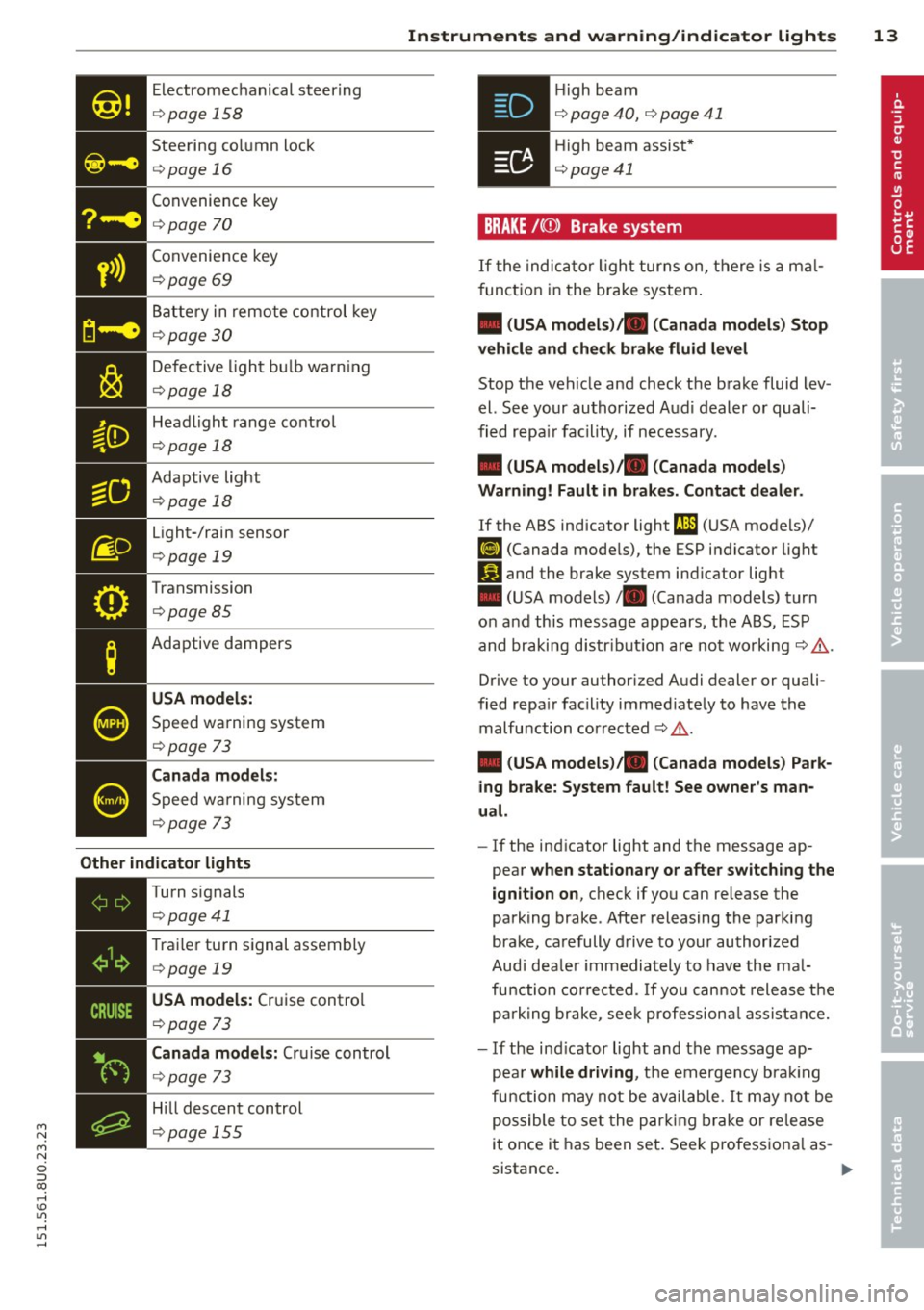
Electromechanical steering
¢page 158
Steering column lock
¢page 16
Convenience key
¢page 70
• Convenience
key ¢page 69
Battery in remote control key
¢ page 30
Defective light bulb warn ing
¢ page 18
Headlight range control
¢page 18
- Adaptive light
- ¢page18
Light-/rain sensor
¢ page 19
Transmission
¢page 85
Adaptive dampers
USA models:
Speed warning system
¢page 73
Canada models:
Speed wa rning system
¢page 73
Other indicator lights
•iii
Turn
signals
¢ page41
• T
rai ler turn signal assembly ¢ page 19
• USA models:
Cruise control
¢
page 73
Canada models: Cruise control
¢page 73
Hill descent control
¢page 155
Instruments and warning/indicator lights 13
.Hi gh beam
• ¢ page 40, ¢ page 41
• High beam assist*
¢page41
BRAKE /((D ) Brake system
If the indicator light turns on, there is a mal
function in the brake system.
• (USA models)/ . (Canada models) Stop
vehicle and check brake fluid level
Stop the veh icle and check the brake fluid lev
el. See your authorized Aud i dealer or quali
fied repa ir facility, if necessary.
• (USA models)/ . (Canada models)
Warning! Fault in brakes. Contact dealer .
If the ABS indicator light t1l1 (USA models)/
fiJ (Canada models), the ESP indicator light
Iii and the brake system ind icator light
• (USA models)/ . (Canada models) turn
on and this message appears, t he ABS, ESP
and braking distr ibution are not working¢&.
Drive to your authorized Audi dealer or quali
fied repa ir facility immed iately to have the
malfunction corrected ¢ & .
• (USA models)/ . (Canada models) Park
ing brake: System fault! See owner's man
ual.
- If the indicator light and the message ap
pear
when stationary or after switching the
ignition on,
check if you can release the
park ing brake . After releasing the parking
brake, carefully drive to your author ized
Audi dea le r im mediately to have the mal
function corrected. If you can not release the
park ing brake , seek professional assistance.
- If the ind icator light and the message ap
pea r
while driving , the emergency brak ing
function may not be available. It may not be
possible to set the parking brake or release
it once it has been set. Seek pro fessiona l as-
sistance. .,.
Page 16 of 258
![AUDI Q3 2015 Owners Manual 14 Instrum ent s and w arn ing /indic ato r light s
(USA models): If the warning light . and the
warning light
ll] appear together, immedi
ately contact your authorized Audi deale](/manual-img/6/57629/w960_57629-15.png "AUDI Q3 2015 Owners Manual 14 Instrum ent s and w arn ing /indic ato r light s
(USA models): If the warning light . and the
warning light
ll] appear together, immedi
ately contact your authorized Audi deale")
14 Instrum ent s and w arn ing /indic ato r light s
(USA models): If the warning light . and the
warning light
ll] appear together, immedi
ately contact your authorized Audi dealer or
qua lified workshop to have all brake pads in
spected
¢ page 17.
When the light comes on, an audib le warning
signal is also given .
.&_ WARNING
- Always observe the warnings in
¢ page 179, before opening the hood
and checking the brake fluid.
- Driv ing with low brake fluid is a safety
hazard. Stop the car and get professional
assistance.
- If the . (USA models) . (Canada
models) brake system indicator light
turns on together with the ABS and ESC
indicator lights, the ABS/ESC regu lating
function may have failed. Functions that
stabilize the vehicle are no longer availa
ble. Th is could cause the vehicle to
swerve and increase the risk of sliding .
Drive carefully to the nearest a uthorized
Audi dealer or other qualified workshop
and have the malfunction corrected.
- If the brake warning/indicator light does
not go out after a few seconds and the
park ing brake is released, or lights up
wh ile you are driving, the fluid level in
the brake fluid reservoir is too low .
If you
believe that it is safe to do so, proceed
immediately at low speed to the nearest
authori zed Audi dealer o r qualified wo rk
shop and have the bra ke system inspect
ed.
- Always keep in m ind that after several
brake applicat ions, yo u will need greater
pressure on the brake peda l to stop your
vehicle. Do not re ly on strained brakes to
respond with maxim um stopping power
in critical situations. You must allow for
increased brak ing distances. The extra
distance used up by fad ing brakes could
lead to an acc ident.
PARK !<®> Electromechanical parking brake
The warning/indicator light monitors the
electromechanical parking brake .
If the indicator light. (USA models) •
(Canada models) turns on, the parking brake
was set.
• (USA model s)/. (Canada models ) Press
brake pedal to release parking b ra ke.
To re lease the park ing brake, press the brake
peda l and press the button(®) at the same
t ime or start driving with starting assist
¢ page 71, Starting from rest.
Ill Pa rking br ake : S ys tem f ault! See owne r's
manual.
If the I.II ind ic a tor light tu rns o n and this
message appears, there is a parking b rake
malfunction. Drive to your authorized A udi
dealer or qualified workshop immediately to
have the malfunct ion corrected.
@ Tips
More informat ion on the parking brake
¢page 70 .
-L Engine cooling system
A malfunction in the engine cooling system
must be repaired as soon as possible.
• Turn off engine and ch eck coolant level
T he coolant level is too low .
Do not continue dr iving and turn
off the en
gine. Check the coo lant level
¢ page 186.
-If the coo lant level is too low, add coo lant
¢ page 186. Only continue driving if the in
dicator light turns off.
- If the coo lant level is correct, then the ma l
function may be ca used by fa ilure of the
coolant fan. Do not continue driving. See
your authorized Audi dealer or qualified re pa ir fac ility .
• Coolant temperature! Let engine run
w ith vehicle stationar y.
Page 159 of 258

M N
M N
0 ::i co ,...., \!) 1.1'1 ,...., 1.1'1 ,....,
Effect of w ate r and ro ad salt
In certain situa tions, for example after driving
through water, in heavy rain, after overnight
condensation or after washing your car, the braking effect can be reduced by moisture or
ice on the brake rotors and brake pads. The
brakes must be dried first with a few careful
brake applications.
At higher speeds and with the windshield wip
ers turned on, the brake pads press against
the brake rotors for a short amount of time.
This occurs at regular intervals w ithout the
driver noticing and provides for better brake response time under wet condit ions.
The effectiveness of the brakes can be reduced
when the vehicle is dr iven o n a salt-covered
road and the brakes are not used . Likewise,
you clean
off accumulated sa lt coating from
brake discs and pads with a few caut ious ap
p lications of the brake¢.&. -
Cor ro sion
There may be a tendency for dirt to build up
on the b rake pads and corrosion to form on
the discs if the car is not dr iven regular ly or
only for short t rips with little use of the
brakes.
If the brakes are not used frequently, or if cor rosion has formed on the discs, it is advisable
to clean
off the pads and discs by b rak ing
fi rm ly a few times from a modera tely high
speed¢ .&..
Faults in the brake system
If you should notice a sudden increase in
brake pedal travel, then one of the two brake
circu its may have failed¢&. -
Low brake fluid le vel
Malfunct ions can occur in the brake system if
the brake fluid level is too low. T he brake fluid
level is monitored electronically .
Brake boo ster
The brake booster increases the pressure that
you generate with the brake pedal. It works
only when the engine is running .¢ .&.
Int ellig ent technolog y 157
Brak e lining we ar status
B rake lining wear may be checked by visual in
spection o f the condition of the brake pads
thro ugh the openings in the wheel. If neces
sary, the wheel may be removed for this in
spection
¢ page 218, Changing a wheel.
A WARNING
-New brake pads don't have the best stop
ping power and must be "broken-in" dur
ing the initial 100 to 150 miles (150 to
200 kilometers) of normal c ity dr iving .
You can compensate for this by pressing
the brake pedal more firmly. This also
applies la ter when new pads are instal
led.
- You should perform braking maneuvers
for the purpose of cleaning the brake
system only if road conditions permit .
Other road users must not be put at risk -
you may cause an accident!
- Before descending a steep grade, reduce
speed and shift transmission into a lower
gea r or lower dr iving range. Do not ride
the brakes or hold the pedal down too
long or too often. This could cause the
brakes to get hot and diminish braking
efficiency.
- Do not "ride the brakes" by rest ing your
foot on the pedal when you do not intend
to brake. This may cause the brakes to overheat, p remature wear and increased
s topping distance.
- Unde r ce rtain cl imati c and ope rat ing
conditions such as passing thro ugh wa
ter, dr iv ing in heavy rain o r after washing
the vehicle, the effectiveness of the
brakes can be reduced. In winte r, ice can
accumu late on the brake pads, lin ings,
discs and drums. Carefully app ly brakes
for a test. Brakes w ill dry and ice coat
ings w ill be cleaned
off after a few care
ful brake applicat ions.
- Driving for an extended period of time on
salt-covered roads without using your brakes can a lso affect braking efficiency.
Clean
off accum ulated salt coating from
•
•
Page 169 of 258

M N
M N
0 ::i co ,...., \!) ..,.,
,...., ..,., ,....,
Operating instructions
6"
~ ~
I 1,2 ..
-{ }
l::_
-
2
Fig. 139 Permit ted ball position of the trailer hitch
Trailer towing weights
With a factory-installed or an aftermarket
trailer hitch, the maximum permissible trailer
weight is 2,200 lbs (1,000 kg). The maximum permissible unbraked trailer weight is 1,650
lbs (750 kg) . These specifications apply when
driving on roads having an incline of less than
12%.
Permissible tongue load
For best vehicle handling under these
changed conditions, adjust the trailer load so
that the tongue load is at the maximum al
lowable or slightly lower . You can get an ap
proximation of the tongue load with a bath
room scale or you can measure the load at a
trucking company or weighing station.
With a
factory-installed or an aftermarket
trailer hitch, the maximum permissible load
on the ball hitch may not exceed 220 lbs
(100 kg).
It is recommended to use the maxi
mum permissible load.
Trailer load distribution
Be sure the load in the trailer is held securely
in place to prevent it from shifting forward,
backward or sideways.
Never allow a passenger to ride in a trailer
¢.&. in Driving instructions on page 168.
Ball mount
The trailer hitch may only be used with suita
ble ball mount and ball¢
fig. 139. Installa
tion of the hitch ball must be carried out in ac-
Trailer towing 167
cordance with the manufacturer's instruc
tions.
Engine cooling system
Towing a trailer makes the engine work hard
er .
It is important that the cooling system's
performance is up to the additional load.
Make sure that the cooling system has enough
fluid.
Tire pressure
When towing a trailer, inflate the tires of your
vehicle to the cold tire pressure listed under
"Full load" on the tire pressure label. The tire
pressure label is located on the driver's side B
pillar. Inflate trailer tires to trailer and tire
manufacturers' specifications .
Lights
The headlight settings should be checked with
the trailer attached before driving off. Check
to make sure both vehicle and trailer lights
are working properly.
Safety chains
Be sure trailer safety chains are properly con
nected from the trailer to the hitch on the ve
hicle. Leave enough slack in the chains to per
mit turning corners. When you install safety
chains, make sure they will not drag on the
road when you are driving.
The chains should cross under the trailer
tongue to prevent it from dropping in case of
separation from the hitch.
Driving instructions
Driving with a trailer always requires extra
core and consideration.
To obtain the best possible handling of vehicle
and trailer, please note the following :
.,. Do not tow a loaded trailer when your car it
self is not loaded.
.,. Be especially careful when passing other
vehicles.
.,. Observe speed limits.
•
•
Page 181 of 258
M N M N
0 ::i co
rl I.O
"' rl
"' rl
Checking and filling Engine hood
Releasing and opening the engine hood
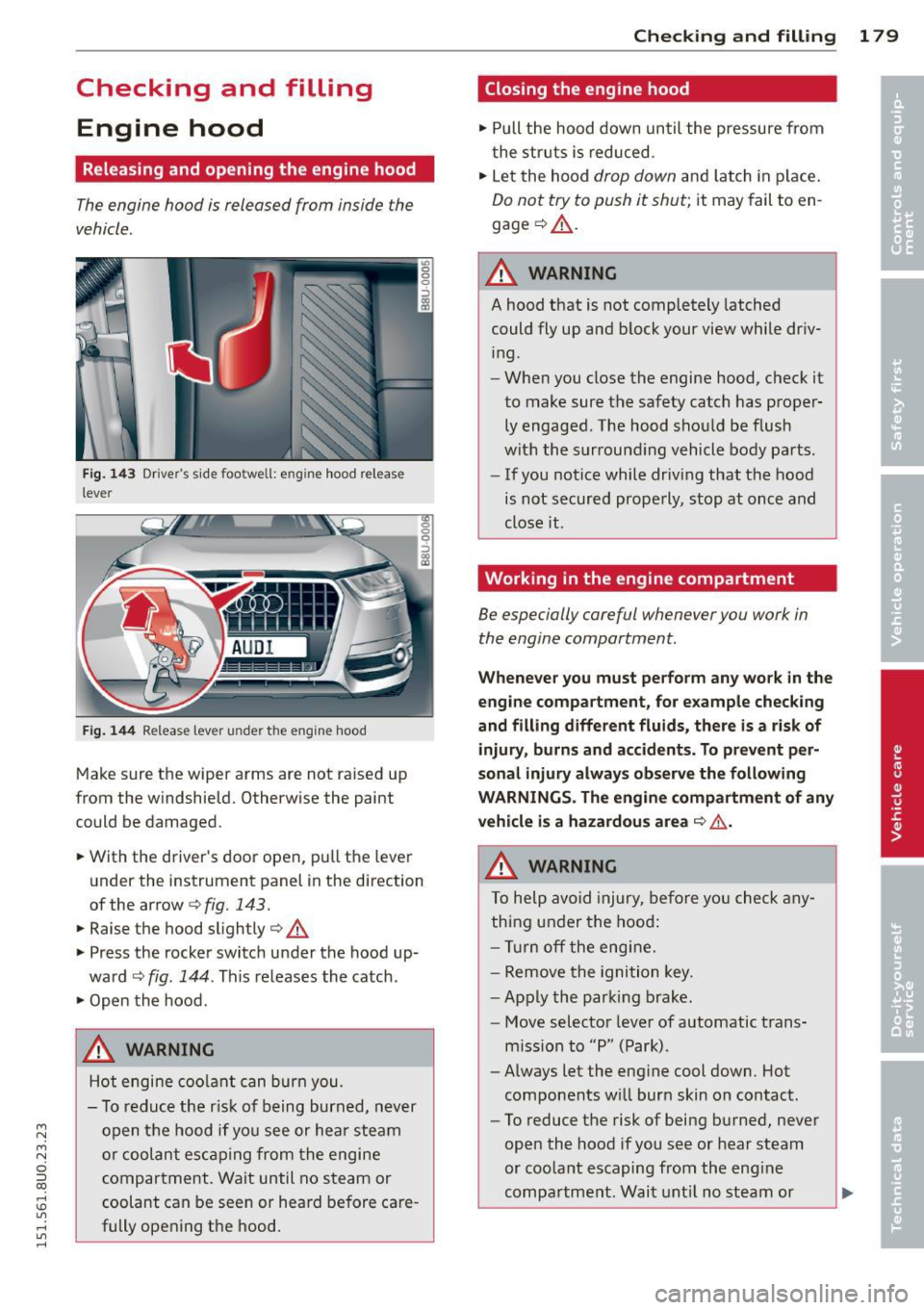
The engine hood is released from inside the
vehicle .
Fig. 1 43 Dr iver's side footwell: eng ine hood release
lever
F ig . 144 Re lease lever un der the engine hood
Make sure the wiper arms are not raised up
from the w indshield. Otherw ise the paint
could be damaged .
.. With the driver's door open, pu ll the lever
under the instrument panel in the direction
of the arrow
c> fig. 143.
.. Raise the hood slightly c> .&,
.. Press the rocker switch under the hood up
ward
c> fig. 144 . This releases the catch .
.. Open the hood.
A WARNING
Hot engine coo lant can burn you.
- T o reduce the r is k of being burned, never
open the hood if you see or hear steam
or coolan t escaping from the engine
compartment. Wait until no steam or
coolant can be seen or heard be fore care
fully opening t he hood.
Checkin g and fillin g 179
Closing the engine hood
.. Pull the hood down un til the pressure from
t he stru ts is reduced.
.. Let the hood
drop down and latch in p lace .
Do not try to push it shut; it may fail to en
gage¢ .&,.
A WARNING
-
A hood that is not completely latched
could fly up and b lock your view while dr iv
ing.
- When you close the engine hood , check it
to make sure the safety catch has proper
ly engaged. The hood shou ld be flush
with the surround ing vehicle body parts.
- If you notice while dr iving that the hood
is not secured properly, stop at once and
close it.
Working in the engine compartment
Be especially careful whenever you work in
the engine compartment.
Whene ve r you must pe rform an y wo rk in the
eng ine compa rtment , for e xample check ing
and filling different fluids, there is a risk of
injury , burns and accidents. To prevent per
so nal injury alway s observe th e foll owing
WARNINGS . Th e engin e compartm ent of an y
v e hicle i s a ha zardou s area
c> .&, .
A WARNING
To help avoid injury, be fore yo u check any
thing under the hood:
- Tu rn off the engi ne .
- Remove the ignition key.
- Apply the parking brake .
- Move selector leve r of automatic trans-
miss ion to "P" (Park) .
- Always let the engine cool down. Hot
components w ill bur n skin on contact.
- To reduce the risk of being burned, never
open the hood if you see or hear steam
or coo la nt escaping from the eng ine
compa rtment. Wait unt il no steam or
Page 182 of 258

180 Checking and filling
coolant can be seen or heard before
carefully opening the hood.
- Keep children away from the engine com
partment.
- Never spill fluids on hot engine compo
nents. They can cause a fire.
- Never touch the radiator fan. The auxili ary electric fan is temperature controlled
and can switch on suddenly.
- Never open the coolant reservoir cap
when the engine is still warm. The cool
ant system is pressurized and hot cool
ant could spray out .
- Protect your face, hands and arm from
steam or hot engine coolant by placing a
thick rag over the cap when you open the
coolant reservoir .
- Do not remove the engine cover under
any circumstances. This increases the
risk of burns.
- If work on the fuel system or the electri
cal system is necessary:
- Always disconnect the battery .
- Never smoke or work near heaters or
open flames. Fluids in the engine com
partment could start a fire.
- Keep an approved fire extinguisher im
mediately available.
- To avoid electrical shock and personal in
jury while the engine is running or being
started, never touch:
- Ignition cables
- Other components of the high voltage
electronic ignition system.
- If you must perform a check or repair
with the engine running:
- First, fully apply the parking brake,
move selector lever of automatic trans
mission to "P" (Park) .
-Always use extreme caution to prevent
clothing, jewelry, or long hair from get- ting caught in the
radiator fan, V-belts
or other moving parts, or from contact
ing hot parts. Tie back hair before
starting, and do not wear clothing that
will hang or droop into the engine .
- Minimize exposure to emission and
chemical hazards
c> A .
A WARNING
-California Proposition 65 Warning:
- Engine exhaust, some of its constituents,
and certain vehicle components contain
or emit chemicals known to the State of
California to cause cancer and birth de
fects and reproductive harm. In addition,
certain fluids contained in vehicles and
certain products of component wear con
tain or emit chemicals known to the
State of California to cause cancer and
birth defects or other reproductive harm.
- Battery posts, terminals and related ac
cessories contain lead and lead com
pounds, chemicals known to the State of
California to cause cancer and reproduc
tive harms. Wash hands after handling.
(D Note
When adding fluids, always make sure that
they are poured into the proper container
or filler opening, otherwise serious dam
age to vehicle systems will occur.
@ For the sake of the environment
To detect leaks in time, inspect the vehicle
floor pan from underneath regularly. If
you see spots from oil or other vehicle flu
ids, have your vehicle inspected by an au
thorized Audi dealer.