2015 AUDI A4 transmission
[x] Cancel search: transmissionPage 265 of 304

"" N
0 ::.,: co ,...., \!) 1.1'1 ,...., 1.1'1 ,....,
~ Unscrew the va lve stem from the s pare tire .
~ Screw the tire filler hose from the compres
sor firm ly onto the valv e of the spare tire.
~ In se rt the p lug from the compress or into a
socket of the vehicle¢
page 66.
~ Switc h the compressor on .
~ Let the compressor run until the valu e speci
fied on the tire pressure label is reached ¢
page 234, fig . 190. Sw itch the compres
so r off afte r runn ing for 12 minutes at the
most -danger of overhea ting!
A WARNING
The compressor and the tire filler hose can
become extremely hot while they are run
ning -danger of burns!
(D Note
Switch the compressor off after running
for 12 minutes at the most -danger of
overheating! Allow the compressor to cool
down for a few minutes before you use it
again.
Changing a wheel
Before changing a wheel
Observe the following precautions for your
own and your passenger' s safety when chang
ing a wheel .
~ After you experience a tire fa ilure, pu ll the
ca r well away from moving traffic and try to
r e ach
level gro und before yo u stop ¢ LI)..
~ All p assengers sho uld leave the car and
move to a safe loca tion (for instance, beh ind
the guardrai l) ¢
A .
~ Engage the parking brake to prevent your
vehicle from ro lling un intentionally ¢
A.
~ Shift into 1st gear on vehicles with manua l
transmission, o r move the
selector lever to
the P po sition
on veh icles with au toma tic
t ransmission .
~ If you are tow ing a tra ile r: u nhi tch the trail
er from your veh icle.
~ T ake the jack ¢ page 260 and the spare tire
¢ page 261 out of the luggage compart
ment.
What do I do now? 263
A WARNING
You or your passengers could be injured
while c hanging a wheel if you do not fo l
low these safety precaut ions:
- If you have a flat tire, move a safe d is
tance off the road . T urn off the engine,
tur n the eme rg ency flashers on and use
other wa rn in g devices to a le rt othe r mo
torists.
- Ma ke sur e that passengers wait in a safe
p lace away from the vehicle and well
away from the ro ad and traffic.
- T o help prevent the vehicle from moving
suddenly and possib ly sli pping off the
j a ck, alw ay s fu lly se t the par king br ake
an d block the wheel d iagonally opposi te
the whee l be ing changed w ith the fol d
ing chocks or other objects. When one
front wheel is lifted off the ground, plac ing the Automatic Transmission in "P"
(Park) will
not prevent the vehicle from
moving .
- Before you change a wheel, be sure the
grou nd is level and firm. I f necessary,
use a sturdy board unde r the jack .
- Always sto re the vehicle tool kit, the
jack* and the replaced tire in the luggage compa rtment
¢page 132.
(D Note
If you are changing the whee l on a steep
i ncline, use a rock or s imilar object to
block the opposite whee l to prevent the
vehicle from moving.
(D Tips
Obey all laws.
Changing a wheel
When you change a wheel , follow these
quence described below step-by-step and in
exactly that order .
l. Remove the decorative wheel cover* or
-
the wheel bolt caps* . For more details see..,.
•
•
Page 267 of 304
M N
~ co
rl I.O
"' rl
"' rl
Refitting
• Place th e caps over the wheel bo lts and
push th em back on.
The caps are to protect and keep the wheel bolts clean.
Loosening and tightening the wheel
bolts
The wheel bolts must be loosened before ra is
ing th e vehicle .
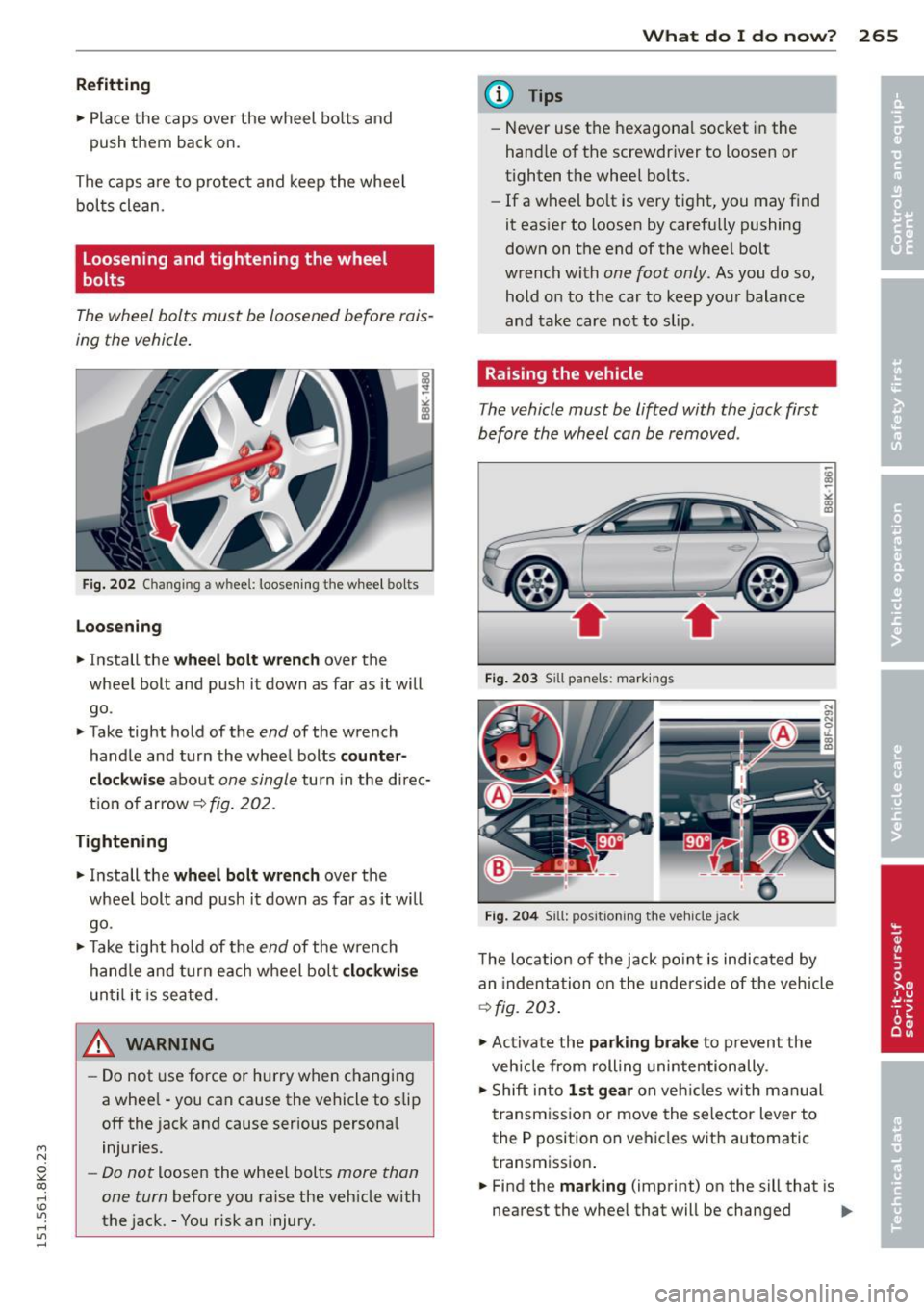
Fig. 20 2 Changin g a w hee l: l oosening t he w heel bolts
Loo sening
• In stall the w heel bo lt wre nch over the
wheel bolt and push it down as far as it will
go .
• Take tight hold of the
end of the wrench
handle and turn the whee l bolts
co unter
cl ock wise
about one single turn in the direc
t ion of arrow
9 fig. 202 .
Tightening
• Install the whe el b olt wrench over the
wheel bolt and push it down as far as it will
go .
• Take tight hold of the
end of the wrench
hand le and turn each wheel bolt
cl ockwi se
until it is seated .
_& WARNING
-Do not use force or hurry when changing
a whee l -you can cause the vehicle to slip
off the jack and cause serious persona l
injuries.
- Do not loosen the wheel bolts more than
one turn
before you raise the veh icle with
the jack. -You risk an injury .
What do I do now ? 265
@ Tips
-Never use the hexagona l socket in the
hand le of the screwdr iver to loosen or
tighten the wheel bolts.
- If a wheel bo lt is very tight, you may find
it eas ier to loosen by carefully pushing
down on the end of the wheel bolt
wrench with
one foot only . As you do so,
hold o n to the car to keep your balance
and take care not to slip .
Raising the vehicle
The vehicle must be lifted with the jack first
before the wheel can be removed .
Fig . 203 Sill panels: mark ings
Fig. 20 4 Sill: positi on ing the v eh icle ja ck
The location of the jack po int is indicated by
an indentation on the underside of the vehicle
9 fig . 203 .
• Activate the parking brake to prev ent the
veh icle from rolling unintentionally .
• Shift into
1st ge ar on veh icles with manual
transmiss ion or move the selector lever to
the P position on vehicles w ith automatic
transmission .
• Find the
mark ing (imprint) on the sill that is
nearest the wheel that will be changed .,..
Page 276 of 304

2 7 4 Emergency situations
Emergency situations
General
This chapter is intended for trained emer
gency crews and working per sonnel who
have the necessary tools and equ ipment to
perform these ope rations.
Starting by pushing or
towing
Q;) Note
Vehicle s with an automati c transmission
cannot be started by pushing or towing .
Starting with jumper
cables
If necessary, the engine can be started by
connecting it to the battery of another vehi
cle.
If the engine should fail to start because of a
discha rged or wea k batte ry, the battery can be
connected to the battery o f
another vehicle,
using a
pair of jumper cables to start the en
g ine .
Jumper cables
Use only jumper cab les of sufficiently
large cross section to carry the starter cur rent
safely. Refer to the manufact urer's spec ifica
ti ons.
Use on ly jumper cables with
insulated te rmi
na l clamps wh ic h are d istinctly mar ked :
plus (+) cable in most c ases co lore d red
minu s (-) cable
in most cases colored black .
A WARNING
Batterie s cont ain e lec tricity, a cid, a nd gas.
A ny o f these c an ca use ve ry ser io us or f atal
in ju ry . F ollow the i nstruc tio ns below for
safe ha ndling of your ve hicle's bat tery.
- Alw ay s sh ield yo ur eye s and a vo id le an
ing over the batte ry w henever p ossib le . -
A discharged battery can freeze at tem
pe rat ures just below 32 °F (0 °C). Before
connecting a jumper cable, you must
thaw the fr ozen battery complete ly , ot h
e rwise it cou ld explode.
- Do not allow batte ry acid to contact eyes
or skin . Fl ush any contacted a rea wi th
wate r im media tely.
- Imp roper use of a booster battery to
s tart a vehicle may cause an explosion.
- Vehicle batter ies generate explosive gas
es . Keep sparks, flame and lighted ciga
rettes away from ba tte ries .
- Do not try to jump start a ny ve hicle w ith
a low ac id leve l in the battery .
- The vo ltage of the booster batte ry m ust
a lso have a 12-Vo lt rat ing . The capacity
(A h) of the booster batte ry should not b e
lowe r than that of the discharged bat
tery . U se o f batt erie s of d iffe ren t voltage
or subs tanti ally diffe ren t "Ah" rat ing
may c ause an exp losion and person al in
ju ry .
- N ever ch arge a fr ozen bat te ry. Gas t rap
ped in the ice may ca use an ex plosion .
- N ever ch arge o r use a batt ery th at has
been fro zen. T he battery case may have
be weakened.
- Us e of batt erie s of di ffere nt vo ltag e or
substan tially differen t ca pa city (Ah) rat
i ng may cause an exp losion and injury.
T he capac ity (Ah) of the booster battery
should not be lower than that of the dis
charged batte ry.
- Before you check anything in the engine
compartment, always read and heed a ll
W ARNI NGS¢
page 212.
(D Note
- App lyi ng a hig her voltage booste r bat
tery wi ll cause expens ive damage to sen
sitive e lectronic components, such as
cont ro l units, relays, rad io, etc.
- There must be no electrical contact be twee n the vehicles as otherwise current
co uld already start to f low as soon as t he
posi tive(+) terminals a re con nected . ..,.
Page 277 of 304

M N
~ co
rl I.O
"' rl
"' rl
@ Tips
The discharged battery must be properly
connected to the vehicle's electrical sys
tem. When jump starting or charg ing the
battery, never connect the negative
ground cable to the battery negat ive post
because the ba ttery manager system must
be ab le to detect the battery's state of
charge. Always connect the negative
g round cab le to the negative ground pos t
of t he battery manager cont ro l unit.
Use of jumper cables
Make sure to connect the jumper coble
clomps in exactly the order described b elow!
Fi g. 21 1 Eng ine co mpar tment: Co nnecto rs fo r jum per
c ab les a nd c har ge r
F ig. 212 Jump start in g w ith t he ba ttery of a not her ve ·
hi cle :@ booster battery, @ disc harged veh icle battery
The procedure described below for connecting
jumper cables is intended to provide a jump
start for your veh icle .
Vehicle with di scharged battery :
~Turnoff lights and accessories , move lever
of automatic transmission to N (Neutral) or P (Park) and set parking brake .
Emergency situ ation s 2 7 5
Connect POSITIVE(+) to POSITIVE(+ )
(red )
~ Remove the cover above the jump start con
nection .
~ Open the cover on the positive pole
¢fig . 211 .
1. Connect one end of the red positive cable
on the
jump sta rt bolt c::;, fig. 212 (D
(Bolts under cove r= "posit ive ") of the ve
hicle to be started @.
2 . Conne ct the othe r end to the pos itive ter -
mina l@ of the booster battery @.
Connect NEGATIVE (-) to NEGATIVE (-)
(black )
3. Co nnect one end o f the b lack neg ative c a
ble to the nega tive te rmi na l@ of the
booster battery @.
4 . Connect the other end to the
jump start
bolt @
(Bolts with hex head = "negative")
of the vehicle to be started @.
Starting the engine
~ Start the engine of the ve hicle with the
booste r battery @. Run the engine at a
moderate speed.
~ Start engine with d ischarged vehicle battery
® in the usual manner .
~ If the engine fails to start: do not keep t he
starter cran king for lo nger than 10 seconds .
Wait for about 30 seco nds and the n try
aga in.
~ W ith engi ne runni ng, remove jumpe r cab les
from both vehicles in the exa ct
reverse o r
der .
~ Close the cover on the positive pole .
T he b attery is vented to the o utside to p reven t
gases from en tering the veh icle in ter ior . Ma ke
s ur e that the j umper clamps a re well connect
e d with their
metal ports in full contact with
the batte ry term inals.
A WARNING
To avoid serious personal injury and dam
age to the vehicle, heed all warnings and
in structions of the jumper cable ma nufac-
turer . If i n dou bt, call for road servic e.
Ill>
Page 281 of 304

"' N
0 ::.,: co ,...., \!) ..,.,
,...., ..,., ,....,
This might happen, for example, when
heavy components such as the engine
b lock or transmiss io n are removed.
- When removing heavy components like
these, anchor vehicle to ho ist or add cor
responding weig hts to mai nta in the cen
ter of g ravity. Otherwise, the veh icle
m ight tilt o r slip off t he hois t, causi ng
serious p ersona l injury.
(I) Note
- Be awa re of th e fo llowing points befo re
li fting the vehicle:
- The vehicle should never be lifted or
jacked up from underneath the engine oil pan , the transmission housing , the
front or rear axle or the body s ide
members. This could lead to ser ious
damage.
- To avoid damage to the underbody or
chassis frame , a rubber pad must be
inserted between the floor jack and
the lift points .
-Before driv ing over a workshop hoist,
check that the vehicle weight does not
exceed the permi ssible lifting capacity
of the hoi st.
- Before driv ing over a workshop hoist,
ensure that there i s sufficient clear
ance between the hoist and low parts
of the vehicle.
Emergency situations 2 79
•
•
Page 282 of 304

280 Technical Dat a
Technical Data
Vehicle identification
F ig. 220 Vehicle I dent ifica tion Num be r (VlN) pla te: lo·
cat ion on driver 's side dash pane l
XXXXX XX · X -XXXX XXX
r,"\__l f~ -11!111 · NII. ~ V!Hlll -llllll . NO.
xx
XXXXXXXX XX X XXXXXXXX
XXX XXX IYP IT'fl'E
XX XXXXXXX XX X X XX
XXX
KW XXX
®i ~~:f :l~~ XXXX XXX XXX
@+ ~~r= XXXX I XXXX XXX I XX M ,. AIIISl./ lflllllS
EOA 7D5 4 UB 6XM SSG 5RW
2E H JDZ llB l AS lBA
3FC 5MU 7Xl
FO A
9G3 OG7 O
YH OJF
TL6 3
KA BEH
UlA X9B QZ 7
l XW
8Q3 9Q8 82 4 020
7T6 CV 7 7KO 4X3 2K2
3L4 4 KC 3YO 4I3 502
lS A 7GB Q1A 4GQ
XX X
XX X XX X XXXX
Fig. 221 Th e ve hicle identi ficat ion labe l: ins ide the lu g
gage compart men t
Vehicle Identification Number (VlN )
The Ve hicle Identific ation Number is located
in different p laces :
- under the w indshield on the dr iver's s ide
~fig . 220.
- in the rad io or in the MM !": Select: I CAR !
func tion button >
Vehicle ID number (VIN)
or se lect: ICAR !f unct ion button> Car sys
tems* control button > Servicing & check s >
VIN number .
-on the veh icle identific ation label.
Vehicle identification label
T he veh icle identification label is lo cate d in
the luggage compartment near the ba ttery .
T he labe l~
fig. 221 shows the fo llowing vehi
cl e dat a:
(D Vehicle Identificat ion Number (VIN)
@ Vehicle type, engine o utp ut, transmission
@ Engine and transm iss ion code
@ Pa int number and inte rior
® Optional equipment numbers
T he information of the veh icle identification
l a bel ca n also be fou nd i n your War ran ty
&
Maintenance booklet .
Safety compliance sticker
The safety compliance sticker is you r assur
ance that yo ur new ve hicle complies with all
applicable Federa l Motor Vehicle Safety
S tan dards which we re in effect at the t ime the
vehicle was manufactured . You can find this
sticker on the door jamb on the driver's side .
It shows the month and year of production
and the vehicle ident ificat ion number of your
vehicle (perforation) as well as th e Gross Veh i
cle Weight Rating (GVWR) and the Gross A xle
Weight Rating (GAWR) .
High vo ltage warning label
The high voltage warning label is located in
the engine compartment next to the engine
hood release. The spark ignition system com
plies with the Ca nadian standard ICES-002 .
Weights
Gross Vehicle Weight Rating
The Gross Vehicle Weight Rating (GVWR), and
the Gross Axle Weight Rat ing (GAWR) for
front and rear are listed on a sticker on the
doo r jamb on the driver 's side .
The Gross Vehicle Weight Rating includes the
weight of the basic vehicle plus fu ll fuel ta nk,
o il and coolant, plus max imum load, which in
cludes passenger weight (150 lbs/68 kg per
designated seating posi tion) and luggage
we ight~ _&.
Page 287 of 304

"' N
0 ::.,: co ,...., \!) ..,.,
,...., ..,., ,....,
-Always make sure the transm ission se
lector lever (automatic transmiss ion) is
in "P" (Park position) or Neutral (manual
transmission) and the park brake is firm
ly appl ied .
® For the sake of the environment
-Changing the eng ine settings w ill ad
versely affect em ission levels. This is det
rimental to the environment and increas
es fuel consumption .
- Always observe env ironmental regula
tions when d ispos ing of old engine oil,
used brake fluid, dirty engine coolant,
spent batter ies or worn out t ires.
- Undeployed airbag modules and p reten
s ioners might be classified as Perchlo
rate Material -special handling may ap
ply, see www.dtsc.ca .gov/hazardous
waste/perch lorate . When the veh icle or
parts of the restraint system including
airbag modules safety belts with preten
s ioners are scrapped, all applicable laws
and regulations must be observed. Your
authorized Audi dealer is familiar w ith
these requirements and we recommend
that you have your dealer perform this
serv ice for you .
Additional accessories,
modifications and
parts replacement
Additional accessories and parts
replacement
Always consult an authorized Audi dealer be
fore purchasing accessories.
Your veh icle incorporates the latest safety de
sign featu res ensu ring a high standard of ac
tive and passive safety.
This safety could be compromised by non-ap
proved changes to the veh icle. For this reason ,
if parts have to be replaced, p lease observe
the following points when installing addition
al accessories:
Con sumer In formation 285
Approved Audi accessories and genuine Audi
parts are available from authorized Audi deal
er.
T hese dea lers a lso have the necessary facili
ties, tools and trained specialists to install the
parts and accessories proper ly.
A WARNING
Using the wrong spare parts or using non
approved accessories can cause damage to
the vehicle and serious persona l injury.
- Use on ly accessories express ly approved
by Audi and genuine Audi spare parts
- These parts and accessories have been
specially designed to be used on your ve
hicle.
- Never install accessories such as tele
phone cradles or beverage holders on air
bag covers or within the airbag deploy
ment zones . Do ing so will increase the
risk of injury if a irbags are triggered in an
accident!
- Before you check anything in the engine
compartment, always read and heed all
WARNINGS r:::;. page 212.
(D Note
-If items other than genuine Audi spare
parts, add-on equipment and accessory
items are used or if repair work is not
performed accord ing to specified meth
ods, this can result in severe damage to
your vehicle's engine and body (such as
corrosion) and adversely affect your vehi
cle's warranty .
- If emergency repairs must be performed
elsewhere, have the vehicle examined by
an authorized Audi dealer as soon as
possible.
- The manufacturer cannot be held liable
for damage wh ich occurs due to failure
to comply with these stipulations.
•
•
Page 290 of 304

288 Index .:..:..:..::....::.....:..._ ___________________________ _
A
A/C (automatic clima te control) .. .... . . 79
Acc esso ries . . . . . . . . . . . . . . . . . . . . 66, 285
adapt ive cruise control
Vehicles wit h manual transmission 103
A dap tive cr uise con trol .... .. .. .. .. .. . 10 1
C leaning the sensor .. ... .. .. .. .... . 203
M essages . . . . . . . . . . . . . . . . . . . . . . . . 109
Request for dr iver intervention . ..... . 10 7
Sett ing t he driving program .. .. .. ... 106
A dapt ive dampers .......... .... .... . 115
Adapt ive light ................ ... ... . 49
Ada ptive Lig ht (defective) ... .. .. .... .. 22
Adding Eng ine coolan t . . . . . . . . . . . . . . . . . . . . 219
E ng ine oil . .... .. ..... ... .. .. .... . 216
Windshie ld washe r fl uid ... .. .. .... . 225
Addit ional accesso ries
Addit ives 2
85
Eng ine oil .. ............. .. .. .. .. . 216
Ad justa ble s teer ing column . ... .. .... .. 82
Ad justing
A ir dist ribution (automatic climate con -
trol) . .. .. .. ............. .. .. .... .. 80
I ns trumen t illum ina tion . .. .. .. .. .. . . S 2
Steer ing column .. ..... ... .. .. .... .. 82
Tempe rature (automat ic climate control) 80
A irbag
War ning/ indica to r ligh ts ... .... .... .. 20
A irbag system . . . . . . . . . . . . . . . . . 144, 160
Advanced Airbag System . ...... .. .. . 148
Advanced Airbag System compone nts . 15 1
Ca re . .. .. .. ........ ..... .. .. .... . 157
C hil dren . ............... .. .. .. .. . 166
C hil d restr aints ........... .. .. .. .. . 16 7
Componen ts (front airbags) . . . . . . . . . 1 51
D anger of fitting a child safety seat on
the front passenger seat . . . . . . . . . . . . 145
Disposal . .... ........... .. .. .... . 157
Front airbags . . . . . . . . . . . . . . . . 148, 149
H ow do the front airbags work? . .. .. . 153
H ow ma ny airbags does my vehicle
have? ..... .......... ...... ... .. . 15 1
H ow t he Advan ced Airbag System com-
p o nents wo rk toge ther .... .. .. .. .. . 15 2
I mpor tan t things to know .. .. .. .. .. . 14 4 Indicator lig
ht ... ... .. ..... .... . .. 154
Monito ring . ..... .. ... ..... ... .. .. 154
PASSENGER AIR BAG OFF light ... .. .. 155
Repairs ... .... .. ............. .... 157
Safety instr uctions ............. .... 156
S ide a irbags ..... ................ . 159
S ide cu rtain airbags .... .. ... ..... .. 162
Weight-sensing mat .............. . 166
When must t he sys tem be inspected? 154
Alcantara Cleaning ...... .. .......... ...... . 205
all-wheel drive
All wheel d rive 190
Winter tires . .. .. .. ........... .. .. 254
Alternato r
refer to Generator ................ .. 16
Anti-freeze
refer to E ng ine coolant system ... .... 218
An ti-lock b rak ing system ......... .. .. 185
W arning/ind icator lights . . . . . . . . . 18 , 19
An ti-s lip reg ulation ................ . 185
Warning/ind icator lights ........... .. 18
Anti-theft a larm warning system ... .... . 31
An ti-the ft systems
El ectronic immob ilizer . . . . . . . . . . . . . . . 3 7
Arm rest ...... .. .. .. ... ... ... .. .. .. . 62
Asht ray .. .. .. .. .. ............. .. .. . 65
As te ris k
Wha t does i t mean when somet hing is
marked w it h an asterisk? . . . . . . . . . . . . . . 6
Audi braking guard
refer to b ra ki ng guard .......... .. .. 101
Audi drive select . .. ............. .... 115
Adaptive dampers .. .... .... ... .. .. 115
Desc ription ...... ................ . 115
Dynam ic steer ing . ..... ........... . 115
Setting the dr iv ing mode ........ .... 116
S po rt differential . ............. .... 115
Audi Serv ice Repai r Manuals and Li tera-
ture 283
A UTO
Automat ic climate contro l ..... .. .. .. . 80
Automat ic head lights .......... .. .. . 49
A ut o Lock . . . . . . . . . . . . . . . . . . . . . . . . . . 31
Automat ic be lt ret ractor ...... ...... . 139