2015 AUDI A3 service
[x] Cancel search: servicePage 222 of 288

220 Checking and Filling
Battery
General information
Under normal operating conditions, the bat
tery in your Audi does not need any mainte
nance. With
high outs ide temperatu res or
long daily drives we recommend that you have
the electro lyte level checked by a service fa
cility. The e lectrolyte level shou ld also be
checked each time the battery is charged
c:>page222.
Have the battery checked when you take your
vehicle in for service. You are well advised to replace a battery that is older than 5 years.
With certain types o f airbag deployment, the
battery is disconnected from the vehicle elec
trica l system for safety reasons
c;, .&. in Re
pair , care and disposal of the airbags on
page 156.
Disconnecting the battery terminals
Some vehicle functions such as power win
dows are unavai lable if the battery termina ls
are d isconnected. These functions have to be
relearned after the battery terminals are con
nected again. To prevent this, the battery
should only be disconnected from the vehicle
electrical system when absolutely necessary
for repairs .
To reprogram the functions, proceed as fol lows:
Function Reprogramming
Power window one-c;, page 40, Correcting
touch up/down power window mal-
function functions
Remote control key If the vehicle does not
or react to the key, it
convenience key must be synchroni zed
c:>page 33
Digital clock c:>page 10
ESC indicator light The indicator light
goes out after driving
a few meters
Vehicles not driven for long periods
If you do not drive your vehicle over a period
of severa l days or weeks, e lectrica l compo
nents are gradually sca led back or switched
off. This reduces energy consumption and
maintains starting capability over a longer pe
riod
c;, page 190. Some of the conven ience
functions may not operate, such as the interi
or lights or power seat adjustment. The con
venience functions will be availab le aga in
when you switch on the ignition and start the
engine.
Winter operation
During the winter months, battery capacity
tends to decrease as temperatures drop. This
is because more power is also consumed wh ile
sta rting, and the headlights, rear window de
fogger, etc. , are used more often.
Avoid unnecessary power consumpt ion, par
ticularly in city traffic or when traveling only
short distances. Let your authorized Aud i
dealer check the capacity of the vehicle bat
tery before winter sets in ~ page 222. A well
charged battery will not on ly prevent starting
problems when the weather is cold, but will
also last longer.
A WARNING -
-Work on the battery requ ires expert
know ledge. Contact your authorized Audi
dealer qualified repair facility for infor
mat ion regarding the vehicle battery.
There is a risk for chemical burns or ex
p losions.
- Never open the vehicle batte ry . Do not
try to change the battery electrolyte lev
el. Otherwise explosive gas will escape
from the battery and increase the risk of
an explosion .
(i) Tips
If your vehicle is left standing for several
weeks at extremely low temperatures, the
vehicle battery should be removed and
stored where it w ill not freeze. This will ..,.
Page 235 of 288

-Only when all tires on the vehicle are fi l
led to the correct pressure, the tire pres
sure monitoring system can work cor rect ly.
- The use of incorrect tire pressure values
can lead to accidents or other damage.
Therefore it is essential that the driver
observe the specif ied tire pressure values
for the tires and the co rrect p ress ures for
the f unction of t he tire pressure mo nitor
ing system.
- Always inflate ti res to the recommended
and co rrec t tire pressu re befo re d rivi ng
off.
- Drivi ng with under inflated ti res bend
more, letti ng them get too ho t res ulting
in t read separation, sudden t ire fail ure
and loss of control.
- Excessive spee d and/ove rloading can
cause heat bui ld -up, sudden tire fa il u re
and loss of control.
- If the t ire pressure is too low or too high,
the tires w ill wea r prematurely and the
vehicle will not hand le we ll.
- If the t ire is no t flat and you do no t have
to change a w heel imme diate ly, drive at
reduced speed to the nearest service sta
t ion to check the tire pressure and add
air as required.
(D Note
Driving without va lve stem caps ca n cause
damage to the t ire va lves. To prevent this,
always make s ure that facto ry installed
valve stem caps on all wheels a re secure ly
mounted on the va lve .
@) For the sake of the environment
Underinflated tires will a lso increase the
fue l consumption .
Tires and vehicle load limits
There are limits to the amount of load or
weight that any veh icle and any t ire can carry .
A vehicle that is ove rloaded w ill not ha ndle
well and is more difficult to stop . Overload ing
can no t on ly lead to loss o f vehicle con tro l,
Tire s an d wheel s 233
but can also damage important parts of the
vehicle and ca n lead to sud den tire fai lure, in
clud ing a b lowout and s udden def lation that
can cause the vehicle to cras h.
Your safety and that of your passengers also depends on making sure that load limits are
not exceeded . Vehicle load includes everybody
and everything in and on the veh icle. These
load lim its are technically referred to as the
vehicle's
Gross Vehicle We ight Rating
("GVWR ") .
The "GVWR" includes the weight of the basic
vehicle, all factory installed accessories, a full
tank of fuel, o il, coo lant and other fluids plus
maximum load . The max imum load includes
the number of passenge rs that th e vehicle is
i n tended to car ry ("seat ing capa city") wi th an
ass umed we igh t of 150 lbs (68 kg) fo r each
passenger at a designated seating posi tion
and t he tota l weight of any luggage i n the ve
hicle . If you tow a trai ler, the weight of the
tra iler hitch and the tongue weight of the
loaded tra iler must be included as part of the
vehicle load.
T he
Gro ss Axle Weight Rating ("GAWR") is
the maximum load that can be applied at each
of the vehicle's two axles.
T he Gross Vehicle Weight Rating and the
G ross Axle Weig ht Rating are listed on the
safety comp liance sticker label located on the
driver's side B-pillar. Your Audi has 5 seat ing
pos itions, 2 in the front and 3 in the rea r for
total seating capacity of 5 . Each seating posi
t ion has a safety belt
~ page 131, Safety
belts.
The fact that there is an upper limit to your
vehicle's Gross Vehicle Weight Rating means
t h at the total weight of whatever is bei ng car
ried in the vehicle ( in cl ud ing t he weight of a
t ra ile r hi tc h a nd the tongue we ight of t he
l o ad ed tr ailer) is lim ited. The more p assen
gers in the vehicle or passengers who are
heavier than the standard weights assumed
mean that less weight can be carried as lug -
gage.
~
•
•
•
Page 237 of 288

and luggage load capacity
calculated in Step 4.
6 . If your vehicle will be towing
a trailer, load from your trail
er will be transferred to your
vehicle. Consult this manual
to determine how this re duces the available cargo
and luggage load capacity of
your vehicle.
~check the tire sidewall
(¢page 236, fig. 160) to de
termine the designated load
rating for a specific tire.
Tire service life
The service life of tires depends on a lot of
different things including proper installation
and balan cing, correct tire pressure and driv
ing style.
Fig. 158 T ir e tread: tread wea r ind icators (TWI)
Fig. 159 Rotat ing t ires for more even wea r
Tires and wheels 235
Tread Wear Indicator (TWI)
The orig inal tires on your vehicle have
1/16 inch ( 1.6 mm) hig h "wear indicators"
r:::>fig. 158 run ning across the tread. Depend
ing on the make, there will be six to eight of
them evenly placed around the tire. Marks on
the tire sidewall (for examp le "TWI" or other
symbols) indicate the positions of the tread
wear indicators . Worn tires must be replaced .
D ifferent figures may apply in other countr ies
¢ Lr:,. .
Tire pressure
Incorrect t ire pressure causes premature wear
and can cause sudde n tire blow-out. For this
reason, tire pressure must be checked at least
once a month
r::> page 231.
Driving style
Driving fast around curves , heavy acce lerat ion
and hard braking increase tire wear .
Rotating tires for more even wear
For all four tires on your vehicle to have the
same service life, we recommend that the
front and rear tires are rotated according to
the tire manufacturer's suggested tire rota
tion intervals. Please remember the follow
i ng:
- Tire rotation intervals may differ from the
veh icle service intervals outlined in your
Warranty
& Maintenance booklet.
- The longer one tire is used in one location
on the vehicle, the more it wears at certain
points; therefore, we recommend that you
follow the tire manufact urer's suggested
tire rotation intervals.
- Ve hicl es w ith front -wheel dr ive experience
more tread wear on the fro nt wheels com
pared to a ll-wheel drive (quattro) .
- Please rotate tires as shown
r:::> fig . 159 .
-Extra care must be taken when rotating di-
rection-specific tires
r::> page 253 .
Wheel balancing
The wheels on new vehicles are balanced .
However, various s ituations during everyday
driv ing can cause them to become
Page 255 of 288

(D Note
When removing or installing the wheel,
the rim could hit the bra ke rotor and dam
age the rotor . W ork carefully and have a
second person help you.
N ever use the hexa gonal s ocket in the ha n
d le of the screwdriver to loosen or t ighten
the wheel bolts .
- Pull the reversib le blade from the screw
drive r before yo u use the hexagonal
socket in t he handle to t urn the whee l
bo lts .
- When mounting tires with
unid irectional
tread design
make s ure the tread pat
te rn is poi nte d the r ight way
c:> pag e253 .
- The w heel bolts should be clea n and easy
to tu rn . Ch eck for dirt and corros ion on
the mat ing su rfaces of both the whee l
a nd th e hu b. Remove a ll dir t fro m these
s ur fa ces before remo unting the wheel.
Tires with unidirectional tread design
Tires with unidirectional tread design must be
mounted with their tread pattern poin ted in
t he right direction.
Using a spare tire with a tread pattern
intended for use in a specific direction
When using a sp are tire w ith a tr ead p atte rn
i ntended fo r u se in a specific direc tion, p lease
note t he following:
- T he di rection of rotation is ma rked by an a r
r ow on the side o f the tire.
- If th e spare t i re has to be installed in the in
c orrec t direction, use the spa re tire only
tem por ari ly si nce the t ire will no t be able to
ac hieve its op timum perfo rmance character
ist ics with rega rd to aquaplani ng, noise and
wea r.
- We recommend that you pay particular at
tent io n to this fact du ring wet weat he r and
that you adjust your speed to matc h road
condit ions .
What do I do now? 253
-Replace the flat t ire with a new one and
have it installed on your vehicle as soon as
possible to restore the han dling advantages
of a un idirectional tire.
Notes on wheel changing
Please read the i nfo rmation c:> page 236, New
tires and replacing tires and wh eels
if you a re
go ing to use a spare tire wh ich is different
from the ti res on you r vehicle.
After you cha nge a tire :
-Check the tire pressure on the spare imme
diately after installation .
- Have the wheel bolt tightening torque
checked with a torque wrench as soon as
possible by your authorized Audi dealer o r
a qualified service station.
- With steel and alloy wheel r ims, the wheel
bolts are correctly tightened at a torque of
90 ft lb (120 Nm ).
- If you notice that the wheel bolts are cor
roded and diff icult to turn while changing
a tire, they should be replaced before you
check the tightening torque.
- Replace the flat tire w ith a new one and
have it installed on your vehicle as soon as
possible. Remount the whee l cover.
Until then , dr ive with e xtra care and at re
duced speeds.
A WARNING
-
- I f you are going to e quip your ve hicle
wit h tires o r rims which differ from those
which were fac to ry inst alled, t hen be
s ure to read t he informa tion
c:> p age 2 36,
New tire s and repla cing tires a nd
wheels .
-Always make s ure th e d am age d wheel o r
eve n a fla t tire an d the jack an d too l ki t
are p rope rly secu red in the luggage com
pa rtment an d are not loose in the pas
senger compartment .
- In an accident or sudden maneuver they
co uld f ly forwa rd, inj uring a nyone in the
veh icle.
•
•
•
Page 263 of 288

10. With the engines running, remove the ca
b les in
reverse order of the way they were
installed. Make sure the cables do not get
caught in moving engine components.
11. Switch the heater fan and rear window de-
froster off .
12 . C lose the battery cover.
The battery is vented to the outside to prevent
gases from entering the vehicle interior . Make
sure that the jumper clamps are well connect
ed with their metal parts in full contact with
the battery termina ls.
.&, WARNING
To avoid serious pe rsonal injury and dam
age to the vehicle, heed all warnings and
instructions of the jumper cable manufac
turer. If in doubt, ca ll for road service .
- Jumper cables must be long enough so
that the vehicles do not touch.
- When connecting jumper cables, make
surethattheycannotgetcaughtinany
moving parts in the engine compart
ment.
- Be fore you check anything in the engine
compartment, always read and heed all
WARNINGS
~ page 210.
(D Note
Improper hook-up of jumper cables can ru
in the generator.
- Always connect POSITIVE( +) to POSI
TIV E(+), and NEGA TIVE( -) to NEGATIVE
( - ) ground post of the battery manager
control un it .
- Check that all screw plugs on the battery
ce lls are screwed in firmly. If not, tighten
plugs prior to connecting clamp on nega
tive battery terminal.
- Please note th at the procedure for con
necting a jumper cable as described
above applies specifically to the case of
your vehicle be ing jump started. When
you are giv ing a jump start to another ve
hicle, do
not connect the negat ive( -) ca
ble to the negat ive( -) term inal on the
discharged battery@~
fig. 179. In-
-
Em erg en cy si tuation s 261
stead, secure ly connect the negative( -)
cable to either a solid meta l component
that is firmly bo lted to the engine block
or to the engine block itself. If the bat
tery that is be ing charged does not vent
to the outside, escaping battery gas could ig nite and explode!
- Make sure that the connected positive
terminal clamps have sufficient contact
with metal.
- Do not use the battery negat ive terminal
for jump start ing or a malfunct ion could
occur in the vehicle electrical system .
Emergency towing
with commercial tow
truck
General hints
Your Audi requires special handling for tow
ing.
The following information is to be used by
comme rc ial tow truck operators who know
how to operate their equipment safely.
-Ne ver t ow your A udi. Towing will caus e
da mage to the engin e and tr an smi ssion .
- Nev er wrap the safet y chains or wi nch ca
ble s around the brak e lines.
- To p revent unnecessar y damage , your Aud i
must be t ran spor ted with a flat bed truck.
- To lo ad the vehicle on to the fl at bed , u se
the to w ing loop found in the vehicle tool s
and attach to the front or rear ancho rage
~ page 262 and ~page 262.
.&, WARNING
A veh icle being towed is not safe for pas
sengers. Neve r allow a nyone to ride in a
vehi cle be ing towed, fo r any reason.
-
•
•
•
Page 270 of 288

268 Consumer Information
Consumer Information
Warranty coverages
You r Audi is covered by the following war
ranties:
- New Vehicle Limited Warranty
- Limited Warranty Against Corrosion Perfo-
ration
- Emissions Control System Warranty
- Emissions Performance Warranty
- California Emissions Control Warranty (USA
vehicles only)
- California Emissions Performance Warranty
(USA vehicles only)
Detailed information regarding your warran
ties can be found in your
Warranty & Mainte
nance booklet .
Operating your vehicle
outside the U.S.A. or
Canada
Government regu lations in the United States
and Canada require that automobiles meet
specific emission regulations and safety
standards. Therefore, veh icles built for the
U.S.A . and Canada differ from vehicles sold in
other countries .
If you p lan to take your vehicle outside the
continental limits of the United States or Can
ada, there is the possibility that:
- unleaded fuels for vehicles with cata lytic
converter may not be available;
- fuel may have a considerably lowe r octane
rating. Improper fuel may cause engine
damage ;
- service may be inadequate due to lack of
proper service facilities, tools or testing
equipment ;
- replacement pa rts may not be readily availa
ble.
- Navigation systems for vehicles built for the
U.S.A. and Canada will not necessar ily work
in Europe, and may not work in other coun
tries outside North America .
(D Note
Audi cannot be responsible for mechanical
damage that could result from inadequate
fuel, service or parts availability.
Audi Service Repair Manuals and Literature
Audi Official Factory Service Manuals and Lit
erature are published as soon as possible after
model introduction. Service manuals and lit
erature are available to order from the Audi
T echnical Literature Ordering Center at:
www.audi.techliterature.com
Maintenance
General
Your vehicle has been designed to help keep
maintenance requirements to a minimum.
However, a certain amount of regular mainte
nance is still necessary to assure your vehicle's
s afety, economy and rel iability. For detailed
vehicle maintenance consult your Warranty &
Maintenance booklet.
Under difficult operating conditions, for ex
ample at extremely low outside temperatures,
i n very dusty regions , when towing a trailer
very frequently, etc., some service work
should be performed between the intervals
specified. This applies particularly to:
- oil changes, and
- cleaning or replacing the air filter .
(® For the sake of the environment
By regularly maintaining your vehicle, you
help make sure that emission standards
are maintained, thus minimizing adverse
effects on the environment.
Important considerations for you and
your vehicle
The increasing use of electronics, sophisticat
ed fuel injection and emission contro l sys-
tems, and the genera lly increasing technical
liJJ,
Page 275 of 288

Index 273
-----------------------------------.......
Audi drive select . ... .... ... .. .. .. .. . 102
Indicator light . . . . . . . . . . . . . . . . . . . . . 25
Aud i magnetic ride
refer to Adaptive dampers . .. .. .. .. . 102
Aud i Service Repa ir Manuals and Litera-
ture .. .. .. ... ............. ... ... .. 268
AUTO Automatic climate control system . .. .. 67
Automatic headlights . .... .. .. .. .. .. 42
Auto Lock (centra l locking system) . ... .. 32
Automatic belt retracto r .. .. .. .. .. .. . 134
Automatic climate control system
refer to Climate control system (auto-
mat ic) ... .. ................. .. .... 66
Automatic headlights .... ... .. .. .. .. .. 42
Automatic transmission ............ .. 105
Dr iving t ips . ............. .... .. .. . 107
E mergency mode ......... .... .. .. . 111
H ill descent co ntrol ....... .. .. .. .. . 10 9
I gnition key safety in terlock . . . . . . . . . . 70
K ick -down .. .. ... .. ..... ... .. .. ... 110
L aunch Contro l-Program ... .. .. .. .. . 1 11
malfunction ............. .... .. .. . 106
Selector lever emergen cy rele ase .. .. . 112
Selector lever lock . . . . . . . . . . . . . . . . . 106
Selecto r lever pos it io ns ....... .... .. 105
Shift ing ma nua lly ............ .... .. 110
St eer ing whee l w ith shift paddles .. .. . 110
S tron ic .. .. .... ............. .. .. . 105
tiptronic . .. .... ........... .. .. .. . 110
Automatic wipe/wash system .. .. . ... .. 46
Auto Safety Hotline ..... ... .. .. .. .. . 129
Average consumpt ion ....... .. .. .. .. .. 27
Average speed .. ........... .. .. .. .. .. 27
B
Battery ... .. .. .. ........... .. .. ... 220
C harge level ............. .... .. .. . 190
C ha rging . . . . . . . . . . . . . . . . . . . . . 20, 222
Energy management .......... ... .. 190
Impor tant war nings ....... ... ... .. 22 1
Indicator light . . . . . . . . . . . . . . . . . . . . . 20
J ump starti ng ............ .... .. .. . 259
L ocat ion . .. .. .. ........... .. .. ... 22 1
Replacing the ba ttery .. ... .. .. .. .. . 223
Wo rking on the battery . ... .. .. .. .. . 22 1
B efore dr iving ... .. ..... ... .. .. .. .. . 121 B
lended gaso line .... . .. .. ..... ... .. 206
B lowe r
automat ic Climate contro l system .. .. . 67
Manua l cli mate control system ... .. .. . 65
Booster seats . .. .. .. . ... ...... ... .. 175
B rake fluid
Changing the brake fluid ..... ... .. .. 219
Checking the brake fluid level ...... .. 219
Wha t is the correct brake fluid level? .. 219
Wha t should I do if the brake fluid warn-
. l' h ? mg 19 t comes on ................ . 219
Brakes ... .. .. .... .. . .. .. ..... ... .. 187
Brake assist system . . . . . . . . . . . . . . . . 185
Brake booster .. .. .... ............. 187
Ind icator light . . . . . . . . . . . . . . . . . 18, 24
New brake pads . . . . . . . . . . . . . . . . . . . 187
Pa rking brake .. .. .. .......... ...... 76
Brake system Brake fluid .. .. .. ................. 219
Brake fluid specifications for refill and re-
placeme nt ... .... ................ 219
B ra ke pads .. .. .. .. . .. .... .... .. .. 193
Fl uid reservo ir ..... ... .. ..... ..... 219
W orn brake pads symbo l . . . . . . . . . . . . . 22
Brak ing
Emergency brak ing funct ion ........ .. 78
Starting on inclines .. .. .. .. ... ... .. . 78
Break -in per iod .. ...... ............. 193
Brake pads .. .. .. ............... .. 193
Tires ..... .. .. .. ................. 193
Bulb s .... .. .. .. .... . ... ...... ... .. 258
C
Cali forn ia Pr oposition 65 War ning . .. .. 211
B attery specific .... . .. ... .... ... .. 222
Capacities Fuel tank .. .. .. .... .......... ..... 266
Washe r fl uid reservo ir .......... .... 266
Care ....... .. .. .. ................. 201
also refer to Cleaning ......... .... . 201
Cargo area . ... .. .... . ... ...... ... .. 127
Cargo net . . . . . . . . . . . . . . . . . . . . . . . . . . . 62
Catalytic converter . ................. 194
CD -RO M playe r (nav igat ion) . . . . . . . . . . . . 58
Cent ral indicator light .............. .. 14
•
•
•
Page 283 of 288
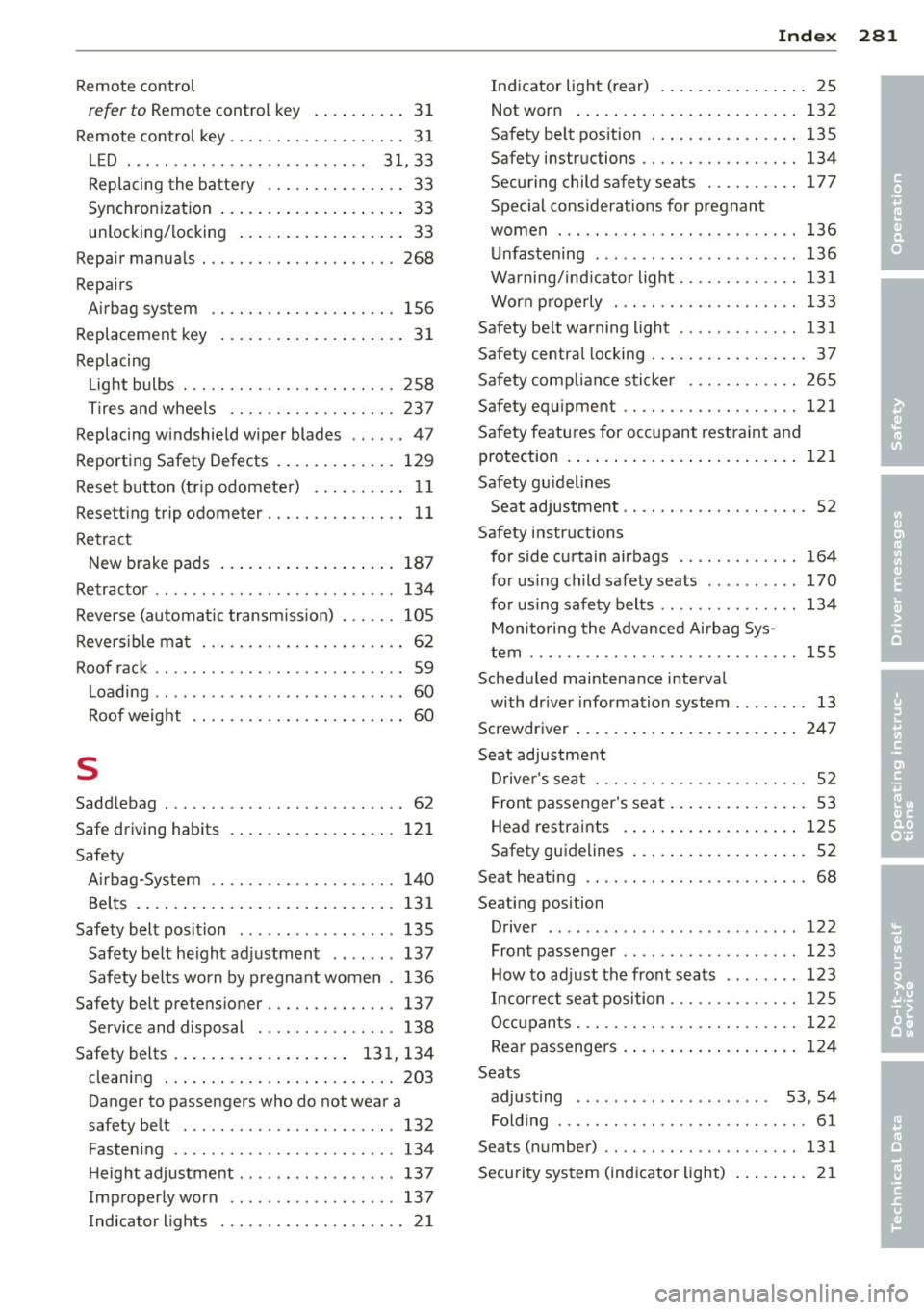
Index 281
-----------------------------------.......
Remote control
refer to Remote control key . . . . . . . . . . 31
Remote control key . . . . . . . . . . . . . . . . . . . 3 1
L ED . .. .. .. .... ........... .. .. 3 1,33
Replacing the ba ttery ..... .. .. .. .. .. 33
Synchron izat ion ... .... ... .. .. .. .. .. 33
un locking/ locking ..... ... .. .. .. .. .. 33
Repa ir manua ls ............ .... .. .. . 268
Repairs Airbag system ........... .... .. .. . 156
Replacement key . . . . . . . . . . . . . . . . . . . . 31
Replacing Lig ht bulbs . ............. .. .. .. .. . 258
T ires and whee ls ......... .... .. .. . 23 7
Replacing w indshield wiper blades ...... 47
Report ing Safety Defects . ... .. .. .. .. . 129
Reset b utton (tr ip odomete r) . . . . . . . . . . 11
Resett ing trip odometer ..... .. .. .. .. .. 11
Re tract
New brake pads . . . . . . . . . . . . . . . . . . . 187
Retractor ...... .............. ... ... 134
Reverse (automat ic transmiss ion) . .. .. . 105
Revers ible ma t ............ .... .. .. .. 62
Roof rack . . . . . . . . . . . . . . . . . . . . . . . . . . . 59
L oading .. ... ............. ... ... ... 60
Roof weight .... .. .... .... . .. .. .. .. 60
s
Sadd lebag ..... ................ .... . 62
Safe driving habits . ..... ... .. .. .. ... 121
Safety Airbag-System ........... .... .. ... 1 40
Belts . ..... .. ... .. ..... ... .. .. ... 131
Safety belt position ............ ... .. 135
Safety belt he ight ad justment .. . ... . 137
S afety belts worn by p regnant women . 136
Safety belt pretens ioner ..... .. .. .. .. . 13 7
Service and disposal ...... .. .. .. .. . 138
Safety belts . ... ... ..... ... .. .. 131,134
cleaning ... .. .... .. .... ... .. .. ... 203
Danger to passengers who do not wea r a
safety belt . .. ........... .. .. .. ... 132
Fastening .. ... .. .. ...... .. .. .. .. . 134
H eight adjustme nt ........... .. .... 137
Imp roperly worn .......... ... ... .. 137
I ndicator lights . . . . . . . . . . . . . . . . . . . . 2 1 In
dicator lig ht ( rear) . .. ..... ... .. .. . 25
Not worn ... .. .. .. . ... ...... ... .. 132
Safety be lt pos ition .. .. ..... ... .. .. 135
Safety instr uctions ................. 134
Securing child safety seats ........ .. 177
Spec ial considerations for pregnant
women ... .. .. .. .. . .. .... .... .... 136
Un fastening ...... ...... .......... 136
Wa rning/ind icator light . . . . . . . . . . . . . 131
Wor n pro perly . .. .... ........... .. 133
Safety be lt warning light ............. 131
Safety centra l locking . . . . . . . . . . . . . . . . . 3 7
Safety comp lia n ce sticke r ........ .. .. 265
Safety equ ipment ...... ............. 121
Safety featu res for occ upan t rest raint and
protection . . . . . . . . . . . . . . . . . . . . . . . . . 121
Safety gu idelines
Seat adjustment . . . . . . . . . . . . . . . . . . . . 52
Safety instr uctions
for s ide cu rtain airbags .. ...... .... . 164
fo r us ing child safety seats ......... . 170
for us ing safe ty belts .............. . 134
Moni to ring the Advanced Ai rbag Sys-
tem .... .... .. .... ... .......... .. 155
Scheduled maintena nce i nterval
with dr iver information system . . . . . . . . 13
Screwdr iver ....... .. . .. .. ..... ... .. 247
Seat adjustment Drive r's sea t . . . . . . . . . . . . . . . . . . . . . . . 52
F ron t passenger's seat . . . . . . . . . . . . . . . 53
Hea d restraints ..... .. .. ..... ... .. 125
Safety gu idelines ... . ... ...... ... .. . 52
Seat heating .. .. .. .... ............. . 68
Seating position Driver .. .. .. .. .... .. ........ ..... 122
Front passenger .. .. .. .. ...... ..... 123
How to ad just the front s eats ....... . 123
Incorre ct seat position .......... .. .. 1 2S
O ccu pan ts ... .. ...... ........... .. 1 22
Rear passengers . ... .. ... ..... ... .. 124
Seats adjust ing . . . . . . . . . . . . . . . . . . . . . 53, 54
Fold ing ... .. .. .. .. .. ........... .. . 61
Seats (number) .. ...... ............. 131
S ecurity sys tem (ind icator light) ... .. .. . 21
•
•
•