Page 97 of 180
7-13
1
2
3
4
5
67
8
9
10
11
12
13
14
Steering wheel
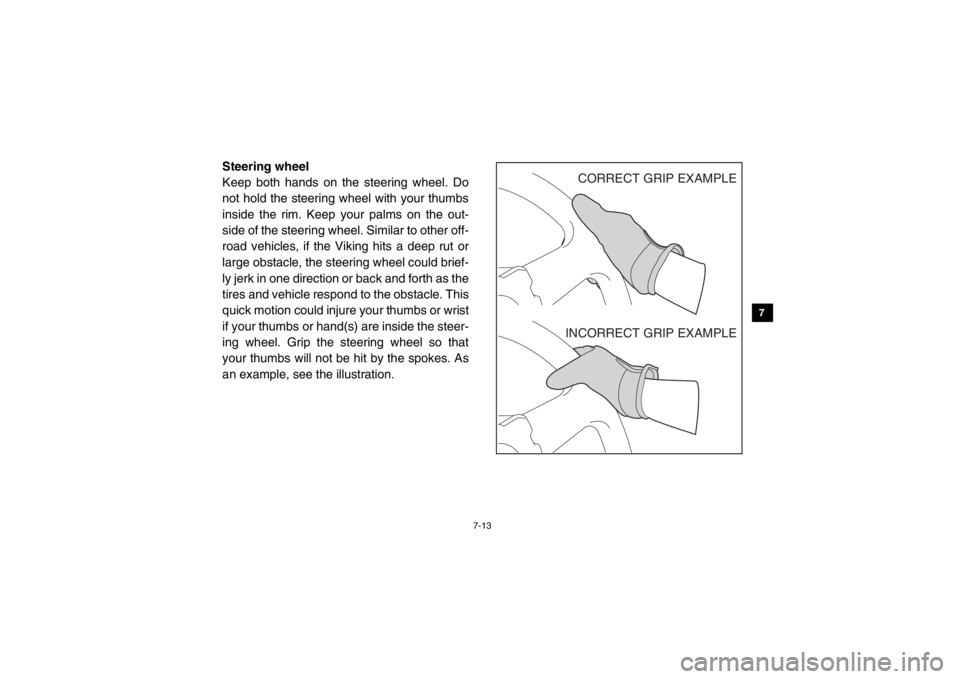
Keep both hands on the steering wheel. Do
not hold the steering wheel with your thumbs
inside the rim. Keep your palms on the out-
side of the steering wheel. Similar to other off-
road vehicles, if the Viking hits a deep rut or
large obstacle, the steering wheel could brief-
ly jerk in one direction or back and forth as the
tires and vehicle respond to the obstacle. This
quick motion could injure your thumbs or wrist
if your thumbs or hand(s) are inside the steer-
ing wheel. Grip the steering wheel so that
your thumbs will not be hit by the spokes. As
an example, see the illustration.
CORRECT GRIP EXAMPLE
INCORRECT GRIP EXAMPLE
1XP7B_EE.book Page 13 Tuesday, February 4, 2014 3:40 PM
Page 99 of 180
7-15
1
2
3
4
5
67
8
9
10
11
12
13
14
Wear eye protection when operating or riding
the vehicle to reduce the risk of a serious ac-
cident or injury. Eye protection, such as a face
shield or goggles, may reduce the risk of for-
eign material getting in your eyes and help
prevent loss of vision.
Practice for new Yamaha Viking users
You should become familiar with the perfor-
mance characteristics of the vehicle in a large,
flat area that is free of obstacles and other ve-
hicles. Practice controlling the accelerator
pedal, brakes, steering, and drive select lever.
Drive at slow speeds with gradual accelera-
tion and turning. Practice smooth throttle ap-
plication. Practice slowing down before
turning. Practice maintaining a steady throttle
through the turn. Avoid higher speeds until
you are thoroughly familiar with the operation
of your vehicle. Remember, driving aggres-
sively or making abrupt maneuvers even on
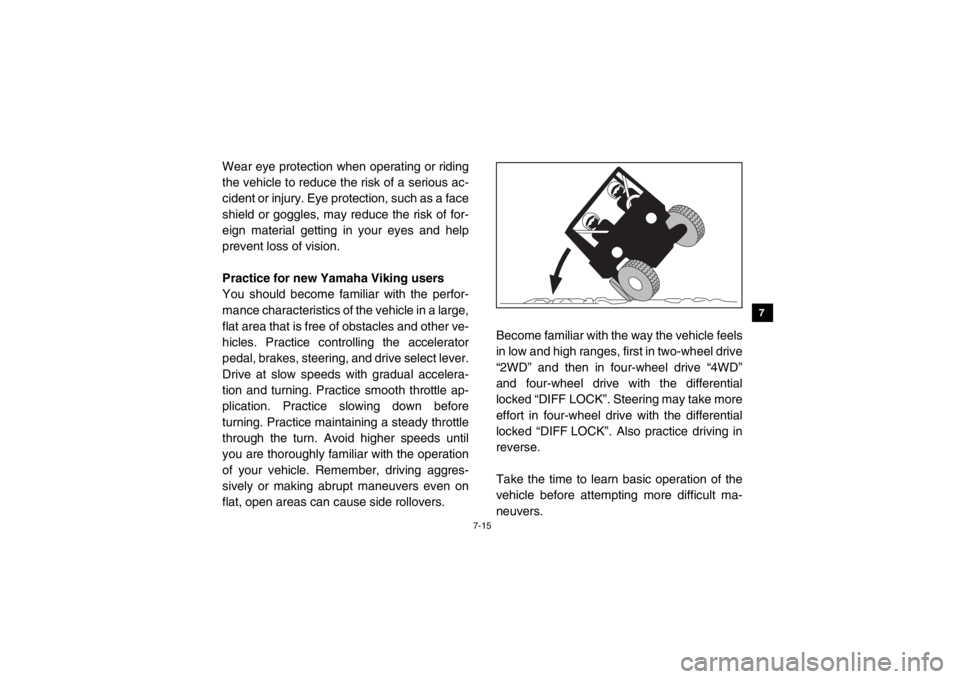
flat, open areas can cause side rollovers.Become familiar with the way the vehicle feels
in low and high ranges, first in two-wheel drive
“2WD” and then in four-wheel drive “4WD”
and four-wheel drive with the differential
locked “DIFF LOCK”. Steering may take more
effort in four-wheel drive with the differential
locked “DIFF LOCK”. Also practice driving in
reverse.
Take the time to learn basic operation of the
vehicle before attempting more difficult ma-
neuvers.1XP7B_EE.book Page 15 Tuesday, February 4, 2014 3:40 PM
Page 100 of 180
7-16
7
8
9
10
11
12
13
14
Getting ready to ride
Perform the Pre-Operation Checks on page
5-1. Follow the instructions starting on page
6-2 to start the engine. Turning
Use care in turns – turning the steering wheel
too far or too fast can result in loss of control
or a rollover. Slow down before entering turns.
When making tight turns from a standstill or at
slow speeds, avoid sudden or hard accelera-
tion. Driving aggressively or making abrupt
maneuvers even on flat, open areas can
cause side rollovers. Avoid sideways sliding,
skidding, or back-wheel sliding, and never do
donuts. If you feel the Viking begin to slide
sideways or the back wheels slide during a
turn, steer into the direction of the slide, if pos-
sible, and gradually let off the accelerator ped-
al to regain directional control and avoid
rollover. For example, if you feel the back of
the vehicle start to slide to your right, steer to
the right.1XP7B_EE.book Page 16 Tuesday, February 4, 2014 3:40 PM
Page 101 of 180

7-17
1
2
3
4
5
67
8
9
10
11
12
13
14
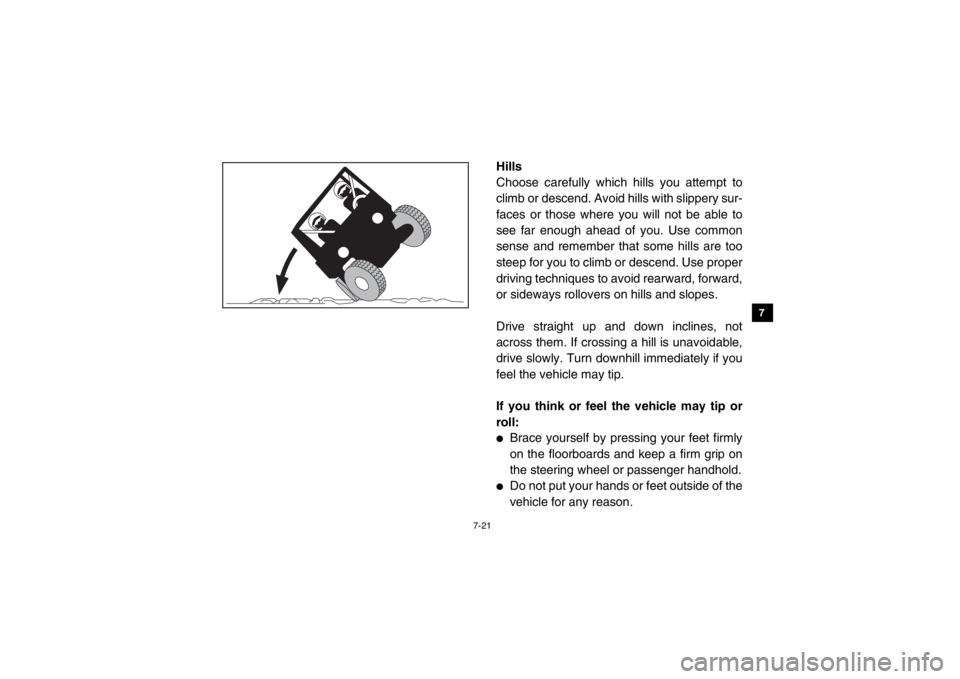
If you think or feel that the vehicle may tip or
roll, keep your body completely inside the pro-
tective structure of the vehicle:●
Brace yourself by pressing your feet firmly
on the floorboards and keep a firm grip on
the steering wheel or passenger handhold.
●
Do not put your hands or feet outside of the
vehicle for any reason. Do not try to stop a
tipover using your arm or leg.Accelerating
With the engine idling in neutral and your foot
on the brake, shift the drive select lever into
low or high.
NOTICE: Do not shift from low
to high or vice versa without coming to a
complete stop and waiting for the engine
to return to normal idle speed – damage to
the engine or drive train may occur. Then
release the parking brake. Press the accel-
erator pedal slowly and smoothly. The centrif-
ugal clutch will engage and the vehicle will
begin to accelerate.
Avoid higher speeds and sudden or hard ac-
celeration until you are thoroughly familiar
with the operation of your vehicle. Avoid sud-
den or hard acceleration in any turn.
1XP7B_EE.book Page 17 Tuesday, February 4, 2014 3:40 PM
Page 105 of 180
7-21
1
2
3
4
5
67
8
9
10
11
12
13
14
Hills
Choose carefully which hills you attempt to
climb or descend. Avoid hills with slippery sur-
faces or those where you will not be able to
see far enough ahead of you. Use common
sense and remember that some hills are too
steep for you to climb or descend. Use proper
driving techniques to avoid rearward, forward,
or sideways rollovers on hills and slopes.
Drive straight up and down inclines, not
across them. If crossing a hill is unavoidable,
drive slowly. Turn downhill immediately if you
feel the vehicle may tip.
If you think or feel the vehicle may tip or
roll:●
Brace yourself by pressing your feet firmly
on the floorboards and keep a firm grip on
the steering wheel or passenger handhold.
●
Do not put your hands or feet outside of the
vehicle for any reason.
1XP7B_EE.book Page 21 Tuesday, February 4, 2014 3:40 PM
Page 115 of 180
8-5
1
2
3
4
5
6
78
9
10
11
12
13
14
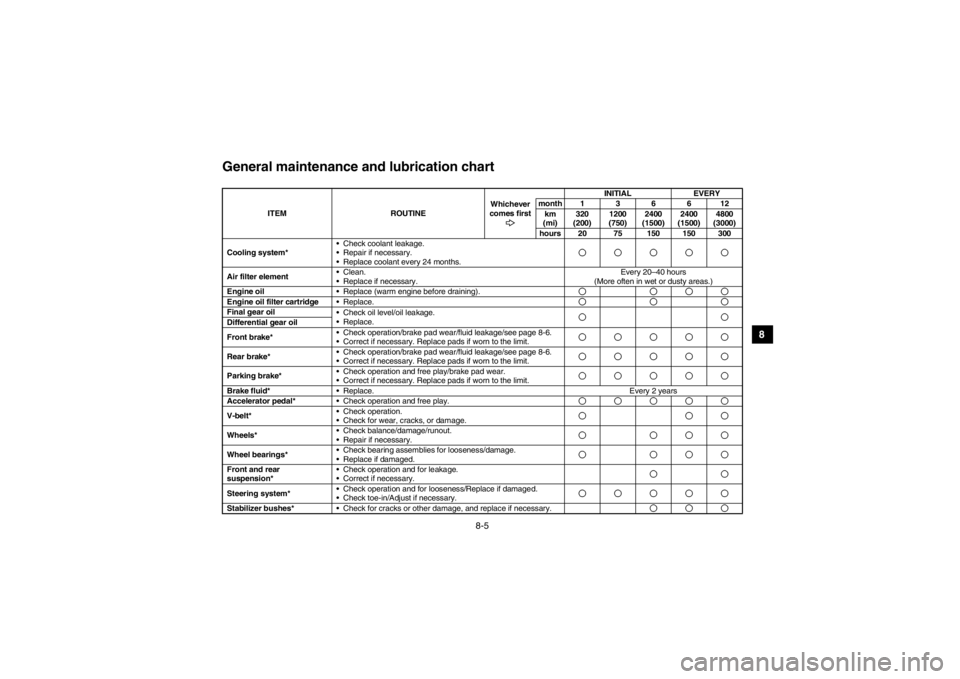
EVU01650General maintenance and lubrication chart
ITEM ROUTINEWhichever
comes first INITIAL
EVERY
month136612 km
(mi) 320
(200) 1200
(750) 2400
(1500) 2400
(1500) 4800
(3000)
hours 20 75 150 150 300
Cooling system* Check coolant leakage.
Repair if necessary.
Replace coolant every 24 months.
Air filter element
Clean.
Replace if necessary. Every 20–40 hours
(More often in wet or dusty areas.)
Engine oil Replace (warm engine before draining).Engine oil filter cartridge Replace.Final gear oil
Check oil level/oil leakage.
Replace.Differential gear oil
Front brake* Check operation/brake pad wear/fluid leakage/see page 8-6.
Correct if necessary. Replace pads if worn to the limit.Rear brake* Check operation/brake pad wear/fluid leakage/see page 8-6.
Correct if necessary. Replace pads if worn to the limit.Parking brake*
Check operation and free play/brake pad wear.
Correct if necessary. Replace pads if worn to the limit.Brake fluid*
Replace. Every 2 years
Accelerator pedal* Check operation and free play.V-belt* Check operation.
Check for wear, cracks, or damage.Wheels* Check balance/damage/runout.
Repair if necessary.Wheel bearings*
Check bearing assemblies for looseness/damage.
Replace if damaged.Front and rear
suspension* Check operation and for leakage.
Correct if necessary.Steering system*
Check operation and for looseness/Replace if damaged.
Check toe-in/Adjust if necessary.Stabilizer bushes*
Check for cracks or other damage, and replace if necessary.
1XP7B_EE.book Page 5 Tuesday, February 4, 2014 4:19 PM
Page 149 of 180
8-39
1
2
3
4
5
6
78
9
10
11
12
13
14
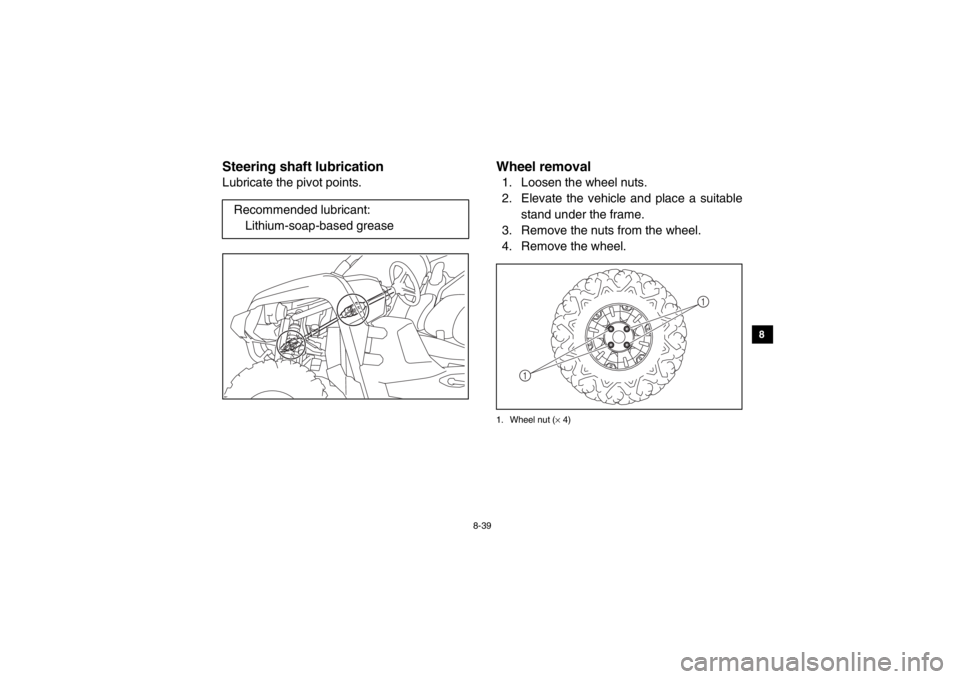
EVU00920Steering shaft lubricationLubricate the pivot points.
EVU00930Wheel removal1. Loosen the wheel nuts.
2. Elevate the vehicle and place a suitablestand under the frame.
3. Remove the nuts from the wheel.
4. Remove the wheel.1. Wheel nut ( × 4)
Recommended lubricant:
Lithium-soap-based grease
1
1
1XP7B_EE.book Page 39 Tuesday, February 4, 2014 3:40 PM
Page:
< prev 1-8 9-16 17-24