Page 78 of 180

6-5
6
7
8
9
10
11
12
13
14
Shifting: neutral to reverse
WARNING
Before you shift into reverse, make sure
there are no obstacles or people behind
you. When it is safe to proceed, go slowly.
Hitting an obstacle or person could result
in serious injury or death.1. Stop the vehicle, take your foot off the ac- celerator pedal, and check behind you.
2. Apply the brake pedal.
3. Shift from neutral to reverse or vice versa
by moving the drive select lever along the
shift guide.
●
When in reverse, the reverse indicator
light should be on. If the light does not
come on, ask a Yamaha dealer to in-
spect the reverse indicator light elec-
trical circuit.
●
Due to the synchronizing mechanism
in the engine, the light may not come
on until the vehicle starts moving.
1. Drive select lever 2. L (Low-range)
3. H (High-range) 4. N (Neutral)
5. R (Reverse)4. Release the parking brake, if applied.
5. Check behind the vehicle for people or obstacles, and then release the brake
pedal.
6. Press the accelerator pedal gradually and continue to watch to the rear while
backing.
1
2
5 4
3
1XP7B_EE.book Page 5 Tuesday, February 4, 2014 3:40 PM
Page 158 of 180
8-48
8
9
10
11
12
13
14
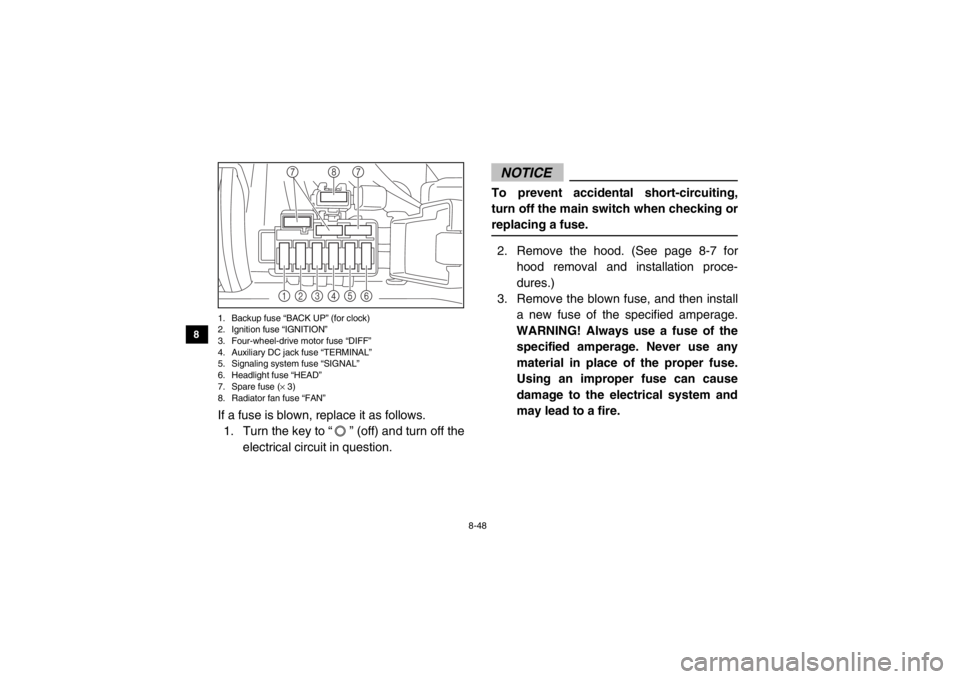
1. Backup fuse “BACK UP” (for clock)
2. Ignition fuse “IGNITION”
3. Four-wheel-drive motor fuse “DIFF”
4. Auxiliary DC jack fuse “TERMINAL”
5. Signaling system fuse “SIGNAL”
6. Headlight fuse “HEAD”
7. Spare fuse ( × 3)
8. Radiator fan fuse “FAN”If a fuse is blown, replace it as follows.
1. Turn the key to “ ” (off) and turn off the
electrical circuit in question.
NOTICETo prevent accidental short-circuiting,
turn off the main switch when checking or
replacing a fuse.2. Remove the hood. (See page 8-7 for hood removal and installation proce-
dures.)
3. Remove the blown fuse, and then install a new fuse of the specified amperage.
WARNING! Always use a fuse of the specified amperage. Never use any
material in place of the proper fuse.
Using an improper fuse can cause
damage to the electrical system and
may lead to a fire.
1
2
3
4
5
6
8
7
7
1XP7B_EE.book Page 48 Tuesday, February 4, 2014 3:40 PM
Page 165 of 180
8-55
1
2
3
4
5
6
78
9
10
11
12
13
14
EVU01010TroubleshootingAlthough Yamaha vehicles receive an inspec-
tion before shipment from the factory, trouble
may occur during operation. Any problem in
the fuel, compression, or ignition systems can
cause poor starting and loss of power. The
troubleshooting chart describes a quick, easy
procedure for making checks. If your vehicle
requires any repair, take it to a Yamaha deal-
er.
The skilled technicians at a Yamaha dealer-
ship have the tools, experience, and know-
how to properly service your vehicle. Use only
genuine Yamaha parts on your vehicle. Imita-
tion parts may look like Yamaha parts, but
they are often inferior. Consequently, they
have a shorter service life and can lead to ex-
pensive repair bills.
WARNING
When checking the fuel system, do not
smoke and make sure there are no open
flames or sparks in the area, including pi-
lot lights from water heaters or furnaces.
Gasoline or gasoline vapors can ignite or
explode, causing severe injury or property
damage.
1XP7B_EE.book Page 55 Tuesday, February 4, 2014 3:40 PM
Page 175 of 180

10-5
1
2
3
4
5
6
7
8
910
11
12
13
14
Neutral indicator light:LED
Reverse indicator light: LED
Coolant temperature warning light:
LED
Engine trouble warning light: LED
Parking brake indicator light: LED
On-Command four-wheel-drive/differential gear lock indica-
tor: LCD
High-range indicator light:
LED
Low-range indicator light: LED
Differential gear lock indicator light: LED
EPS warning light:
LED
Helmet/Seat belt indicator light: 14 V, 0.85 W × 2Fuses:Main fuse:
40.0 A
Fuel injection system fuse: 10.0 A
EPS fuse: 40.0 A
Headlight fuse:
15.0 A Signaling system fuse:
10.0 A
Ignition fuse: 10.0 A
Auxiliary DC jack fuse:
10.0 A
Backup fuse: 10.0 A
Four-wheel-drive motor fuse: 10.0 A
Radiator fan fuse:
25.0 A
For Europe only
The figures quoted are emission levels and
are not necessarily safe working levels. Whilst
there is a correlation between the emission
and exposure levels, this cannot be used reli-
ably to determine whether or not further pre-
cautions are required.
Factors that influence the actual level of expo-
sure of work-force include the characteristics
of the work room, the other sources of noise,
etc. i.e. the number of machines and other ad-
jacent processes, and the length of time for
which an operator is exposed to the noise.
Also the permissible exposure level can vary
1XP7B_EE.book Page 5 Tuesday, February 4, 2014 3:40 PM