Page 86 of 180
7-2
7
8
9
10
11
12
13
14
Doing things with a Viking that some people
do for thrills in other vehicles (such as side-
ways sliding, skidding, back-wheel sliding, or
donuts) have led to side rollovers. These roll-
overs can result in crushed limbs and other
serious injuries or death to drivers or passen-
gers.
As the owner/operator, it is your responsibility
to protect yourself and your passengers from
accidents, including rollovers. The Viking has
many features, including a protective struc-
ture and seat belts, to help protect occupants,
but the best way to avoid injuries is to avoid
accidents. There is a risk of injury or death in
any accident, even with these safety features.1XP7B_EE.book Page 2 Tuesday, February 4, 2014 3:40 PM
Page 87 of 180
7-3
1
2
3
4
5
67
8
9
10
11
12
13
14
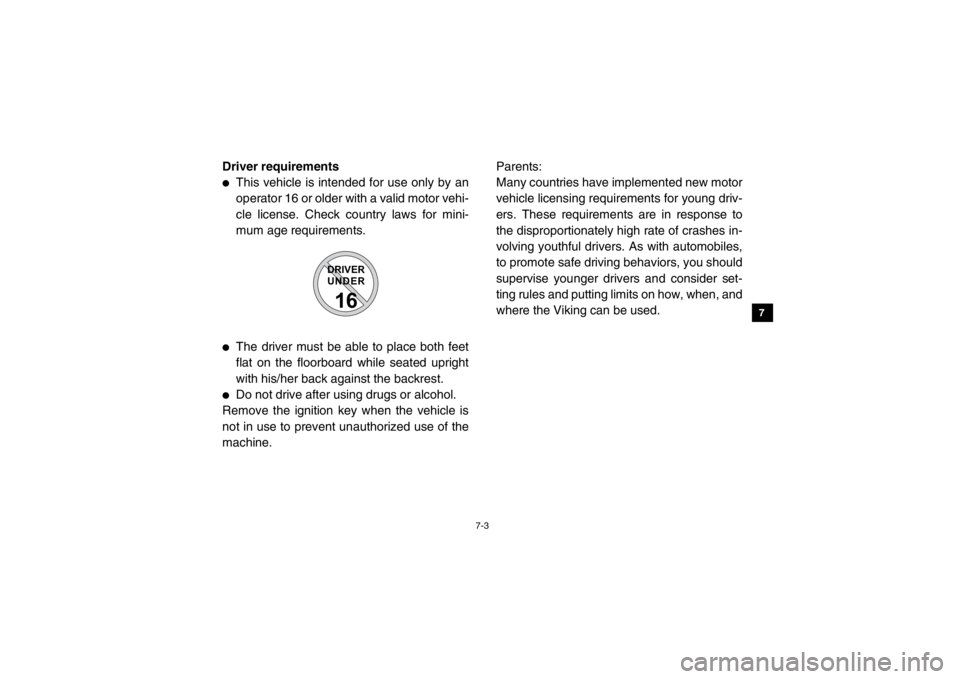
Driver requirements●
This vehicle is intended for use only by an
operator 16 or older with a valid motor vehi-
cle license. Check country laws for mini-
mum age requirements.
●
The driver must be able to place both feet
flat on the floorboard while seated upright
with his/her back against the backrest.
●
Do not drive after using drugs or alcohol.
Remove the ignition key when the vehicle is
not in use to prevent unauthorized use of the
machine. Parents:
Many countries have implemented new motor
vehicle licensing requirements for young driv-
ers. These requirements are in response to
the disproportionately high rate of crashes in-
volving youthful drivers. As with automobiles,
to promote safe driving behaviors, you should
supervise younger drivers and consider set-
ting rules and putting limits on how, when, and
where the Viking can be used.
DRIVER
UNDER16
1XP7B_EE.book Page 3 Tuesday, February 4, 2014 3:40 PM
Page 88 of 180
7-4
7
8
9
10
11
12
13
14
Passenger requirements
This vehicle is designed for the operator and
two passengers. Allowing passengers to ride
improperly can lead to serious injury or death.
As the operator, you are responsible for your
passengers.●
Your passengers must be able to place
both feet on the floorboard while seated up-
right with their backs against the backrests.
●
Your passengers must be able to reach
and hold the passenger handhold.
●
Allow only two passengers in the vehicle
and only in the designated passenger
seats. Do not carry any other passengers.
Do not carry passengers in the cargo bed.
●
Do not allow someone to ride as a passen-
ger who has been using drugs or alcohol.
●
Do not allow children who need child safety
seats or booster seats in the Viking. The
seat belt is not designed to restrain auto-
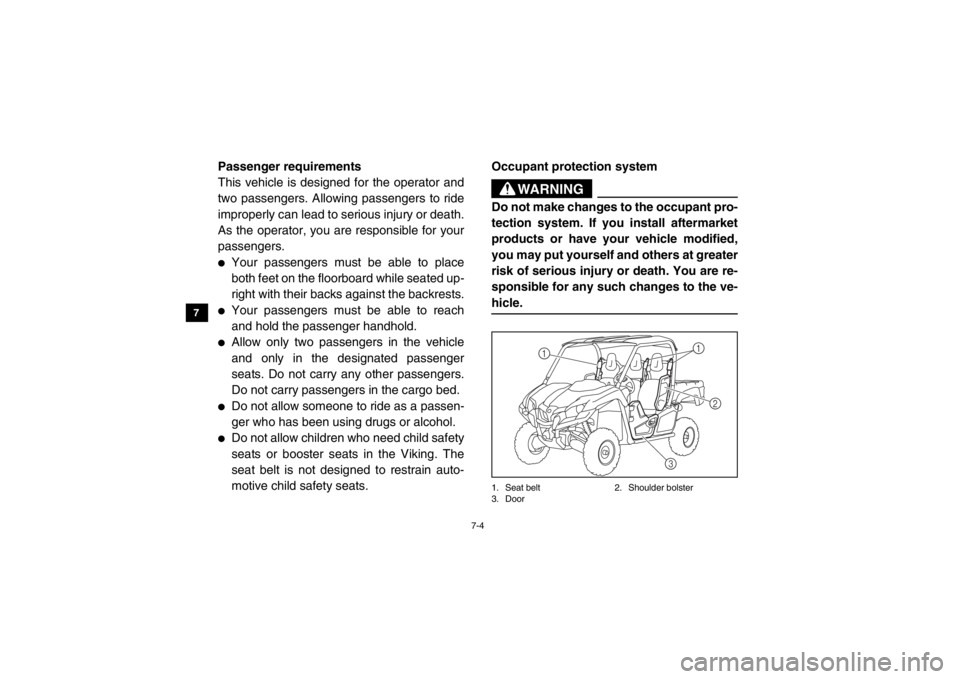
motive child safety seats. Occupant protection system
WARNING
Do not make changes to the occupant pro-
tection system. If you install aftermarket
products or have your vehicle modified,
you may put yourself and others at greater
risk of serious injury or death. You are re-
sponsible for any such changes to the ve-
hicle.1. Seat belt
2. Shoulder bolster
3. Door
2
3
1
1
1XP7B_EE.book Page 4 Tuesday, February 4, 2014 3:40 PM
Page 97 of 180
7-13
1
2
3
4
5
67
8
9
10
11
12
13
14
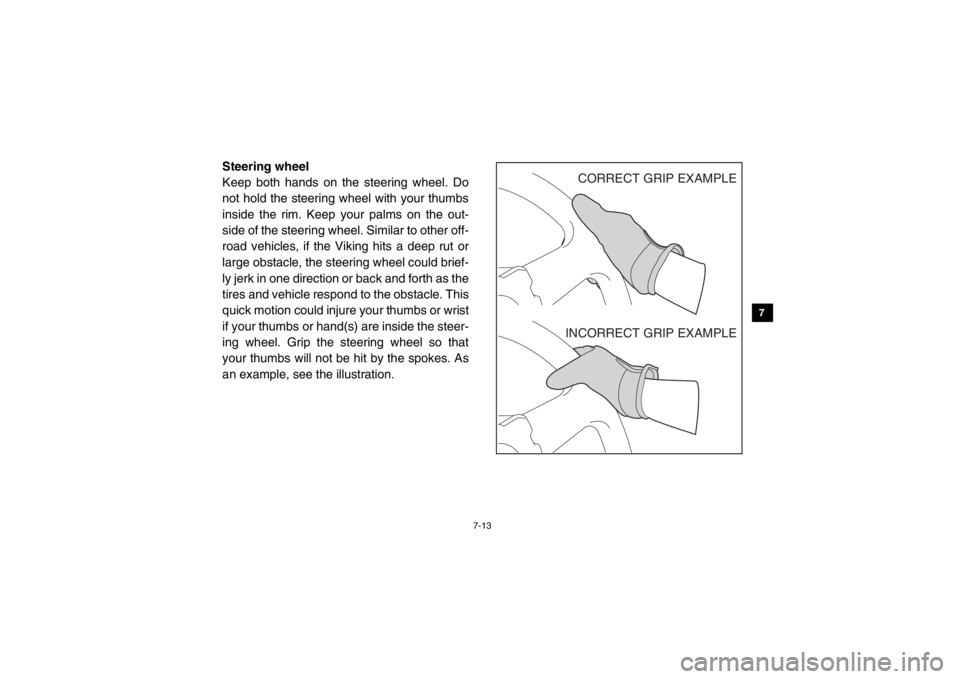
Steering wheel
Keep both hands on the steering wheel. Do
not hold the steering wheel with your thumbs
inside the rim. Keep your palms on the out-
side of the steering wheel. Similar to other off-
road vehicles, if the Viking hits a deep rut or
large obstacle, the steering wheel could brief-
ly jerk in one direction or back and forth as the
tires and vehicle respond to the obstacle. This
quick motion could injure your thumbs or wrist
if your thumbs or hand(s) are inside the steer-
ing wheel. Grip the steering wheel so that
your thumbs will not be hit by the spokes. As
an example, see the illustration.
CORRECT GRIP EXAMPLE
INCORRECT GRIP EXAMPLE
1XP7B_EE.book Page 13 Tuesday, February 4, 2014 3:40 PM
Page 170 of 180

9-3
9
10
11
12
13
14
2. Remove the spark plug, pour about one tablespoon of SAE 10W-40 or 20W-50
motor oil in the spark plug hole and install
the spark plug. Ground the spark plug
wire and turn the engine over several
times to coat the cylinder wall with oil.
3. Lubricate all control cables.
4. Block up the frame to raise all wheels off the ground.
5. Tie a plastic bag over the exhaust pipe outlet to prevent moisture from entering.
6. If storing in a humid or salt-air atmo-
sphere, coat all exposed metal surfaces
with a light film of oil. Do not apply oil to
any rubber parts or the seat covers. 7. Remove the battery and charge it. Store
it in a dry place and recharge it once a
month. Do not store the battery in an ex-
cessively warm or cold place [less than
0 °C (30 °F) or more than 30 °C (90 °F)].
Use of fuel stabilizer and conditioner elimi-
nates the need to drain the fuel system. Con-
sult a Yamaha dealer if the fuel system needs
to be drained.1XP7B_EE.book Page 3 Tuesday, February 4, 2014 3:40 PM