Page 67 of 180
5-5
1
2
3
45
6
7
8
9
10
11
12
13
14
Portable fuel containers
If you carry a portable fuel container in the bed
of your Yamaha Viking, be sure to secure it
with the cap tightened before driving the vehi-
cle.
Always place a portable fuel container on the
ground before filling it. Before removing the
container cap, touch the container with the
fuel dispenser nozzle. Keep fuel dispenser
nozzle in contact with container inlet when fill-
ing. WARNING! Never refill a fuel container
in the bed of any vehicle. Fire may result
from a build-up of static electricity. The
discharge of this build-up while refueling
can cause a spark and ignite the gasoline.
Recommended fuel:
Regular unleaded gasoline only
For Europe:
Regular unleaded gasoline only with a re-
search octane number of 95 or higher
Fuel tank capacity: 36.7 L (9.70 US gal, 8.07 Imp.gal)
1XP7B_EE.book Page 5 Tuesday, February 4, 2014 3:40 PM
Page 69 of 180
5-7
1
2
3
45
6
7
8
9
10
11
12
13
14
EVU00430Final gear oilMake sure the final gear oil is at the specified
level. Add oil as necessary. (See page 8-15
for details.)
If desired, an SAE 80W-90 hypoid gear oil
may be used for all conditions.TIPGL-4 is a quality and additive rating; GL-5 or
GL-6 rated hypoid gear oils may also be used.EVU00440Differential gear oilMake sure the differential gear oil is at the
specified level. Add oil as necessary. (See
page 8-17 for details.)
EVU00450Accelerator pedalCheck to see that the accelerator pedal oper-
ates correctly. It must operate smoothly and
spring back to the idle position fully when re-
leased. Have a Yamaha dealer repair as nec-
essary for proper operation.EVU00460Seat beltsMake sure that the seat belts are not frayed,
torn, stretched, or damaged. The seat belts
must move smoothly when pulled out and re-
tract on its own when released. The seat belts
must also lock up when quickly pulled out.
The latch plate should click securely into the
buckle and release when the release button is
pushed firmly. Wash off any dirt or mud that
could affect operation. Have a Yamaha dealer
repair as necessary for proper operation.
Recommended oil:
SAE 80 API GL-4 Hypoid gear oil
Recommended oil: SAE 80 API GL-4 Hypoid gear oil
1XP7B_EE.book Page 7 Tuesday, February 4, 2014 3:40 PM
Page 70 of 180

5-8
5
6
7
8
9
10
11
12
13
14
A crash can damage the restraint systems in
your vehicle. A damaged restraint system
may not properly protect the person using it,
resulting in serious injury or death in a crash.
To help make sure your restraint systems are
working properly after a crash, have them in-
spected and any necessary replacements
made as soon as possible.Passenger handholdCheck that the handhold bar and its supports
are in good condition. Confirm that the locking
pins are securely fastened, and then push
and pull on the handhold to make sure that it
is not loose.EVU01230SteeringPark on level ground. Turn the steering wheel
right and left. Check for excessive free play,
abnormal noises, or a rough feeling. Have a
Yamaha dealer repair as necessary for proper operation.
EVU00470Fittings and fastenersAlways check the tightness of chassis fittings
and fasteners before a ride. Take the vehicle
to a Yamaha dealer or refer to the Service
Manual for correct tightening torque.Instruments, lights and switchesCheck that all instruments, lights and switches
are working properly. Correct if necessary.Control cablesWhen riding in cold weather, always make
sure all control cables work smoothly before
you begin riding. WARNING! Control cables
can freeze in cold weather and you could
be unable to control the vehicle.EVU00500TiresCheck tire pressure regularly to make sure it
is at the recommended specifications. Also
check for wear and damage.
1XP7B_EE.book Page 8 Tuesday, February 4, 2014 3:40 PM
Page 82 of 180

6-9
6
7
8
9
10
11
12
13
14
Prepare your load or trailer
WARNING
Improper loading or towing can increase
the risk of loss of control, an overturn, or
other accident:●
Do not exceed the Maximum Loading
Limits for the vehicle (see page 6-10
and vehicle labeling).
●
Keep weight in the cargo bed centered
side to side, and as low and as far for-
ward as possible. Top-heavy loads in-
crease the risk of overturn. Be sure
cargo is secured – a loose load could
change handling unexpectedly or
strike occupants.
●
Do not exceed the maximum tongue
weight.
●
Make sure the load does not interfere
with your control or ability to see
where you are going.
●
Tie down cargo in the trailer securely.
Make sure cargo in the trailer cannot
move around. A shifting load can
cause an accident.
Use the hooks equipped on the cargo bed to
tie down loads.
Choose a trailer hitch drawbar designed for
use with a 5 cm (2 in) receiver. (See page
4-28 for more information.)
1XP7B_EE.book Page 9 Tuesday, February 4, 2014 3:40 PM
Page 90 of 180

7-6
7
8
9
10
11
12
13
14
Seat belts
Seat belts should be worn by the driver and
passengers. The driver must be sure that the
passengers are belted before driving.●
Be sure that each occupant’s seat belt
latch plate is inserted into the appropriate
buckle.
●
Be sure the seat belt is not twisted, is
close-fitting across the hips and chest,
and is latched securely.
●
Do not wear the seat belt across the ab-
domen or stomach.
●
Do not put the seat belt behind the back.
Failure to use seat belts properly may lead to
an increased likelihood and severity of injury. An unbelted occupant may strike the interior
of the vehicle, the protective structure, or oth-
er objects in an accident or during operation.
You may also fall completely out or be partial-
ly ejected from the vehicle, which may lead to
being crushed between the ground and the
vehicle. Wearing the seat belt helps you re-
main in the vehicle – the doors and passenger
handhold are not a substitute for using a seat
belt.
A crash can damage the restraint systems in
your vehicle. A damaged restraint system
may not properly protect the person using it,
resulting in serious injury or death in a crash.
To help make sure your restraint systems are
working properly after a crash, have them in-
spected and any necessary replacements
made as soon as possible.
1XP7B_EE.book Page 6 Tuesday, February 4, 2014 3:40 PM
Page 91 of 180
7-7
1
2
3
4
5
67
8
9
10
11
12
13
14
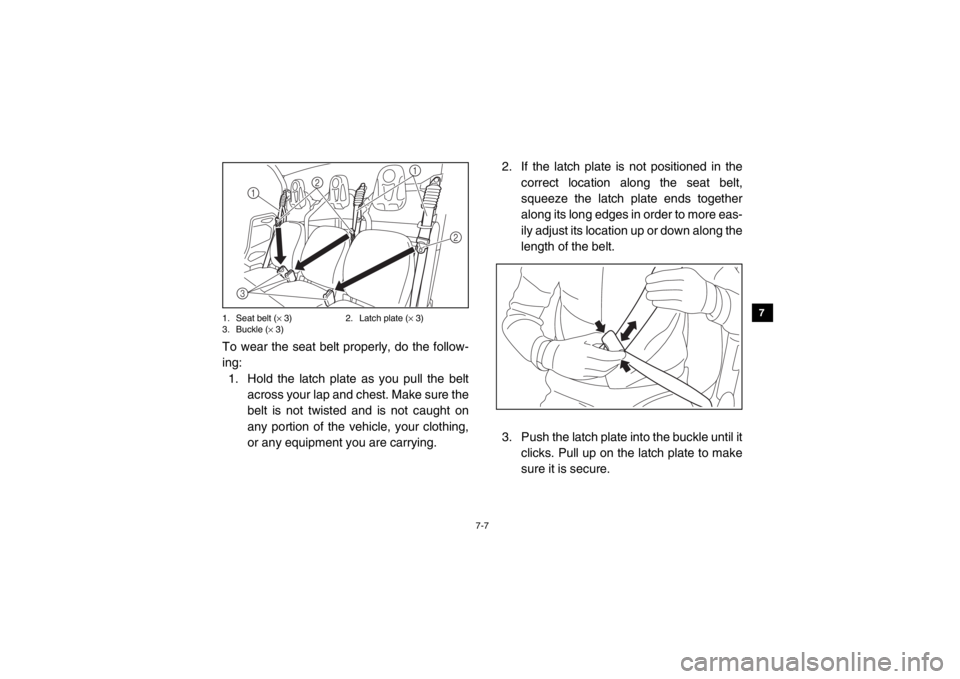
1. Seat belt (× 3) 2. Latch plate ( × 3)
3. Buckle ( × 3)To wear the seat belt properly, do the follow-
ing:
1. Hold the latch plate as you pull the belt across your lap and chest. Make sure the
belt is not twisted and is not caught on
any portion of the vehicle, your clothing,
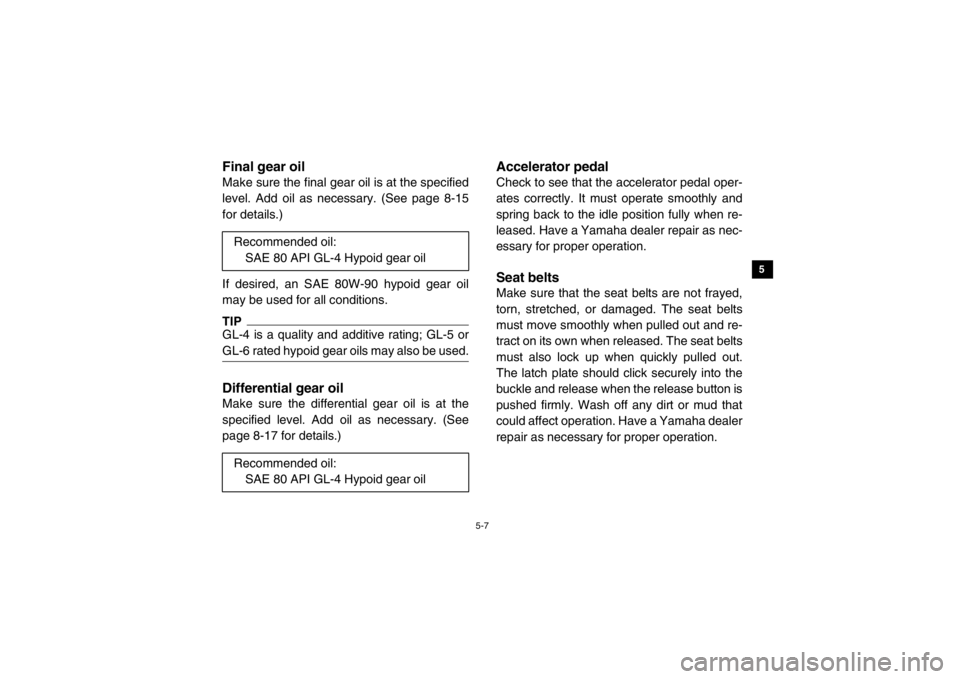
or any equipment you are carrying. 2. If the latch plate is not positioned in the
correct location along the seat belt,
squeeze the latch plate ends together
along its long edges in order to more eas-
ily adjust its location up or down along the
length of the belt.
3. Push the latch plate into the buckle until it clicks. Pull up on the latch plate to make
sure it is secure.
3 2
1
2
1
1XP7B_EE.book Page 7 Tuesday, February 4, 2014 3:40 PM
Page 93 of 180
7-9
1
2
3
4
5
67
8
9
10
11
12
13
14
Doors
The doors are designed to reduce the likeli-
hood that you will stick your leg out to stop the
vehicle from tipping over or for any other rea-
son in a rollover. The doors may also reduce
intrusion of objects into the occupant area.
Make sure the door is securely latched before
operation. Do not place your arm or hand on
the door during operation. Your hand or arm
may be struck by objects or crushed against
outside objects or the ground during a roll-
over.Passenger handhold
The passenger handhold is provided to grip
during operation to maintain proper position
and balance. Holding onto the handhold helps
to reduce the likelihood that the passengers
put a hand outside the vehicle if the vehicle
begins to tip.
The driver should make sure the passengers
are holding onto the handhold with both
hands before operating the vehicle.1XP7B_EE.book Page 9 Tuesday, February 4, 2014 3:40 PM
Page 95 of 180
7-11
1
2
3
4
5
67
8
9
10
11
12
13
14
2. Slide the handhold to the desired positionand align the holes in the handhold bar
with the holes in the handhold supports.1. Handhold bar 2. Handhold support3. Insert the pins into the holes and secure
them with the wire loops. Make sure that
the handhold is properly secured before
riding.
1. Wire loop
2
1
1
1XP7B_EE.book Page 11 Tuesday, February 4, 2014 3:40 PM