2014 VOLVO V60 change wheel
[x] Cancel search: change wheelPage 291 of 442

08 Starting and driving
08
289
and
• Deactivated ECO function: Short coasting with
engine braking = Minimum con-
sumption.
NOTE
However, to achieve optimal low fuel con- sumption, Eco Coast in combination withshort coasting distances should generallybe avoided.
Activate Eco CoastThe function is activated when the accelera- tor pedal is fully released, in combination withthe following parameters: • The
ECO button activated
• The gear selector in
D position
• Speed within the range of approx. 65-140 km/h
• The road's downhill gradient is notsteeper than approx. 6%.
Deactivate Eco CoastIn certain situations it may be desirable to deactivate the Eco Coast function. Examplesof such situations include:
• on steep downhill gradients - to be able to use engine braking.
• before an imminent overtaking manoeu-vre - in order to be able to complete it inthe safest way possible. Deactivating Eco Coast and returning to engine braking can be performed as follows:
• Press the
ECO button.
• Move the gear lever to manual "
S+/-"
position.
• Change gear with the steering wheel pad- dle shifters.
• Actuate the accelerator or brake pedal.
Eco Coast - LimitationsThe function is not available if:
• cruise control is activated
• the road's downhill gradient is steeperthan approx. 6%.
• manual gear changing is performed withthe steering wheel paddle shifters*
• engine and/or gearbox are not at normaloperating temperature.
• the gear selector is moved from
D- to " S
+/- " position
• speed is outside the range ofapprox. 65-140 km/h
More information and settings
The car's menu system
MY CAR contains
further information on the ECO concept - see the section MY CAR (p. 103).
Related information
• General information on climate control (p. 115)
ProCarManuals.co’
Page 293 of 442

08 Starting and driving
08
291
WARNING
If and illuminate at the same
time, there may be a fault in the brake sys- tem. If the level in the brake fluid reservoir is normal at this stage, drive carefully to thenearest workshop and have the brake sys-tem checked - an authorised Volvo work-shop is recommended. If the brake fluid is below the MIN level in
the brake fluid reservoir, do not drive fur- ther before topping up the brake fluid. The reason for the loss of brake fluid must be investigated.
Related information
• Parking brake (p. 293)
• Foot brake - emergency brake lights and automatic hazard warning flashers (p.291)
• Foot brake - emergency brake assistance(p. 292)
• Foot brake - anti-lock braking system (p.291)
Foot brake - anti-lock braking system
The anti-lock braking system, ABS (Anti-lock Braking System), prevents the wheels fromlocking up during braking. The function allows steering ability to be maintained, and it is easier to swerve to avoida hazard for example. Vibration may be felt inthe brake pedal when this is engaged and thisis normal. A short test of the ABS system is made auto- matically after the engine has been startedwhen the driver releases the brake pedal. Afurther automatic test of the ABS system maybe made when the car reaches 10 km/h. Thetest may be experienced as pulses in thebrake pedal.
Related information
•Foot brake (p. 290)
• Parking brake (p. 293)
• Foot brake - emergency brake lights and automatic hazard warning flashers (p.291)
• Foot brake - emergency brake assistance(p. 292)
Foot brake - emergency brake lights and automatic hazard warningflashers
Emergency brake lights are activated to alert vehicles behind about sudden braking. Thefunction means that the brake light flashesinstead of - as in normal braking - shining witha constant glow. Emergency brake lights are activated at speeds above 50 km/h in the event of suddenbraking. After the car's speed has beenslowed below 10 km/h the brake light returnsfrom flashing to the normal constant glow -while at the same time the hazard warningflashers (p. 86) are activated, and they flashuntil the driver changes engine speed with theaccelerator pedal or they are deactivated withtheir button.
Related information
•Foot brake (p. 290)
• Parking brake (p. 293)
• Foot brake - emergency brake assistance (p. 292)
• Foot brake - anti-lock braking system (p.291)
ProCarManuals.co’
Page 295 of 442

08 Starting and driving
08
}}
293
Parking brake
The parking brake holds the car stationary, when the driver's seat is empty, by mechani-cally locking/blocking two wheels.
FunctionA faint electric motor noise can be heardwhen the electrical parking brake is beingapplied. The noise can also be heard duringthe automatic function checking of the park-ing brake. If the car is stationary when the parking brake is applied then it only acts on the rear wheels.If it is applied when the car is moving then thenormal foot brake is used, i.e. the brake actson all four wheels. Brake function changesover to the rear wheels when the car is almoststationary.
Low battery voltageIf the battery voltage is too low then the park-ing brake can neither be released nor applied.Connect a donor battery if the battery voltageis too low, see Jump starting with battery (p.270).
Applying the parking brake
Parking brake control - apply.
1. Press the foot brake pedal down firmly.
2. Press the control PUSH LOCK/PULL
RELEASE .
>
The combined instrument pan-
el's symbol starts flashing - once there is a constant glow the parking brake isapplied.
3. Release the foot brake pedal and make sure that the car is at a standstill position.
• When parking the vehicle, always engage 1st gear (for manual gearbox) or put thegear selector in position
P (for automatic
gearbox).
Emergency brakeIn an emergency the parking brake can be applied when the vehicle is in motion by pressing and holding the control for
PUSH
LOCK/PULL RELEASE . The braking proce-
dure is stopped when the control is released.
NOTE
In the event of emergency braking at speeds above 10 km/h a signal soundsduring the braking procedure.
Parking on a hillIf the car is parked facing uphill:
• Turn the wheels
away from the kerb.
If the car is parked facing downhill: • Turn the wheels
towards the kerb.
WARNING
Always apply the parking brake when parking on a slope - leaving the car ingear, or in P if it has automatic transmis-
sion, is not sufficient to hold the car in allsituation.
ProCarManuals.co’
Page 321 of 442

09 Wheels and tyres
09
319
New tyres
Tyres are perishable. After a few years they begin to harden at the same time as the fric-tion capacity/characteristics gradually deteri-orate. For this reason, aim to get as freshtyres as possible when you replace them.This is especially important with regard towinter tyres. The last four digits in thesequence mean the week and year of manu-facture. This is the tyre's DOT marking(Department of Transportation), and this isstated with four digits, for example 1510. Thetyre in the figure was manufactured in week15 of 2010.
Summer and winter tyresWhen summer and winter wheels arechanged the wheels should be marked withwhich side of the car they were mounted on,for example L for left and R for right.
Wear and maintenanceCorrect tyre pressure (p. 328) results in moreeven wear. Driving style, tyre pressure, cli-mate and road condition affect how quicklyyour tyres age and wear. To avoid differencesin tread depth and to prevent wear patternsarising, the front and rear wheels can beswitched with each other. A suitable distancefor the first change is approx. 5000 km andthen at 10000 km intervals. Volvo recom-mends that you contact an authorised Volvoworkshop for checking if you are uncertainabout tread depth. If significant differences inwear (> 1 mm difference in tread depth)between tyres have already occurred, theleast worn tyres must always be placed onthe rear. Understeer is normally easier to cor-rect than oversteer, and leads to the car con-tinuing forwards in a straight line rather thanhaving the rear end skidding to one side,resulting in possible complete loss of controlover the car. This is why it is important for therear wheels never to lose grip before the frontwheels. Wheels should be stored lying down or hang- ing up - and not standing up.
WARNING
A damaged tyre may lead to loss of control over the car.
Related information
• Tyres - dimensions (p. 322)
• Tyres - speed ratings (p. 323)
• Tyres - load index (p. 323)
• Tyres - direction of rotation (p. 318)
• Tyres - tread wear indicators (p. 320)
ProCarManuals.co’
Page 322 of 442

09 Wheels and tyres
09
320* Option/accessory, for more information, see Introduction.
Tyres - tread wear indicators
A tread wear indicator shows the status of the tyre's tread.
G021829
Tread wear indicators.
Tread wear indicators are narrow treadless bands across the width of the tread. On theside of the tyre are the letters TWI (TreadWear Indicator). When the tyre's tread depthis down to 1.6 mm, the tread depth will belevel in height with the tread wear indicators.Change to new tyres as soon as possible.Remember that tyres with little tread depthprovide very poor grip in rain and snow.
Related information
• Tyres - dimensions (p. 322)
• Tyres - speed ratings (p. 323)
• Tyres - load index (p. 323)
• Tyres - direction of rotation (p. 318)
• Tyres - maintenance (p. 318)
Wheel bolts
Wheel bolts are used to fasten the wheels at the hubs and are available in different ver-sions.
IMPORTANT
The wheel bolts must be tightened to 140 Nm. Overtightening can damage the nutsand the bolts.
Only use rims that are tested and approved by Volvo and which are Volvo genuine acces-sories. Check the torque with a torquewrench.
Locking wheel bolts*Locking wheel bolts* can be used on bothaluminium and steel rims. Under the cargoarea floor there is space for the sleeve for thelockable wheel bolts.
Related information
•
Wheel and wheel rim dimensions (p. 322)
Tools
Amongst other things, the car contains towing
eye, jack* and wheel bolt wrench*.
Located under the cargo area floor are the car's towing eye, jack* and wheel wrench*.There is also space for the sleeve for thelockable wheel bolts.
Related information
• Emergency puncture repair (p. 333)
• Towing eye (p. 315)
• Changing wheels - removing wheels (p. 324)
• Wheel bolts (p. 320)
• Jack* (p. 321)
ProCarManuals.co’
Page 326 of 442

||
09 Wheels and tyres
09
324* Option/accessory, for more information, see Introduction.
W270 km/h
Y300 km/h
WARNING
The car must be fitted with tyres which have the same or a higher load index (p.323) (LI) and speed rating (SS) than speci-fied. If a tyre with too low a load index orspeed rating is used, it may overheat.
Related information
• Tyres - dimensions (p. 322)
• Tyres - load index (p. 323)
• Tyres - direction of rotation (p. 318)
Changing wheels - removing wheels
The car's wheels can be changed for e.g. win- ter wheels/winter tyres.
Spare wheel*The following instructions only apply if aspare wheel has been purchased as an accessory for the car.
If the car is not equip-
ped with a spare wheel - see information about Emergency puncture repair (TMK) (p.333). The spare wheel (Temporary spare) is only intended for use temporarily and must bereplaced by an ordinary wheel as soon aspossible. The car's handling may be alteredby the use of the spare wheel. The sparewheel is smaller than the normal wheel. Thecar's ground clearance is affected accord-ingly. Pay attention to high kerbs and do notmachine wash the car. If the spare wheel isfitted on the front axle, you cannot use snowchains at the same time. On all-wheel drivecars the drive on the rear axle can be discon-nected. The spare wheel must not berepaired. The correct tyre pressure for the spare wheel is stated in the tyre pressure table (p. 407).
IMPORTANT
• Never drive faster than 80 km/h with a spare wheel on the car.
• The car must never be driven fittedwith more than one "TemporarySpare" wheel.
The spare wheel is supplied in a bag which must be secured on the cargo area floorusing straps.
Cars with four load retaining eyelets.
Turn the handle on the spare wheel bag out towards you. Attach the sewn-in tensioningstrap hooks in the front load retaining eyelets.Attach the long strap into one of the frontload retaining eyelets, run the strap diagonallyover the spare wheel and through the upperhandle. Tighten the short tensioning straponto the long one. Attach the rear load retain-ing eyelet and tighten.
ProCarManuals.co’
Page 329 of 442

09 Wheels and tyres
09
* Option/accessory, for more information, see Introduction.327
Changing wheels - fitting
It is important that the procedure for fitting the wheel is carried out correctly.
Fitting1. Clean the contact surfaces between
wheel and hub.
2. Put on the wheel. Tighten the wheel bolts thoroughly.
3. Lower the car so that the wheels cannot rotate.
4. Tighten the wheel bolts crosswise. It isimportant that the wheel bolts are tight- ened properly. Tighten to 140 Nm. Checkthe torque with a torque wrench.
5. Refit any full wheel covers.
NOTE
• After a tyre has been inflated, always refit the dust cap in order to avoiddamage to the valve from gravel, dirt,etc.
• Only use plastic dust caps. Metal dustcaps can rust and become difficult tounscrew.
NOTE
The wheel cover outlet for the valve must be positioned over the valve on the wheelrim during fitting.
WARNING
Never crawl under the car when it is raised on the jack. Passengers must leave the car when it is raised on the jack. Park the car such that passengers have the car, or ideally a crash barrier, betweenthemselves and the roadway.
NOTE
The car's regular jack is designed only for use occasionally and for a short time, suchas when changing a wheel with a punc-tured tyre, switching between summertyres and winter tyres, etc. Only the jackbelonging to the specific model is to beused to jack up the car. If the car is to bejacked up more often, or for a longer timethan is required just to change a wheel,use of a garage jack is recommended. Inthis instance, follow the instructions foruse that come with the equipment.
Related information
•
Changing wheels - removing wheels (p. 324)
• Jack* (p. 321)
• Warning triangle (p. 329)
• Wheel bolts (p. 320)
ProCarManuals.co’
Page 349 of 442
10 Maintenance and service
10
}}
347
WARNING
Never fill above the MAX mark. The level
should never be above MAX or below MIN
as this could lead to engine damage.
WARNING
Do not spill oil onto the hot exhaust mani- fold due to the risk of fire.
Engine with electronic oil level sensor, 4-cyl. 2.0 l 6
Filler pipe.
7
You do not need to take action with respect to the engine oil level before a message isshown in the display, see the illustrationbelow.
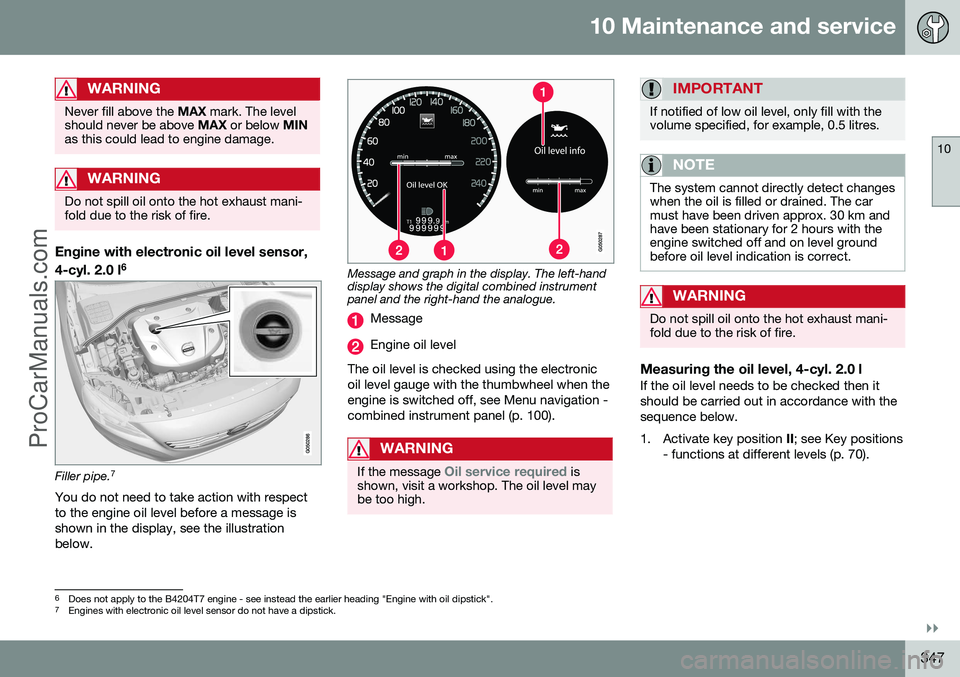
Message and graph in the display. The left-hand display shows the digital combined instrumentpanel and the right-hand the analogue.
Message
Engine oil level
The oil level is checked using the electronic oil level gauge with the thumbwheel when theengine is switched off, see Menu navigation -combined instrument panel (p. 100).
WARNING
If the message Oil service required is
shown, visit a workshop. The oil level may be too high.
IMPORTANT
If notified of low oil level, only fill with the volume specified, for example, 0.5 litres.
NOTE
The system cannot directly detect changes when the oil is filled or drained. The carmust have been driven approx. 30 km andhave been stationary for 2 hours with theengine switched off and on level groundbefore oil level indication is correct.
WARNING
Do not spill oil onto the hot exhaust mani- fold due to the risk of fire.
Measuring the oil level, 4-cyl. 2.0 lIf the oil level needs to be checked then it should be carried out in accordance with thesequence below.
1. Activate key position II; see Key positions
- functions at different levels (p. 70).
6 Does not apply to the B4204T7 engine - see instead the earlier heading "Engine with oil dipstick".7
Engines with electronic oil level sensor do not have a dipstick.
ProCarManuals.co’