2014 VOLKSWAGEN PASSAT CC Mirror
[x] Cancel search: MirrorPage 339 of 429

Make sure there is enough distance to soft materials such as rubber hoses or insulating material as well as the sensors of the Park Distance Control system. The Park Distance Control system sensors
can be found in the front and rear bumpers ⇒ .
Never use concentrated jet nozzles or so-called dirt blasters ⇒ .
Never use a power washer to clean the engine compartment, Cleaning the engine compartment.
WARNING
Improper use of power washers can cause serious invisible permanent damage leading to tire failure and loss of vehicle control. This can cause accidents and severe personal injury.
x Keep sufficient distance between water jet and tires. Never wash tires with a nozzle that sprays the water out in a direct stream regardless of the distance to the tire and even for a very short time.
x Never use “dirt blasters” to clean tires. Even spraying from a relatively long distance for a very short time can do visible or invisible damage to tires.
WARNING
After the vehicle has been washed, the wet brakes or, in winter, brake discs or pads coated with ice, react slower and need longer stopping distances.
x Always dry the brakes and clean off any ice coatings with a few careful applications of the brake. Make sure not to endanger other motorists or cyclists or disobey legal requirements.
NOTICE
x Water temperature should not be more than +140 °F (+60 °C).
x To help prevent damage to the paint, do not wash the vehicle in direct sunlight.
x In order for Park Distance Control to work correctly, the sensors in the rear bumper must be kept clean and clear of snow and ice.
x When using a power washer or steam cleaner, only spray the sensors directly for a short period of time and always keep the nozzle at least 4 inches (10 cm) from the sensor.
x Do not clean icy or snow-covered windows with a power washer.
x When washing or rinsing the vehicle in cold weather, do not let water get into the lock cylinders or point the hose at gaps around the doors, hood, or luggage compartment lid. The water could freeze on the locks and seals and make it difficult to open the vehicle!
Cleaning windows and outside mirrors
Page 340 of 429
341
Removing wax residue
Automatic car washes and vehicle care products can leave a wax residue on all glass surfaces. These wax residues can only be removed with special cleaners or cleaning cloths. Wax residue left on the windshield can cause the windshield wipers to grab and squeak instead of gliding smoothly. We recommend that after every car wash you remove any wax residue left on the windshield with a window cleaning cloth/chamois G 052 522 A1 or equivalent.
Windshield wiper squeak and grab can be reduced by filling the windshield washer fluid tank with a wiper fluid containing wax-removing agents. Make sure to maintain the proper mixing ratio when
refilling the washer fluid tank. Grease-removing cleaning agents cannot remove wax residue ⇒ .
Windshield cleaners, special cleaners, and cleaning cloths are available from your authorized Volkswagen dealer and authorized Volkswagen Service Facility.
Removing snow
Remove snow from all windows and outside mirrors with an appropriate brush.
Removing ice
The best way to remove ice is with a deicer spray. When using an ice scraper always scrape in one direction, never back and forth. Dirt can scratch the glass when moving the scraper backward.
WARNING
Dirty or fogged up windows reduce visibility and increase the risk of accidents and severe injuries.
x Don't drive until you have clear visibility through all windows.
x Remove ice, snow and condensation from all inside and outside window surfaces.
NOTICE
x Never mix recommended cleaning agents with other cleaning agents in the windshield washer reservoir. If you do, this could cause sediments or other by-products that can clog the windshield wiper nozzles.
x Never use warm or hot water to remove snow and ice from windows and mirrors. This could cause the glass to crack!
x The heating elements for the rear defroster are on the inside of the rear window. Do not put stickers over the heating elements on the inside of the rear window and never clean the inside of the windows with corrosive or acidic cleaning agents or other chemicals that could damage the heating elements.
x Antennas installed on the insides of windows can be damaged by abrasive objects or by corrosive or acidic cleaning agents or other chemicals. Do not place any stickers on the windshield-integrated antenna and never clean the antenna with corrosive or acidic cleaning agents or other chemicals.
Page 369 of 429

Frequently asked questions (FAQ)
If you suspect a malfunction or vehicle damage, read and follow the following advice before contacting an authorized Volkswagen dealer or an authorized Volkswagen Service Facility. You may also find helpful information under “Special considerations” or “Checklist” in the index.
Description Possible causes, among others Possible remedy
Engine does not start.
Vehicle battery dead. – Perform jump-start – Charge vehicle battery
The wrong vehicle key is used. Use a valid vehicle key
Fuel level too low. Refuel
Vehicle cannot be locked or unlocked using vehicle key.
– Battery in the remote control vehicle key is dead. – Too far away from the vehicle (out of range). – Buttons have been pressed too many times.
– Replace the battery in the remote control vehicle key – Move closer to vehicle. – Synchronize vehicle key – Lock or unlock vehicle manually
Unusual noises. Cold engine, braking assist systems, electronic steering column lock. Check the “Noises” entry in the index.
Odd driving behavior.
Assistance systems activated. Check the “Assistance systems” entry in the index.
DSG® Direct Shift Gearbox too hot. Stop vehicle as soon as you can safely do so.
Driver seat and outside mirrors move when vehicle is unlocked.
Convenience settings are stored. Correct convenience settings
Memory-seat settings are stored. – Reassign seat setting – Clear memory-seat memory
Front seats cannot be adjusted with power controls.
Vehicle battery dead. Charge vehicle battery
Fuse blown. Check fuse and replace if necessary
No jack, spare wheel, or compact spare wheel in the vehicle.
Equipment differs depending on the vehicle. No direct corrective action possible; depends on the vehicle equipment. Contact an authorized Volkswagen dealer or an authorized Volkswagen Service Facility for assistance.
Vehicle has run-flat tires (mobility tires).
Features do not work as described in this manual.
Settings were adjusted in the Volkswagen Information System.
Check and reset to factory settings if necessary
Headlights do not light up the road as they should.
– Headlights incorrectly adjusted. – Light bulbs burned out. – Low beams not switched on.
– Have the headlight range adjusted by an authorized Volkswagen dealer or an authorized Volkswagen Service Facility. – Change light bulbs– Switch on low beams
Electrical consumers do not work.
Vehicle battery charge too low. Charge vehicle battery
Remaining fuel level too low. Refuel
Page 410 of 429

8. Install the rubber cover ⇒ fig. 195 (2).
Replacing the HID bulb
See your authorized Volkswagen dealer or authorized Volkswagen Service Facility for assistance in replacing the HID bulb (1).
The illustrations show the right headlight from behind. The left headlight is arranged as a mirror image of the right.
Failure of a single LED within a headlight is not indicated. However, the = indicator light will appear if all LEDs fail.
Different models may have different lights, and the location and design of covers, bulb holders, and bulbs may be in a different location than shown in the illustrations.
You cannot replace the LEDs in LED daytime running lights. Contact your authorized Volkswagen dealer or an authorized Volkswagen Service Facility for assistance.
Replacing light bulbs in the front bumper
Fig. 197 In the left front bumper: Fog light.
Page 413 of 429
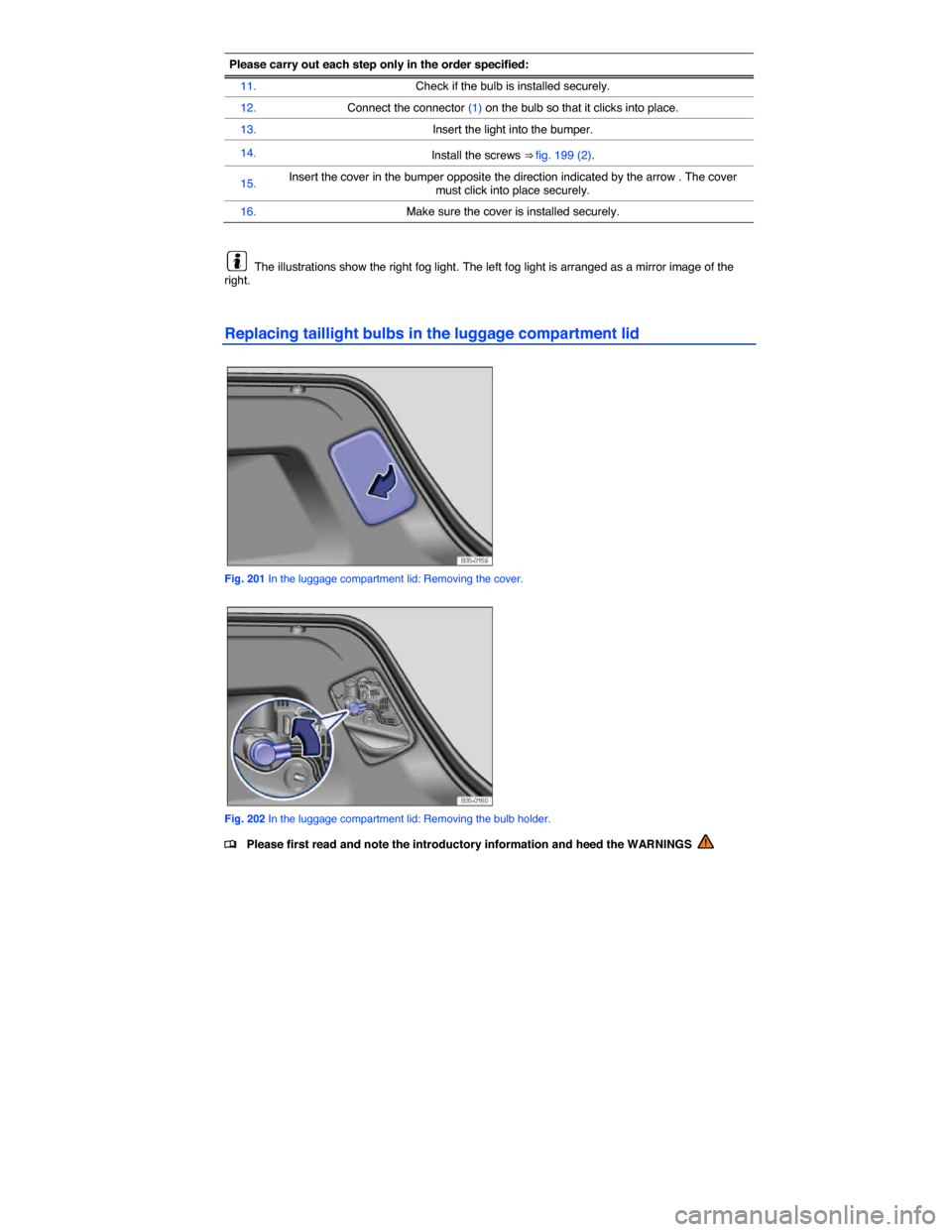
Please carry out each step only in the order specified:
11. Check if the bulb is installed securely.
12. Connect the connector (1) on the bulb so that it clicks into place.
13. Insert the light into the bumper.
14. Install the screws ⇒ fig. 199 (2).
15. Insert the cover in the bumper opposite the direction indicated by the arrow . The cover must click into place securely.
16. Make sure the cover is installed securely.
The illustrations show the right fog light. The left fog light is arranged as a mirror image of the right.
Replacing taillight bulbs in the luggage compartment lid
Fig. 201 In the luggage compartment lid: Removing the cover.
Fig. 202 In the luggage compartment lid: Removing the bulb holder.