Page 210 of 872
210 1-7. Safety information
SIENNA_OM_OM45483U_(U)
CAUTION
■When installing a child restraint system
●When installing a child restraint system on the third center seat, adjust
both seatbacks at the same angle. Otherwise, the child restraint system
cannot be securely restrained and this may cause death or serious injuries
in the event of sudden braking, sudden swerving or an accident.
● When using the LATCH anchors for a child restraint system, move the seat
as far back as possible (second seat only), with the seatback close to the
child restraint system.
● When a booster seat is installed, always ensure that the shoulder belt is
positioned across the center of the child’s shoulder. The belt should be
kept away from the child’s neck, but not so that it could fall off the child’s
shoulder. Failing to do so may result in death or serious injury in the event
of sudden braking, sudden swerving or an accident.
● Ensure that the belt and plate are securely locked and the seat belt is not
twisted.
● Push and pull the child restraint system from side to side and forward to be
sure it is secure.
● After securing a child restraint system, never adjust the seat.
● Follow all installation instructions provided by the child restraint system
manufacturer.
Page 211 of 872
211
1-7. Safety information
1
Before driving
SIENNA_OM_OM45483U_(U)
CAUTION
■
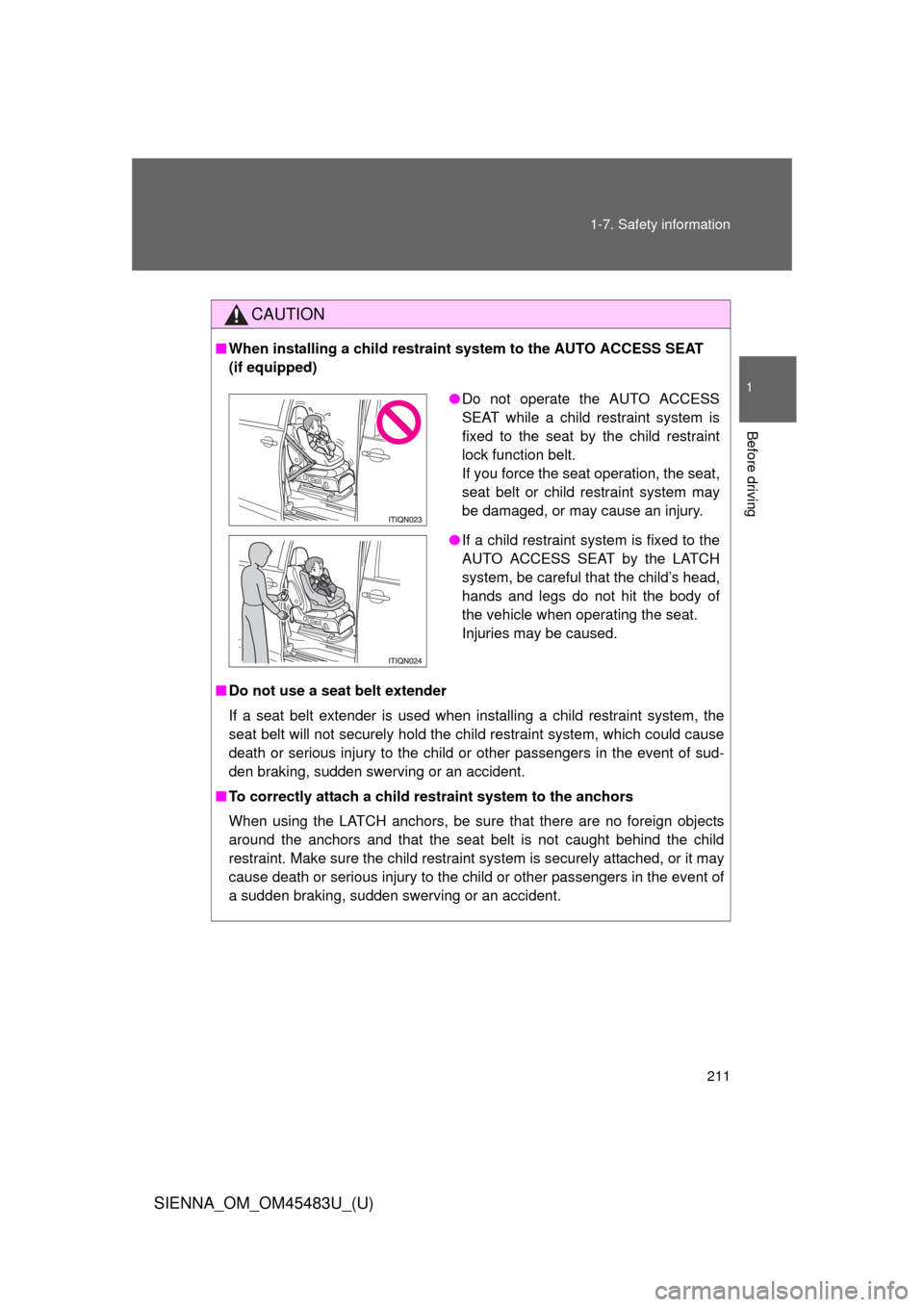
When installing a child restraint s ystem to the AUTO ACCESS SEAT
(if equipped)
■ Do not use a seat belt extender
If a seat belt extender is used when installing a child restraint system, the
seat belt will not securely hold the child restraint system, which could cause
death or serious injury to the child or other passengers in the event of sud-
den braking, sudden swerving or an accident.
■ To correctly attach a child r estraint system to the anchors
When using the LATCH anchors, be sure that there are no foreign objects
around the anchors and that the seat belt is not caught behind the child
restraint. Make sure the child restraint system is securely attached, or it may
cause death or serious injury to the child or other passengers in the event of
a sudden braking, sudden swerving or an accident.
● Do not operate the AUTO ACCESS
SEAT while a child restraint system is
fixed to the seat by the child restraint
lock function belt.
If you force the seat operation, the seat,
seat belt or child restraint system may
be damaged, or may cause an injury.
● If a child restraint system is fixed to the
AUTO ACCESS SEAT by the LATCH
system, be careful that the child’s head,
hands and legs do not hit the body of
the vehicle when operating the seat.
Injuries may be caused.
Page 222 of 872
222 2-1. Driving procedures
SIENNA_OM_OM45483U_(U)
CAUTION
■When the vehicle is stopped
●Do not race the engine.
If the vehicle is in any gear other than P or N, the vehicle may accelerate
suddenly and unexpectedly, causing an accident.
● Do not leave the vehicle with the engine running for a long time.
If such a situation cannot be avoided, park the vehicle in an open space
and check that exhaust fumes do not enter the vehicle interior.
● In order to prevent accidents due to the vehicle rolling away, always keep
depressing the brake pedal while the engine is running, and apply the
parking brake as necessary.
● If the vehicle is stopped on an incline, in order to prevent accidents caused
by the vehicle rolling forward or backward, always depress the brake pedal
and securely apply the parking brake as needed.
● Avoid revving or racing the engine.
Running the engine at high speed while the vehicle is stopped may cause
the exhaust system to overheat, which could result in a fire if combustible
material is nearby.
Page 225 of 872
225
2-1. Driving procedures
2
When driving
SIENNA_OM_OM45483U_(U)
CAUTION
■
When taking a nap in the vehicle
Always turn the engine off. Otherwise, if you accidentally move the shift lever
or depress the accelerator pedal, this could cause an accident or fire due to
engine overheating. Additionally, if the vehicle is parked in a poorly venti-
lated area, exhaust gases may collect and enter the vehicle, leading to
death or a serious health hazard.
■ When braking
●When the brakes are wet, drive more cautiously.
Braking distance increases when the brakes are wet, and this may cause
one side of the vehicle to brake differently than the other side. Also the
parking brake may not securely hold the vehicle.
● If the power brake assist function does not operate, do not follow other
vehicles closely and avoid hills or sharp turns that require braking.
In this case, braking is still possible, but the brake pedal should be
depressed more firmly than usual. Also, the braking distance will increase.
Have your brakes fixed immediately.
● Do not pump the brake pedal if the engine stalls.
Each push on the brake pedal uses up the reserve for the power-assisted
brakes.
● The brake system consists of 2 individual hydraulic systems: If one of the
systems fails, the other will still operate. In this case, the brake pedal
should be depressed more firmly than usual and braking distance will
increase.
Have your brakes fixed immediately.
■ If the vehicle becomes stuck (AWD models)
Do not spin the wheels excessively when any of the tires is up in the air, or
the vehicle is stuck in sand or mud, etc. This may damage the driveline com-
ponents or unexpectedly propel the vehicle forward or backward, causing an
accident.
Page 245 of 872
245
2-1. Driving procedures
2
When driving
SIENNA_OM_OM45483U_(U)
Hor n
■After adjusting the steering wheel
Make sure that the steering wheel is securely locked.
The horn may not sound if the steering wheel is not securely locked.
(P. 138)
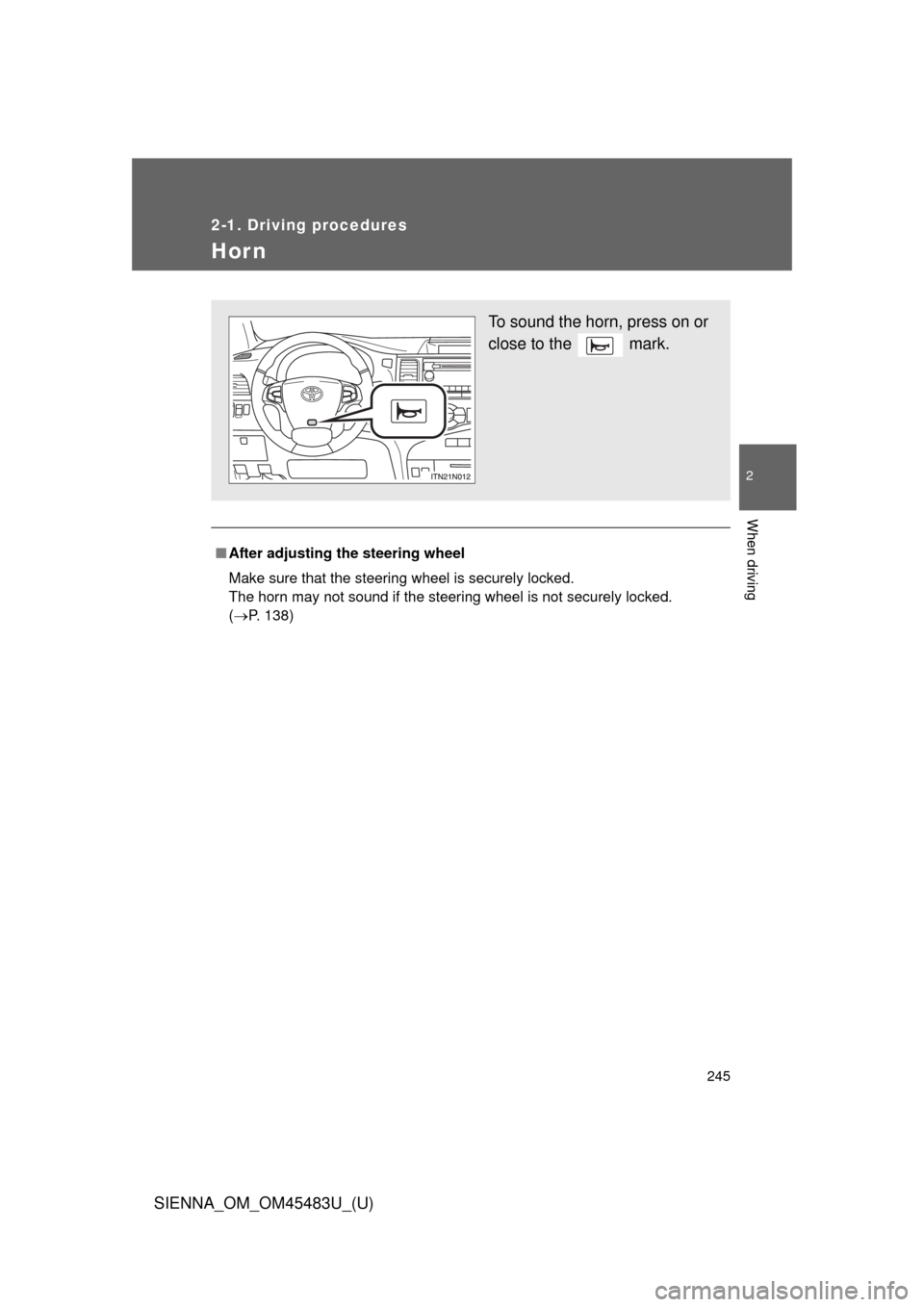
To sound the horn, press on or
close to the mark.
Page 251 of 872
251
2-2. Instrument cluster and information display
2
When driving
SIENNA_OM_OM45483U_(U)
■
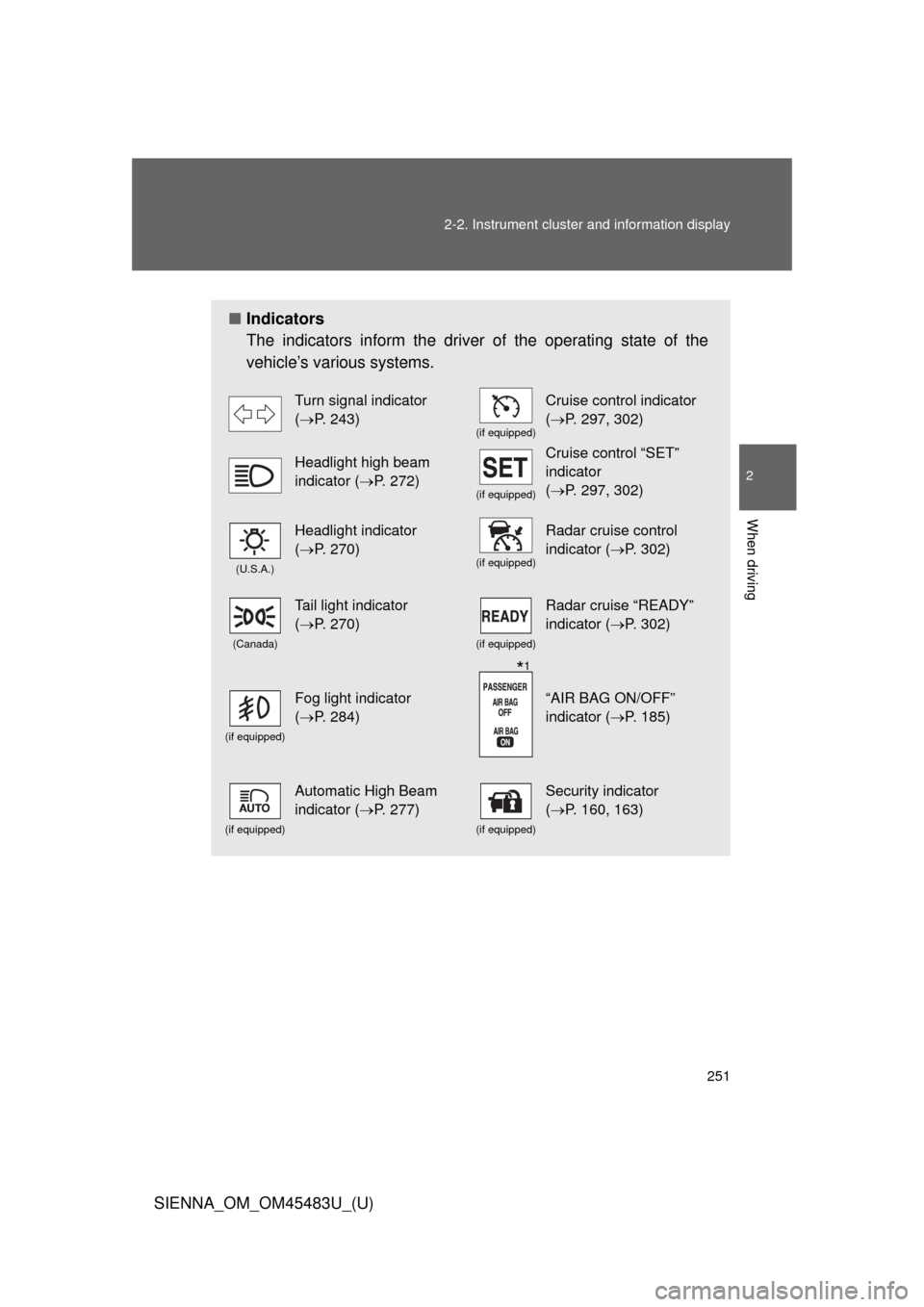
Indicators
The indicators inform the driver of the operating state of the
vehicle’s various systems.
Turn signal indicator
(P. 243)
(if equipped)
Cruise control indicator
(P. 297, 302)
Headlight high beam
indicator ( P. 272)
(if equipped)
Cruise control “SET”
indicator
(P. 297, 302)
(U.S.A.)
Headlight indicator
(P. 270)
(if equipped)
Radar cruise control
indicator (P. 302)
(Canada)
Tail light indicator
(P. 270)
(if equipped)
Radar cruise “READY”
indicator (P. 302)
(if equipped)
Fog light indicator
(P. 284)“AIR BAG ON/OFF”
indicator (P. 185)
(if equipped)
Automatic High Beam
indicator ( P. 277)
(if equipped)
Security indicator
(P. 160, 163)
*1
Page 284 of 872
284
2-3. Operating the lights and wipers
SIENNA_OM_OM45483U_(U)
Fog light switch
: If equipped
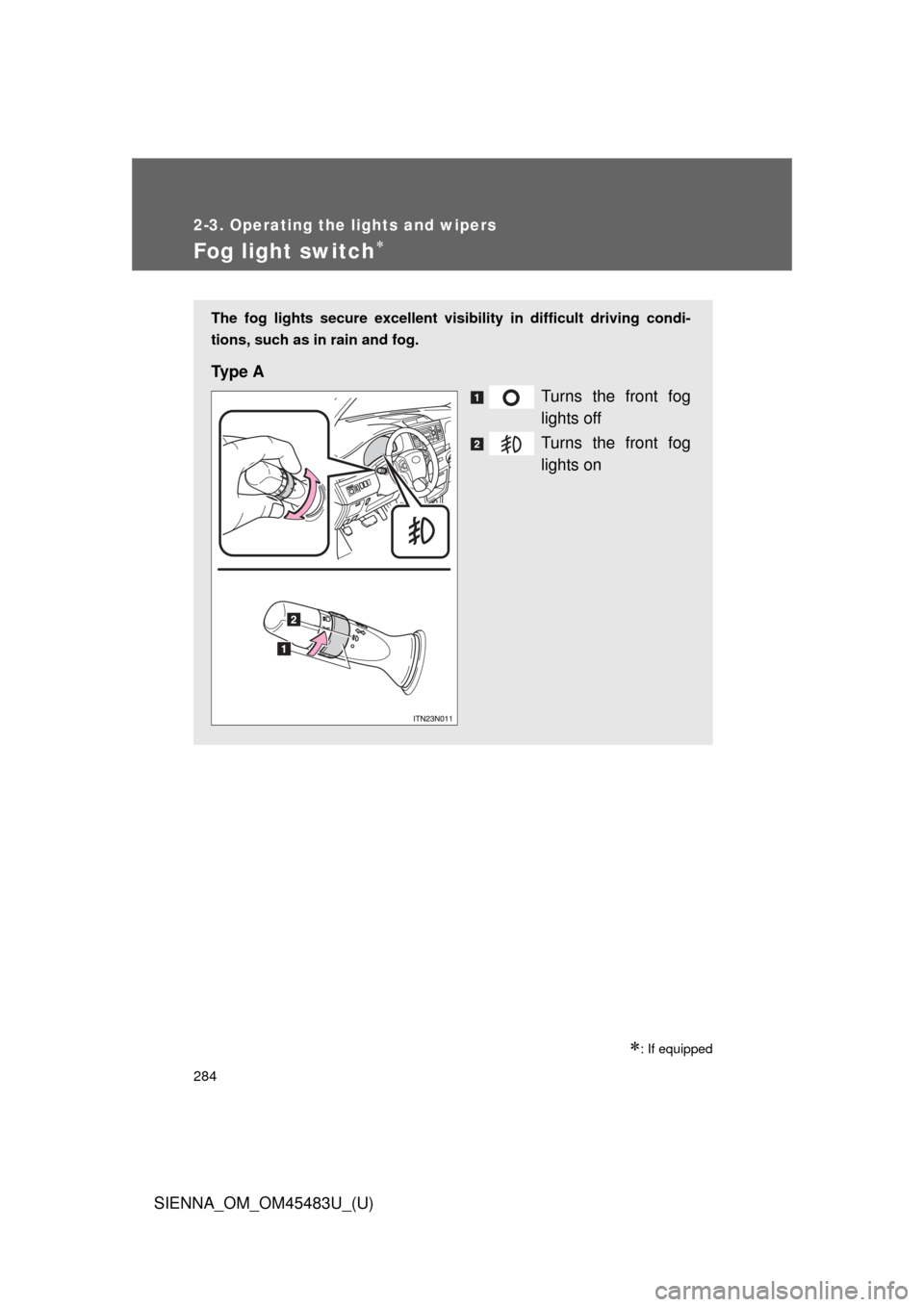
The fog lights secure excellent visibility in difficult driving condi-
tions, such as in rain and fog.
Ty p e A
Turns the front fog
lights off
Turns the front fog
lights on
Page 354 of 872
354 2-4. Using other driving systems
SIENNA_OM_OM45483U_(U)
■Conditions under which the Blind Spot Monitor function may not func-
tion correctly
●The Blind Spot Monitor function may not detect vehicles correctly in the
following conditions:
• During bad weather such as heavy rain, fog, snow etc.
• When ice or mud etc. is attached to the rear bumper
• When driving on a road surface that is wet due to rain, standing water
etc.
• When there is a significant difference in speed between your vehicle and the vehicle that enters the detection area
• When a vehicle is in the detection area from a stop and remains in the detection area as your vehicle accelerates
• When driving up or down consecutive steep inclines, such as hills, a dip in the road etc.
• When multiple vehicles approach with only a small gap between each vehicle
• When vehicle lanes are wide, and the vehicle in the next lane is too far away from your vehicle
• When the vehicle that enters the detection area is traveling at about the same speed as your vehicle
• When there is a significant difference in height between your vehicle and the vehicle that enters the detection area
• Directly after the BSM main switch is set to on
• When towing a trailer
• When items such as a bicycle carrier are installed on the rear of the vehicle
● Instances of the Blind Spot Monitor function unnecessarily detecting a
vehicle and/or object may increase under the following conditions:
• When there is only a short distance between your vehicle and a guard-
rail, wall etc.
• When there is only a short distance between your vehicle and a follow- ing vehicle
• When vehicle lanes are narrow and a vehicle driving 2 lanes across from your vehicle enters the detection area
• When items such as a bicycle carrier are installed on the rear of the vehicle