Page 415 of 563
412 4-3. Do-it-yourself maintenance
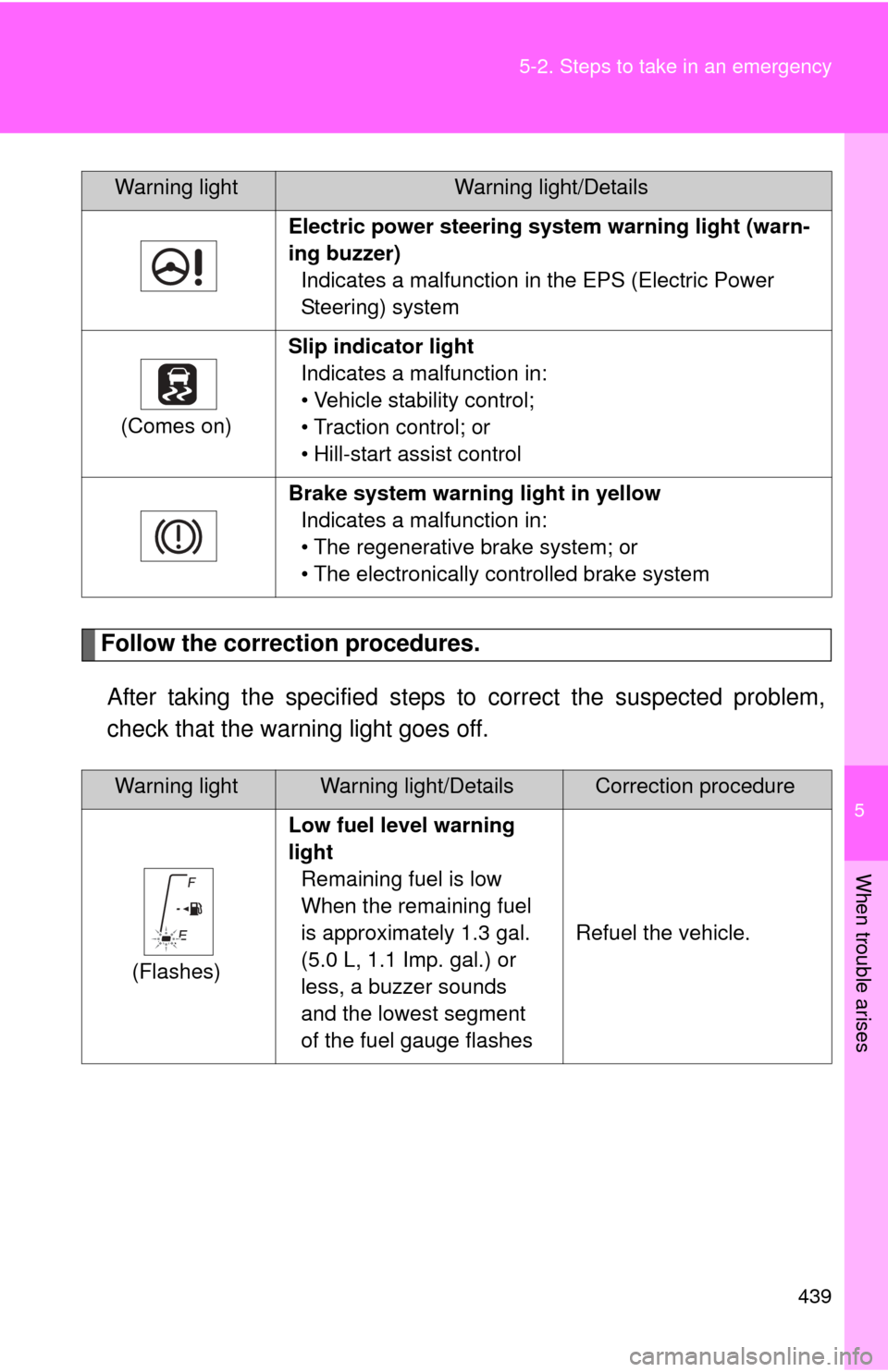
Under the driver’s side instrument panel
FuseAmpereCircuit
1 TAIL 10 A Parking lights, side marker lights,
tail lights, license plate lights, front
fog lights, gauge and meters
2 PANEL 5 A Instrument panel lights
3 DOOR R/R 20 A Rear power window (right side)
4 DOOR P 20 A Front power window (right side)
5 ECU-IG NO.1 5 A Rear window defogger, tire pres-
sure warning system, main body
ECU, brake system, vehicle stabil-
ity control system, power door lock
system, smart key system
6 ECU-IG NO.2 5 A Electric power steering system
7HTR-IG 7.5 A Air conditioning system, PTC
heater
8 GAUGE 10 A Back-up lights, audio system, shift
lock control system, moon roof,
vehicle control and operation data
recording, vehicle proximity notifi-
cation system
9 WASHER 15 A Windshield wipers and washer
10 WIPER 25 A Windshield wipers and washer
11 WIPER RR 15 A Windshield wipers and washer
12 P/W 30 A Power window
Page 420 of 563
417
4-3. Do-it-yourself maintenance
4
Maintenance and care
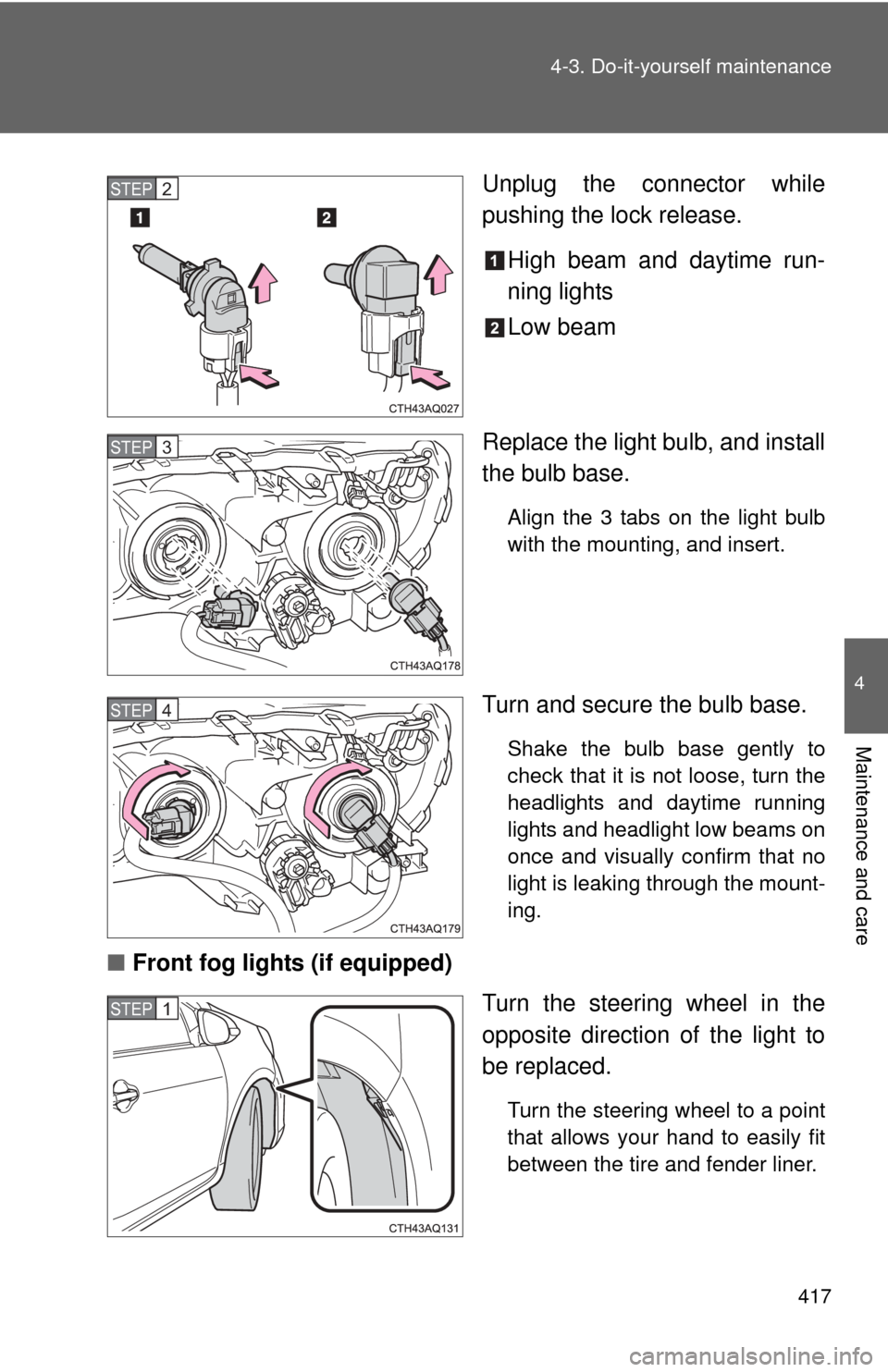
Unplug the connector while
pushing the lock release.
High beam and daytime run-
ning lights
Low beam
Replace the light bulb, and install
the bulb base.
Align the 3 tabs on the light bulb
with the mounting, and insert.
Turn and secure the bulb base.
Shake the bulb base gently to
check that it is not loose, turn the
headlights and daytime running
lights and headlight low beams on
once and visually confirm that no
light is leaking through the mount-
ing.
■ Front fog lights (if equipped)
Turn the steering wheel in the
opposite direction of the light to
be replaced.
Turn the steering wheel to a point
that allows your hand to easily fit
between the tire and fender liner.
STEP2
STEP3
STEP4
STEP1
Page 423 of 563
420 4-3. Do-it-yourself maintenance
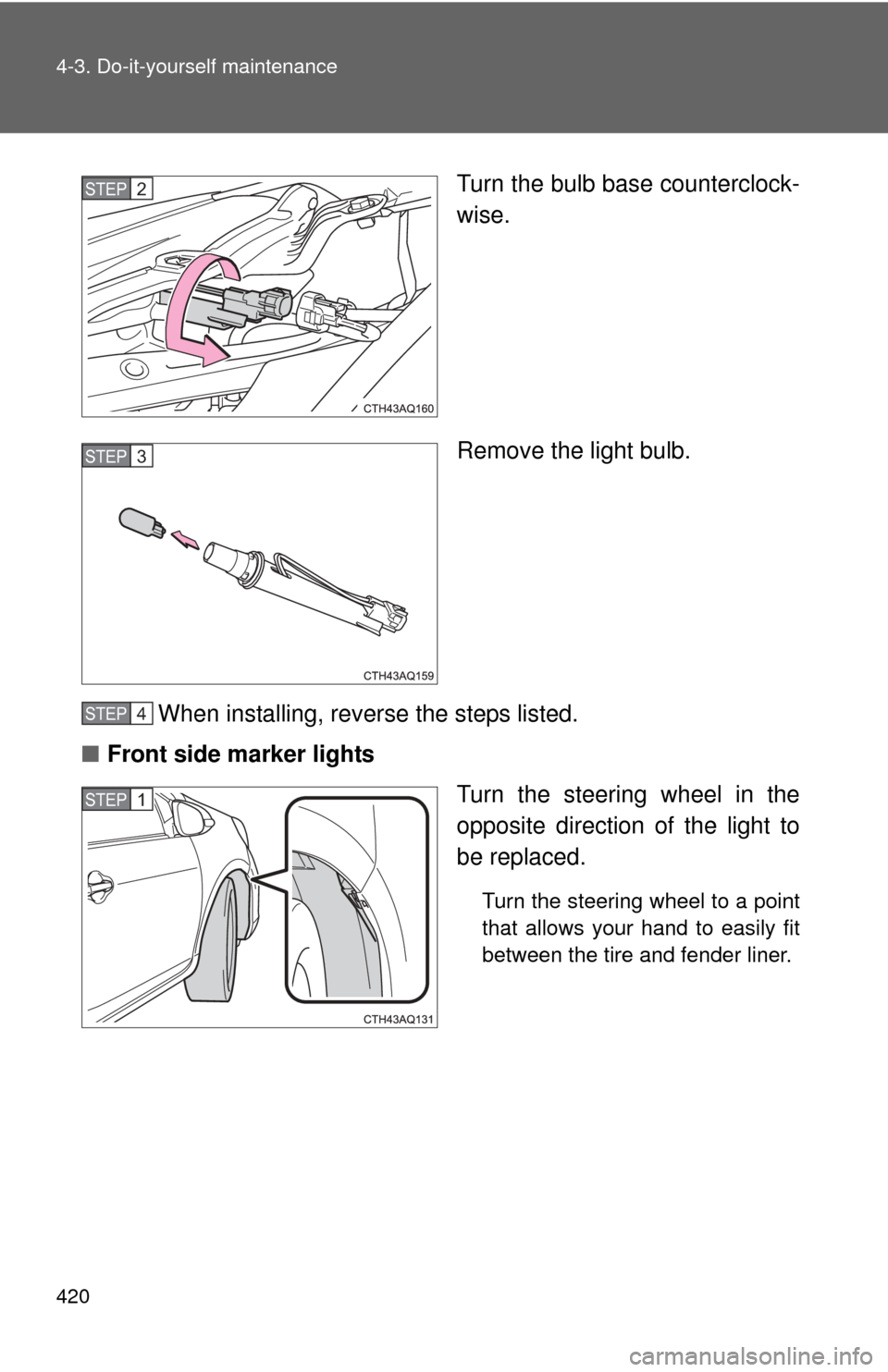
Turn the bulb base counterclock-
wise.
Remove the light bulb.
When installing, reverse the steps listed.
■ Front side marker lights
Turn the steering wheel in the
opposite direction of the light to
be replaced.
Turn the steering wheel to a point
that allows your hand to easily fit
between the tire and fender liner.
STEP2
STEP3
STEP4
STEP1
Page 434 of 563
5
When trouble arises
431
5-1. Essential information
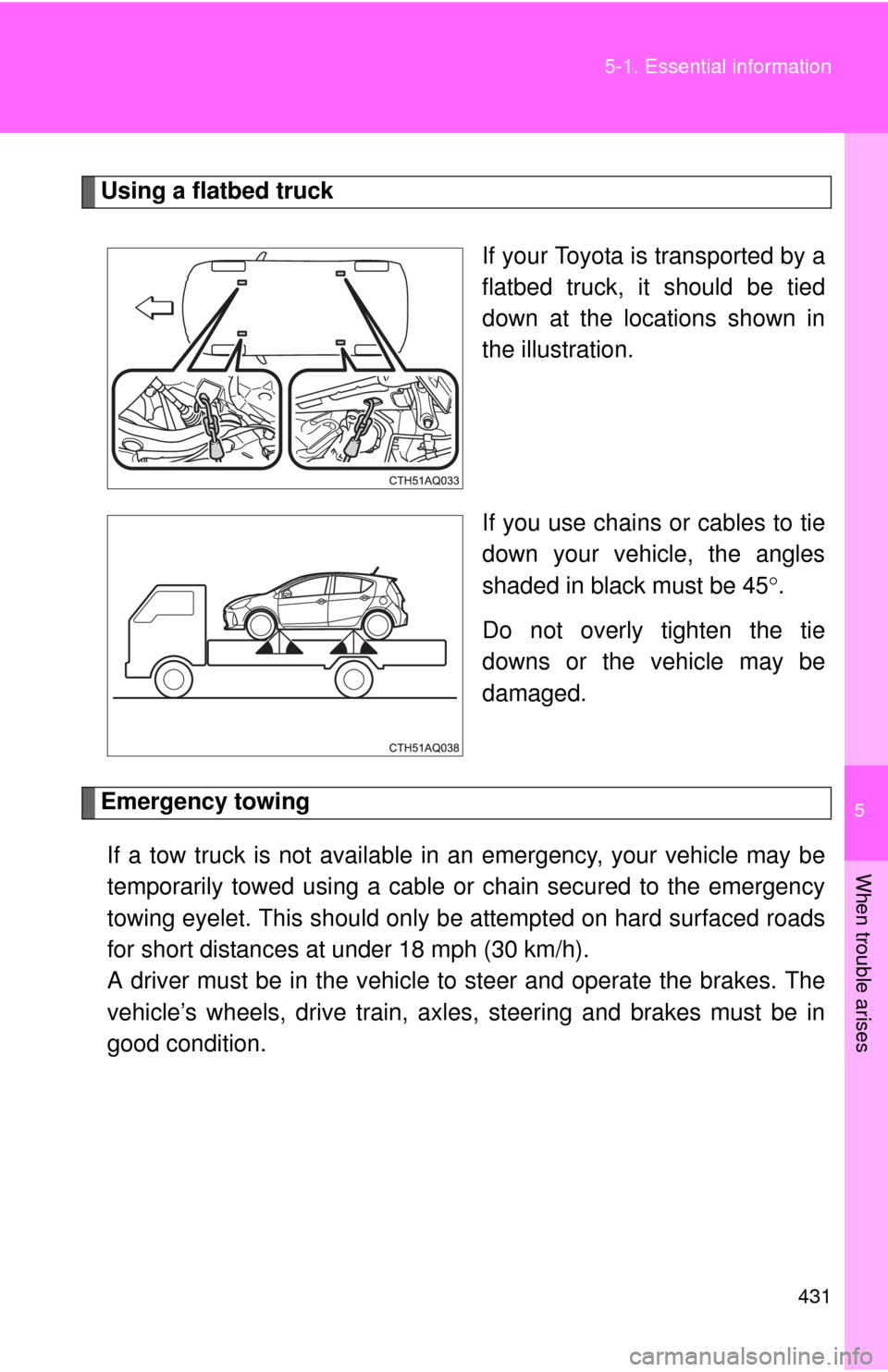
Using a flatbed truck
If your Toyota is transported by a
flatbed truck, it should be tied
down at the locations shown in
the illustration.
If you use chains or cables to tie
down your vehicle, the angles
shaded in black must be 45.
Do not overly tighten the tie
downs or the vehicle may be
damaged.
Emergency towing
If a tow truck is not available in an emergency, your vehicle may be
temporarily towed using a cable or chain secured to the emergency
towing eyelet. This should only be attempted on hard surfaced roads
for short distances at under 18 mph (30 km/h).
A driver must be in the vehicle to steer and operate the brakes. The
vehicle’s wheels, drive train, axles, steering and brakes must be in
good condition.
Page 436 of 563
5
When trouble arises
433
5-1. Essential information
Vehicles without a smart key
system: Enter the vehicle being
towed and start the hybrid system.
If the hybrid system does not start, turn the engine switch to the “ON”
position.
Vehicles with a smart key sy stem: Enter the vehicle being
towed and start the hybrid system.
If the hybrid system does not start, turn the “POWER” switch to ON
mode.
Shift the shift lever to N and release the parking brake.
When the shift lever cannot be shifted: P. 477
■While towing
If the hybrid system is off, the power assist for the brakes and steering will
not function, making steering and braking more difficult.
■ Wheel nut wrench
Wheel nut wrench is installed in luggage compartment. ( P. 463)
STEP6
STEP7
Page 437 of 563
434 5-1. Essential information
CAUTION
Observe the following precautions.
Failure to do so may result in death or serious injury.
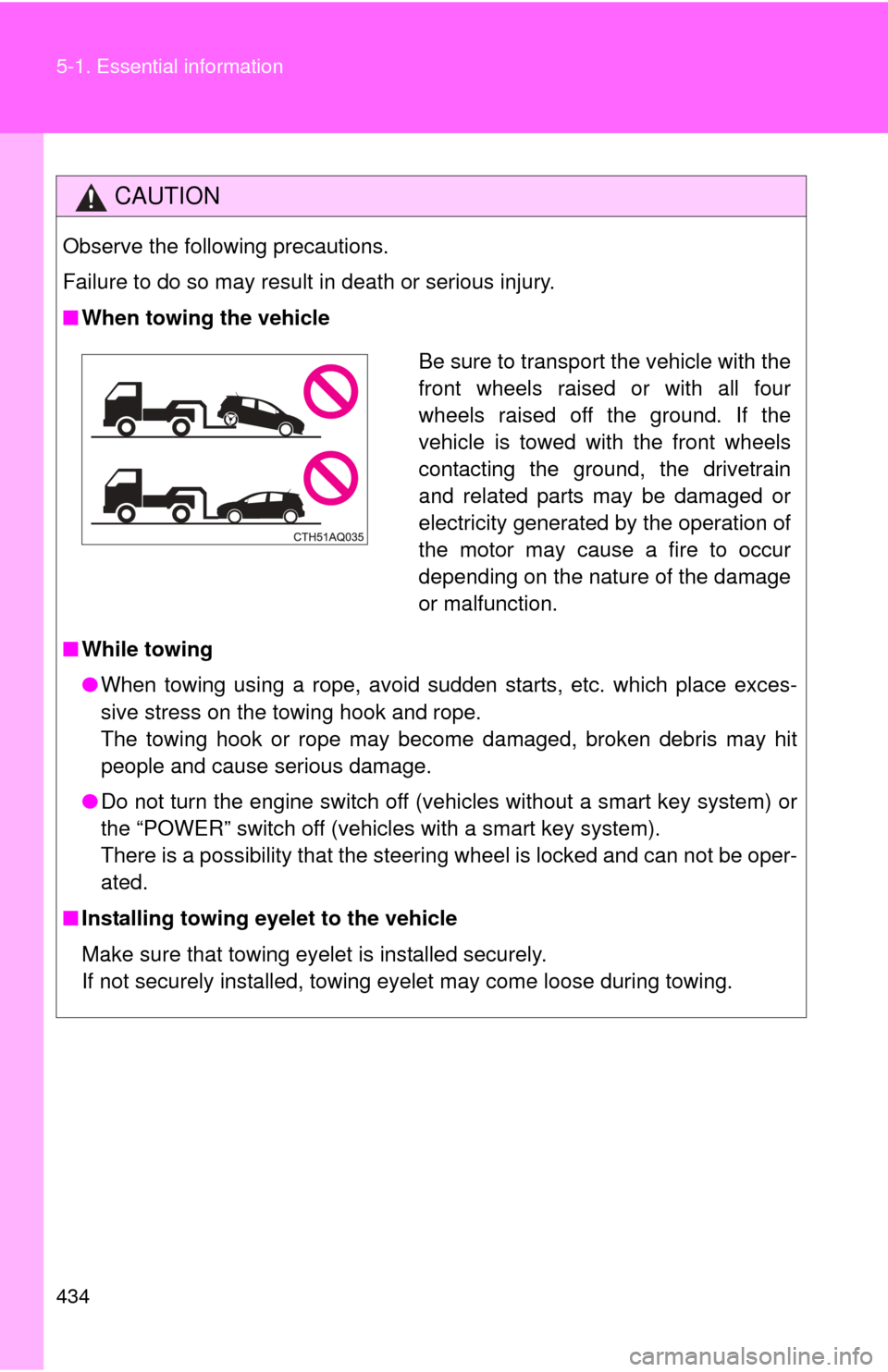
■When towing the vehicle
■ While towing
●When towing using a rope, avoid sudden starts, etc. which place exces-
sive stress on the towing hook and rope.
The towing hook or rope may become damaged, broken debris may hit
people and cause serious damage.
● Do not turn the engine switch off (vehicles without a smart key system) or
the “POWER” switch off (vehicles with a smart key system).
There is a possibility that the steering wheel is locked and can not be oper-
ated.
■ Installing towing eyelet to the vehicle
Make sure that towing eyelet is installed securely.
If not securely installed, towing eyelet may come loose during towing.
Be sure to transport the vehicle with the
front wheels raised or with all four
wheels raised off the ground. If the
vehicle is towed with the front wheels
contacting the ground, the drivetrain
and related parts may be damaged or
electricity generated by the operation of
the motor may cause a fire to occur
depending on the nature of the damage
or malfunction.
Page 442 of 563
5
When trouble arises
439
5-2. Steps to take in an emergency
Follow the correction procedures.
After taking the specified steps to correct the suspected problem,
check that the warning light goes off.
Electric power steering syst em warning light (warn-
ing buzzer) Indicates a malfunction in the EPS (Electric Power
Steering) system
(Comes on) Slip indicator light
Indicates a malfunction in:
• Vehicle stability control;
• Traction control; or
• Hill-start assist control
Brake system warning light in yellow Indicates a malfunction in:
• The regenerative brake system; or
• The electronically controlled brake system
Warning lightWarning light/DetailsCorrection procedure
(Flashes) Low fuel level warning
light
Remaining fuel is low
When the remaining fuel
is approximately 1.3 gal.
(5.0 L, 1.1 Imp. gal.) or
less, a buzzer sounds
and the lowest segment
of the fuel gauge flashes Refuel the vehicle.
Warning lightWarning light/Details
Page 444 of 563

5
When trouble arises
441
5-2. Steps to take in an emergency
*: Driver's and front passen
ger's seat belt buzzer:
The driver's and front passenger's seat belt buzzer sounds to alert the driver
and front passenger that his or her seat belt is not fastened. Once the engine
switch is turned to the “ON” or “START” position (vehicles without a smart
key system) or the “POWER” switch is turned to ON mode (vehicles with a
smart key system), the buzzer sounds for 6 seconds. If the vehicle reaches a
speed of 12 mph (20 km/h), the buzzer sounds once. If the seat belt is still
unfastened after 30 seconds, the buzzer will sound intermittently for 10 sec-
onds. Then, if the seat belt is still unfastened, the buzzer will sound in a dif-
ferent tone for 20 more seconds.
■ SRS warning light
This warning light system monitors the airbag sensor assembly, front impact
sensors, side impact sensors, driver's seat belt buckle switch, front passen-
ger occupant classification system (ECU and sensors), “AIR BAG ON” indi-
cator light, “AIR BAG OFF” indicator light, front passenger's seat belt buckle
switch, seat belt pretensioner assemblies, airbags, interconnecting wiring
and power sources. ( P. 438)
■ Front passenger detection sensor, passenger seat belt reminder and
warning buzzer
● If luggage is placed on the front passenger seat, the front passenger
detection sensor may cause the warning light to flash and the warning
buzzer to sound even if a passenger is not sitting in the seat.
● If a cushion is placed on the seat, the sensor may not detect a passen-
ger, and the warning light may not operate properly.
■ Electric power steering system wa rning light (warning buzzer)
When the 12-volt battery charge becomes insufficient or the voltage tempo-
rarily drops, the electric power st eering system warning light may come on
and the warning buzzer may sound.