2014 TOYOTA 4RUNNER lights
[x] Cancel search: lightsPage 406 of 530
4046-3. Do-it-yourself maintenance
4RUNNER (U)_(OM35A83U)■
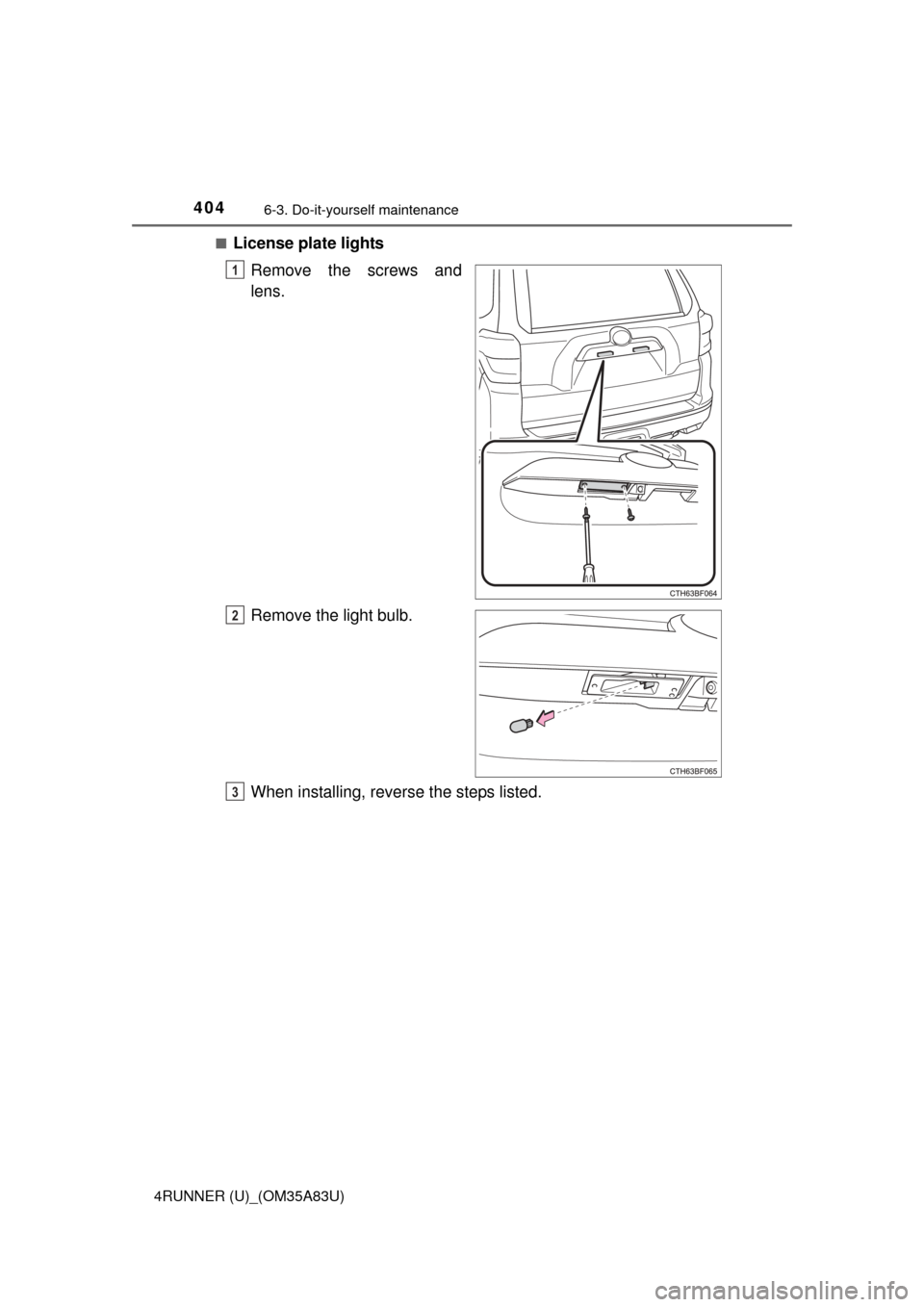
License plate lights
Remove the screws and
lens.
Remove the light bulb.
When installing, reverse the steps listed.
1
2
3
Page 407 of 530

4056-3. Do-it-yourself maintenance
6
Maintenance and care
4RUNNER (U)_(OM35A83U)■
Replacing the following bulbs
If any of the lights listed below
has burnt out, have it replaced by
your Toyota dealer.
● Fog light (right side)
● Side turn signal lights
● Stop/tail lights
● Rear side marker lights
● High mounted stoplight
● Outer foot lights (if equipped)
■LED light bulbs
The side turn signal lights, stop/tail lights, rear side marker lights, high
mounted stoplight and outer foot lights consist of a number of LEDs. If any
LEDs burn out, take your vehicle to your Toyota dealer to have the light
replaced.
■ Condensation build-up on the inside of the lens
Temporary condensation build-up on the inside of the lens does not indicate a
malfunction. Contact your Toyota dealer for more information in the following
situations:
●Large drops of water have built up on the inside of the lens.
● Water has built up inside the lens.
CAUTION
■Replacing light bulbs
● Turn off the lights. Do not attempt to replace the bulb immediately after
turning off the lights.
The bulbs become very hot and may cause burns.
● Do not touch the glass portion of the light bulb with bare hands. When it is
unavoidable to hold the glass portion, use and hold with a clean dry cloth
to avoid getting moisture and oils on the bulb.
Also, if the bulb is scratched or dropped, it may blow out or crack.
● Fully install light bulbs and any parts used to secure them. Failure to do so
may result in heat damage, fire, or water entering the headlight unit. This
may damage the headlights or cause condensation to build up on the lens.
■ To prevent damage or fire
● Make sure bulbs are fully seated and locked.
● Check the wattage of the bulb before installing to prevent heat damage.
Page 420 of 530
4187-2. Steps to take in an emergency
4RUNNER (U)_(OM35A83U)
If a warning light turns on or a warning
buzzer sounds
Calmly perform the following actions if any of the warning lights
comes on or flashes. If a light comes on or flashes, but then
goes off, this does not necessarily indicate a malfunction in the
system. However, if this continues to occur, have the vehicle
inspected by your Toyota dealer.
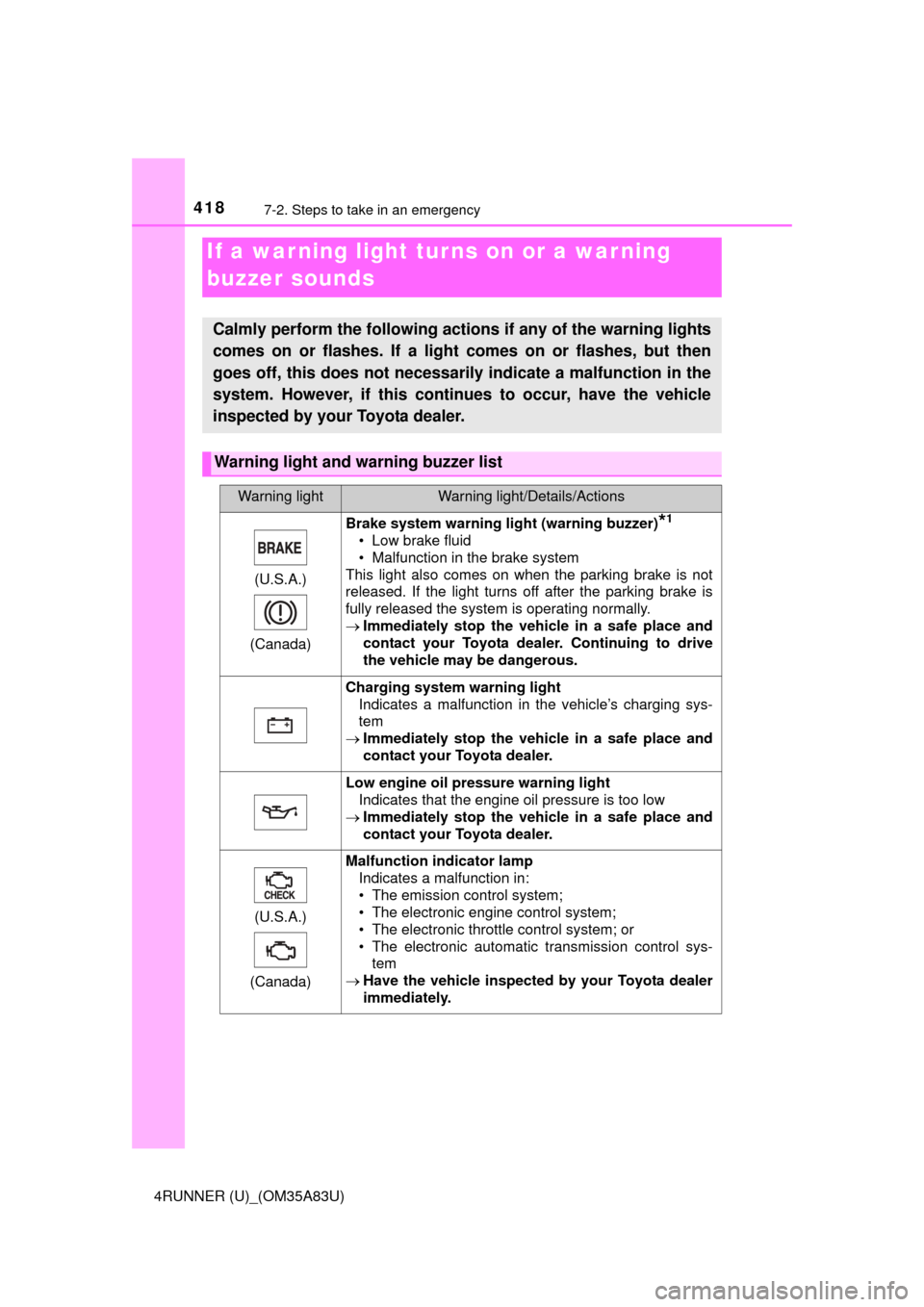
Warning light and warning buzzer list
Warning lightWarning light/Details/Actions
(U.S.A.)
(Canada)
Brake system warning light (warning buzzer)*1
• Low brake fluid
• Malfunction in the brake system
This light also comes on when the parking brake is not
released. If the light turns off after the parking brake is
fully released the system is operating normally.
Immediately stop the vehicle in a safe place and
contact your Toyota dealer. Continuing to drive
the vehicle may be dangerous.
Charging system warning light
Indicates a malfunction in the vehicle’s charging sys-
tem
Immediately stop the vehicle in a safe place and
contact your Toyota dealer.
Low engine oil pressure warning light
Indicates that the engine oil pressure is too low
Immediately stop the vehicle in a safe place and
contact your Toyota dealer.
(U.S.A.)
(Canada)
Malfunction indicator lamp Indicates a malfunction in:
• The emission control system;
• The electronic engine control system;
• The electronic throttle control system; or
• The electronic automatic transmission control sys-tem
Have the vehicle inspected by your Toyota dealer
immediately.
Page 424 of 530

4227-2. Steps to take in an emergency
4RUNNER (U)_(OM35A83U)
*1: Parking brake engaged warning buzzer:A buzzer will sound if the vehicle is driven at a speed of approximately 3
mph (5 km/h) or more.
*2: Open door warning buzzer:The open door warning buzzer sounds to alert one or more of the doors is
not fully closed (with the vehicle having reached a speed of 3 mph [5 km/h]).
*3: Driver’s and front passenger’s seat belt buzzer: The driver’s and front passenger’s seat belt buzzer sounds to alert the
driver and front passenger that
his or her seat belt is not fastened. The
buzzer sounds intermittently for 10 seconds after the vehicle reaches a
speed of 12 mph (20 km/h). Then, if the seat belt is still unfastened, the
buzzer will sound in a different tone for 20 more seconds.
■ SRS warning light
This warning light system monitors the airbag sensor assembly, front impact
sensors, side impact sensors (front door), side impact sensors (rear), safing
sensor (rear), driver's seat belt buckle switch, front passenger occupant clas-
sification system (ECU and sensors) , “AIR BAG ON” and “AIR BAG OFF”
indicator lights, front passenger's seat belt buckle switch, seat belt preten-
sioners, airbags, interconnecting wiring and power sources. (P. 3 5 )
■ Key reminder buzzer (vehicles without a smart key system)
The buzzer indicates that the key has not been removed with the engine off
and the driver’s door opened.
■ Open moon roof reminder buzzer (if equipped)
The buzzer indicates that the moon roof is not fully closed with the engine off
and the driver’s door opened.
■ Front passenger detection sensor, passenger seat belt reminder and
warning buzzer
● If luggage is placed on the front passenger seat, the front passenger detec-
tion sensor may cause the warning light to flash and the warning buzzer to
sound even if a passenger is not sitting in the seat.
● If a cushion is placed on the seat, the sensor may not detect a passenger,
and the warning light may not operate properly.
■ If the malfunction indicator la mp comes on while driving
First check the following:
● Is the fuel tank empty?
If it is, fill the fuel tank immediately.
● Is the fuel tank cap loose?
If it is, tighten it securely.
The light will go off after several driving trips.
If the light does not go off even after several trips, contact your Toyota dealer
as soon as possible.
Page 448 of 530
4467-2. Steps to take in an emergency
4RUNNER (U)_(OM35A83U)
One of the following may be the cause of the problem:
●There may not be sufficient fuel in the vehicle’s tank.
Refuel the vehicle.
● The engine may be flooded.
Try to restart the engine again following correct starting procedures.
( P. 192, 195)
● There may be a malfunction in the engine immobilizer system.
( P. 70)
One of the following may be the cause of the problem:
● The battery may be discharged. ( P. 452)
● The battery terminal connections may be loose or corroded.
The engine starting system may be malfunctioning due to an electrical
problem such as an open circuit or a blown fuse. However, an interim
measure is available to start the engine.
( P. 447)
If the engine will not start
If the engine will not start even though correct starting proce-
dures are being followed ( P. 192, 195), consider each of the fol-
lowing points:
The engine will not start even though the starter motor operates
normally.
The starter motor turns over slowly, the interior lights and head-
lights are dim, or the horn does not sound or sounds at a low
volume.
The starter motor does not turn over
Page 449 of 530
4477-2. Steps to take in an emergency
7
When trouble arises
4RUNNER (U)_(OM35A83U)
One of the following may be the cause of the problem:
●One or both of the battery terminals may be disconnected.
● The battery may be discharged. ( P. 452)
● There may be a malfunction in the steering lock system (vehicles
with a smart key system).
Contact your Toyota dealer if the problem cannot be repaired, or if repair
procedures are unknown.
When the engine does not start, the following steps can be used as an
interim measure to start the engine if the engine switch is functioning
normally:
Set the parking brake.
Shift the shift lever to P.
Turn the engine switch to ACCESSORY mode.
Press and hold the engine switch for about 15 seconds while
depressing the brake pedal firmly.
Even if the engine can be started using the above steps, the system
may be malfunctioning. Have the v ehicle inspected by your Toyota
dealer.
The starter motor does not turn ov er, the interior lights and head-
lights do not turn on, or the horn does not sound.
Emergency start function (vehicles with a smart key system)
1
2
3
4
Page 455 of 530
4537-2. Steps to take in an emergency
7
When trouble arises
4RUNNER (U)_(OM35A83U)
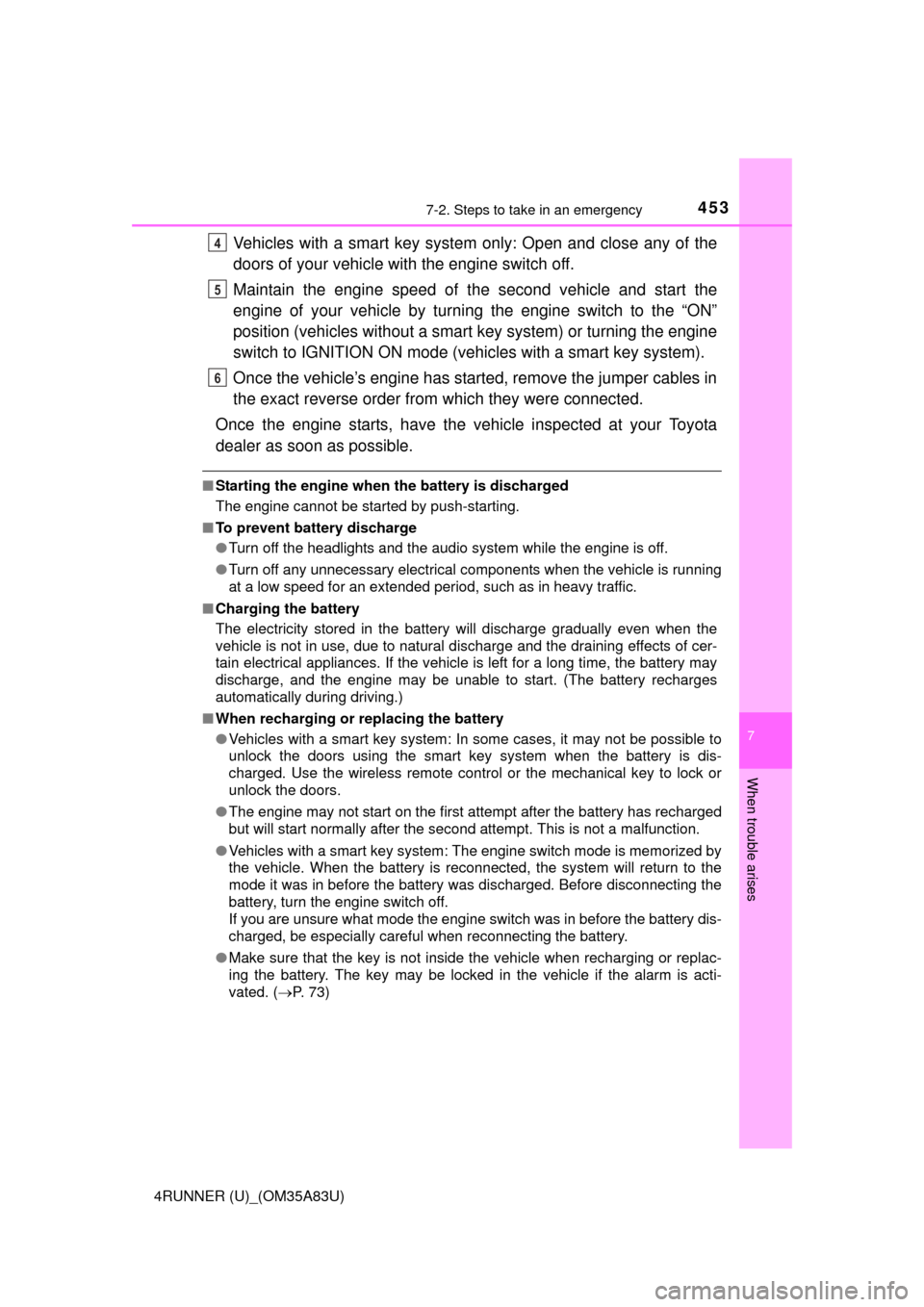
Vehicles with a smart key system only: Open and close any of the
doors of your vehicle with the engine switch off.
Maintain the engine speed of the second vehicle and start the
engine of your vehicle by turni ng the engine switch to the “ON”
position (vehicles without a smart key system) or turning the engine
switch to IGNITION ON mode (v ehicles with a smart key system).
Once the vehicle’s engine has started, remove the jumper cables in
the exact reverse order from which they were connected.
Once the engine starts, have the vehicle inspected at your Toyota
dealer as soon as possible.
■ Starting the engine when the battery is discharged
The engine cannot be started by push-starting.
■ To prevent battery discharge
●Turn off the headlights and the audio system while the engine is off.
● Turn off any unnecessary electrical components when the vehicle is running
at a low speed for an extended period, such as in heavy traffic.
■ Charging the battery
The electricity stored in the battery will discharge gradually even when the
vehicle is not in use, due to natural discharge and the draining effects of cer-
tain electrical appliances. If the vehicle is left for a long time, the battery may
discharge, and the engine may be unable to start. (The battery recharges
automatically during driving.)
■ When recharging or replacing the battery
●Vehicles with a smart key system: In some cases, it may not be possible to
unlock the doors using the smart key system when the battery is dis-
charged. Use the wireless remote control or the mechanical key to lock or
unlock the doors.
● The engine may not start on the first attempt after the battery has recharged
but will start normally after the second attempt. This is not a malfunction.
● Vehicles with a smart key system: The engine switch mode is memorized by
the vehicle. When the battery is reconnected, the system will return to the
mode it was in before the battery was discharged. Before disconnecting the
battery, turn the engine switch off.
If you are unsure what mode the engine switch was in before the battery dis-
charged, be especially careful when reconnecting the battery.
● Make sure that the key is not inside the vehicle when recharging or replac-
ing the battery. The key may be locked in the vehicle if the alarm is acti-
vated. ( P. 73)
4
5
6
Page 467 of 530
4658-1. Specifications
8
Vehicle specifications
4RUNNER (U)_(OM35A83U)
*: Your Toyota vehicle is filled with “Toyota Genuine Transfer Gear oil LF” atthe factory. Use Toyota approved “Toyota Genuine Transfer Gear oil LF” or
an equivalent of matching quality to satisfy the above specification. Pl\
ease
contact your Toyota dealer for further details.
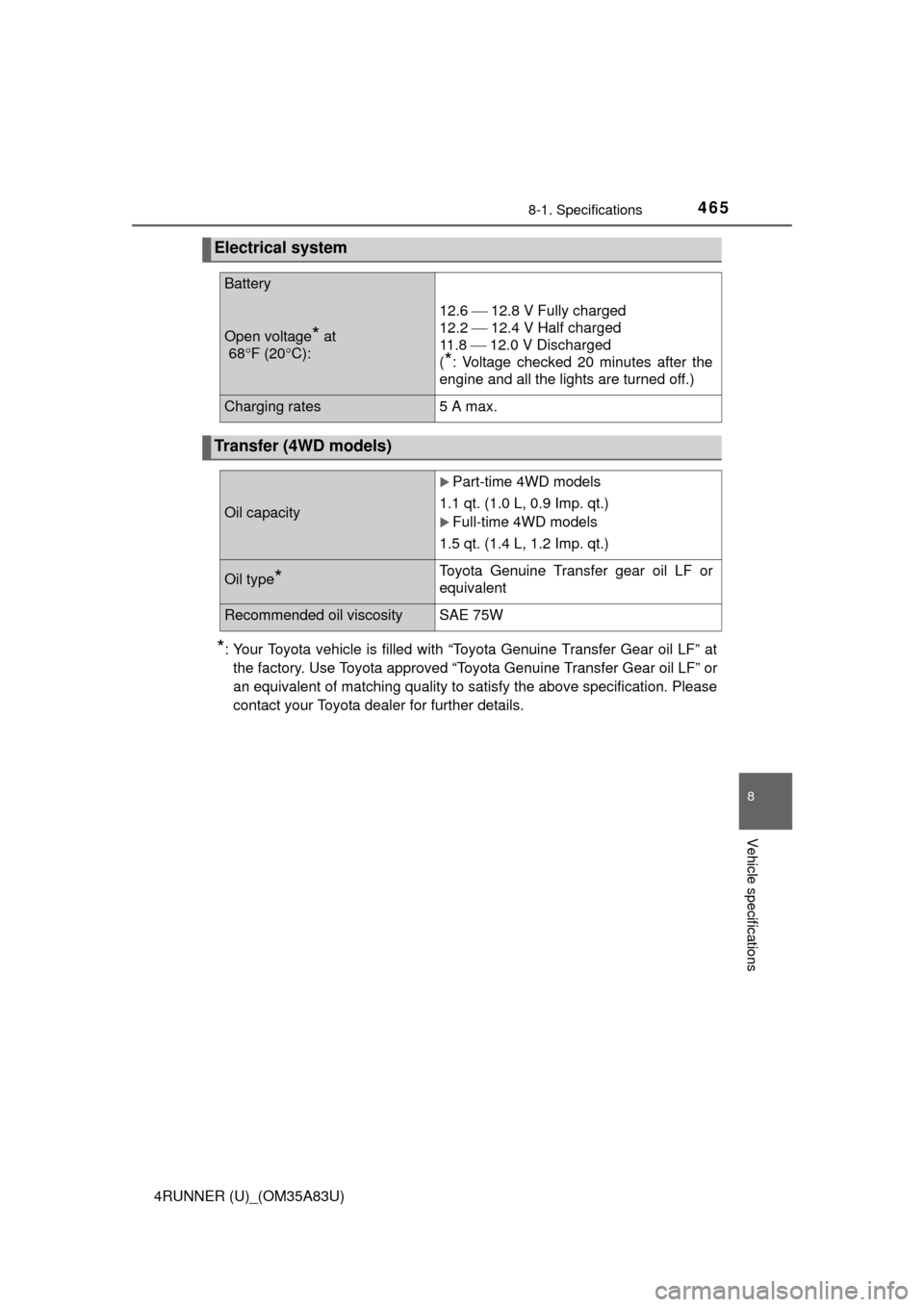
Electrical system
Battery
Open voltage* at
68 F (20 C):
12.6 12.8 V Fully charged
12.2 12.4 V Half charged
11 . 8 12.0 V Discharged
(
*: Voltage checked 20 minutes after the
engine and all the lights are turned off.)
Charging rates5 A max.
Transfer (4WD models)
Oil capacity
Part-time 4WD models
1.1 qt. (1.0 L, 0.9 Imp. qt.)
Full-time 4WD models
1.5 qt. (1.4 L, 1.2 Imp. qt.)
Oil type*Toyota Genuine Transfer gear oil LF or
equivalent
Recommended oil viscositySAE 75W