2014 SUBARU TRIBECA maintenance
[x] Cancel search: maintenancePage 359 of 426
11-26Maintenance and service
the direction mark facing forward.
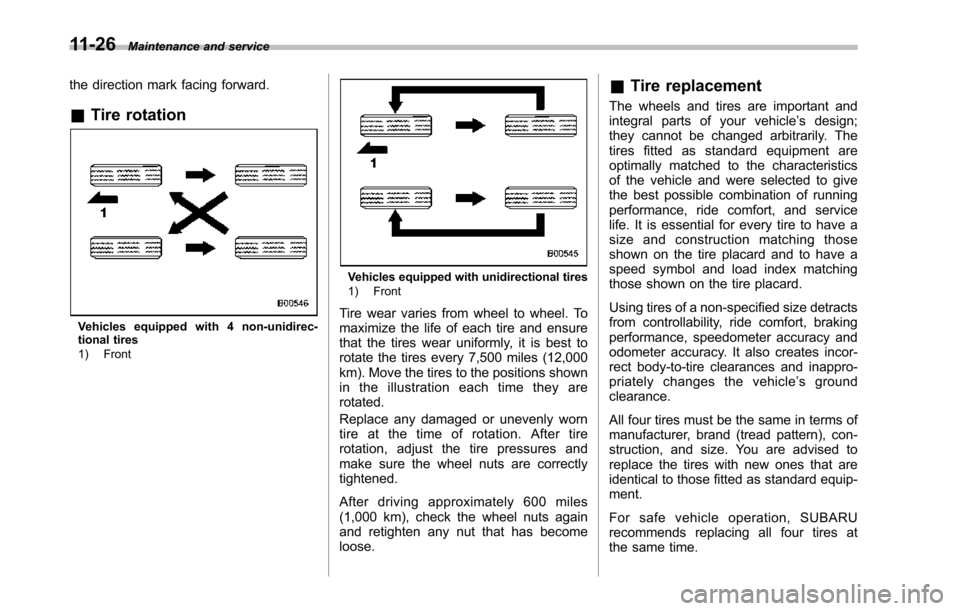
&Tire rotation
Vehicles equipped with 4 non-unidirec-tional tires1) Front
Vehicles equipped with unidirectional tires1) Front
Tire wear varies from wheel to wheel. Tomaximize the life of each tire and ensurethat the tires wear uniformly, it is best torotate the tires every 7,500 miles (12,000km). Move the tires to the positions shownin the illustration each time they arerotated.
Replace any damaged or unevenly worntire at the time of rotation. After tirerotation, adjust the tire pressures andmake sure the wheel nuts are correctlytightened.
After driving approximately 600 miles(1,000 km), check the wheel nuts againand retighten any nut that has becomeloose.
&Tire replacement
The wheels and tires are important andintegral parts of your vehicle’s design;they cannot be changed arbitrarily. Thetires fitted as standard equipment areoptimally matched to the characteristicsof the vehicle and were selected to givethe best possible combination of runningperformance, ride comfort, and servicelife. It is essential for every tire to have asize and construction matching thoseshown on the tire placard and to have aspeed symbol and load index matchingthose shown on the tire placard.
Usingtires of a non-specified size detractsfrom controllability, ride comfort, brakingperformance, speedometer accuracy andodometer accuracy. It also creates incor-rect body-to-tire clearances and inappro-priately changes the vehicle’sgroundclearance.
All four tires must be the same in terms ofmanufacturer, brand (tread pattern), con-struction, and size. You are advised toreplace the tires with new ones that areidentical to those fitted as standard equip-ment.
For safe vehicle operation, SUBARUrecommends replacing all four tires atthe same time.
Page 360 of 426
WARNING
.When replacing a tire, you mustuse a tire that is of the same size,circumference, speed symboland load index as the originaltires listed on the tire placard.Using tires of other sizes, cir-cumferences or constructionsmay result in severe mechanicaldamage to the drive train of yourvehicle and may affect ride,handling, braking, speedometer/odometer calibration, and clear-ance betweenthe body and tires.It also may be dangerous andlead to loss of vehicle control.
.You must install four tires that areof the same size, circumference,construction, manufacturer,brand(tread pattern), degree ofwear, speed symbol and loadindex. Mixing tires of differenttypes, sizes or degrees of wearcan result in damage to thevehicle’spowertrain.Useofdifferent types or sizes of tirescan also dangerously reducecontrollability and braking per-formance and can lead to anaccident.
.Use only radial tires. Do not use
radial tires together with beltedbias tires and/or bias-ply tires.Doing so can dangerously re-duce controllability, resulting inan accident.
&Wheel replacement
When replacing wheels due, for example,to damage, make sure the replacementwheels match the specifications of thewheels that are fitted as standard equip-ment. Replacement wheels are availablefrom SUBARUdealers.
WARNING
Use only those wheels that arespecified for your vehicle. Wheelsnot meeting specifications couldinterfere with brake caliper opera-tion and may cause the tires to rubagainst the wheel well housing dur-ing turns. The resulting loss ofvehicle control could lead to anaccident.
Aluminum wheels
.Aluminum wheels can be scratchedand damaged easily. Handle them care-fully to maintain their appearance, perfor-mance, and safety.
.When any of the wheels are removedand replaced for tire rotation or to changea flat tire, always check the tightness ofthe wheel nuts after driving approximately600 miles (1,000 km). If any nut is loose,tighten it to the specified torque.–For the wheel nut tightening torque,refer to“Tires”F12-8.–For the wheel nut tightening proce-dure, refer to“Changing a flat tire”F9-6..Never apply oil to the threaded parts,wheel nuts, or tapered surface of thewheel.
.Never let the wheel rub against sharpprotrusions or curbs.
.When wheel nuts, balance weights, orthe center cap is replaced, be sure toreplace them with genuine SUBARU partsdesigned for the specific wheel.
Maintenance and service11-27
Page 361 of 426
11-28Maintenance and service
Windshield washer fluid
CAUTION
Never use engine coolant as washerfluid because it could cause paintdamage.
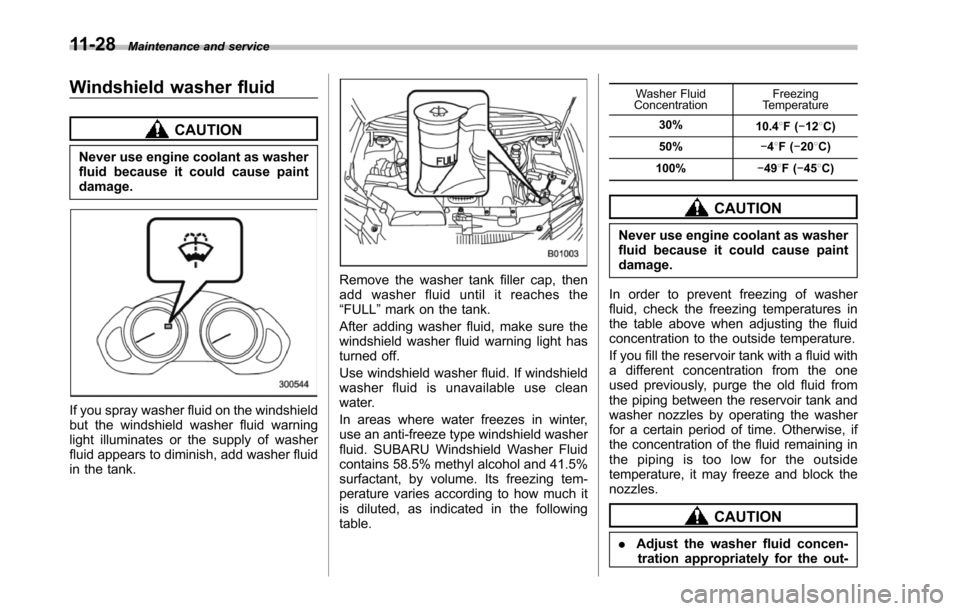
If you spray washer fluid on the windshieldbut thewindshield washer fluid warninglight illuminates or the supply of washerfluid appears to diminish, add washer fluidin the tank.
Remove the washer tank filler cap, thenadd washer fluid until it reaches the“FULL”mark on the tank.
After adding washer fluid, make sure thewindshieldwasher fluid warning light hasturned off.
Use windshield washer fluid. If windshieldwasher fluid is unavailable use cleanwater.
In areas where water freezes in winter,use an anti-freeze type windshield washerfluid. SUBARU Windshield Washer Fluidcontains 58.5% methyl alcohol and 41.5%surfactant, by volume. Its freezing tem-perature varies according to how much itis diluted, as indicated in the followingtable.
Washer FluidConcentrationFreezingTemperature
30%10.48F(!128C)
50%!48F(!208C)
100%!498F(!458C)
CAUTION
Never use engine coolant as washerfluid because it could cause paintdamage.
In order to prevent freezing of washerfluid, check the freezing temperatures inthe table above when adjusting the fluidconcentration to the outside temperature.
If you fill the reservoir tank with a fluid witha different concentration from the oneused previously, purge the old fluid fromthe piping between the reservoir tank andwasher nozzles by operating the washerfor a certain period of time. Otherwise, ifthe concentration of the fluid remaining inthe piping is too low for the outsidetemperature, it may freeze and block thenozzles.
CAUTION
.Adjust the washer fluid concen-tration appropriately for the out-
Page 362 of 426
side temperature. If the concen-tration is inappropriate, sprayedwasher fluid may freeze on thewindshield and obstruct yourview, and the fluid may freeze inthe reservoir tank.
.State or local regulations onvolatileorganic compounds mayrestrict the use of methanol, acommon windshield washer anti-freeze additive. Washer fluidscontaining non-methanol anti-freeze agents should be usedonly if they provide cold weatherprotection without damagingyour vehicle’s paint, wiper bladesor washer system.
Replacement of wiper blades
Grease, wax, insects, or other materialson the windshield or the wiper bladeresults in jerky wiper operation and streak-ing on the glass. If you cannot remove thestreaks after operating the windshieldwasher or if the wiper operation is jerky,clean the outer surface of the windshield(or rear window) and the wiper bladesusing a sponge or soft cloth with a neutraldetergent or mild abrasive cleaner. Aftercleaning,rinse the windshield and wiperblades with clean water. The windshield isclean if beads do not form when you rinsethe windshield with water.
CAUTION
.Do not clean the wiper bladeswith gasoline or a solvent, suchas paint thinner or benzine. Thiswill cause deterioration of thewiper blades.
.When you wish to raise thepassenger-side wiper arm, firstraise the driver-side wiper arm.Otherwise, the passenger-sidewiper assembly and driver-sidewiper assembly will touch eachother, possibly resulting inscratches.
.While removing the wiper bladesfrom the wiper arms, do notreturn the wiper arms to theoriginal positions. Otherwise,the windshield surface may bescratched.
.When returning the raised wiperarms to the original positions,carefully return the wiper armson the windshield while support-ing them with your hands. Youshould not return the wiper armsto the windshield only by thereturn spring. Otherwise, the wi-per arms may be deformed and/or the windshield surface may bescratched.
.Return the passenger-side wiperarm to its original position beforereturning the driver-side wiperarm to its original position.Otherwise, the passenger-sidewiper assembly and driver-sidewiper assembly will touch eachother, possibly resulting inscratches.
If you cannot eliminate the streaking evenafter following this method, replace thewiperblades using the following proce-dures. Be sure to use genuine SUBARUwiper blade rubbers as replacements.
Maintenance and service11-29
–CONTINUED–
Page 363 of 426
11-30Maintenance and service
&Windshield wiper blade as-
sembly
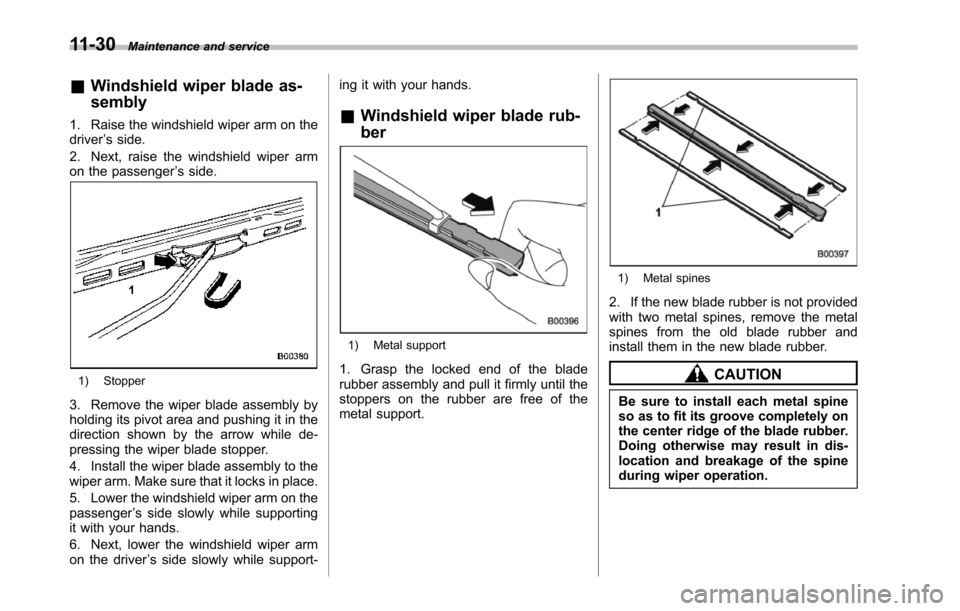
1. Raise the windshield wiper arm on thedriver’s side.
2. Next, raise the windshield wiper armon the passenger’s side.
1) Stopper
3. Remove the wiper blade assembly byholding its pivot area and pushing it in thedirection shown by the arrow while de-pressing the wiper blade stopper.
4. Install the wiper blade assembly to thewiper arm. Make sure that it locks in place.
5. Lower the windshield wiper arm on thepassenger’s side slowly while supportingit with your hands.
6. Next, lower the windshield wiper armon the driver’s side slowly while support-
ing it with your hands.
&Windshield wiper blade rub-
ber
1) Metal support
1. Grasp the locked end of the bladerubber assemblyand pull it firmly until thestoppers on the rubber are free of themetal support.
1) Metal spines
2. If the new blade rubber is not providedwith two metal spines, remove the metalspines from the old blade rubber andinstall them in the new blade rubber.
CAUTION
Be sure to install each metal spineso as to fit its groove completely onthe center ridge of the blade rubber.Doing otherwise may result in dis-location and breakage of the spineduring wiper operation.
Page 364 of 426
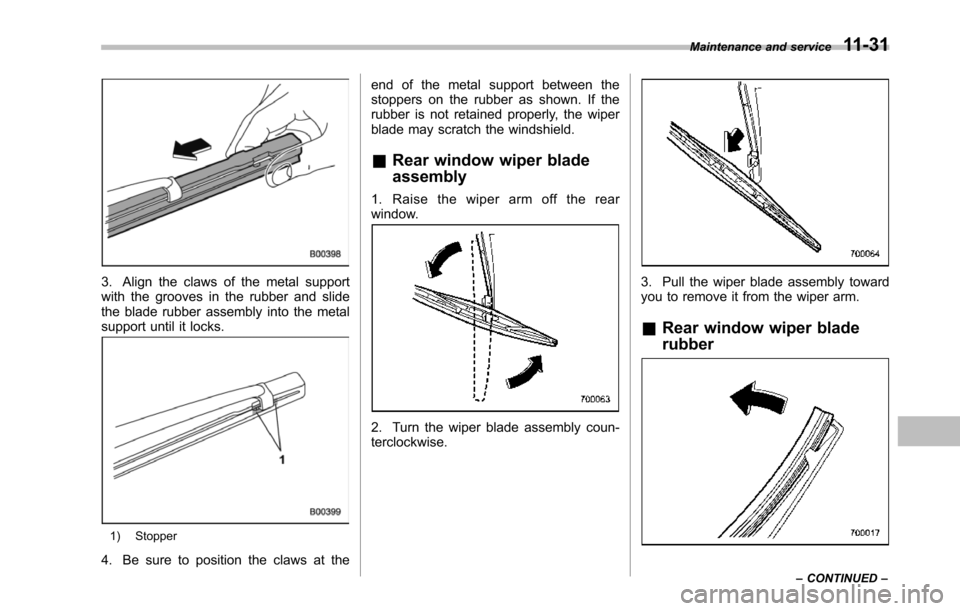
3. Align the claws of the metal supportwith the grooves in the rubber and slidethe blade rubber assembly into the metalsupport until it locks.
1) Stopper
4. Be sure to position the claws at the
end of the metal support between thestoppers on the rubber as shown. If therubber is not retained properly, the wiperblade may scratch the windshield.
&Rear window wiper blade
assembly
1. Raise the wiper arm off the rearwindow.
2. Turn the wiper blade assembly coun-terclockwise.
3. Pull the wiper blade assembly towardyou to remove it from the wiper arm.
&Rear window wiper blade
rubber
Maintenance and service11-31
–CONTINUED–
Page 365 of 426
11-32Maintenance and service
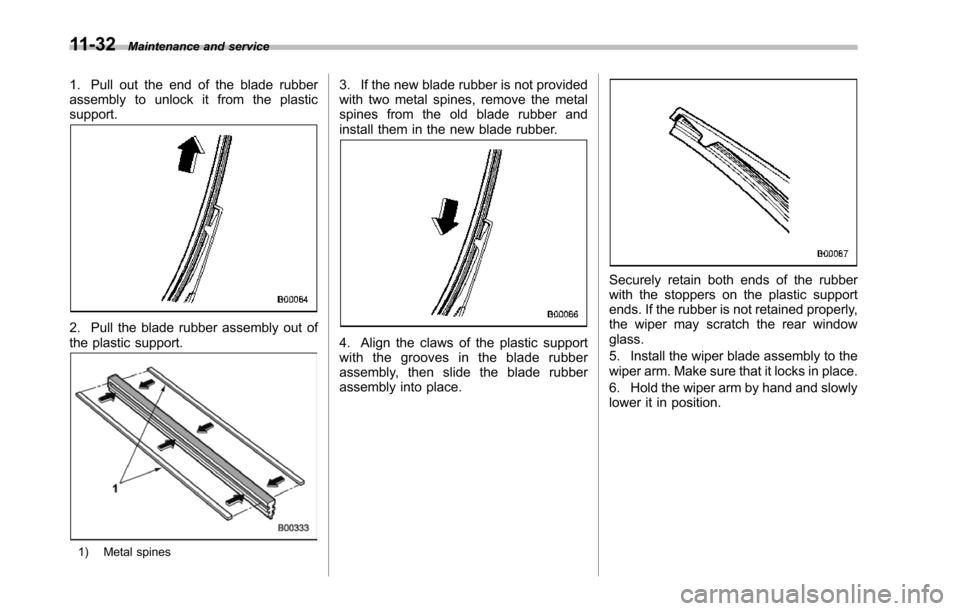
1. Pull out the end of the blade rubberassembly to unlock it from the plasticsupport.
2. Pull the blade rubber assembly out ofthe plastic support.
1) Metal spines
3. If the new blade rubber is not providedwith two metal spines, remove the metalspines from the old blade rubber andinstall them in the new blade rubber.
4. Align the claws of the plastic supportwith the grooves in the blade rubberassembly, then slide the blade rubberassembly into place.
Securely retain both ends of the rubberwith thestoppers on the plastic supportends. If the rubber is not retained properly,the wiper may scratch the rear windowglass.
5. Install the wiper blade assembly to thewiperarm. Make sure that it locks in place.
6. Hold the wiper arm by hand and slowlylower it in position.
Page 366 of 426
Battery
WARNING
.Before beginning work on or nearany battery, be sure to extinguishall cigarettes, matches, and light-ers. Never exposea battery to anopen flame or electric sparks.Batteries give off a gas which ishighly flammable and explosive.
.For safety, in case an explosiondoes occur, wear eye protectionor shield your eyes when work-ing near any battery. Never leanover a battery.
.Do not let battery fluid contacteyes, skin, fabrics, or paint be-causebattery fluid is a corrosiveacid. If battery fluid gets on yourskin or in your eyes, immediatelyflush the area with water thor-oughly. Seek medical help imme-diately if acid has entered theeyes.
If battery fluid is accidentallyswallowed, immediately drink alarge amount of milk or water,and seek medical attention im-mediately.
.To l e s s e n t h e r i s k o f s p a r k s ,
remove rings, metal watchbands,and other metal jewelry. Neverallow metal tools to contact thepositive battery terminal and any-thing connected to it WHILE youare at the same time in contactwith any other metallic portion ofthe vehicle because a short cir-cuit willresult.
.Keep everyone including childrenaway from the battery.
.Charge the battery in a well-ventilated area.
.Battery posts, terminals, and re-lated accessories contain leadand lead compounds, chemicalsknown to the State of Californiato cause cancer and reproductiveharm. Batteries also containother chemicals known to theState of California to cause can-cer. Wash hands after handling.
CAUTION
Never use morethan 10 ampereswhen charging the battery becauseit will shorten battery life.
It is unnecessary to periodically check thebattery fluid level or periodically refill with
distilled water.
Maintenance and service11-33