2014 SUBARU TRIBECA service
[x] Cancel search: servicePage 321 of 426
9-14In case of emergency
Engine overheating
WARNING
Never attempt to remove the radia-tor cap until the engine has beenshut off and has fully cooled down.When theengine is hot, the coolantis under pressure. Removing thecap while the engine is still hotcould release a spray of boiling hotcoolant, which could burn you veryseriously.
If the engine overheats, safely pull off theroad and stop the vehicle in a safe place.
&If steam is coming from the
engine compartment
Turn off the engine and get everyoneaway from the vehicle until it cools down.
&If no steam is coming from
the engine compartment
NOTE
For details about how to check thecoolant level or how to add coolant,refer to“Engine coolant”F11-11.
1. Keep the engine running at idlingspeed.
2. Open the hood to ventilate the enginecompartment. Refer to“Engine hood”F11-4.
Confirm that the cooling fan is turning. Ifthe fan is not turning, immediately turn offthe engine and contact your authorizeddealer for repair.
3. After the engine coolant temperaturehas dropped, turn off the engine.
If the temperature gauge stays at theoverheated zone, turn off the engine.
4. After the engine has fully cooled down,check the coolant level in the reservetank.
If the coolant level is below the“LOW”mark, add coolant up to the“FULL”mark.
5. If there is no coolant in the reservetank, add coolant to the reserve tank.Then remove the radiator cap and fill theradiator with coolant.
If you remove the radiator cap from a hotradiator, first wrap a thick cloth around theradiator cap, then turn the cap counter-clockwise slowly without pressing downuntil it stops. Release the pressure fromthe radiator. After the pressure has beenfully released, remove the cap by pressingdown and turning it.
Towing
WARNING
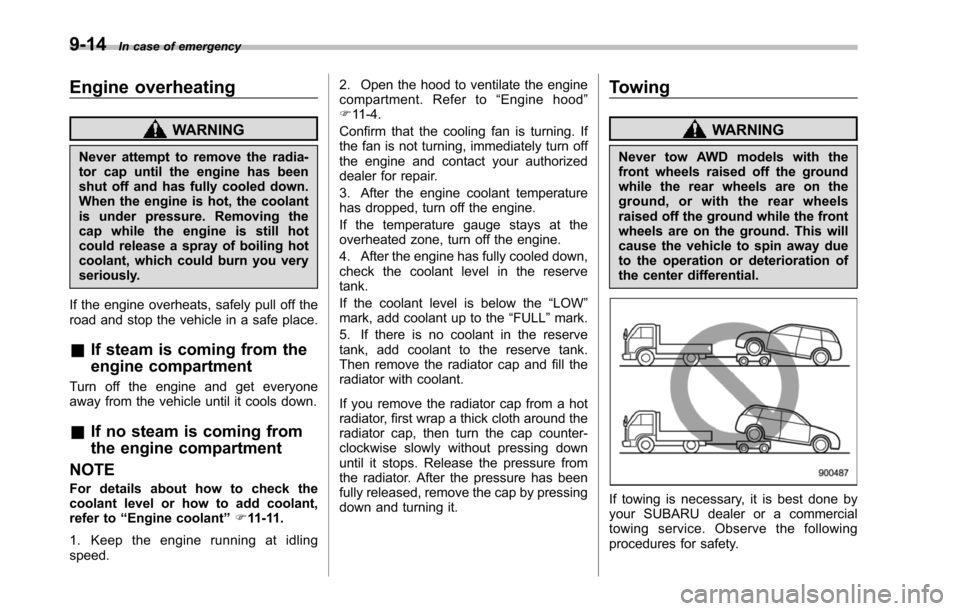
Never tow AWD models with thefront wheels raised off the groundwhile the rear wheels are on theground, or with the rear wheelsraised off the ground while the frontwheels are on the ground. This willcause the vehicle to spin away dueto the operation or deterioration ofthe centerdifferential.
If towing is necessary, it is best done byyour SUBARU dealer or a commercialtowing service. Observe the followingprocedures for safety.
Page 334 of 426

Maintenance schedule....................................... 11-3
Maintenance precautions................................... 11-3Before checking or servicing in the enginecompartment.................................................... 11-4When you do checking or servicing in the enginecompartment while the engine is running.......... 11-4
Engine hood....................................................... 11-4
Engine compartment overview.......................... 11-6
Engine oil............................................................ 11-7Checking the oil level......................................... 11-7Changing the oil and oil filter.............................. 11-8Recommendedgrade and viscosity.................... 11-9Synthetic oil....................................................... 11-9
Cooling system................................................ 11-10Hose and connections...................................... 11-10Engine coolant................................................. 11-11
Air cleaner element.......................................... 11-12Replacing the air cleaner element..................... 11-12
Spark plugs...................................................... 11-13Recommended spark plugs.............................. 11-13
Drive belts........................................................ 11-13
Automatic transmission fluid.......................... 11-14Checking the fluid level.................................... 11-14Recommended fluid......................................... 11-15
Front differential gear oil................................. 11-15Checking the oil level....................................... 11-15Recommended grade and viscosity.................. 11-16
Rear differential gear oil.................................. 11-16Recommended grade and viscosity.................. 11-16
Power steering fluid........................................ 11-16Checking the fluid level.................................... 11-16Recommended fluid......................................... 11-17
Brake fluid........................................................ 11-17Checking the fluid level.................................... 11-17Recommended brake fluid............................... 11-18
Brakebooster.................................................. 11-18
Brake pedal...................................................... 11-19Checking the brake pedal free play.................. 11-19Checking the brake pedal reserve distance....... 11-19
Replacement of brake pad and lining............ 11-19Breaking-in of new brake pads and linings....... 11-20
Parking brake stroke....................................... 11-20
Tires and wheels.............................................. 11-21Types of tires................................................... 11-21Tire pressure monitoring system (TPMS).......... 11-21Tire inspection................................................. 11-22Tire pressuresand wear.................................. 11-23Wheel balance................................................. 11-25Wear indicators............................................... 11-25Tire rotation direction mark.............................. 11-25Tire rotation..................................................... 11-26Tire replacement.............................................. 11-26Wheel replacement.......................................... 11-27
Aluminum wheels............................................ 11-27
Windshield washer fluid.................................. 11-28
Replacement of wiper blades......................... 11-29Windshield wiper blade assembly..................... 11-30Windshield wiper blade rubber ......................... 11-30Rear window wiper blade assembly.................. 11-31
Maintenance and service
11
Page 335 of 426
Maintenance and service
Rear window wiper blade rubber....................... 11-31
Battery............................................................... 11-33
Fuses................................................................ 11-34
Main fuse.......................................................... 11-35
Installation of accessories............................... 11-36
Replacing bulbs............................................... 11-36Headlights(models with HID headlights)........... 11-36Headlights (models without HID headlights) ...... 11-36Parking light (right-hand side)........................... 11-38Front turn signal light (right-hand side)............. 11-39
Front fog light.................................................. 11-39Rear combination lights................................... 11-39Backup light/Tail light...................................... 11-40Rear gate light................................................. 11-41License plate light........................................... 11-41Dome light....................................................... 11-42Map light......................................................... 11-43Vanity mirror light............................................ 11-43Door step light................................................. 11-43Cargo area light............................................... 11-44
Page 336 of 426
Maintenance schedule
The scheduled maintenance items re-quired to be serviced at regular intervalsare shown in the“Warranty and Main-tenance Booklet”.
For details of your maintenance schedule,read the separate“Warranty and Main-tenance Booklet”.
Maintenance precautions
When maintenance and service are re-quired, it is recommended that all work bedone by an authorized SUBARU dealer.
If you perform maintenance and serviceby yourself, you should familiarize yourselfwith the information provided in thissection on general maintenance andservice for yourSUBARU.
Incorrect or incomplete service couldcause improper or unsafe vehicle opera-tion. Any problems caused by impropermaintenance and service performed byyou are not eligible for warranty coverage.
WARNING
.Te s t i n g o f a n A l l - W h e e l D r i v emodel must NEVER be per-formed on a single two-wheeldynamometer or similar appara-tus. Attempting to do so willresult in transmission damageand in uncontrolled vehiclemovement and may cause anaccident or injuries to personsnearby.
.Always select a safe area whenperforming maintenance on yourvehicle.
.Always be very careful to avoidinjury when working on the vehi-cle. Remember that some of thematerials in the vehicle may behazardous if improperly used orhandled, for example, batteryacid.
.Your vehicle should only be ser-viced by persons fully competentto do so. Serious personal injurymay result to persons not experi-enced in servicing vehicles.
.Always use the proper tools andmake certain that they are wellmaintained.
.Never get under the vehicle sup-ported only by a jack. Always usea safety stands to support thevehicle.
.Never keep the engine running ina poorly ventilated area, such asa garage or other closed areas.
.Do not smoke or allow openflames around the fuel or battery.This will cause a fire.
.Because the fuel system is underpressure, replacement of the fuelfilter should be performed onlyby your SUBARU dealer.
.Wear adequate eye protection to
Maintenance and service11-3
–CONTINUED–
Page 337 of 426
11-4Maintenance and service
guard against getting oil or fluidsin your eyes. If something doesget in your eyes, thoroughlywash them out with clean water.
.Do not tamper with the wiring ofthe SRS airbag system or seat-belt pretensioner system, or at-tempt to take its connectorsapart, as that may activate thesystem or it can render it inop-erative. NEVER use a circuittester for these wiring. If yourSRS airbag or seatbelt preten-sioner needs service, consultyour nearest SUBARU dealer.
&Before checking or servicing
in the engine compartment
WARNING
.Always stop the engine and setthe parking brake firmly to pre-vent the vehicle from moving.
.Always let the engine cool down.Engine parts become very hotwhen the engine is running andremain hot for some time afterthe engine is stopped.
.Do not spill engine oil, enginecoolant, brake fluid or any other
fluid on hot engine components.This may cause a fire.
.Always remove the key from theignition switch. When the ignitionswitch is in the“ON”position,the cooling fan may operatesuddenly even when the engineis stopped.
&When you do checking or
servicing in the engine com-
partment while the engine is
running
WARNING
A running engine can be dangerous.Keep your fingers, hands, clothing,hair and tools away from the coolingfan, belts and any other movingengine parts. Removing rings,watches and ties is advisable.
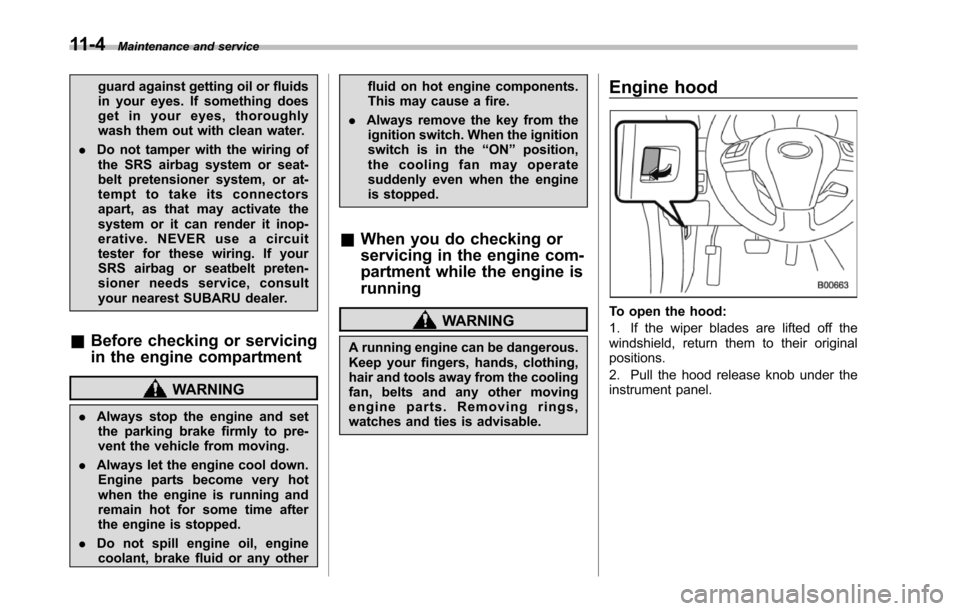
Engine hood
To open the hood:
1. If the wiper blades are lifted off thewindshield, return them to their originalpositions.
2. Pull the hood release knob under theinstrument panel.
Page 338 of 426
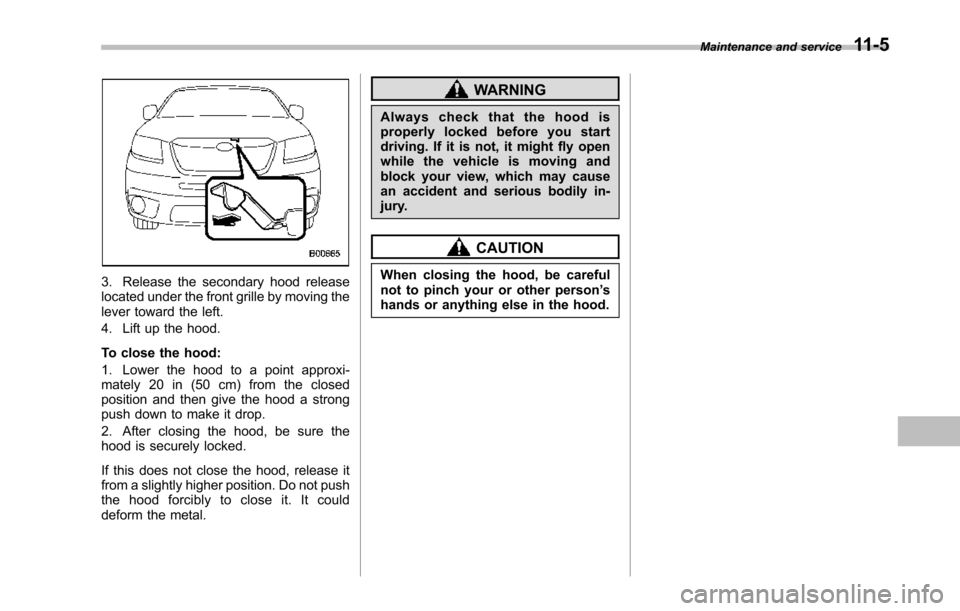
3. Release the secondary hood releaselocated under the front grille by moving thelever toward the left.
4. Lift up the hood.
To close the hood:
1. Lower the hood to a point approxi-mately 20 in (50 cm) from the closedposition and then give the hood a strongpush down to make it drop.
2. After closing the hood, be sure thehoodis securely locked.
If this does not close the hood, release itfrom a slightly higher position. Do not pushthe hood forcibly to close it. It coulddeform the metal.
WARNING
Always check that the hood isproperly locked before you startdriving. If it is not, it might fly openwhile the vehicle is moving andblock your view, which may causean accident and serious bodily in-jury.
CAUTION
When closing the hood, be carefulnot to pinch your or other person’shands or anything else in the hood.
Maintenance and service11-5
Page 339 of 426
11-6Maintenance and service
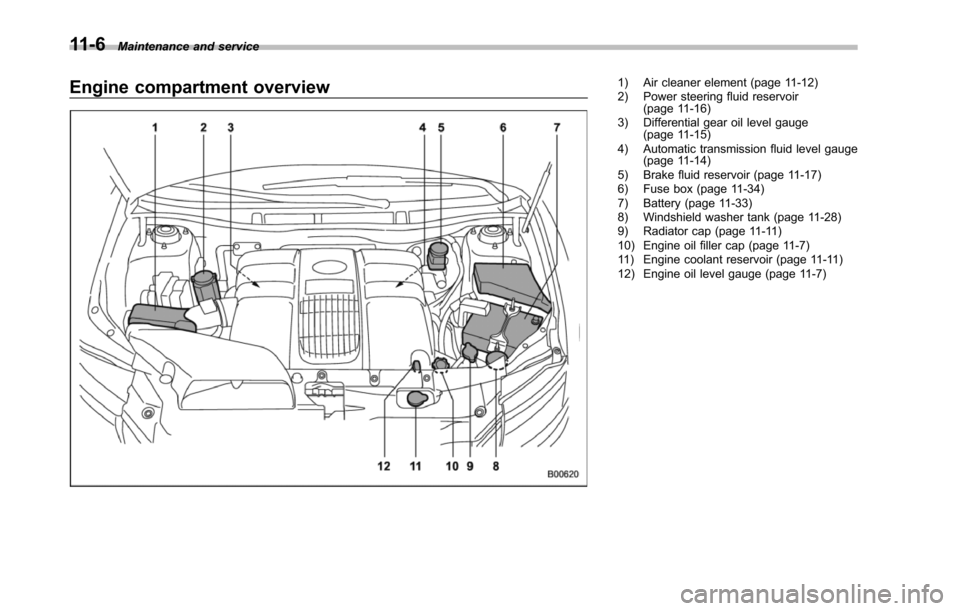
Engine compartment overview1) Air cleaner element (page 11-12)2) Power steering fluid reservoir(page 11-16)3) Differential gear oil level gauge(page 11-15)4) Automatic transmission fluid level gauge(page 11-14)5) Brake fluid reservoir (page 11-17)6) Fuse box (page 11-34)7) Battery (page 11-33)8) Windshield washer tank (page 11-28)9) Radiator cap (page 11-11)10) Engine oil filler cap (page 11-7)11) Engine coolant reservoir (page 11-11)12) Engineoil level gauge (page 11-7)
Page 340 of 426
Engine oil
NOTE
.The engine oil consumption rate isnot stabilized, and therefore cannot bedetermined until the vehicle has tra-veled at least several thousand miles(kilometers). Even after break-in, whenthe vehicle is used under severe driv-ing conditions such as those men-tioned in the“Warranty and Mainte-nance Booklet”,engineoiliscon-sumed or deteriorated more quicklythan under normal driving conditions.If you drive your vehicle under thesesevere conditions, you should checkthe oil level at least at every secondfuel fill-up time, and change the oilmore frequently. Please refer to the“Warranty and Maintenance Booklet”for more details..If the oil consumption rate seemsabnormally high after the break-inperiod, for example more than 1 quartper 1,200 miles or 1 liter per 2,000kilometers, we recommend that youcontact your SUBARU dealer.
&Checking the oil level
Check the engine oil level at each fuelstop.
1. Park the vehicle on a level surface andstop the engine.
2. Pull out the level gauge, wipe it clean,and insert it again.
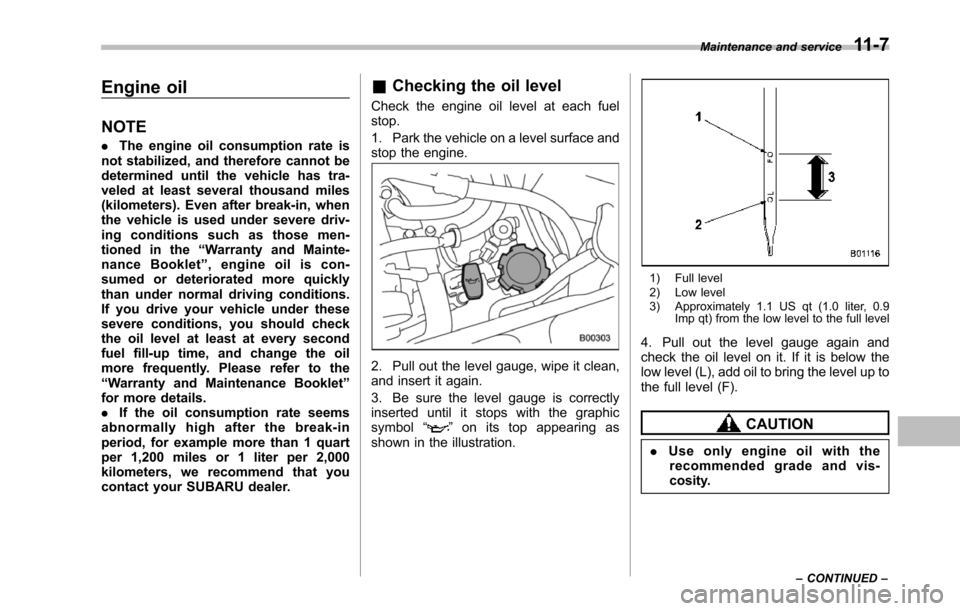
3. Be sure the level gauge is correctlyinserted until it stops with the graphicsymbol“”on its top appearing asshown in the illustration.
1) Full level2) Low level3) Approximately 1.1 US qt (1.0 liter, 0.9Imp qt) from the low level to the full level
4. Pull out the level gauge again andcheck the oil level on it. If it is below thelow level (L), add oil to bring the level up tothe fulllevel (F).
CAUTION
.Use only engine oil with therecommended grade and vis-cosity.
Maintenance and service11-7
–CONTINUED–