2014 SUBARU TRIBECA trailer
[x] Cancel search: trailerPage 307 of 426
8-28Driving tips
zone in the“D”position than in themanual mode position.
.Avoid using the accelerator pedal tostay stationary on an uphill slope insteadof using the parking brake or foot brake.That may cause the transmission fluid tooverheat.
!Parking on a grade
Always block the wheels under bothvehicle and trailer when parking. Applythe parking brake firmly. You should notpark on a hill or slope. But if parking on ahill or slope cannot be avoided, youshould take the following steps.
1. Apply the brakes and hold the pedaldown.
2. Have someone place wheel blocksunder both the vehicle and trailer wheels.
3. When the wheel blocks are in place,release the regular brakes slowly until theblocks absorb theload.
4. Apply the regular brakes and thenapply the parking brake; slowly releasethe regular brakes.
5. Shift into“P”and shut off the engine.
Page 312 of 426

of the tire facing up).
3. Turn the hoist shaft end clockwise withthe wheel nut wrench to wind the cable upcompletely until you hear a few clickingsounds.Confirm that the temporary sparetire holding cable has been wound upcompletely by shaking the temporary tire.
CAUTION
If the temporary spare tire is notstored securely, it could damageadjacent areas of the vehicle andmake an abnormal noise.
4. Place the wheel nut wrench andextension back into the tool bag and storethe jackand tool bag in their storagelocations.
5. Fit the lid of the cargo area.
CAUTION
.When stowing a flat tire in thespare tire holder, turn the hoistshaft end only slowly. If it isturned quickly, the wheel disc ofthe flat tire could be damaged.
.Afull-sizeflattireshouldbestowed in the spare tire holderin an emergency only. After hav-ingthe flat tire repaired, immedi-ately swap it with the temporaryspare tire.
.Remember that the tread width ofa flat tire is wider than that of thetemporary spare tire. When car-rying a flat tire stowed in thespare tire holder, make sure thetiredoes not touch any obsta-cles.
Temporary spare tire
WARNING
.Never tow a trailer when thetemporary spare tire is used.The temporary spare tire is notdesigned to sustain the towingload. Use of the temporary sparetire when towing can result infailure of the spare tire and/orless stability of the vehicle andmay lead to an accident.
.When a spare tire is mounted or awheel rim is replaced without theoriginal pressure sensor/trans-mitter being transferred, the lowtire pressure warning light willilluminate steadily after blinkingfor approximately one minute.This indicates the tire pressuremonitoring system (TPMS) is un-able to monitor all four roadwheels. Contact your SUBARUdealer as soon as possible fortire and sensor replacement and/or system resetting.
In case of emergency9-5
–CONTINUED–
Page 386 of 426
Fuses and circuits
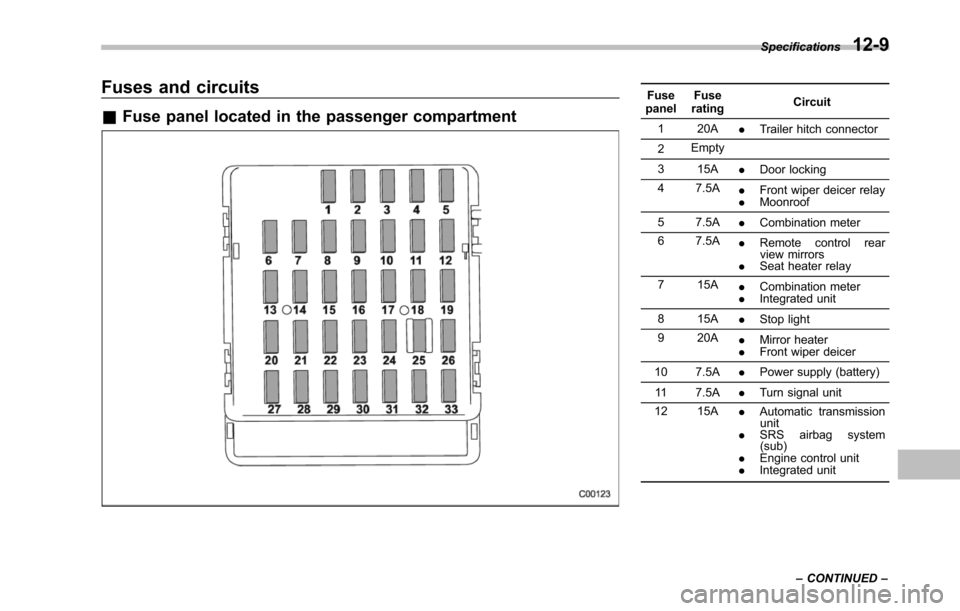
&Fuse panel located in the passenger compartment
FusepanelFuseratingCircuit
1 20A.Trailer hitch connector
2Empty
3 15A.Door locking
4 7.5A.Front wiper deicer relay.Moonroof
5 7.5A.Combination meter
6 7.5A.Remote control rearview mirrors.Seat heater relay
7 15A.Combination meter.Integrated unit
8 15A.Stop light
9 20A.Mirror heater.Front wiper deicer
10 7.5A.Power supply (battery)
11 7.5A.Turn signal unit
12 15A.Automatic transmissionunit.SRS airbag system(sub).Engine control unit.Integrated unit
Specifications12-9
–CONTINUED–
Page 403 of 426
13-10Consumer information and Reporting safety defects
.To maximize the life of each tire
and ensure that the tires wear
uniformly, it is best to rotate the
tires every 7,500 miles (12,000 km).
For information about the tire rota-
tion order, refer to“Tire rotation”
F11-26.Replace any damaged or
unevenly worn tires at the time of
rotation. After tire rotation, adjust
the tire pressures and make sure
the wheel nuts are correctly tigh-
tened. For information about the
tightening torque and tightening
sequence for the wheel nuts, refer
to“Flat tires”F9-6.
&Vehicle load limit–how to
determine
The load capacity of your vehicle is
determined by weight, not by avail-
able cargo space. The load limit of
your vehicle is shown on the
vehicle placard attached to the
driver’ssideB-pillar.Locatethe
statement“The combined weight
of occupants and cargo should
never exceed XXX kg or XXX lbs”
on your vehicle’s placard.
The vehicle placard also shows
seating capacity of your vehicle.
The total load capacity includes the
total weight of driver and all pas-
sengers and their belongings, any
cargo, any optional equipment such
as a trailer hitch, roof rack or bike
carrier, etc., and the tongue load of
a trailer. Therefore cargo capacity
can be calculated by the following
method.
Cargo capacity = Load limit!(total
weight of occupants + total weight
of optional equipment + tongue
load of a trailer (if applicable))
For information about vehicle load-
ing, refer to“Loading your vehicle”
F8-12.
For information about towing capa-
city and weight limits, refer to
“Trailer towing”F8-21.
!Calculating total and load ca-
pacities varying seating con-
figurations
Calculate the available load capa-
city as shown in the following
examples.
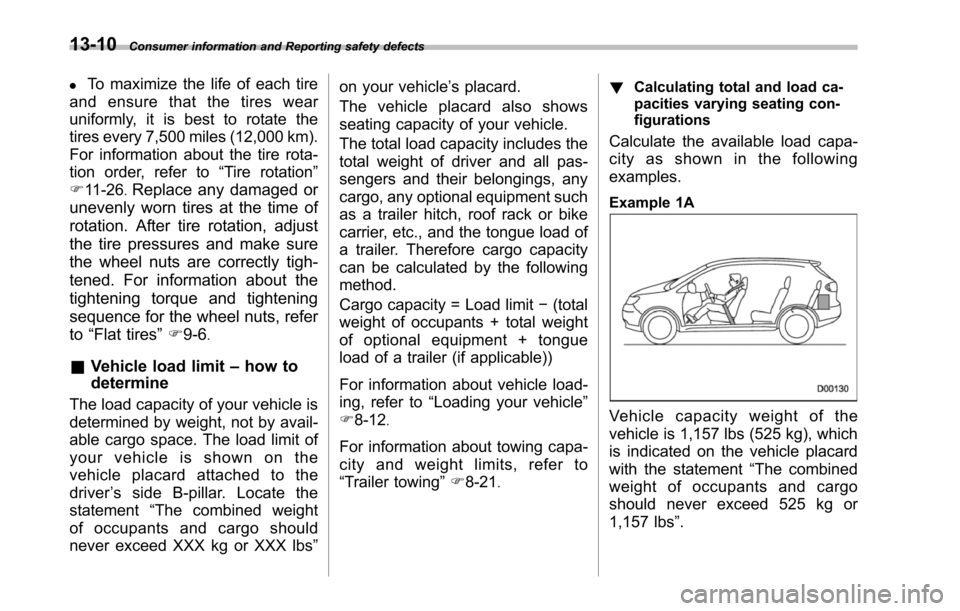
Example 1A
Vehicle capacity weight of the
vehicle is 1,157 lbs (525 kg), which
is indicated on the vehicle placard
with the statement“The combined
weight of occupants and cargo
should never exceed 525 kg or
1,157 lbs”.
Page 405 of 426
13-12Consumer information and Reporting safety defects
vehicle is 1,157 lbs (525 kg), which
is indicated on the vehicle placard
with the statement“The combined
weight of occupants and cargo
should never exceed 525 kg or
1,157 lbs”.
For example, the vehicle has one
occupant weighing 165 lbs (75 kg)
plus cargo weighing 705 lbs (320
kg). In addition, the vehicle is fitted
with a trailer hitch weighing 22 lbs
(10 kg), to which is attached a
trailer weighing 1,764 lbs (800 kg).
10% of the trailer weight is applied
to the trailer tongue (i.e. Tongue
load = 176 lbs (80 kg)).
1.Calculate the total weight.
2.Calculate the available load ca-
pacity.
3.The result of step 2 shows that a
further 88 lbs (40 kg) of cargo can
be carried.
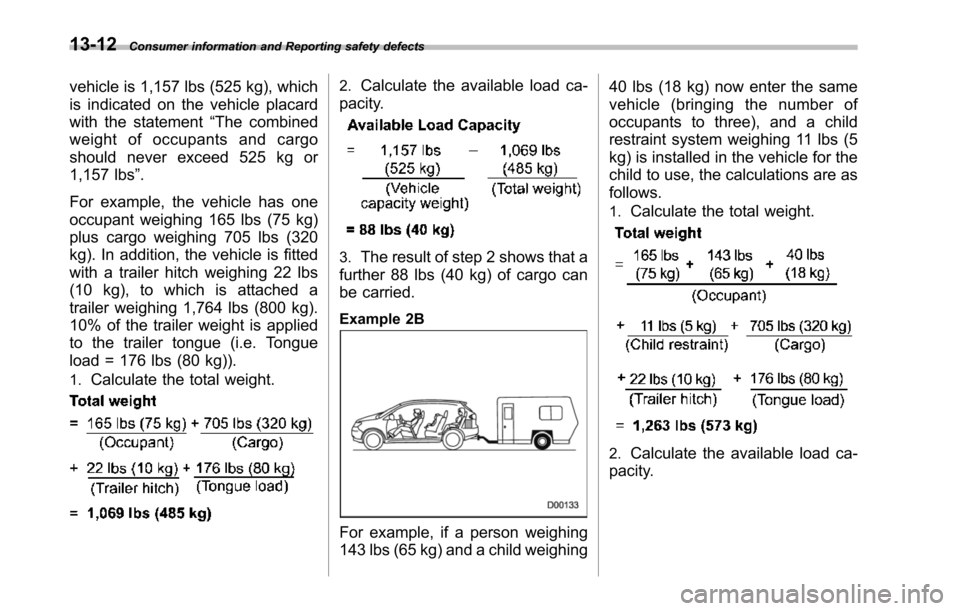
Example 2B
For example, if a person weighing
143 lbs (65 kg) and a child weighing
40 lbs (18 kg) now enter the same
vehicle (bringing the number of
occupants to three), and a child
restraint system weighing 11 lbs (5
kg) is installed in the vehicle for the
child to use, the calculations are as
follows.
1.Calculate the total weight.
2.Calculate the available load ca-
pacity.
Page 407 of 426
13-14Consumer information and Reporting safety defects
XXX kg or XXX lbs.
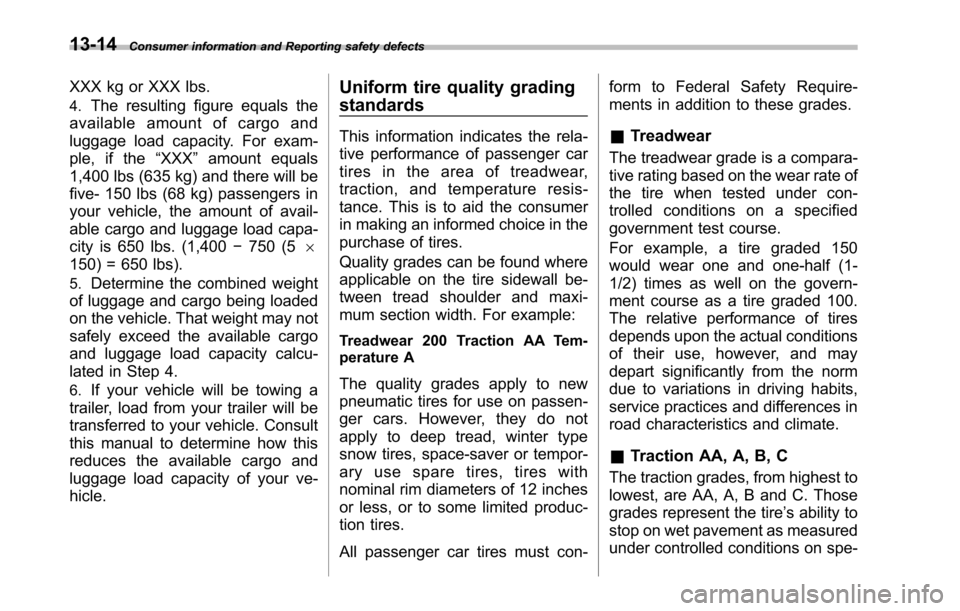
4.The resulting figure equals the
available amount of cargo and
luggage load capacity. For exam-
ple, if the“XXX”amount equals
1,400 lbs (635 kg) and there will be
five- 150 lbs (68 kg) passengers in
your vehicle, the amount of avail-
able cargo and luggage load capa-
city is 650 lbs. (1,400!750 (56
150) = 650 lbs).
5.Determine the combined weight
of luggage and cargo being loaded
on the vehicle. That weight may not
safely exceed the available cargo
and luggage load capacity calcu-
lated in Step 4.
6.If your vehicle will be towing a
trailer, load from your trailer will be
transferred to your vehicle. Consult
this manual to determine how this
reduces the available cargo and
luggage load capacity of your ve-
hicle.
Uniform tire quality grading
standards
This information indicates the rela-
tive performance of passenger car
tires in the area of treadwear,
traction, and temperature resis-
tance. This is to aid the consumer
in making an informed choice in the
purchase of tires.
Quality grades can be found where
applicable on the tire sidewall be-
tween tread shoulder and maxi-
mum section width. For example:
Treadwear 200 Traction AA Tem-
perature A
The quality grades apply to new
pneumatic tires for use on passen-
ger cars. However, they do not
apply to deep tread, winter type
snow tires, space-saver or tempor-
ary use spare tires, tires with
nominal rim diameters of 12 inches
or less, or to some limited produc-
tion tires.
All passenger car tires must con-
form to Federal Safety Require-
ments in addition to these grades.
&Treadwear
The treadwear grade is a compara-
tive rating based on the wear rate of
the tire when tested under con-
trolled conditions on a specified
government test course.
For example, a tire graded 150
would wear one and one-half (1-
1/2) times as well on the govern-
ment course as a tire graded 100.
The relative performance of tires
depends upon the actual conditions
of their use, however, and may
depart significantly from the norm
due to variations in driving habits,
service practices and differences in
road characteristics and climate.
&Traction AA, A, B, C
The traction grades, from highest to
lowest, are AA, A, B and C. Those
grades represent the tire’s ability to
stop on wet pavement as measured
under controlled conditions on spe-
Page 419 of 426
14-10Index
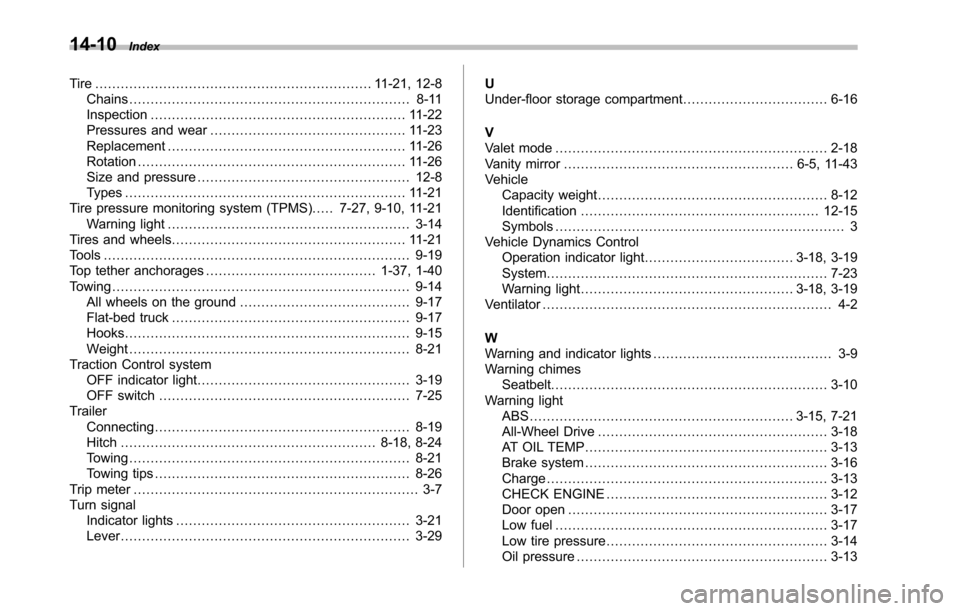
Tire . . . . . . . . . . . . . . . . . . . . . . . . . . . . . . . . . . . . . . . . . . . . . . . . . . . . . . . . . . . . . . . . . 11-21, 12-8Chains.................................................................. 8-11Inspection............................................................ 11-22Pressures and wear.............................................. 11-23Replacement........................................................ 11-26Rotation............................................................... 11-26Size and pressure.................................................. 12-8Types.................................................................. 11-21Tire pressure monitoring system (TPMS)..... 7-27, 9-10, 11-21Warning light......................................................... 3-14Tires and wheels....................................................... 11-21Tools........................................................................ 9-19Top tether anchorages........................................ 1-37, 1-40Towing...................................................................... 9-14All wheels on the ground........................................ 9-17Flat-bed truck........................................................ 9-17Hooks................................................................... 9-15Weight ..................................................................8-21Traction Control systemOFF indicator light.................................................. 3-19OFF switch........................................................... 7-25TrailerConnecting............................................................ 8-19Hitch............................................................ 8-18, 8-24Towing.................................................................. 8-21Towing tips............................................................ 8-26Trip meter................................................................... 3-7Turn signalIndicator lights....................................................... 3-21Lever.................................................................... 3-29
UUnder-floor storage compartment.................................. 6-16
VValet mode................................................................ 2-18Vanity mirror...................................................... 6-5, 11-43VehicleCapacity weight...................................................... 8-12Identification........................................................ 12-15Symbols.................................................................... 3Vehicle Dynamics ControlOperation indicator light................................... 3-18, 3-19System.................................................................. 7-23Warning light.................................................. 3-18, 3-19Ventilator.................................................................... 4-2
WWarning and indicator lights.......................................... 3-9Warning chimesSeatbelt................................................................. 3-10Warning lightABS .............................................................. 3-15, 7-21All-Wheel Drive...................................................... 3-18AT OIL TEMP......................................................... 3-13Brake system......................................................... 3-16Charge.................................................................. 3-13CHECK ENGINE.................................................... 3-12Door open............................................................. 3-17Low fuel................................................................ 3-17Low tire pressure.................................................... 3-14Oil pressure........................................................... 3-13