2014 SUBARU TRIBECA fuel cap
[x] Cancel search: fuel capPage 291 of 426
8-12Driving tips
Loading your vehicle
WARNING
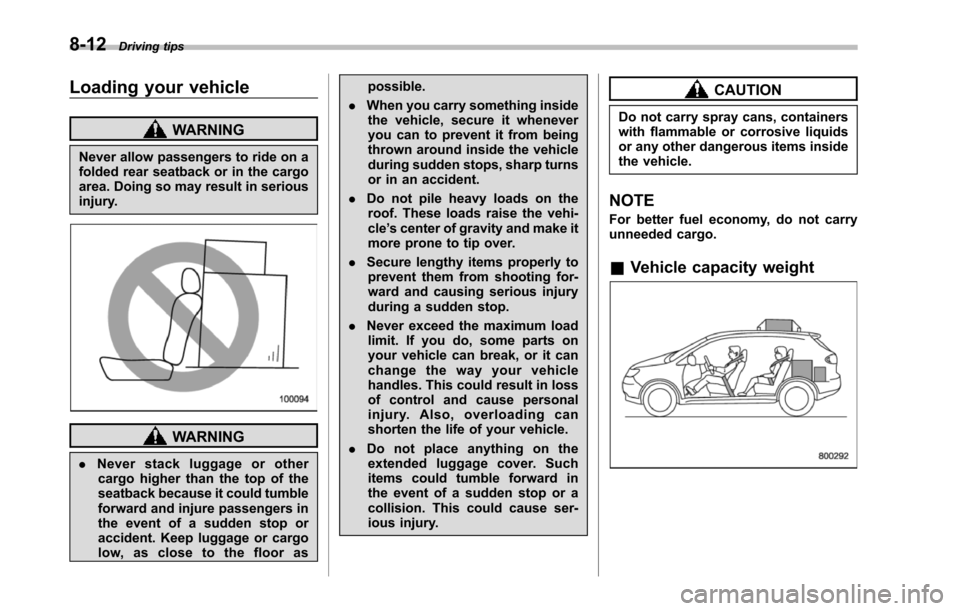
Never allow passengers to ride on afolded rear seatback or in the cargoarea. Doing so may result in seriousinjury.
WARNING
.Never stack luggage or othercargo higher than the top of theseatback because it could tumbleforward and injure passengers inthe event of a sudden stop oraccident. Keep luggage or cargolow, as close to the floor as
possible.
.When you carry something insidethe vehicle, secure it wheneveryou can to prevent it from beingthrown around inside the vehicleduring sudden stops, sharp turnsor in an accident.
.Do not pile heavy loads on theroof. These loads raise the vehi-cle’s center of gravity and make itmore prone to tip over.
.Secure lengthy items properly toprevent them from shooting for-ward and causing serious injuryduring a sudden stop.
.Never exceed the maximum loadlimit. If you do, some parts onyour vehicle can break, or it canchange the way your vehiclehandles. This could result in lossof control and cause personalinjury. Also, overloading canshorten the life of your vehicle.
.Do not place anything on theextended luggage cover. Suchitems could tumble forward inthe event of a sudden stop or acollision. This could cause ser-ious injury.
CAUTION
Do not carry spray cans, containerswith flammable or corrosive liquidsor any other dangerous items insidethe vehicle.
NOTE
For better fueleconomy, do not carryunneeded cargo.
&Vehicle capacity weight
Page 292 of 426
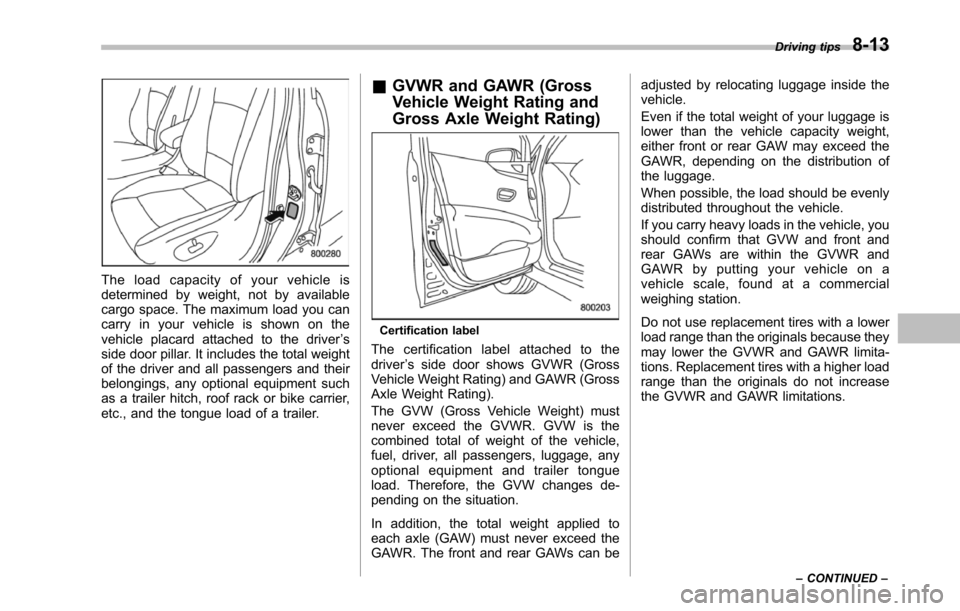
The load capacity of your vehicle isdetermined by weight, not by availablecargospace. The maximum load you cancarry in your vehicle is shown on thevehicle placard attached to the driver’sside door pillar. It includes the total weightof the driver and all passengers and theirbelongings, any optional equipment suchas a trailer hitch, roof rack or bike carrier,etc., and the tongue load of a trailer.
&GVWR and GAWR (Gross
Vehicle Weight Rating and
Gross Axle Weight Rating)
Certification label
The certification label attached to thedriver’s side door shows GVWR (GrossVehicle Weight Rating) and GAWR (GrossAxle Weight Rating).
The GVW (Gross Vehicle Weight) mustnever exceed the GVWR. GVW is thecombined total of weight of the vehicle,fuel, driver, all passengers, luggage, anyoptional equipment and trailer tongueload. Therefore, the GVW changes de-pending on the situation.
In addition, the total weight applied toeach axle (GAW) must never exceed theGAWR. The front and rear GAWs can be
adjusted by relocating luggage inside thevehicle.
Even if the total weight of your luggage islower than the vehicle capacity weight,either front or rear GAW may exceed theGAWR, depending on the distribution ofthe luggage.
When possible, the load should be evenlydistributedthroughout the vehicle.
If you carry heavy loads in the vehicle, youshould confirm that GVW and front andrearGAWs are within the GVWR andGAWR by putting your vehicle on avehicle scale, found at a commercialweighing station.
Do not use replacement tires with a lowerload range than the originals because theymay lower the GVWR and GAWR limita-tions. Replacement tires with a higher loadrange than the originals do not increasethe GVWR and GAWR limitations.
Driving tips8-13
–CONTINUED–
Page 342 of 426
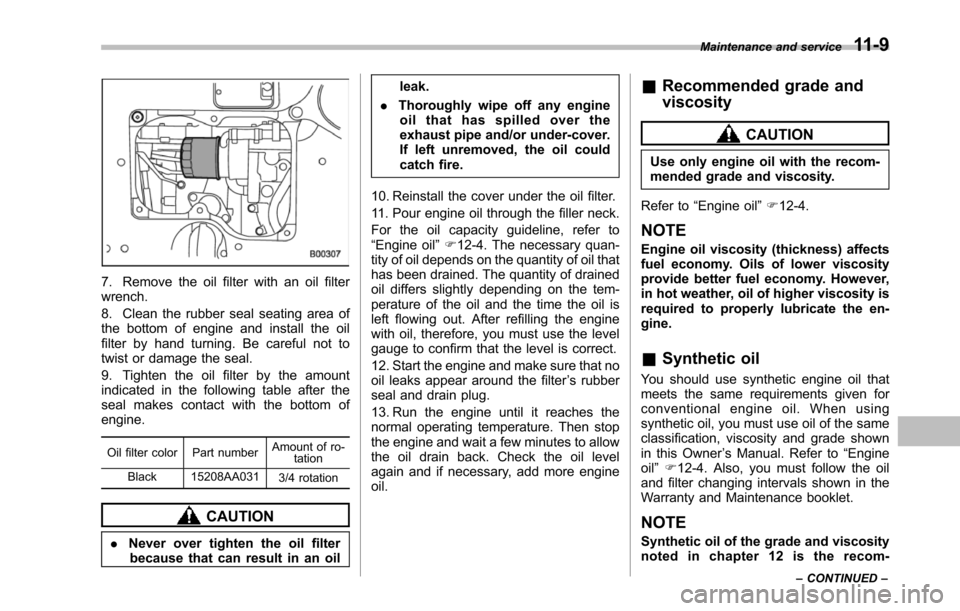
7. Remove the oil filter with an oil filterwrench.
8. Clean the rubber seal seating area ofthe bottom of engine and install the oilfilterby hand turning. Be careful not totwist or damage the seal.
9. Tighten the oil filter by the amountindicatedin the following table after theseal makes contact with the bottom ofengine.
Oil filter color Part numberAmount of ro-tation
Black 15208AA0313/4 rotation
CAUTION
.Never over tighten the oil filterbecause that can result in an oil
leak.
.Thoroughly wipe off any engineoil that has spilled over theexhaust pipe and/or under-cover.If left unremoved, the oil couldcatch fire.
10. Reinstall thecover under the oil filter.
11. Pour engine oil through the filler neck.
For the oil capacity guideline, refer to“Engine oil”F12-4. The necessary quan-tity of oil depends on the quantity of oil thathas been drained. The quantity of drainedoil differs slightly depending on the tem-perature of the oil and the time the oil isleft flowing out. After refilling the enginewith oil, therefore, you must use the levelgauge to confirm that the level is correct.
12.Start the engine and make sure that nooil leaks appear around the filter’s rubberseal and drain plug.
13. Run the engine until it reaches thenormal operating temperature. Then stopthe engine and wait a few minutes to allowthe oil drain back. Check the oil levelagain and if necessary, add more engineoil.
&Recommended grade and
viscosity
CAUTION
Use only engine oil with the recom-mended grade and viscosity.
Refer to“Engine oil”F12-4.
NOTE
Engine oil viscosity (thickness) affectsfuel economy. Oils of lower viscosityprovide better fuel economy. However,in hot weather, oil of higher viscosity isrequired to properly lubricate the en-gine.
&Synthetic oil
You should use synthetic engine oil thatmeets the samerequirements given forconventional engine oil. When usingsynthetic oil, you must use oil of the sameclassification,viscosity and grade shownin this Owner’s Manual. Refer to“Engineoil”F12-4. Also, you must follow the oiland filter changing intervals shown in theWarranty and Maintenance booklet.
NOTE
Synthetic oil of the grade and viscositynoted in chapter 12 is the recom-
Maintenance and service11-9
–CONTINUED–
Page 344 of 426
&Engine coolant
!Checking the coolant level
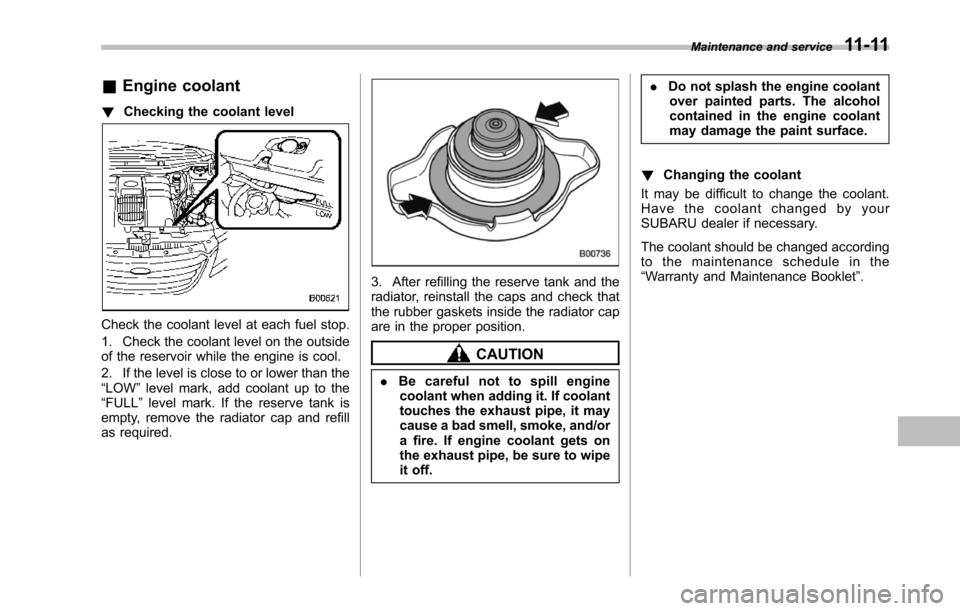
Check the coolant level at each fuel stop.
1. Check the coolant level on the outsideof the reservoir while the engine is cool.
2. If the level is close to or lower than the“LOW”level mark, add coolant up to the“FULL”level mark. If the reserve tank isempty, remove the radiator cap and refillas required.
3. After refilling the reserve tank and theradiator, reinstall the caps and check thatthe rubber gaskets inside the radiator capare in the proper position.
CAUTION
.Be careful not to spill enginecoolant when adding it. If coolanttouches the exhaust pipe, it maycause a bad smell, smoke, and/ora fire. If engine coolant gets onthe exhaust pipe, be sure to wipeit off.
.Do not splash the engine coolantover painted parts. The alcoholcontained in the engine coolantmay damage the paint surface.
!Changing the coolant
It may be difficult to change the coolant.Have the coolant changed by yourSUBARU dealer if necessary.
The coolant should be changed accordingto the maintenance schedule in the“Warranty and Maintenance Booklet”.
Maintenance and service11-11
Page 380 of 426
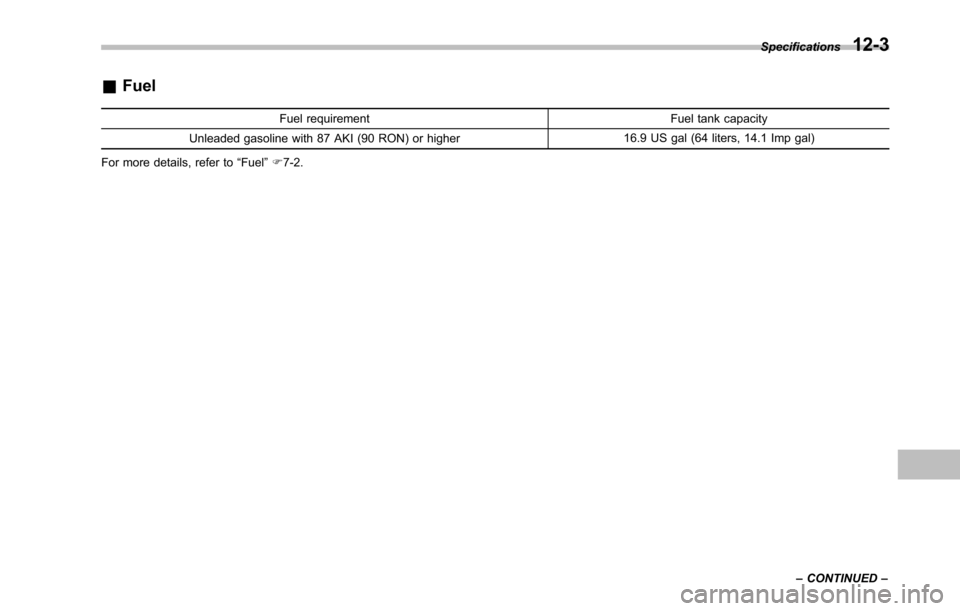
&Fuel
Fuel requirement Fuel tank capacity
Unleaded gasoline with 87 AKI (90 RON) or higher16.9 US gal (64 liters, 14.1 Imp gal)
For more details, refer to“Fuel”F7-2.
Specifications12-3
–CONTINUED–
Page 399 of 426
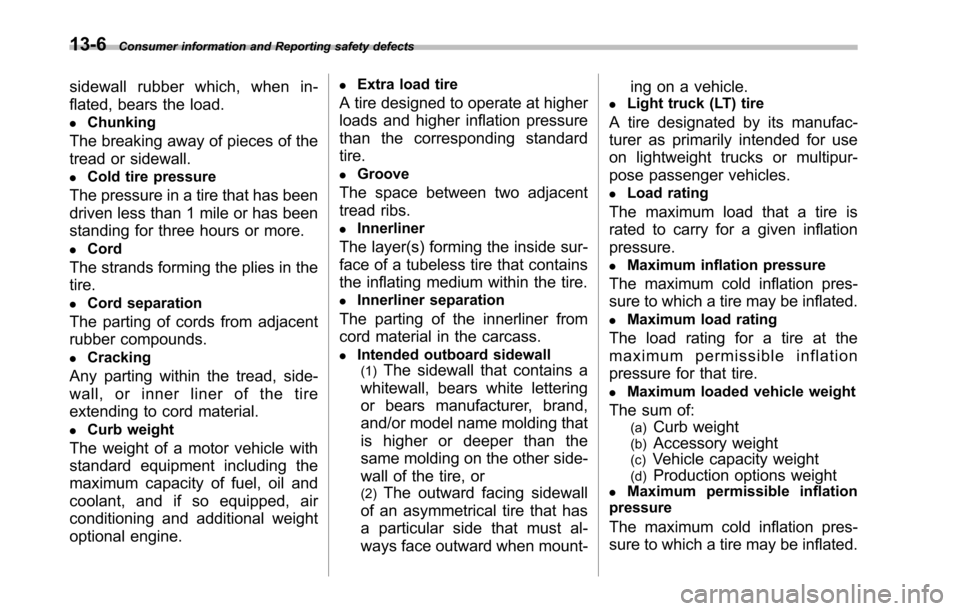
13-6Consumer information and Reporting safety defects
sidewall rubber which, when in-
flated, bears the load.
.Chunking
The breaking away of pieces of the
tread or sidewall.
.Cold tire pressure
The pressure in a tire that has been
driven less than 1 mile or has been
standing for three hours or more.
.Cord
The strands forming the plies in the
tire.
.Cordseparation
The parting of cords from adjacent
rubber compounds.
.Cracking
Any parting within the tread, side-
wall, or inner liner of the tire
extending to cord material.
.Curb weight
The weight of a motor vehicle with
standard equipment including the
maximum capacity of fuel, oil and
coolant, and if so equipped, air
conditioning and additional weight
optional engine.
.Extra load tire
A tire designed to operate at higher
loads and higher inflation pressure
than the corresponding standard
tire.
.Groove
The space between two adjacent
tread ribs.
.Innerliner
The layer(s) forming the inside sur-
face of a tubeless tire that contains
the inflating medium within the tire.
.Innerliner separation
The parting of the innerliner from
cord material in the carcass.
.Intended outboard sidewall(1)The sidewall that contains a
whitewall, bears white lettering
or bears manufacturer, brand,
and/or model name molding that
is higher or deeper than the
same molding on the other side-
wall of the tire, or
(2)The outward facing sidewall
of an asymmetrical tire that has
a particular side that must al-
ways face outward when mount-
ing on a vehicle.
.Light truck (LT) tire
A tire designated by its manufac-
turer as primarily intended for use
on lightweight trucks or multipur-
pose passenger vehicles.
.Load rating
The maximum load that a tire is
rated to carry for a given inflation
pressure.
.Maximum inflation pressure
The maximum cold inflation pres-
sure to which a tire may be inflated.
.Maximum load rating
The load rating for a tire at the
maximum permissible inflation
pressure for that tire.
.Maximum loaded vehicle weight
The sum of:
(a)Curb weight(b)Accessory weight(c)Vehicle capacity weight(d)Production options weight.Maximum permissible inflation
pressure
The maximum cold inflation pres-
sure to which a tire may be inflated.
Page 414 of 426
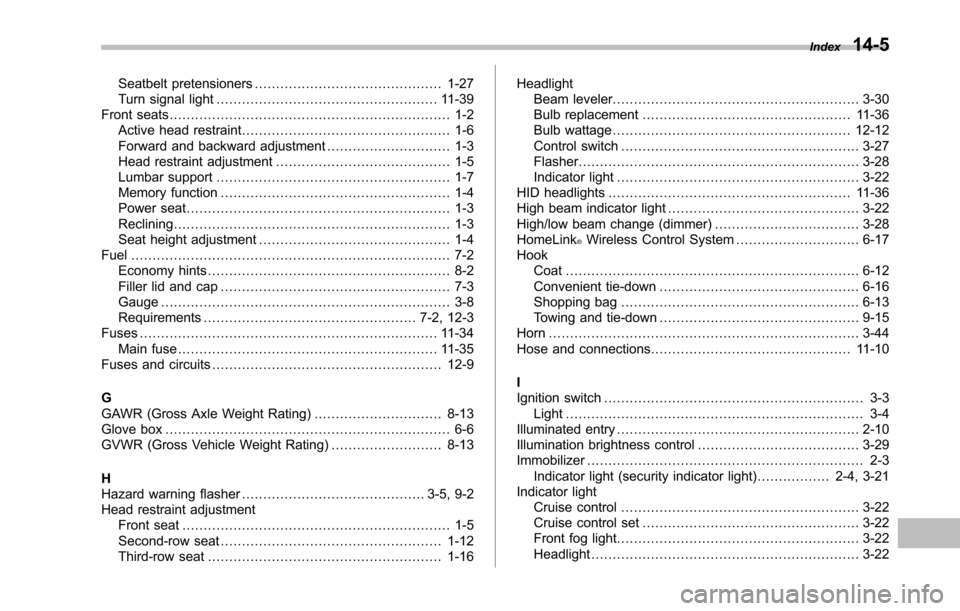
Seatbelt pretensioners............................................ 1-27Turn signal light.................................................... 11-39Front seats.................................................................. 1-2Active head restraint................................................. 1-6Forward and backward adjustment............................. 1-3Head restraint adjustment......................................... 1-5Lumbar support....................................................... 1-7Memory function...................................................... 1-4Power seat.............................................................. 1-3Reclining................................................................. 1-3Seat height adjustment............................................. 1-4Fuel........................................................................... 7-2Economy hints......................................................... 8-2Filler lid and cap...................................................... 7-3Gauge.................................................................... 3-8Requirements.................................................. 7-2, 12-3Fuses...................................................................... 11-34Main fuse............................................................. 11-35Fuses and circuits...................................................... 12-9
GGAWR (Gross Axle Weight Rating).............................. 8-13Glove box................................................................... 6-6GVWR (Gross Vehicle Weight Rating).......................... 8-13
HHazard warning flasher........................................... 3-5, 9-2Head restraint adjustmentFront seat............................................................... 1-5Second-row seat.................................................... 1-12Third-row seat....................................................... 1-16
HeadlightBeam leveler.......................................................... 3-30Bulb replacement................................................. 11-36Bulb wattage........................................................ 12-12Control switch........................................................ 3-27Flasher.................................................................. 3-28Indicator light......................................................... 3-22HID headlights......................................................... 11-36High beam indicator light............................................. 3-22High/low beam change (dimmer).................................. 3-28HomeLink®Wireless Control System............................. 6-17HookCoat..................................................................... 6-12Convenienttie-down............................................... 6-16Shopping bag........................................................ 6-13Towing and tie-down............................................... 9-15Horn......................................................................... 3-44Hose and connections............................................... 11-10
IIgnition switch............................................................. 3-3Light...................................................................... 3-4Illuminated entry......................................................... 2-10Illumination brightness control...................................... 3-29Immobilizer................................................................. 2-3Indicator light (security indicator light)................. 2-4, 3-21Indicator lightCruise control........................................................ 3-22Cruise control set................................................... 3-22Front fog light......................................................... 3-22Headlight............................................................... 3-22
Index14-5
Page 419 of 426
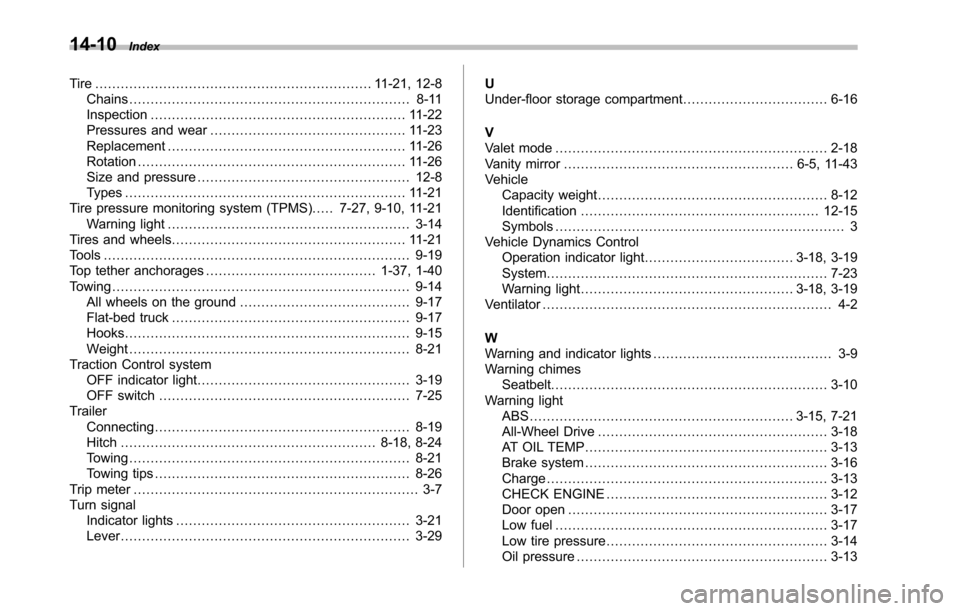
14-10Index
Tire . . . . . . . . . . . . . . . . . . . . . . . . . . . . . . . . . . . . . . . . . . . . . . . . . . . . . . . . . . . . . . . . . 11-21, 12-8Chains.................................................................. 8-11Inspection............................................................ 11-22Pressures and wear.............................................. 11-23Replacement........................................................ 11-26Rotation............................................................... 11-26Size and pressure.................................................. 12-8Types.................................................................. 11-21Tire pressure monitoring system (TPMS)..... 7-27, 9-10, 11-21Warning light......................................................... 3-14Tires and wheels....................................................... 11-21Tools........................................................................ 9-19Top tether anchorages........................................ 1-37, 1-40Towing...................................................................... 9-14All wheels on the ground........................................ 9-17Flat-bed truck........................................................ 9-17Hooks................................................................... 9-15Weight ..................................................................8-21Traction Control systemOFF indicator light.................................................. 3-19OFF switch........................................................... 7-25TrailerConnecting............................................................ 8-19Hitch............................................................ 8-18, 8-24Towing.................................................................. 8-21Towing tips............................................................ 8-26Trip meter................................................................... 3-7Turn signalIndicator lights....................................................... 3-21Lever.................................................................... 3-29
UUnder-floor storage compartment.................................. 6-16
VValet mode................................................................ 2-18Vanity mirror...................................................... 6-5, 11-43VehicleCapacity weight...................................................... 8-12Identification........................................................ 12-15Symbols.................................................................... 3Vehicle Dynamics ControlOperation indicator light................................... 3-18, 3-19System.................................................................. 7-23Warning light.................................................. 3-18, 3-19Ventilator.................................................................... 4-2
WWarning and indicator lights.......................................... 3-9Warning chimesSeatbelt................................................................. 3-10Warning lightABS .............................................................. 3-15, 7-21All-Wheel Drive...................................................... 3-18AT OIL TEMP......................................................... 3-13Brake system......................................................... 3-16Charge.................................................................. 3-13CHECK ENGINE.................................................... 3-12Door open............................................................. 3-17Low fuel................................................................ 3-17Low tire pressure.................................................... 3-14Oil pressure........................................................... 3-13