Page 5 of 352
.
.
Contents
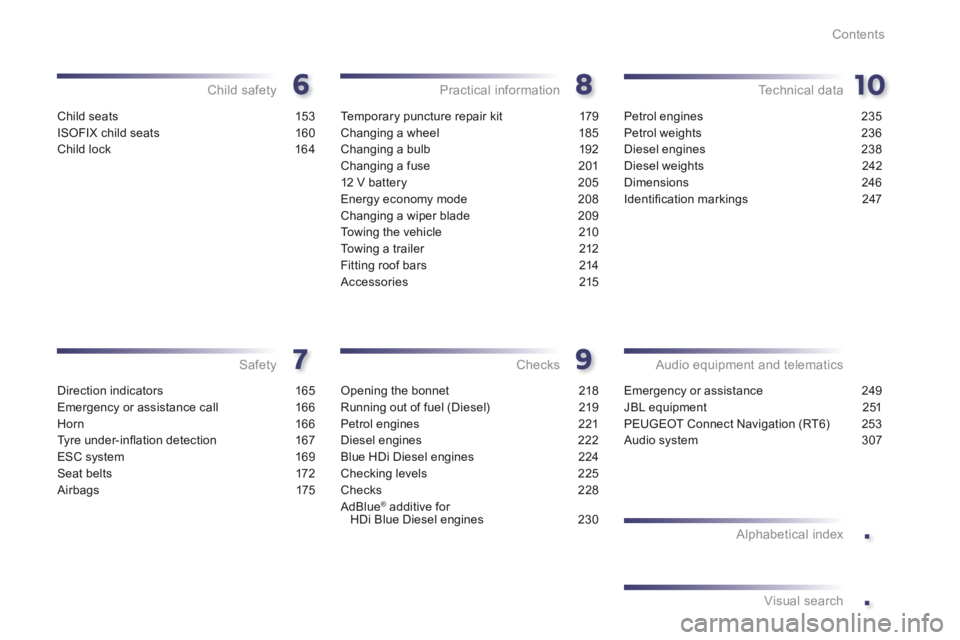
Child seats 153
ISOFIX child seats 160
Child lock 164
Child safety
Direction indicators 165
Emergency or assistance call 166
Horn 166
Tyre under-infl ation detection 167
ESC system 169
Seat belts 172
Airbags 175
Safety
Temporary puncture repair kit 179
Changing a wheel 185
Changing a bulb 192
Changing a fuse 201
12 V battery 205
Energy economy mode 208
Changing a wiper blade 209
Towing the vehicle 210
Towing a trailer 212
Fitting roof bars 214
Accessories 215
Practical information
Opening the bonnet 218
Running out of fuel (Diesel) 219
Petrol engines 221
Diesel engines 222
Blue HDi Diesel engines 224
Checking levels 225
Checks 228
AdBlue® additive for ® additive for ®
HDi Blue Diesel engines 230
Checks
Petrol engines 235
Petrol weights 236
Diesel engines 238
Diesel weights 242
Dimensions 246
Identifi cation markings 247
Technical data
Emergency or assistance 249
JBL equipment 251
PEUGEOT Connect Navigation (RT6) 253
Audio system 307
Audio equipment and telematics
Alphabetical indexVisual search
Page 12 of 352
10Familiarisation
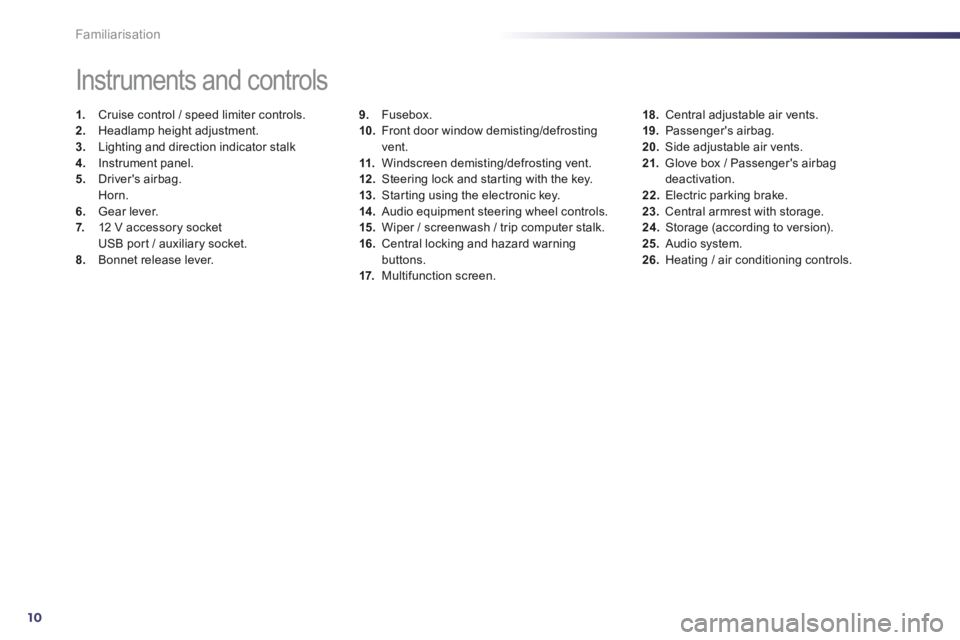
9. Fusebox. 10. Front door window demisting/defrosting vent. 11. Windscreen demisting/defrosting vent. 12 . Steering lock and starting with the key. 13. Starting using the electronic key. 14 . Audio equipment steering wheel controls. 15. Wiper / screenwash / trip computer stalk. 16. Central locking and hazard warning buttons. 17. Multifunction screen.
Instruments and controls
1. Cruise control / speed limiter controls. 2. Headlamp height adjustment. 3. Lighting and direction indicator stalk 4. Instrument panel. 5. Driver's airbag. Horn. 6. Gear lever. 7. 12 V accessory socket USB port / auxiliary socket. 8. Bonnet release lever.
18. Central adjustable air vents. 19. Passenger's airbag. 20. Side adjustable air vents. 21. Glove box / Passenger's airbag deactivation. 22. Electric parking brake. 23. Central armrest with storage. 24. Storage (according to version). 25. Audio system. 26. Heating / air conditioning controls.
Page 203 of 352
8
201
Practical information
Changing a fuse Procedure for replacing a failed fuse with a new fuse to rectify a failure of the corresponding function.
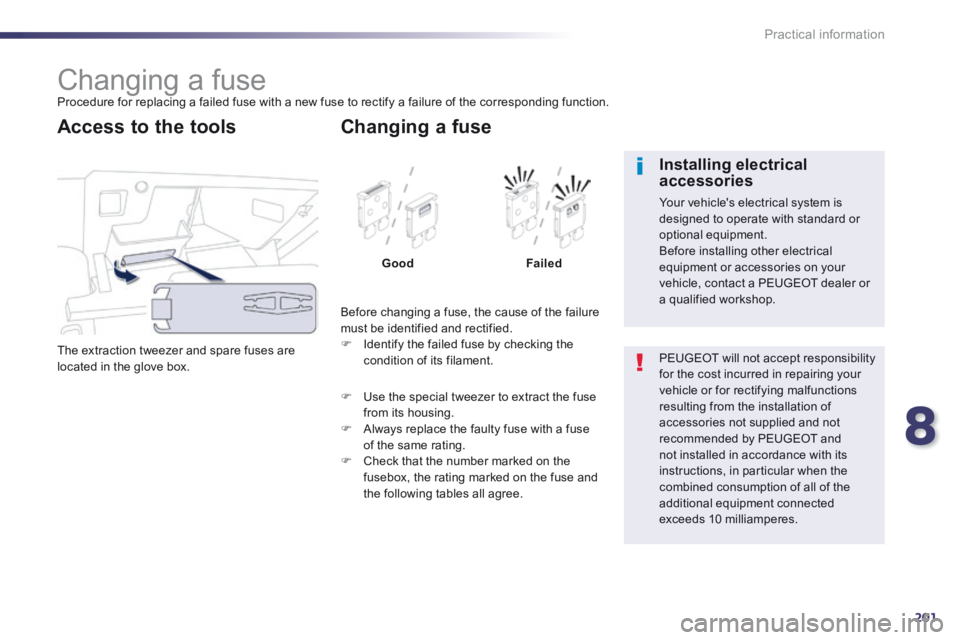
The extraction tweezer and spare fuses are located in the glove box.
Access to the tools
Before changing a fuse, the cause of the failure must be identified and rectified. Identify the failed fuse by checking the condition of its filament.
Changing a fuse
GoodFailed
Use the special tweezer to extract the fuse from its housing. Always replace the faulty fuse with a fuse of the same rating. Check that the number marked on the fusebox, the rating marked on the fuse and the following tables all agree.
PEUGEOT will not accept responsibility for the cost incurred in repairing your vehicle or for rectifying malfunctions resulting from the installation of accessories not supplied and not
recommended by PEUGEOT and not installed in accordance with its instructions, in particular when the combined consumption of all of the additional equipment connected exceeds 10 milliamperes.
Installing electrical accessories
Your vehicle's electrical system is designed to operate with standard or optional equipment. Before installing other electrical equipment or accessories on your vehicle, contact a PEUGEOT dealer or a qualified workshop.
Page 204 of 352
202
Practical information
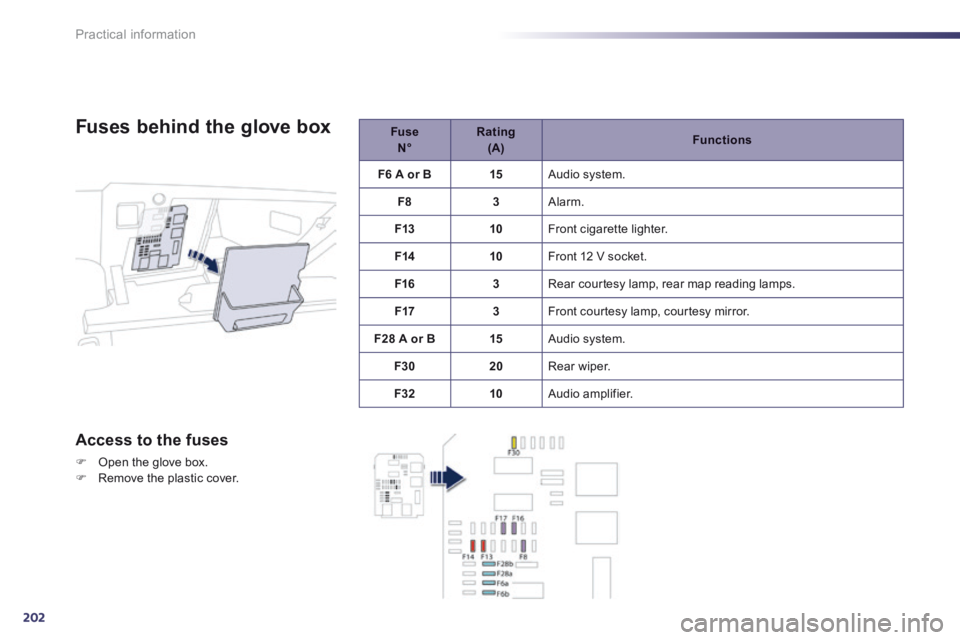
Fuses behind the glove box
Access to the fuses
Open the glove box. Remove the plastic cover.
Fuse N° Rating (A) Functions
F6 A or B 15 Audio system.
F8 3 Alarm.
F13 10 Front cigarette lighter.
F14 10 Front 12 V socket.
F16 3 Rear courtesy lamp, rear map reading lamps.
F17 3 Front courtesy lamp, courtesy mirror.
F28 A or B 15 Audio system.
F30 20 Rear wiper.
F32 10 Audio amplifier.
Page 205 of 352
8
203
Practical information
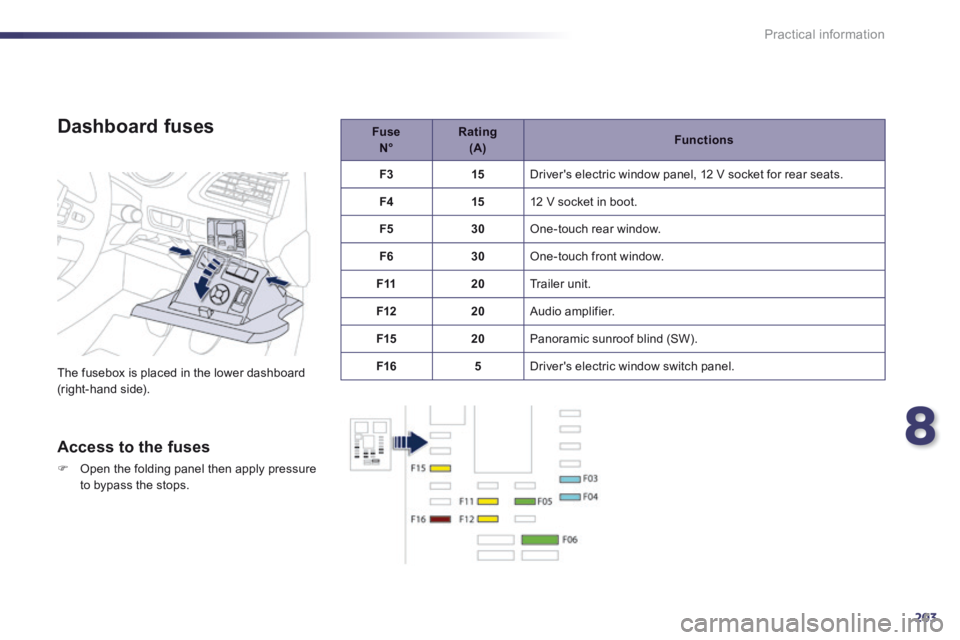
Dashboard fuses
The fusebox is placed in the lower dashboard (right-hand side).
Access to the fuses
Open the folding panel then apply pressure to bypass the stops.
Fuse N° Rating (A) Functions
F3 15 Driver's electric window panel, 12 V socket for rear seats.
F4 15 12 V socket in boot.
F5 30 One-touch rear window.
F6 30 One-touch front window.
F11 20 Trailer unit.
F12 20 Audio amplifier.
F15 20 Panoramic sunroof blind (SW).
F16 5 Driver's electric window switch panel.
Page 206 of 352
204
Practical information
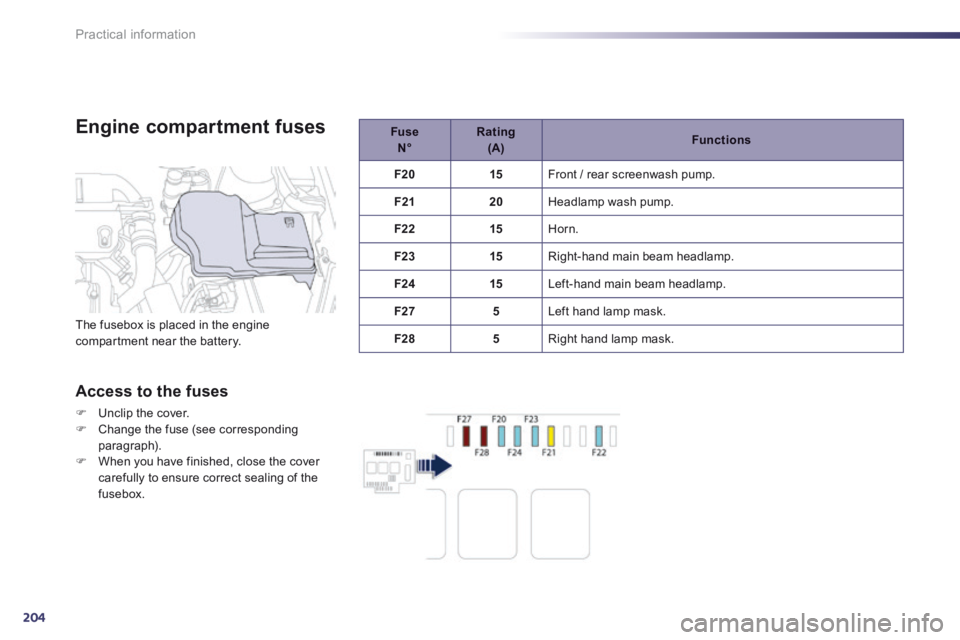
Engine compartment fuses Fuse N° Rating (A) Functions
F20 15 Front / rear screenwash pump.
F21 20 Headlamp wash pump.
F22 15 Horn.
F23 15 Right-hand main beam headlamp.
F24 15 Left-hand main beam headlamp.
F27 5 Left hand lamp mask.
F28 5 Right hand lamp mask. The fusebox is placed in the engine compartment near the battery.
Access to the fuses
Unclip the cover. Change the fuse (see corresponding paragraph). When you have finished, close the cover carefully to ensure correct sealing of the
fusebox.
Page 207 of 352
8
205
Practical information
12 V battery Procedure for charging your battery when it is flat or for starting the engine using another battery.
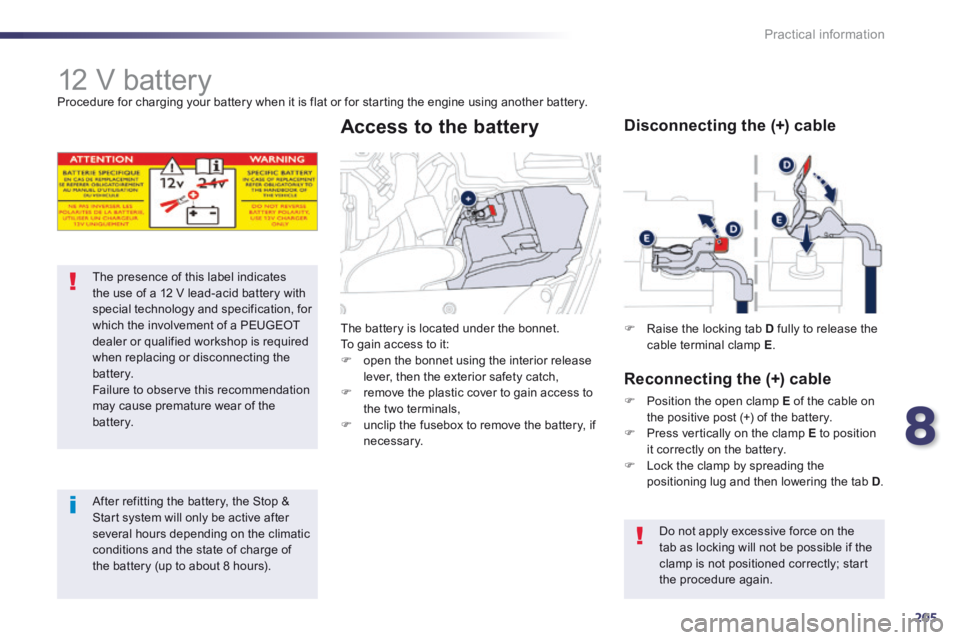
The presence of this label indicates the use of a 12 V lead-acid battery with special technology and specification, for which the involvement of a PEUGEOT dealer or qualified workshop is required when replacing or disconnecting the battery. Failure to observe this recommendation may cause premature wear of the battery.
After refitting the battery, the Stop & Start system will only be active after several hours depending on the climatic conditions and the state of charge of the battery (up to about 8 hours).
The battery is located under the bonnet. To gain access to it: open the bonnet using the interior release lever, then the exterior safety catch, remove the plastic cover to gain access to the two terminals, unclip the fusebox to remove the battery, if
necessary.
Access to the battery
Raise the locking tab D fully to release the cable terminal clamp E .
Disconnecting the (+) cable
Reconnecting the (+) cable
Position the open clamp E of the cable on the positive post (+) of the battery.
Press vertically on the clamp E to position it correctly on the battery. Lock the clamp by spreading the positioning lug and then lowering the tab D .
Do not apply excessive force on the tab as locking will not be possible if the clamp is not positioned correctly; start the procedure again.
Page 218 of 352
216
Practical information
The fitting of electrical equipment or accessories which are not recommended by PEUGEOT may result in a failure of your vehicle's electronic system and excessive electrical consumption. Please note this precaution. You are advised to contact a PEUGEOT representative to be shown the range of recommended equipment and accessories.
Installation of radio communication transmitters
Before installing any after-market radio communication transmitter, you can contact a PEUGEOT dealer for the specification of transmitters which can be fitted (frequency, maximum power, aerial position, specific installation requirements), in line with the Vehicle Electromagnetic Compatibility Directive (2004/104/EC).
Depending on the legislation in force in the country, it may be compulsory to have a high visibility safety vest, warning triangle and spare bulbs and fuses available in the vehicle.
You can also obtain products for cleaning and maintenance (exterior and interior) and topping up fluids (screenwash, ...), as well as refills (cartridge for temporary tyre repair kit...) from PEUGEOT dealers.
"Multimedia":
audio systems, portable navigation system, Takara/Sony portable video screen, Bluetooth system, speakers, DVD player, Wi-Fi, driving aids, video support, microwave unit...