2014 Peugeot 308 media
[x] Cancel search: mediaPage 192 of 400
190
Safety
308_EN_CHAP06_SECURITE_ED02-2013
Under-inflation alert Reinitialisation
Before reinitialising the system, ensure that the pressures of the four tyres are correct for the use of the vehicle and in line with the recommendations on the tyre pressure label. The under-inflation detection system does not give a warning if a pressure is incorrect at the time of reinitialisation.
This is given by fixed illumination of this warning lamp, accompanied by an audible signal and, depending on
equipment, the display of a message.
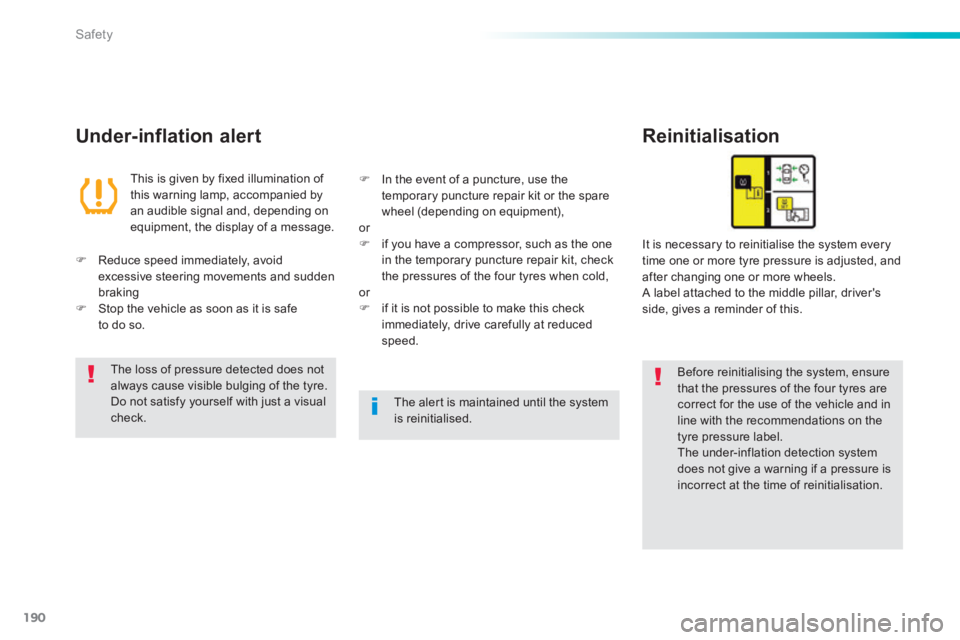
It is necessary to reinitialise the system every time one or more tyre pressure is adjusted, and after changing one or more wheels. A label attached to the middle pillar, driver's side, gives a reminder of this.
Reduce speed immediately, avoid excessive steering movements and sudden braking Stop the vehicle as soon as it is safe to do so.
In the event of a puncture, use the temporary puncture repair kit or the spare wheel (depending on equipment), or if you have a compressor, such as the one in the temporary puncture repair kit, check the pressures of the four tyres when cold, or if it is not possible to make this check immediately, drive carefully at reduced speed.
The loss of pressure detected does not always cause visible bulging of the tyre. Do not satisfy yourself with just a visual check. The alert is maintained until the system is reinitialised.
Page 201 of 400
199
6
Safety
308_EN_CHAP06_SECURITE_ED02-2013
Airbags
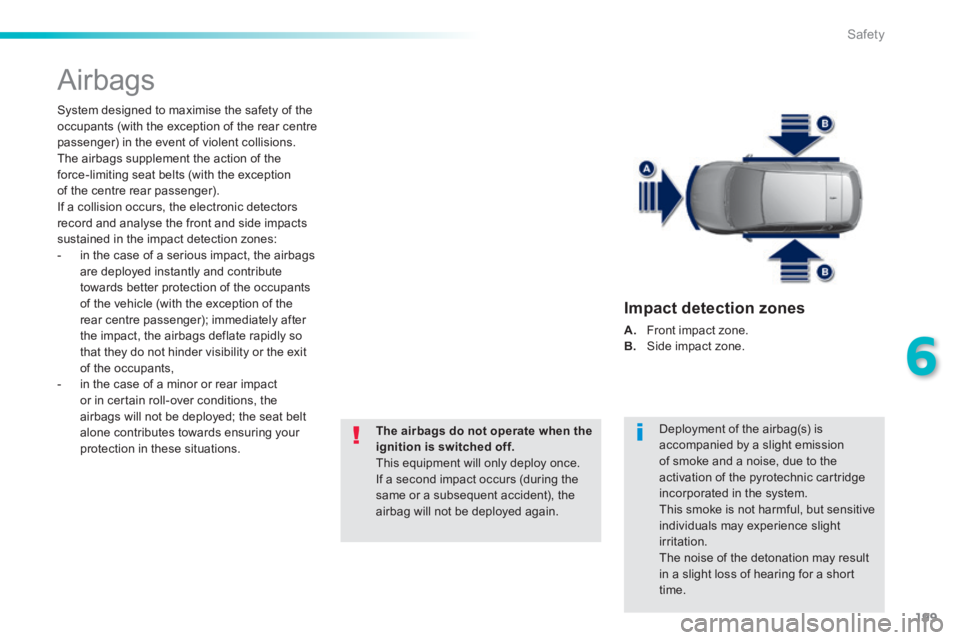
System designed to maximise the safety of the occupants (with the exception of the rear centre passenger) in the event of violent collisions. The airbags supplement the action of the force-limiting seat belts (with the exception of the centre rear passenger). If a collision occurs, the electronic detectors record and analyse the front and side impacts sustained in the impact detection zones: - in the case of a serious impact, the airbags are deployed instantly and contribute towards better protection of the occupants of the vehicle (with the exception of the rear centre passenger); immediately after the impact, the airbags deflate rapidly so that they do not hinder visibility or the exit of the occupants, - in the case of a minor or rear impact or in certain roll-over conditions, the airbags will not be deployed; the seat belt alone contributes towards ensuring your protection in these situations.
The airbags do not operate when the ignition is switched off. This equipment will only deploy once. If a second impact occurs (during the same or a subsequent accident), the airbag will not be deployed again.
Deployment of the airbag(s) is accompanied by a slight emission of smoke and a noise, due to the activation of the pyrotechnic cartridge incorporated in the system. This smoke is not harmful, but sensitive individuals may experience slight irritation. The noise of the detonation may result in a slight loss of hearing for a short time.
Impact detection zones
A. Front impact zone. B. Side impact zone.
Page 214 of 400
212
Safety
308_EN_CHAP06_SECURITE_ED02-2013
U : seat suitable for the installation of a child seat secured using the seat belt and universally approved "rearward facing" and/or "for ward facing". U(R) : as for U , the vehicle seat must be adjusted to the lowest position with 11 operations of the seat height adjuster and intermediate longitudinal position. X : seat not suitable for the installation of a child seat of the weight group indicated.
Remove and stow the head restraint before fitting a child seat with a backrest to a passenger seat. Refit the head restraint when the child seat is removed.
(a) universal child seat: child seat which can be installed in all vehicles using the seat belt. (b) group 0: from birth to 10 kg. Infant car seats and "car cots" cannot be installed on the
front passenger seat. (c) consult the legislation in force in your country before installing your child on this seat. (d) to install a child seat on a rear seat, rear ward or for ward facing, move the front seat for ward, then straighten the backrest to allow enough room for the child seat and the child's legs. (1) a child seat with support leg must never be installed on the centre rear passenger seat.
Page 226 of 400
224
Practical information
308_EN_CHAP07_INFO PR ATIQUES_ED02-2013
If after around 5 to 7 minutes the pressure is not attained, this indicates that the tyre is not repairable; contact a PEUGEOT dealer or a qualified workshop for assistance.
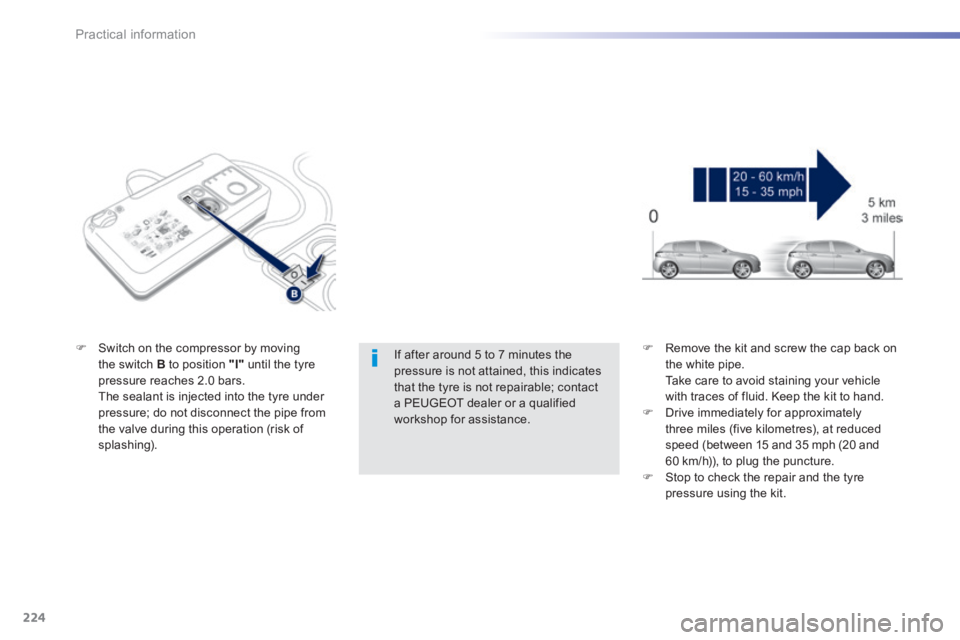
Switch on the compressor by moving the switch B to position "I" until the tyre pressure reaches 2.0 bars. The sealant is injected into the tyre under pressure; do not disconnect the pipe from the valve during this operation (risk of
splashing).
Remove the kit and screw the cap back on the white pipe. Take care to avoid staining your vehicle with traces of fluid. Keep the kit to hand. Drive immediately for approximately three miles (five kilometres), at reduced
speed (between 15 and 35 mph (20 and 60 km/h)), to plug the puncture. Stop to check the repair and the tyre pressure using the kit.
Page 257 of 400
255
7
Practical information
308_EN_CHAP07_INFO PR ATIQUES_ED02-2013
System which manages the duration of use of certain functions to conserve a sufficient level of charge in the battery. After the engine has stopped, you can still use functions such as the audio and telematics system, windscreen wipers, dipped beam headlamps, courtesy lamps, etc. for a maximum combined duration of about forty minutes.
Energy economy mode
Switching to economy
mode
A message then appears in the instrument panel screen indicating that the vehicle has switched to economy mode and the active functions are put on standby.
If a telephone call is being made at this time, it will be maintained for around 10 minutes with the Bluetooth hands-free system of your audio system.
Exiting economy mode
These functions are reactivated automatically next time the vehicle is driven. In order to restore the use of these functions immediately, start the engine and let it run: - for less than ten minutes, to use the equipment for approximately five minutes, - for more than ten minutes, to use the equipment for up to approximately thirty minutes. Let the engine run for the duration specified to ensure that the battery charge is sufficient. Do not repeatedly and continuously restart the engine in order to charge the battery. A flat battery prevents the engine from starting (refer to the "Battery" section).
Load reduction mode
System which manages the use of certain functions according to the level of charge remaining in the battery. When the vehicle is being driven, the load reduction function temporarily deactivates certain functions, such as the air conditioning, the heated rear screen... The deactivated functions are reactivated automatically as soon as conditions permit.
Page 267 of 400
265
7
Practical information
308_EN_CHAP07_INFO PR ATIQUES_ED02-2013
The fitting of electrical equipment or accessories which are not recommended by PEUGEOT may result in a failure of your vehicle's electronic system and excessive electrical consumption. Please note this precaution. You are advised to contact a PEUGEOT representative to be shown the range of recommended equipment and accessories.
Installation of radio communication transmitters
Before installing any after-market radio communication transmitter, you can contact a PEUGEOT dealer for the specification of transmitters which can be fitted (frequency, maximum power, aerial position, specific installation requirements), in line with the Vehicle Electromagnetic Compatibility Directive (2004/104/EC).
Depending on the legislation in force in the country, certain safety equipment may be compulsory: high visibility safety vests, warning triangles, breathalyzers, spare bulbs, spare fuses,
a fire extinguisher, a first aid kit, mud flaps at the rear of the vehicle.
By visiting a PEUGEOT dealer, you can also obtain products for cleaning and maintenance (exterior and interior) - including ecological products in the "TECHNATURE" range, topping up products (screenwash...), touch-up pens and paint aerosols for the exact colour of your vehicle, refills (cartridge for the temporary puncture repair kit...), ...
"Multimedia"
Multimedia support, hands-free kit, DVD player, driving aids, vehicle tracking system, ...
Page 277 of 400
275
8
Checks
308_EN_CHAP08_VERIFICATIONS_ED02-2013
Starting prevented
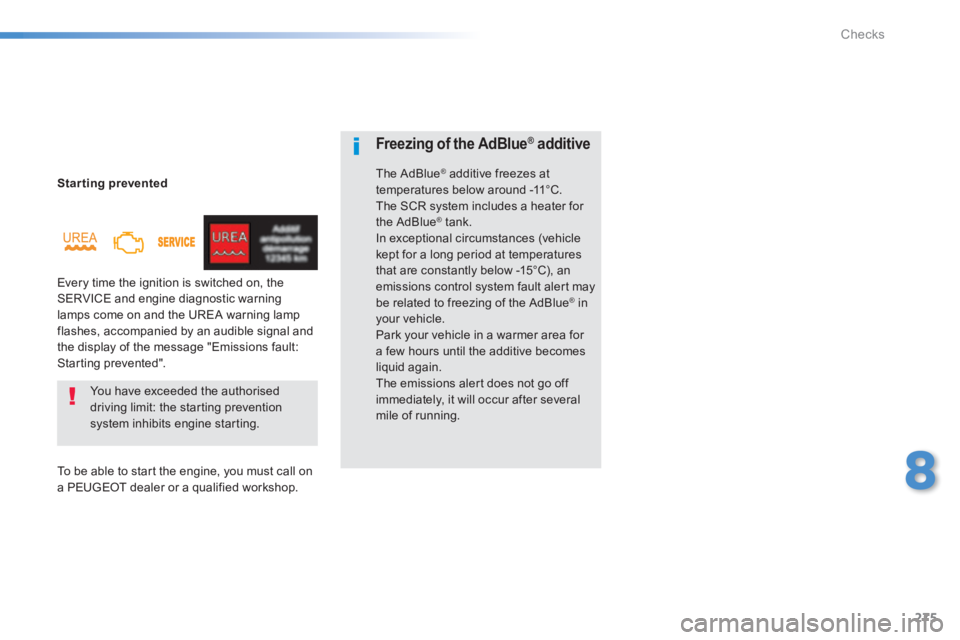
Every time the ignition is switched on, the SERVICE and engine diagnostic warning lamps come on and the UREA warning lamp flashes, accompanied by an audible signal and the display of the message "Emissions fault: Starting prevented".
You have exceeded the authorised driving limit: the starting prevention system inhibits engine starting.
To be able to start the engine, you must call on a PEUGEOT dealer or a qualified workshop.
Freezing of the AdBlue ® Freezing of the AdBlue ® Freezing of the AdBlue additive ® additive ®
The AdBlue ® additive freezes at ® additive freezes at ®
temperatures below around -11°C. The SCR system includes a heater for the AdBlue ® tank. ® tank. ®
In exceptional circumstances (vehicle kept for a long period at temperatures that are constantly below -15°C), an emissions control system fault alert may be related to freezing of the AdBlue ® in ® in ®
your vehicle. Park your vehicle in a warmer area for a few hours until the additive becomes liquid again. The emissions alert does not go off immediately, it will occur after several mile of running.
Page 278 of 400
276
Checks
308_EN_CHAP08_VERIFICATIONS_ED02-2013
Topping-up the AdBlue ®Topping-up the AdBlue ®Topping-up the AdBlue additive ® additive ®
Filling the AdBlue ® tank is an operation ® tank is an operation ®
included in every routine service on your vehicle by a PEUGEOT dealer or a qualified workshop. Nevertheless, given the capacity of the tank, it may be necessary to top-up the additive between services, more particularly if an alert (warning lamps and a message) signals the requirement. You can got to a PEUGEOT dealer or a qualified workshop. If you envisage topping-up yourself, please read the following warnings carefully.
Precautions in use
Keep AdBlue ® out of the reach of ® out of the reach of ®
children, in its original bottle. Never transfer AdBlue ® to another ® to another ®
container: it would loose its purity.
Use only AdBlue ® additive that meets the ® additive that meets the ®
ISO 22241 standard.
Never dilute the additive with water. Never pour the additive into the Diesel fuel tank.
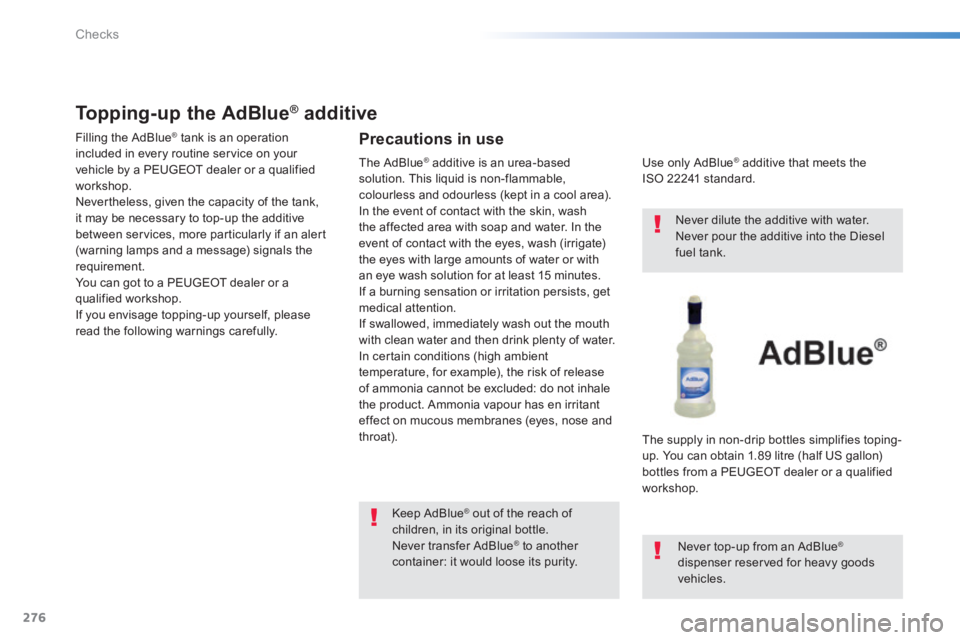
The supply in non-drip bottles simplifies toping-up. You can obtain 1.89 litre (half US gallon) bottles from a PEUGEOT dealer or a qualified workshop.
Never top-up from an AdBlue ®
dispenser reserved for heavy goods vehicles.
The AdBlue ® additive is an urea-based ® additive is an urea-based ®
solution. This liquid is non-flammable, colourless and odourless (kept in a cool area). In the event of contact with the skin, wash the affected area with soap and water. In the event of contact with the eyes, wash (irrigate) the eyes with large amounts of water or with an eye wash solution for at least 15 minutes. If a burning sensation or irritation persists, get medical attention. If swallowed, immediately wash out the mouth with clean water and then drink plenty of water. In certain conditions (high ambient temperature, for example), the risk of release of ammonia cannot be excluded: do not inhale the product. Ammonia vapour has en irritant effect on mucous membranes (eyes, nose and throat).