2014 Peugeot 3008 Hybrid 4 warning
[x] Cancel search: warningPage 167 of 378

9
165
Driving
With the vehicle stationary, to apply the parking brake, pull on control lever A . The application of the parking brake is confirmed by:
- lighting of the braking warning lamp and of the warning lamp P in
the control lever A ,
When the driver’s door is opened with the hybrid system active, there is an audible signal and a
message is displayed if the parking brake has not been applied.
Manual release
With the ignition on or the hybrid system active, to release the parking brake, press on the brake pedal or the accelerator, pull then release control lever A . The full application of the parking brake is confirmed by:
- extinction of the braking warning lamp and of the warning lamp P
in control lever lever A ,
If you pull control lever A If you pull control lever A If you pull control lever without pressing the brake pedal, the parking
brake will not be released and a warning lamp will come on in the instrument panel.
Manual application Maximum application
If necessary, you can make a maximum application of the parking brake. It is obtained by means of a long pull on control lever A , until you see a message that the parking brake is on accompanied by an audible signal is heard.
Maximum application is essential: - in the case of a vehicle towing a trailer, if the automatic functions are activated but you are applying the parking brake manually, - when the gradient you are parked on is variable in its effect (e.g. on a ferry, in a lorry, during towing).
- display of a message that the parking brake is on. - display of a message that the parking brake is off.
Before leaving the vehicle, check that parking brake warning lamp in the instrument panel is on, but not flashing.
In the case of towing a trailer or parking on a gradient, make a maximum application of the parking brake then turn the front wheels towards the pavement and engage a gear when you park. After a maximum application, the release time will be longer.
Page 168 of 378
166Driving
Automatic application,
hybrid system off
With the vehicle stationary, the parking brake is automatically applied when the hybrid system is switched off.
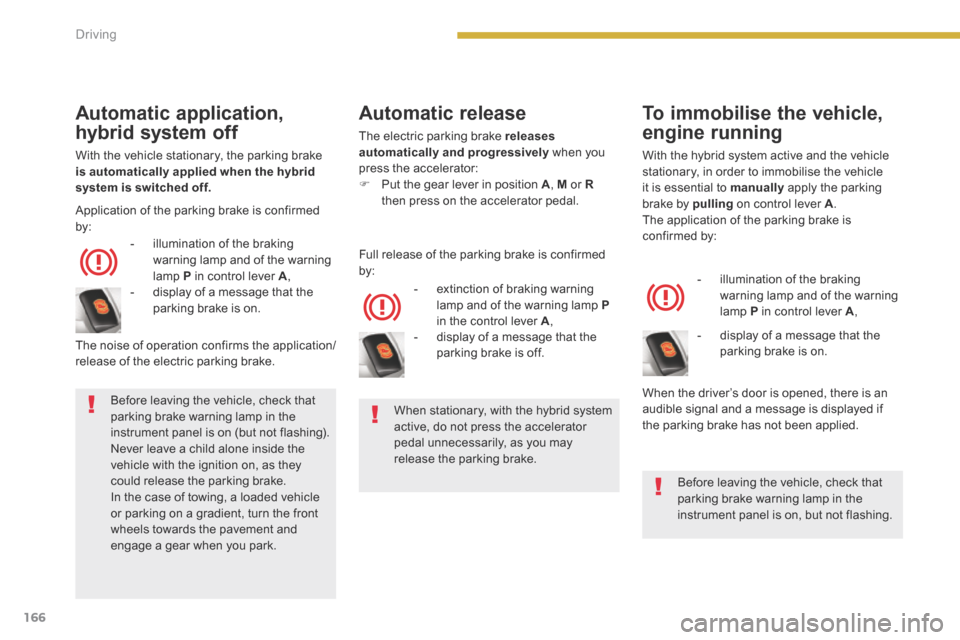
- illumination of the braking warning lamp and of the warning lamp P in control lever A ,
Automatic release
The electric parking brake releases automatically and progressively when you press the accelerator: Put the gear lever in position A , M or Rthen press on the accelerator pedal.
- extinction of braking warning lamp and of the warning lamp Pin the control lever A ,
The noise of operation confirms the application/ release of the electric parking brake.
Full release of the parking brake is confirmed by:
To immobilise the vehicle,
engine running
With the hybrid system active and the vehicle stationary, in order to immobilise the vehicle it is essential to manually apply the parking brake by pulling on control lever A . The application of the parking brake is confirmed by:
- illumination of the braking warning lamp and of the warning lamp P in control lever A ,
When the driver’s door is opened, there is an audible signal and a message is displayed if the parking brake has not been applied.
Application of the parking brake is confirmed
by:
- display of a message that the parking brake is on.
- display of a message that the parking brake is off.
- display of a message that the parking brake is on.
Before leaving the vehicle, check that parking brake warning lamp in the instrument panel is on (but not flashing). Never leave a child alone inside the vehicle with the ignition on, as they could release the parking brake. In the case of towing, a loaded vehicle or parking on a gradient, turn the front wheels towards the pavement and engage a gear when you park.
When stationary, with the hybrid system active, do not press the accelerator pedal unnecessarily, as you may release the parking brake.
Before leaving the vehicle, check that parking brake warning lamp in the instrument panel is on, but not flashing.
Page 169 of 378

9
167
Driving
Emergency braking
In the event of a failure of the main service brake or in an exceptional situation (e.g. driver taken ill, under instruction, etc) a continuous pull on control lever pull on control lever pull on control leverA will stop the vehicle . The dynamic stability control system (DSC) provides stability during emergency braking. If the emergency braking malfunctions, one of the following messages will be displayed: - "Parking brake faulty". - "Parking brake control faulty".
If a failure of the DSC system is signalled by illumination of this warning lamp, then braking stability is not guaranteed.
In this event, stability must be assured by the driver by repeating alternate "pull release" actions on control lever A .
The emergency braking must only be used in exceptional circumstances.
Special situations
In certain situations (e.g. starting the hybrid system), the parking brake can automatically alter its force. This is normal operation. To advance your vehicle a few centimetres without starting the engine, but with the ignition on, press on the brake pedal and release the parking brake by pulling then releasing control lever A . The full release of the parking brake is confirmed by the extinction of warning lamp in control lever A and of the warning lamp in the instrument panel and display of a message that the parking brake is off. If the parking brake malfunctions while applied or if the battery runs flat, an emergency release is always possible.
Page 170 of 378

168Driving
Hill start assist
On an ascending slope, with the vehicle stationar y, the vehicle is held for a brief moment when you release the brake pedal,if the gear selector is in position A or M .
On a descending slope, with the vehicle stationary and reverse gear engaged, the vehicle is held for a brief moment when you release the brake pedal.
Operating fault
If a malfunction of the system occurs, these warning lamps come on. Contact a PEUGEOT dealer or a qualified workshop to have the system checked.
System which keeps your vehicle immobilised temporarily (approximately 2 seconds) when starting on a gradient, the time it takes to move your foot from the brake pedal to the accelerator pedal. This function is only active when: - the vehicle is completely stationary, with your foot on the brake pedal, - in particular conditions on a slope, - with the driver’s door closed. The hill start assist function cannot be deactivated.
Do not exit the vehicle while it is being
held in the hill start assist phase. If you need to exit the vehicle with the hybrid system active, apply the parking brake manually then ensure that the parking brake warning lamp and the warning lamp P on the lever (of the electric brake) are permanently on.
Page 171 of 378
9
169
Driving
Operating faults
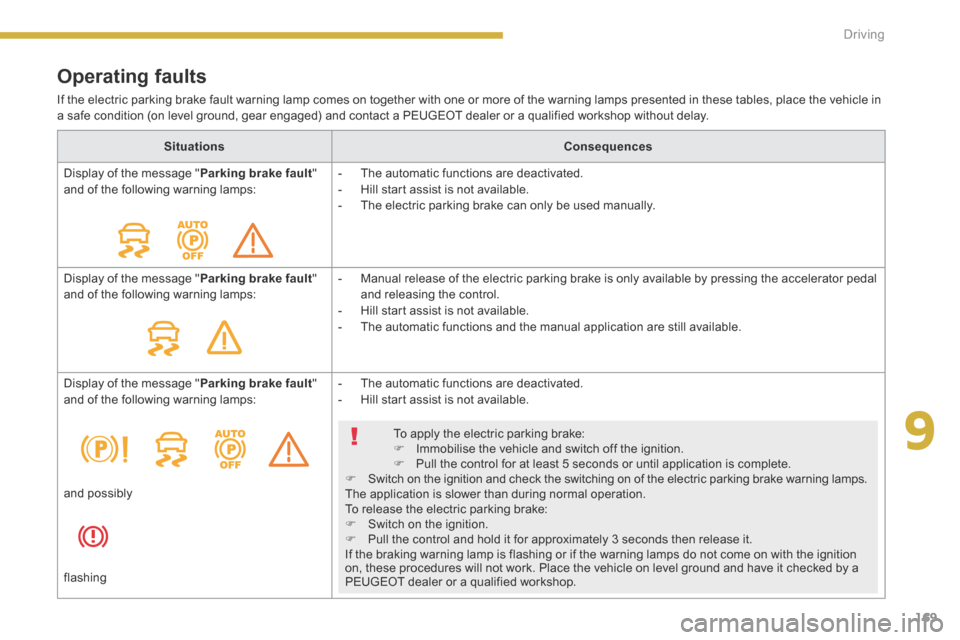
If the electric parking brake fault warning lamp comes on together with one or more of the warning lamps presented in these tables, place the vehicle in a safe condition (on level ground, gear engaged) and contact a PEUGEOT dealer or a qualified workshop without delay.
Situations Consequences
Display of the message " Parking brake fault " and of the following warning lamps: - The automatic functions are deactivated. - Hill start assist is not available. - The electric parking brake can only be used manually.
Display of the message " Parking brake fault " and of the following warning lamps: - Manual release of the electric parking brake is only available by pressing the accelerator pedal and releasing the control. - Hill start assist is not available. - The automatic functions and the manual application are still available.
Display of the message " Parking brake fault " and of the following warning lamps: - The automatic functions are deactivated. - Hill start assist is not available.
To apply the electric parking brake: Immobilise the vehicle and switch off the ignition. Pull the control for at least 5 seconds or until application is complete. Switch on the ignition and check the switching on of the electric parking brake warning lamps. The application is slower than during normal operation. To release the electric parking brake: Switch on the ignition. Pull the control and hold it for approximately 3 seconds then release it. If the braking warning lamp is flashing or if the warning lamps do not come on with the ignition on, these procedures will not work. Place the vehicle on level ground and have it checked by a PEUGEOT dealer or a qualified workshop.
and possibly
flashing
Page 172 of 378

170Driving
Situations Consequences
Display of the message " Parking brake control fault - auto parking brake activated " and of the following warning lamps:
- Only the automatic application on switching off the engine and automatic release on acceleration functions are available. - The manual application/release of the electric parking brake and the emergency braking are not available.
and possibly
flashing
Battery fault - If the battery warning lamp comes on you must stop immediately as soon as the traffic allows. Stop and immobilise your vehicle (if necessary, place the two chocks under the wheels). - Apply the electric parking brake before switching off the engine.
Page 182 of 378
180Driving
Displays in the instrument panel
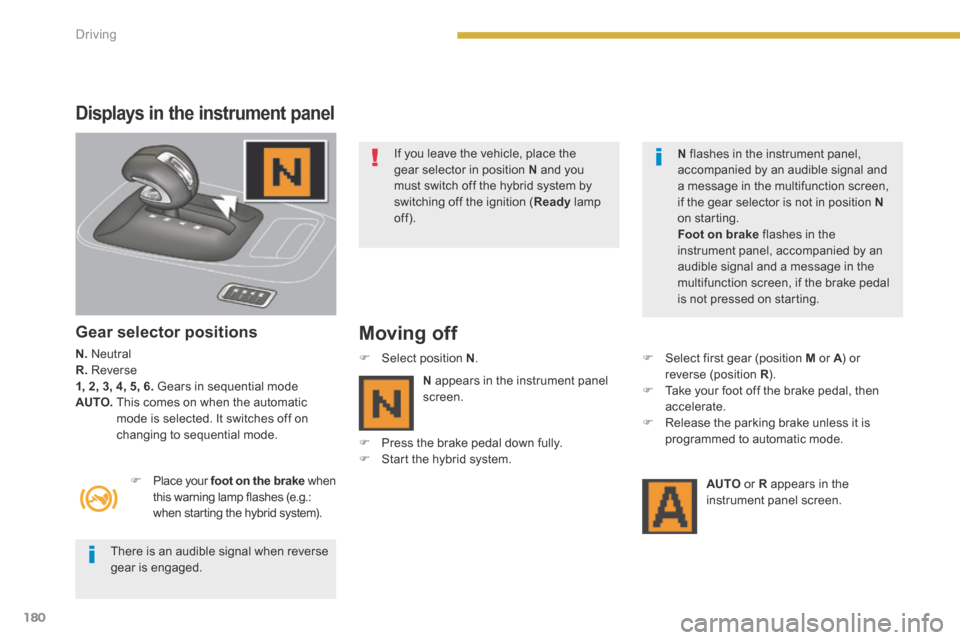
Gear selector positions
N. Neutral R. Reverse 1, 2, 3, 4, 5, 6. Gears in sequential mode AUTO. This comes on when the automatic mode is selected. It switches off on
changing to sequential mode.
Moving off
Place your foot on the brake when this warning lamp flashes (e.g.: when starting the hybrid system).
Select position N . Select first gear (position M or A ) or A ) or Areverse (position R ). R ). R Take your foot off the brake pedal, then accelerate. Release the parking brake unless it is
programmed to automatic mode.
AUTO or R appears in the instrument panel screen.
N appears in the instrument panel screen.
Press the brake pedal down fully. Start the hybrid system.
If you leave the vehicle, place the gear selector in position N and you must switch off the hybrid system by switching off the ignition ( Ready lamp off).
There is an audible signal when reverse gear is engaged.
N flashes in the instrument panel, accompanied by an audible signal and a message in the multifunction screen, if the gear selector is not in position Non starting. Foot on brake flashes in the instrument panel, accompanied by an audible signal and a message in the multifunction screen, if the brake pedal is not pressed on starting.
Page 183 of 378

9
181
Driving
Sequential mode
When the vehicle has moved off, select position M to change to sequential mode.
AUTO disappears and the gears engaged appear in succession in the instrument panel screen.
The gear change requests are only carried out if the engine speed permits. It is not necessary to release the accelerator during gear changes. When braking or slowing down, the gearbox changes down automatically so that the vehicle picks up in the right gear.
At very low speed, if reverse gear is requested, this will only be taken into account when the vehicle is immobilised. The Foot on brake warning lamp may flash on the instrument panel to prompt
you to brake. At high speed, if reverse gear is requested, the N indicator lamp will flash and the gearbox will change to neutral automatically. To engage a gear again, return the selector to position A or A or AM .
On sharp acceleration, the gearbox will not change up unless the driver acts on the gear selector or the steering mounted paddles. Never select neutral N while the vehicle is moving. Only engage reverse gear R when the vehicle is immobilised with the brake pedal pressed.
The gearbox is then operating in auto-active mode, without any action on the part of the driver. It continuously selects the most suitable gear in relation to the following parameters: - style of driving, - profile of the road.
AUTO and the gear engaged appear in the instrument panel
screen.
Automated mode
Following use of the sequential mode, select position A to return to the automatic mode.
For optimum acceleration, for example when overtaking another vehicle, press the accelerator pedal firmly past the point of resistance.