2014 NISSAN QUEST ignition
[x] Cancel search: ignitionPage 421 of 482
8-16Maintenance and do-it-yourself
2. Have the belt condition checked regularly.
WARNING
Be sure the engine and ignition switch
are off and that the parking brake is
engaged securely.
CAUTION
Be sure to use the correct socket to
remove the spark plugs. An incorrect
socket can damage the spark plugs.
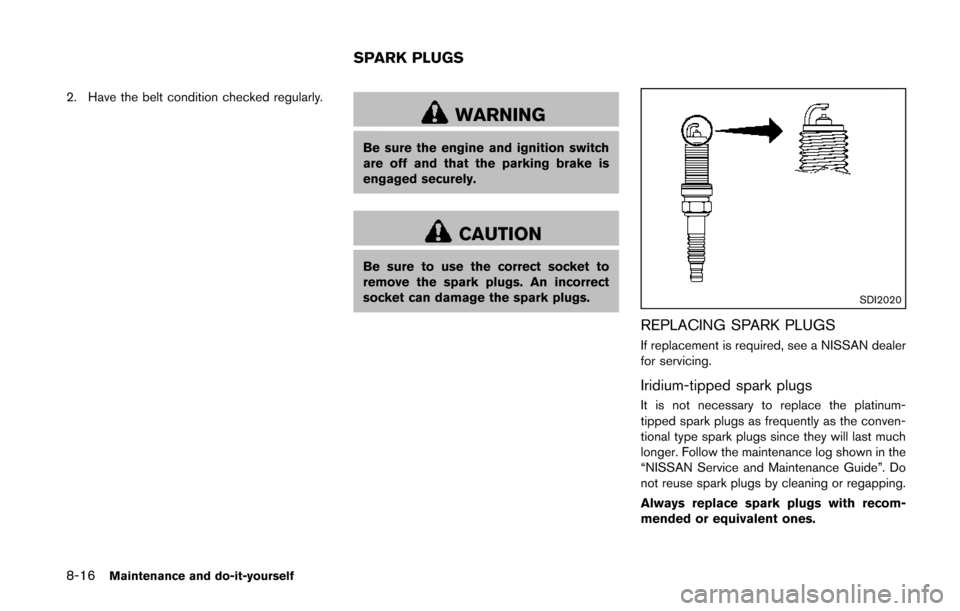
SDI2020
REPLACING SPARK PLUGS
If replacement is required, see a NISSAN dealer
for servicing.
Iridium-tipped spark plugs
It is not necessary to replace the platinum-
tipped spark plugs as frequently as the conven-
tional type spark plugs since they will last much
longer. Follow the maintenance log shown in the
“NISSAN Service and Maintenance Guide”. Do
not reuse spark plugs by cleaning or regapping.
Always replace spark plugs with recom-
mended or equivalent ones.
SPARK PLUGS
Page 426 of 482
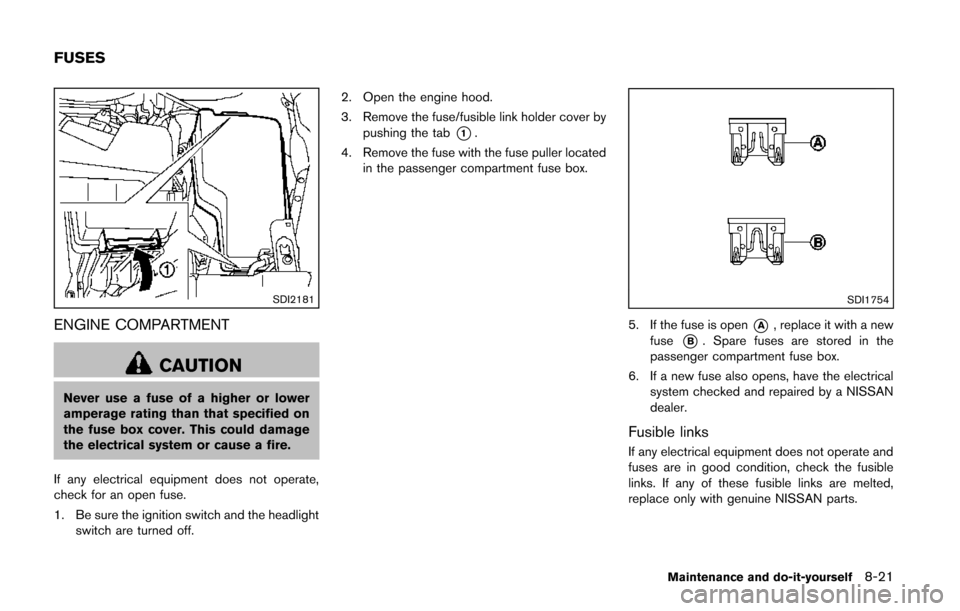
SDI2181
ENGINE COMPARTMENT
CAUTION
Never use a fuse of a higher or lower
amperage rating than that specified on
the fuse box cover. This could damage
the electrical system or cause a fire.
If any electrical equipment does not operate,
check for an open fuse.
1. Be sure the ignition switch and the headlight switch are turned off. 2. Open the engine hood.
3. Remove the fuse/fusible link holder cover by
pushing the tab
*1.
4. Remove the fuse with the fuse puller located in the passenger compartment fuse box.
SDI1754
5. If the fuse is open*A, replace it with a new
fuse
*B. Spare fuses are stored in the
passenger compartment fuse box.
6. If a new fuse also opens, have the electrical system checked and repaired by a NISSAN
dealer.
Fusible links
If any electrical equipment does not operate and
fuses are in good condition, check the fusible
links. If any of these fusible links are melted,
replace only with genuine NISSAN parts.
Maintenance and do-it-yourself8-21
FUSES
Page 427 of 482
8-22Maintenance and do-it-yourself
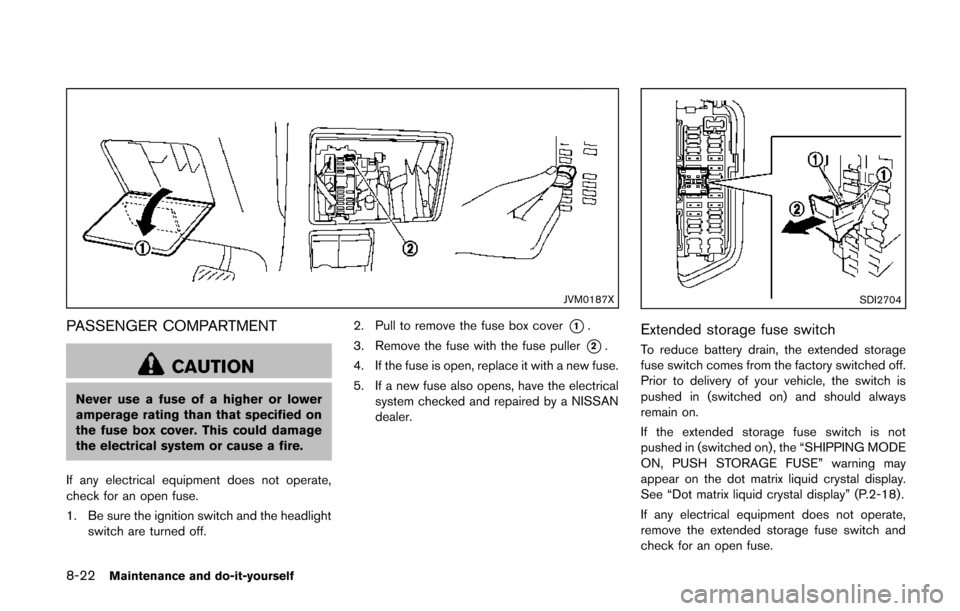
JVM0187X
PASSENGER COMPARTMENT
CAUTION
Never use a fuse of a higher or lower
amperage rating than that specified on
the fuse box cover. This could damage
the electrical system or cause a fire.
If any electrical equipment does not operate,
check for an open fuse.
1. Be sure the ignition switch and the headlight switch are turned off. 2. Pull to remove the fuse box cover
*1.
3. Remove the fuse with the fuse puller
*2.
4. If the fuse is open, replace it with a new fuse.
5. If a new fuse also opens, have the electrical system checked and repaired by a NISSAN
dealer.
SDI2704
Extended storage fuse switch
To reduce battery drain, the extended storage
fuse switch comes from the factory switched off.
Prior to delivery of your vehicle, the switch is
pushed in (switched on) and should always
remain on.
If the extended storage fuse switch is not
pushed in (switched on), the “SHIPPING MODE
ON, PUSH STORAGE FUSE” warning may
appear on the dot matrix liquid crystal display.
See “Dot matrix liquid crystal display” (P.2-18) .
If any electrical equipment does not operate,
remove the extended storage fuse switch and
check for an open fuse.
Page 428 of 482
NOTE:
If the extended storage fuse switch mal-
functions, or if the fuse is open, it is not
necessary to replace the switch. In this
case, remove the extended storage fuse
switch and replace it with a new fuse of the
same rating.
How to remove the extended storage fuse
switch:
1. To remove the extended storage fuse switch,be sure the ignition switch is in the OFF or
LOCK position.
2. Be sure the headlight switch is in the OFF position.
3. Remove the fuse box cover.
4. Pinch the locking tabs
*1found on each
side of the storage fuse switch.
5. Pull the storage fuse switch straight out from the fuse box
*2.
CAUTION
Be careful not to allow children to
swallow the battery and removed parts.
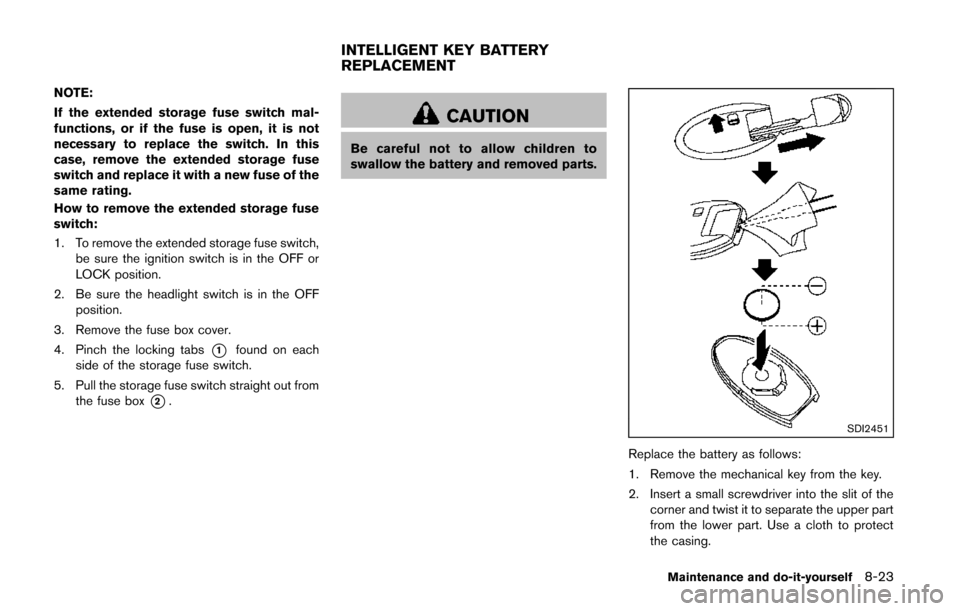
SDI2451
Replace the battery as follows:
1. Remove the mechanical key from the key.
2. Insert a small screwdriver into the slit of the
corner and twist it to separate the upper part
from the lower part. Use a cloth to protect
the casing.
Maintenance and do-it-yourself8-23
INTELLIGENT KEY BATTERY
REPLACEMENT
Page 449 of 482
9-4Technical and consumer information
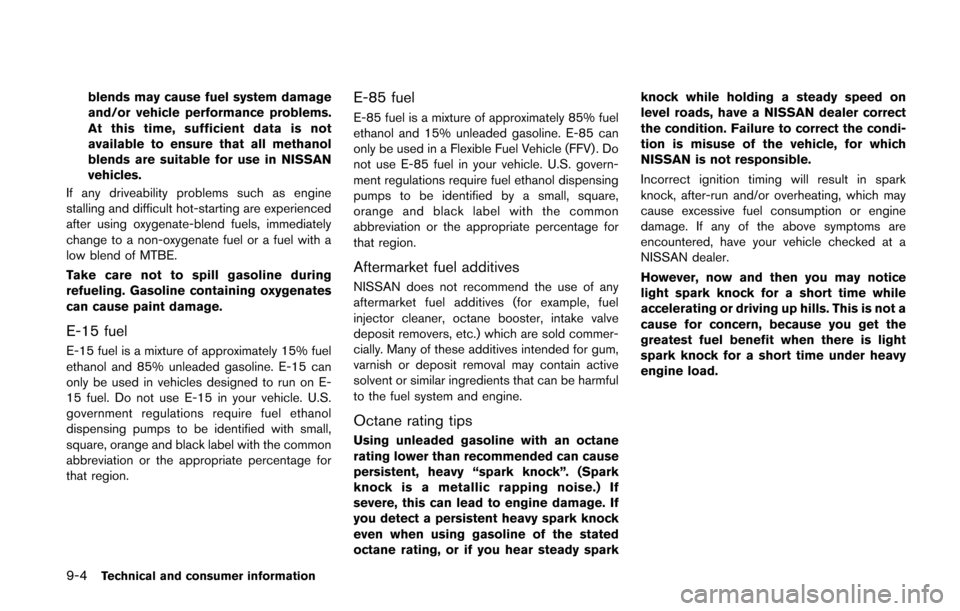
blends may cause fuel system damage
and/or vehicle performance problems.
At this time, sufficient data is not
available to ensure that all methanol
blends are suitable for use in NISSAN
vehicles.
If any driveability problems such as engine
stalling and difficult hot-starting are experienced
after using oxygenate-blend fuels, immediately
change to a non-oxygenate fuel or a fuel with a
low blend of MTBE.
Take care not to spill gasoline during
refueling. Gasoline containing oxygenates
can cause paint damage.
E-15 fuel
E-15 fuel is a mixture of approximately 15% fuel
ethanol and 85% unleaded gasoline. E-15 can
only be used in vehicles designed to run on E-
15 fuel. Do not use E-15 in your vehicle. U.S.
government regulations require fuel ethanol
dispensing pumps to be identified with small,
square, orange and black label with the common
abbreviation or the appropriate percentage for
that region.
E-85 fuel
E-85 fuel is a mixture of approximately 85% fuel
ethanol and 15% unleaded gasoline. E-85 can
only be used in a Flexible Fuel Vehicle (FFV) . Do
not use E-85 fuel in your vehicle. U.S. govern-
ment regulations require fuel ethanol dispensing
pumps to be identified by a small, square,
orange and black label with the common
abbreviation or the appropriate percentage for
that region.
Aftermarket fuel additives
NISSAN does not recommend the use of any
aftermarket fuel additives (for example, fuel
injector cleaner, octane booster, intake valve
deposit removers, etc.) which are sold commer-
cially. Many of these additives intended for gum,
varnish or deposit removal may contain active
solvent or similar ingredients that can be harmful
to the fuel system and engine.
Octane rating tips
Using unleaded gasoline with an octane
rating lower than recommended can cause
persistent, heavy “spark knock”. (Spark
knock is a metallic rapping noise.) If
severe, this can lead to engine damage. If
you detect a persistent heavy spark knock
even when using gasoline of the stated
octane rating, or if you hear steady spark knock while holding a steady speed on
level roads, have a NISSAN dealer correct
the condition. Failure to correct the condi-
tion is misuse of the vehicle, for which
NISSAN is not responsible.
Incorrect ignition timing will result in spark
knock, after-run and/or overheating, which may
cause excessive fuel consumption or engine
damage. If any of the above symptoms are
encountered, have your vehicle checked at a
NISSAN dealer.
However, now and then you may notice
light spark knock for a short time while
accelerating or driving up hills. This is not a
cause for concern, because you get the
greatest fuel benefit when there is light
spark knock for a short time under heavy
engine load.
Page 452 of 482
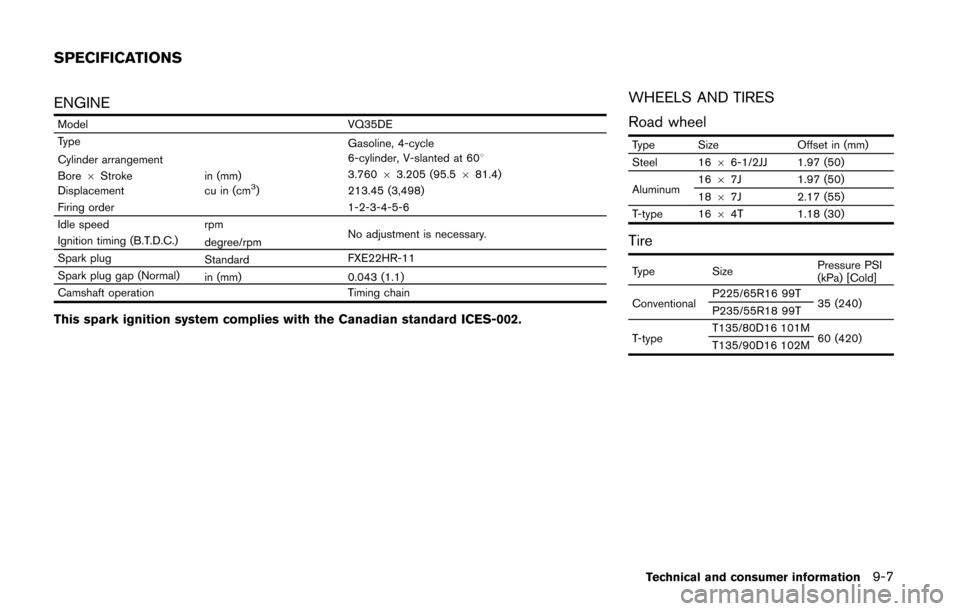
ENGINE
ModelVQ35DE
Type Gasoline, 4-cycle
Cylinder arrangement 6-cylinder, V-slanted at 608
Bore 6Stroke in (mm) 3.760
63.205 (95.5 681.4)
Displacement cu in (cm
3)213.45 (3,498)
Firing order 1-2-3-4-5-6
Idle speed rpm
No adjustment is necessary.
Ignition timing (B.T.D.C.) degree/rpm
Spark plug StandardFXE22HR-11
Spark plug gap (Normal) in (mm)0.043 (1.1)
Camshaft operation Timing chain
This spark ignition system complies with the Canadian standard ICES-002.
WHEELS AND TIRES
Road wheel
Type SizeOffset in (mm)
Steel 16 66-1/2JJ 1.97 (50)
Aluminum 16
67J 1.97 (50)
18 67J 2.17 (55)
T-type 16 64T 1.18 (30)
Tire
Type Size Pressure PSI
(kPa) [Cold]
Conventional P225/65R16 99T
35 (240)
P235/55R18 99T
T-type T135/80D16 101M
60 (420)
T135/90D16 102M
Technical and consumer information9-7
SPECIFICATIONS
Page 472 of 482
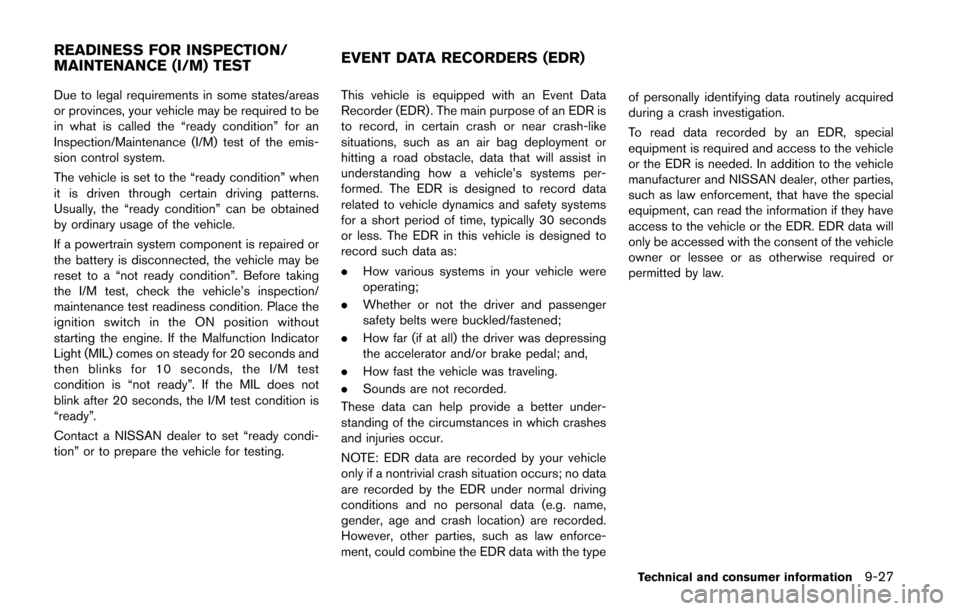
Due to legal requirements in some states/areas
or provinces, your vehicle may be required to be
in what is called the “ready condition” for an
Inspection/Maintenance (I/M) test of the emis-
sion control system.
The vehicle is set to the “ready condition” when
it is driven through certain driving patterns.
Usually, the “ready condition” can be obtained
by ordinary usage of the vehicle.
If a powertrain system component is repaired or
the battery is disconnected, the vehicle may be
reset to a “not ready condition”. Before taking
the I/M test, check the vehicle’s inspection/
maintenance test readiness condition. Place the
ignition switch in the ON position without
starting the engine. If the Malfunction Indicator
Light (MIL) comes on steady for 20 seconds and
then blinks for 10 seconds, the I/M test
condition is “not ready”. If the MIL does not
blink after 20 seconds, the I/M test condition is
“ready”.
Contact a NISSAN dealer to set “ready condi-
tion” or to prepare the vehicle for testing.This vehicle is equipped with an Event Data
Recorder (EDR) . The main purpose of an EDR is
to record, in certain crash or near crash-like
situations, such as an air bag deployment or
hitting a road obstacle, data that will assist in
understanding how a vehicle’s systems per-
formed. The EDR is designed to record data
related to vehicle dynamics and safety systems
for a short period of time, typically 30 seconds
or less. The EDR in this vehicle is designed to
record such data as:
.
How various systems in your vehicle were
operating;
. Whether or not the driver and passenger
safety belts were buckled/fastened;
. How far (if at all) the driver was depressing
the accelerator and/or brake pedal; and,
. How fast the vehicle was traveling.
. Sounds are not recorded.
These data can help provide a better under-
standing of the circumstances in which crashes
and injuries occur.
NOTE: EDR data are recorded by your vehicle
only if a nontrivial crash situation occurs; no data
are recorded by the EDR under normal driving
conditions and no personal data (e.g. name,
gender, age and crash location) are recorded.
However, other parties, such as law enforce-
ment, could combine the EDR data with the type of personally identifying data routinely acquired
during a crash investigation.
To read data recorded by an EDR, special
equipment is required and access to the vehicle
or the EDR is needed. In addition to the vehicle
manufacturer and NISSAN dealer, other parties,
such as law enforcement, that have the special
equipment, can read the information if they have
access to the vehicle or the EDR. EDR data will
only be accessed with the consent of the vehicle
owner or lessee or as otherwise required or
permitted by law.
Technical and consumer information9-27
READINESS FOR INSPECTION/
MAINTENANCE (I/M) TEST
EVENT DATA RECORDERS (EDR)
Page 476 of 482
Fusible links.................................................................. 8-21
G
Garage door opener, HomeLink®
Universal Transceiver.................................................. 2-59
Gas cap......................................................................... 3-30
Gauge .............................................................................. 2-5Engine coolant temperature gauge .................... 2-7
Fuel gauge................................................................ 2-8
Odometer.................................................................. 2-6
Speedometer............................................................ 2-6
Tachometer ............................................................... 2-7
Trip computer........................................................ 2-23
General maintenance ................................................... 8-2
Glove box...................................................................... 2-46
H
Hands-free phone system, Bluetooth®
(models with navigation system).......................... 4-114
Hands-free phone system, Bluetooth®
(models without navigation system) .................... 4-124
Hazard warning flasher switch................................... 6-2
Head restraints/headrests......................................... 1-10
Headlights Aiming control....................................................... 2-36
Bulb replacement................................................. 8-26
Headlight switch................................................... 2-33
Xenon headlights.................................................. 2-33
Heated seats................................................................ 2-38
Heater Engine block heater............................................. 5-34
Heater and air conditioner operation.............. 4-39
HomeLink
®Universal Transceiver ........................... 2-59
Hood release................................................................ 3-25
Hook, Coat hooks....................................................... 2-50 Horn................................................................................ 2-38
Hydraulic pump electric power
steering system............................................................ 5-29
I
Ignition switch (Push-button)..................................... 5-8
Immobilizer system...................................................... 2-29
In-cabin microfilter ...................................................... 4-53
Indicator Dot matrix display................................................. 2-18
Lights....................................................................... 2-16
INFO button.................................................................... 4-9
Inside mirror.................................................................. 3-33
Inspection/maintenance (I/M) test .......................... 9-27
Instrument brightness control .................................. 2-37
Instrument panel................................................. 2-4, 2-43
Intelligent Key system ....................................... 3-3, 3-13 Battery replacement ............................................ 8-23
Intelligent Key system warning light................ 2-14
Key operating range ............................................ 3-15
Key operation ........................................................ 3-16
Warning signals.................................................... 3-19
Interior light control switch ....................................... 2-57
Interior light replacement........................................... 8-27
Interior lights................................................................. 2-56
iPod
®player operation................................... 4-77, 4-96
ISOFIX child restraint................................................. 1-28
J
Jump starting................................................................ 6-10
K
Keyless entry (See remote keyless
entry system)................................................................ 3-21
Keys.................................................................................. 3-3 For Intelligent Key system......................... 3-3, 3-13
L
LabelsAir bag warning labels........................................ 1-59
Air conditioner specification label.................... 9-10
Emission control information label................... 9-10
Engine serial number.............................................. 9-9
F.M.V.S.S./C.M.V.S.S. certification label ........... 9-9
Tire and Loading Information label ....... 8-31, 9-10
Vehicle identification number (VIN) .................... 9-8
LATCH system............................................................. 1-28
License plate, Installing front license plate .......... 9-11
Lift gate.......................................................................... 3-26
Light Air bag warning light........................................... 1-59
Bulb replacement................................................. 8-25
Cargo lights........................................................... 2-58
Fog light switch.................................................... 2-38
Headlight switch................................................... 2-33
Headlights bulb replacement............................ 8-26
Indicator lights....................................................... 2-16
Interior light control switch ................................ 2-57
Interior lights.......................................................... 2-56
Map lights .............................................................. 2-56
Mood lights............................................................ 2-58
Replacement.......................................................... 8-25
Vanity mirror lights ............................................... 2-58
Warning/indicator lights and
audible reminders................................................. 2-12
Xenon headlights.................................................. 2-33
10-3