2014 NISSAN CUBE temperature
[x] Cancel search: temperaturePage 273 of 332
8-10Maintenance and do-it-yourself
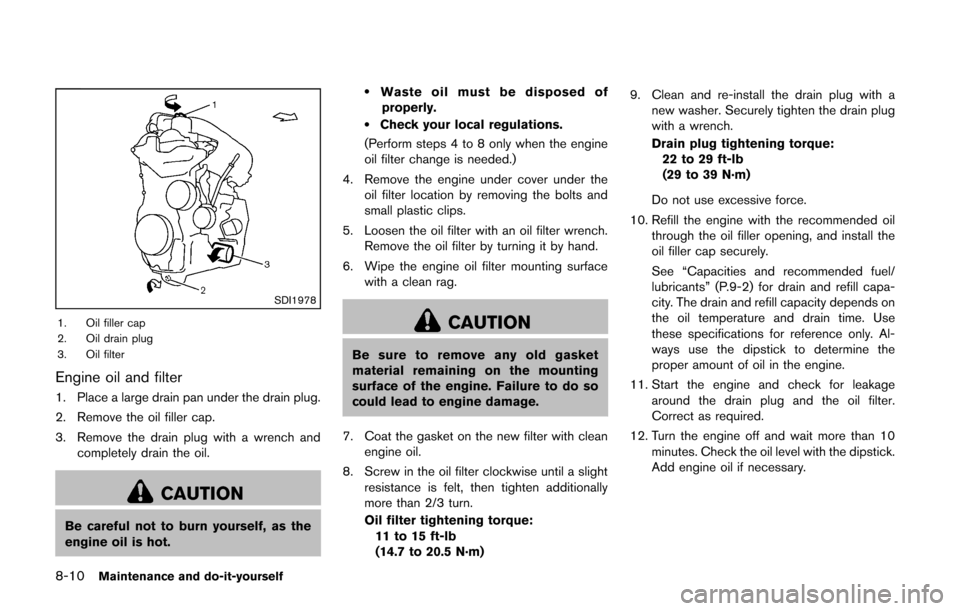
SDI1978
1. Oil filler cap
2. Oil drain plug
3. Oil filter
Engine oil and filter
1. Place a large drain pan under the drain plug.
2. Remove the oil filler cap.
3. Remove the drain plug with a wrench andcompletely drain the oil.
CAUTION
Be careful not to burn yourself, as the
engine oil is hot.
.Waste oil must be disposed ofproperly.
.Check your local regulations.
(Perform steps 4 to 8 only when the engine
oil filter change is needed.)
4. Remove the engine under cover under the oil filter location by removing the bolts and
small plastic clips.
5. Loosen the oil filter with an oil filter wrench. Remove the oil filter by turning it by hand.
6. Wipe the engine oil filter mounting surface with a clean rag.
CAUTION
Be sure to remove any old gasket
material remaining on the mounting
surface of the engine. Failure to do so
could lead to engine damage.
7. Coat the gasket on the new filter with clean engine oil.
8. Screw in the oil filter clockwise until a slight resistance is felt, then tighten additionally
more than 2/3 turn.
Oil filter tightening torque:
11 to 15 ft-lb
(14.7 to 20.5 N·m) 9. Clean and re-install the drain plug with a
new washer. Securely tighten the drain plug
with a wrench.
Drain plug tightening torque:22 to 29 ft-lb
(29 to 39 N·m)
Do not use excessive force.
10. Refill the engine with the recommended oil through the oil filler opening, and install the
oil filler cap securely.
See “Capacities and recommended fuel/
lubricants” (P.9-2) for drain and refill capa-
city. The drain and refill capacity depends on
the oil temperature and drain time. Use
these specifications for reference only. Al-
ways use the dipstick to determine the
proper amount of oil in the engine.
11. Start the engine and check for leakage around the drain plug and the oil filter.
Correct as required.
12. Turn the engine off and wait more than 10 minutes. Check the oil level with the dipstick.
Add engine oil if necessary.
Page 277 of 332
8-14Maintenance and do-it-yourself
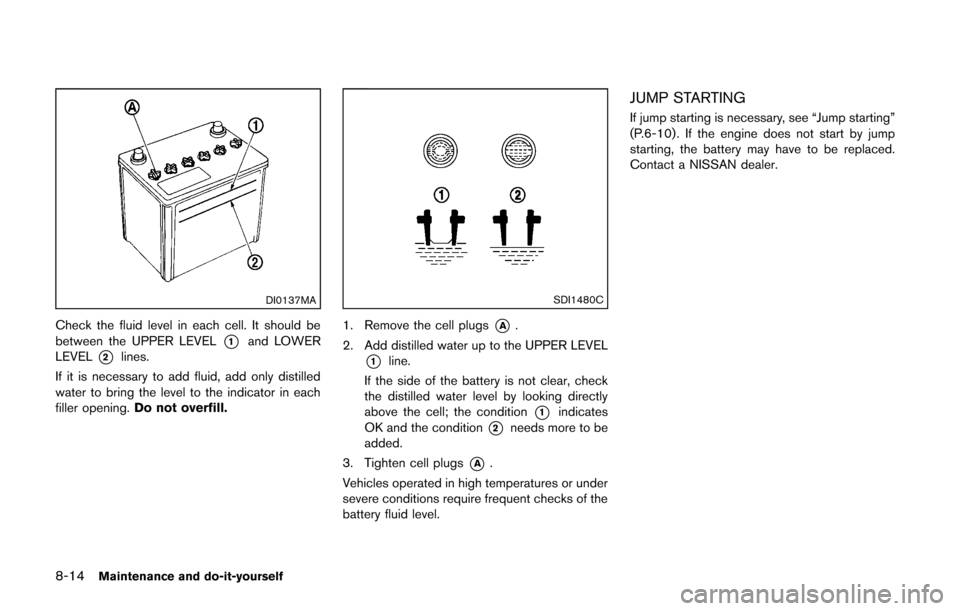
DI0137MA
Check the fluid level in each cell. It should be
between the UPPER LEVEL
*1and LOWER
LEVEL
*2lines.
If it is necessary to add fluid, add only distilled
water to bring the level to the indicator in each
filler opening. Do not overfill.
SDI1480C
1. Remove the cell plugs*A.
2. Add distilled water up to the UPPER LEVEL
*1line.
If the side of the battery is not clear, check
the distilled water level by looking directly
above the cell; the condition
*1indicates
OK and the condition
*2needs more to be
added.
3. Tighten cell plugs
*A.
Vehicles operated in high temperatures or under
severe conditions require frequent checks of the
battery fluid level.
JUMP STARTING
If jump starting is necessary, see “Jump starting”
(P.6-10) . If the engine does not start by jump
starting, the battery may have to be replaced.
Contact a NISSAN dealer.
Page 289 of 332
8-26Maintenance and do-it-yourself
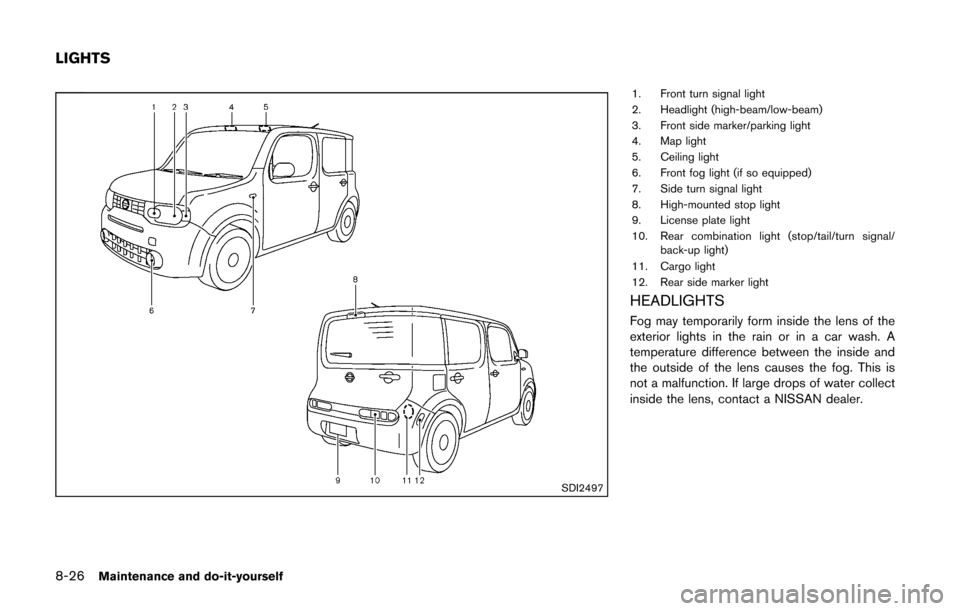
SDI2497
1. Front turn signal light
2. Headlight (high-beam/low-beam)
3. Front side marker/parking light
4. Map light
5. Ceiling light
6. Front fog light (if so equipped)
7. Side turn signal light
8. High-mounted stop light
9. License plate light
10. Rear combination light (stop/tail/turn signal/back-up light)
11. Cargo light
12. Rear side marker light
HEADLIGHTS
Fog may temporarily form inside the lens of the
exterior lights in the rain or in a car wash. A
temperature difference between the inside and
the outside of the lens causes the fog. This is
not a malfunction. If large drops of water collect
inside the lens, contact a NISSAN dealer.
LIGHTS
Page 304 of 332
9 Technical and consumer information
Capacities and recommended fuel/lubricants ................... 9-2Fuel recommendation ......................................................... 9-4
Engine oil and oil filter recommendation ....................... 9-6
Air conditioning system refrigerant and
lubricant recommendations ............................................... 9-7
Specifications ........................................................................\
..... 9-8
Engine ........................................................................\
............ 9-8
Wheels and tires ................................................................. 9-8
Dimensions and weights ................................................... 9-9
When traveling or registering your vehicle in
another country ........................................................................\
.. 9-9
Vehicle identification ................................................................. 9-9 Vehicle Identification Number (VIN) plate ..................... 9-9
Vehicle identification number (chassis number) ....... 9-10
Engine serial number ....................................................... 9-10
F.M.V.S.S. certification label .......................................... 9-10
Emission control information label ............................... 9-11
Tire and loading information label ................................ 9-11
Air conditioner specification label (if
so equipped) ..................................................................... 9-11 Installing front license plate ................................................ 9-12
Vehicle loading information ................................................. 9-13
Terms ........................................................................\
......... 9-13
Vehicle load capacity .................................................... 9-14
Securing the load .......................................................... 9-15
Loading tips ..................................................................... 9-15
Measurement of weights .............................................. 9-16
Towing a trailer ....................................................................... 9-16
Flat towing ........................................................................\
....... 9-17 Continuously Variable Transmission (CVT) ............. 9-17
Manual Transmission ..................................................... 9-17
Uniform tire quality grading ................................................. 9-17 Treadwear ........................................................................\
9-17
Traction AA, A, B and C .............................................. 9-17
Temperature A, B and C .............................................. 9-18
Emission control system warranty ..................................... 9-18
Reporting safety defects ..................................................... 9-19
Readiness for Inspection/Maintenance (I/M) test ......... 9-19
Event Data Recorders (EDR) ............................................. 9-19
Owner’s Manual/Service Manual order information ..... 9-20
Page 309 of 332
9-6Technical and consumer information
JVT0159X
ENGINE OIL AND OIL FILTER RE-
COMMENDATION
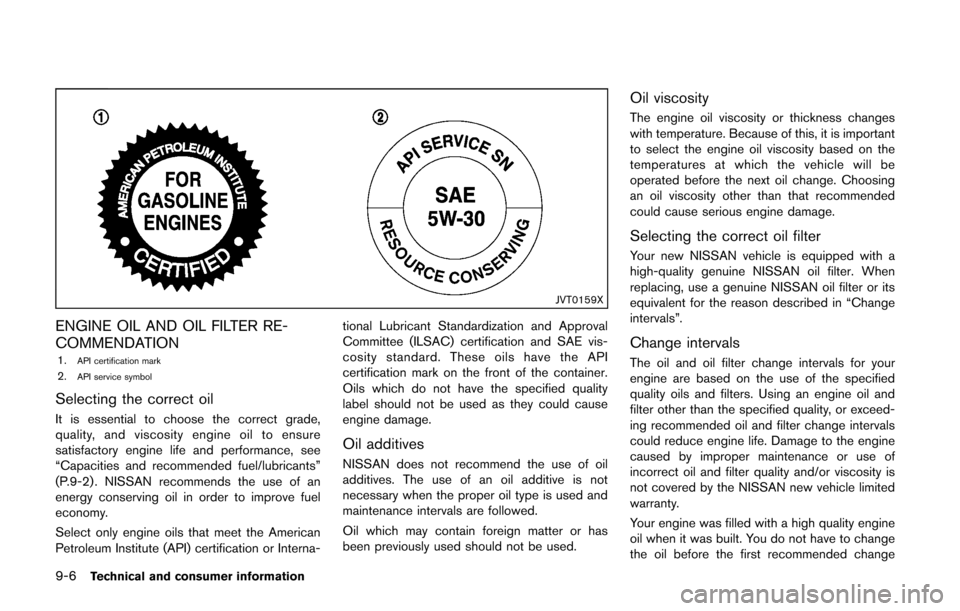
1.API certification mark2.API service symbol
Selecting the correct oil
It is essential to choose the correct grade,
quality, and viscosity engine oil to ensure
satisfactory engine life and performance, see
“Capacities and recommended fuel/lubricants”
(P.9-2) . NISSAN recommends the use of an
energy conserving oil in order to improve fuel
economy.
Select only engine oils that meet the American
Petroleum Institute (API) certification or Interna-tional Lubricant Standardization and Approval
Committee (ILSAC) certification and SAE vis-
cosity standard. These oils have the API
certification mark on the front of the container.
Oils which do not have the specified quality
label should not be used as they could cause
engine damage.
Oil additives
NISSAN does not recommend the use of oil
additives. The use of an oil additive is not
necessary when the proper oil type is used and
maintenance intervals are followed.
Oil which may contain foreign matter or has
been previously used should not be used.
Oil viscosity
The engine oil viscosity or thickness changes
with temperature. Because of this, it is important
to select the engine oil viscosity based on the
temperatures at which the vehicle will be
operated before the next oil change. Choosing
an oil viscosity other than that recommended
could cause serious engine damage.
Selecting the correct oil filter
Your new NISSAN vehicle is equipped with a
high-quality genuine NISSAN oil filter. When
replacing, use a genuine NISSAN oil filter or its
equivalent for the reason described in “Change
intervals”.
Change intervals
The oil and oil filter change intervals for your
engine are based on the use of the specified
quality oils and filters. Using an engine oil and
filter other than the specified quality, or exceed-
ing recommended oil and filter change intervals
could reduce engine life. Damage to the engine
caused by improper maintenance or use of
incorrect oil and filter quality and/or viscosity is
not covered by the NISSAN new vehicle limited
warranty.
Your engine was filled with a high quality engine
oil when it was built. You do not have to change
the oil before the first recommended change
Page 310 of 332
interval. Oil and filter change intervals depend
upon how you use your vehicle.
Operation under the following conditions may
require more frequent oil and filter changes.
.repeated short distance driving at cold
outside temperatures
. driving in dusty conditions
. extensive idling
. stop and go commuting
Refer to the “NISSAN Service and Maintenance
Guide” for the maintenance schedule.
AIR CONDITIONING SYSTEM RE-
FRIGERANT AND LUBRICANT RE-
COMMENDATIONS
The air conditioning system in your
NISSAN vehicle must be charged with the
refrigerant HFC-134a (R-134a) and the oil,
NISSAN A/C system oil Type R or the exact
equivalents.
CAUTION
The use of any other refrigerant or oil
will cause severe damage to the air
conditioning system and will require
the replacement of all air conditioner
system components. The refrigerant HFC-134a (R-134a) in your
NISSAN vehicle will not harm the earth’s ozone
layer. Although this refrigerant does not affect
the earth’s atmosphere, certain governmental
regulations require the recovery and recycling of
any refrigerant during automotive air condition-
ing system service. A NISSAN dealer has the
trained technicians and equipment needed to
recover and recycle your air conditioning system
refrigerant.
Contact a NISSAN dealer when servicing your
air conditioning system.
Technical and consumer information9-7
Page 320 of 332
Towing your vehicle with all four wheels on the
ground is sometimes called flat towing. This
method is sometimes used when towing a
vehicle behind a recreational vehicle, such as a
motor home.
CAUTION
.Failure to follow these guidelines
can result in severe transmission
damage.
. Whenever flat towing your vehicle,
always tow forward, never back-
ward.
. DO NOT tow any Continuously Vari-
able Transmission (CVT) vehicle
with all four wheels on the ground
(flat towing) . Doing so WILL DA-
MAGE internal transmission parts
due to lack of transmission lubrica-
tion.
. For emergency towing procedures
refer to “Towing your vehicle” (P.6-
14) of this manual.
CONTINUOUSLY VARIABLE TRANS-
MISSION (CVT)
To tow a vehicle equipped with a Continuously
Variable Transmission (CVT) , an appropriate
vehicle dolly MUSTbe placed under the towed
vehicle’s driving wheels. Alwaysfollow the dolly
manufacturer’s recommendations when using
their product.
MANUAL TRANSMISSION
. Always tow with the manual transmission in
Neutral.
. Your vehicle speed should never exceed 60
MPH (96 km/h) when flat towing your
vehicle.
. After towing 500 miles, start and idle the
engine with the transmission in Neutral for
two minutes. Failure to idle the engine after
every 500 miles of towing may cause
damage to the transmission’s internal parts. DOT (Department Of Transportation) Quality
Grades: All passenger car tires must conform to
federal safety requirements in addition to these
grades.
Quality grades can be found where applicable
on the tire sidewall between tread shoulder and
maximum section width. For example:
Treadwear 200 Traction AA Temperature A
TREADWEAR
The treadwear grade is a comparative rating
based on the wear rate of the tire when tested
under controlled conditions on a specified
government test course. For example, a tire
graded 150 would wear one and one-half (1
1/2) times as well on the government course as
a tire graded 100. The relative performance of
tires depends upon actual conditions of their
use, however, and may depart significantly from
the norm due to variations in driving habits,
service practices and differences in road char-
acteristics and climate.
TRACTION AA, A, B AND C
The traction grades, from highest to lowest, are
AA, A, B and C. Those grades represent the
tire’s ability to stop on wet pavement as
measured under controlled conditions on spe-
cified government test surfaces of asphalt and
concrete. A tire marked C may have poor
traction performance.
Technical and consumer information9-17
FLAT TOWING
UNIFORM TIRE QUALITY GRADING
Page 321 of 332
9-18Technical and consumer information
WARNING
The traction grade assigned to this tire
is based on straight-ahead braking
traction tests, and does not include
acceleration, cornering, hydroplaning,
or peak traction characteristics.
TEMPERATURE A, B AND C
The temperature grades A (the highest), B, and
C, representing the tire’s resistance to the
generation of heat and its ability to dissipate
heat when tested under controlled conditions on
a specified indoor laboratory test wheel. Sus-
tained high temperature can cause the material
of the tire to degenerate and reduce tire life, and
excessive temperature can lead to sudden tire
failure. The grade C corresponds to a level of
performance which all passenger car tires must
meet under the Federal Motor Vehicle Safety
Standard No. 109. Grades B and A represent
higher levels of performance on the laboratory
test wheel than the minimum required by law.
WARNING
The temperature grade for this tire is
established for a tire that is properly
inflated and not overloaded. Excessive
speed, under-inflation, or excessive
loading, either separately or in combi-
nation, can cause heat build-up and
possible tire failure.Your NISSAN is covered by the following
emission warranties.
.
Emission Defects Warranty
. Emissions Performance Warranty
Details of these warranties may be found with
other vehicle warranties in your Warranty In-
formation Booklet which comes with your
NISSAN. If you did not receive a Warranty
Information Booklet, or it has become lost, you
may obtain a replacement by writing to:
. Nissan North America, Inc.
Consumer Affairs Department
P.O. Box 685003
Franklin, TN 37068-5003
EMISSION CONTROL SYSTEM
WARRANTY