2014 MITSUBISHI OUTLANDER PHEV fuel
[x] Cancel search: fuelPage 266 of 442

Roof carrier precautionCAUTIONlMake sure that the weight of the luggage
does not exceed the allowable roof load.
If the allowable roof load is exceeded, this may cause damage to the vehicle.
The roof load is the total allowable load on
the roof (the weight of the roof carrier plus
the weight of luggage placed on the roof car- rier).
For the specific value, refer to “Maximum
roof load” on page 12-05.
l When luggage is loaded onto the vehicle,
please make sure to drive slowly and avoid excessive manoeuvres such as sudden brak-ing or quick turning.
In addition, place the luggage on the carrier
so that its weight is distributed evenly with the heaviest items on the bottom. Do not
load items that are wider than the roof carri-
er.
The additional weight on the roof could raise the vehicle’s centre of gravity and affect ve-
hicle handling characteristics.
As a result, driving errors or emergency ma- noeuvres could lead to a loss of control and
result in an accident.
l Before driving and after travelling a short
distance, always check the load to make sure
it is securely fastened to the roof carrier. Check periodically during your travel that
the load remains secure.NOTEl To prevent wind noise or reduction in fuel
economy, remove the roof carrier when not
in use.
l Remove the roof carrier before using an au-
tomatic car wash.
l Be sure that adequate clearance is main-
tained for raising the sunroof (if so equip-
ped) and/or the tailgate when installing a roof carrier.Trailer towing
E00610001746
In order to tow a trailer with your vehicle,
have a trailer towing device mounted that
meets all relevant regulations in your area, consult a MITSUBISHI MOTORS Author-
ized Service Point.
The regulations concerning the towing of a
trailer may differ from country to country. You are advised to obey the regulations in
each area.
CAUTIONl Danger of Accident!
A towing bar should be fitted according to MITSUBISHI MOTORS guidelines.Maximum towable weight with
brake and maximum trailer- nose weight
Never exceed the maximum towable weight
with brake and the maximum trailer-nose weight as listed in the specifications.
(Refer to page 12-05.)
If you tow a trailer at an altitude of more than
1,000 m above sea-level, reduce your weight by 10 % of the gross combination weight for
every increase of 1,000 m above sea-level, as
the engine output is lowered owing to de-
crease in atmospheric pressure.
Towing bar mounting specifi-cations
See the following table for fixing points (A) for the towing bar.
Trailer towing
7-76OGGE14E5Starting and driving7
Page 272 of 442

Automatic climate control air conditionerE00702401436
Cooling or heating can only be performed when ready indicator is illuminating. When the operation mode is ON, only the blower is available.NOTEl If the drive battery level display indicates 0, the cooling performance cannot be obtained even the air conditioner is turned on.
Refer to “Drive battery level display screen” on page 6-10.
l If the engine cannot be started due to fuel shortage, etc., the heating performance cannot be obtained even the air conditioner is turned on.
Control panel
E00702502623
Automatic climate control air conditioner
8-04OGGE14E5For pleasant driving8 Dual-zone automatic climate control air conditioner
Page 364 of 442

NOTElFull wheel covers have a symbol mark (E)
provided on the reverse side to show the air
valve location.
Before installing the wheel cover to the wheel, make sure that the opening with the
symbol mark is correctly aligned with the air valve.
3. Push the underside (F) of the wheel cov-
er into the wheel.
4. Gently push both sides (G) of the wheel
cover and hold them in place with both knees.
5. Gently tap around the circumference of
the wheel cover at the top (H), then push
the wheel cover into place.
Towing
E00801504953
If your vehicle needs to be tow- ed
If you need to tow your vehicle, we recom- mend that you contact a MITSUBISHI
MOTORS Authorized Service Point or a
commercial tow truck service.
Transport the vehicle on a flatbed truck or tow the vehicle with all wheels off the
ground.
In the following cases, contact a
MITSUBISHI MOTORS Authorized Service
Point and transport the vehicle with all wheels on a carriage.
l The ready indicator illuminates but the
vehicle does not move, or an abnormal
noise is produced.
l A warning lamp in the meter illuminates.
l Inspection of the vehicle’s underside re-
veals that oil or some other fluid is leak- ing.
l Your vehicle body is severely damaged
or deformed in the event of an accident.
If a wheel gets stuck in a ditch, do not try to
tow the vehicle.
Please contact your MITSUBISHI MOTORS
Authorized Service Point or a commercial tow truck service for assistance.
Your vehicle may be temporarily towed by
another vehicle with a rope in emergency sit- uations such as running out of fuel.
If your vehicle is to be towed by another ve-
hicle, carefully tow your vehicle for the shortest distance possible and in accordance
with the instructions given in “Emergency towing” in this part.
The regulations concerning towing may dif-
fer from country to country. It is recommen-
ded that you obey the regulations of the area where you are driving your vehicle.
Towing
9-18OGGE14E5For emergencies9
Page 365 of 442

CAUTIONlIf the drivetrain or suspension has a prob-
lem, do not tow the vehicle with only the rear wheels or front wheels placed on a dol-
ly.
Towing the vehicle by a tow
truck
WARNINGl Never get under your vehicle after it has
been lifted by a tow truck.
l Never ride in a vehicle that is being tow-
ed.
l Never tow the vehicle with front wheels
and/or rear wheels on the ground. This may cause damage to the electric motorsand transaxle.WARNINGCAUTIONl Never tow the vehicle using a sling type
truck.CAUTIONDoing so will damage the bumper and/or body.
Emergency towing
If your vehicle is temporarily towed by an-
other vehicle with a rope in emergency situa-
tions such as running out of fuel, the towing distance should be as short as possible and
tow carefully in accordance with the follow-
ing procedure.
Towing
9-19OGGE14E5For emergencies9
Page 366 of 442
If your vehicle is to be towed by
another vehicleWARNINGl Never tow your vehicle in this method ex-
cept in emergency situations such as run-
ning out of fuel. If the vehicle is towed in this method, a problem can occur in thevehicle damaging the motor, transaxle,
etc. indicated by illuminating warning lamps.
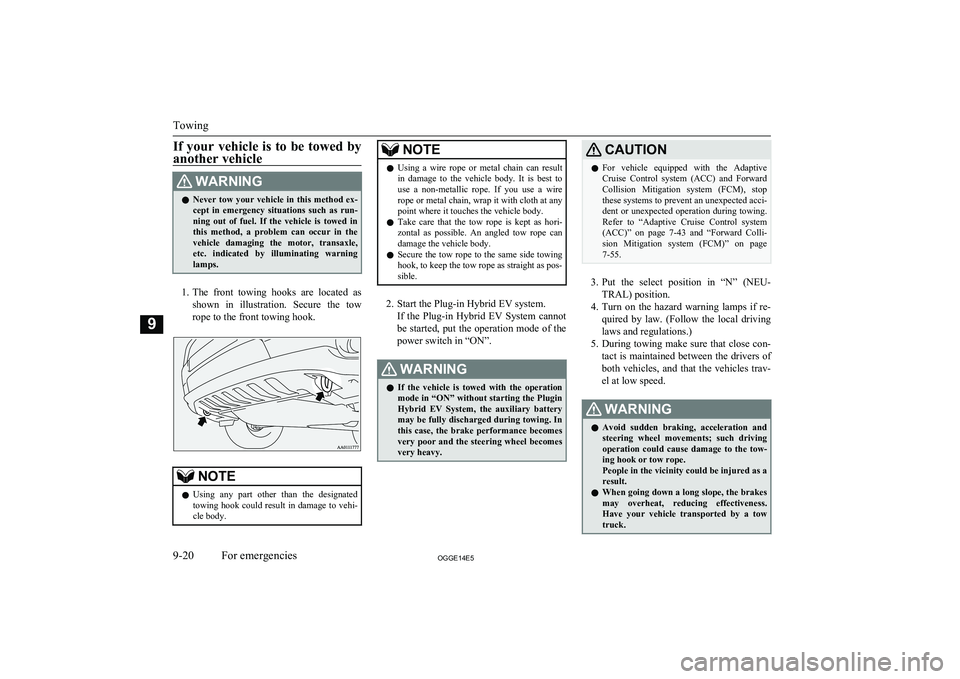
1. The front towing hooks are located as
shown in illustration. Secure the tow rope to the front towing hook.
NOTEl Using any part other than the designated
towing hook could result in damage to vehi-cle body.NOTEl Using a wire rope or metal chain can result
in damage to the vehicle body. It is best to use a non-metallic rope. If you use a wire
rope or metal chain, wrap it with cloth at any
point where it touches the vehicle body.
l Take care that the tow rope is kept as hori-
zontal as possible. An angled tow rope can
damage the vehicle body.
l Secure the tow rope to the same side towing
hook, to keep the tow rope as straight as pos-
sible.
2. Start the Plug-in Hybrid EV system.
If the Plug-in Hybrid EV System cannotbe started, put the operation mode of the
power switch in “ON”.
WARNINGl If the vehicle is towed with the operation
mode in “ON” without starting the Plugin
Hybrid EV System, the auxiliary battery may be fully discharged during towing. In
this case, the brake performance becomes very poor and the steering wheel becomes
very heavy.CAUTIONl For vehicle equipped with the Adaptive
Cruise Control system (ACC) and Forward Collision Mitigation system (FCM), stopthese systems to prevent an unexpected acci-
dent or unexpected operation during towing. Refer to “Adaptive Cruise Control system
(ACC)” on page 7-43 and “Forward Colli-
sion Mitigation system (FCM)” on page 7-55.
3. Put the select position in “N” (NEU-
TRAL) position.
4. Turn on the hazard warning lamps if re-
quired by law. (Follow the local driving
laws and regulations.)
5. During towing make sure that close con-
tact is maintained between the drivers of
both vehicles, and that the vehicles trav-
el at low speed.
WARNINGl Avoid sudden braking, acceleration and
steering wheel movements; such driving
operation could cause damage to the tow- ing hook or tow rope.
People in the vicinity could be injured as a
result.
l When going down a long slope, the brakes
may overheat, reducing effectiveness.
Have your vehicle transported by a tow truck.
Towing
9-20OGGE14E5For emergencies9
Page 374 of 442

CAUTIONlIf your vehicle has rain sensor wipers, place
the wiper switch lever in the “OFF” position
to deactivate the rain sensor before washing the vehicle. Otherwise, the wipers will oper-ate in the presence of water spray on the
windscreen and may get damaged as a result.
l Refrain from excessively using a car wash as
its brushes may scratch the paint surface, causing it to lose its gloss. Scratches will be
especially visible on darker coloured vehi-
cles.
l Never spray or splash water on the electrical
components in the engine compartment. Do-
ing so could have an adverse effect on the
Plug-in Hybrid EV system startability.
Exercise caution also when washing the un- derbody; be careful not to spray water intothe engine compartment.
l Some types of hot water washing equipment
apply high pressure and heat to the vehicle.They may cause heat distortion and damage
to the vehicle resin parts and may result in
flooding of the vehicle interior.
Therefore;
• Maintain a distance of approx. 70 cm or
more between the vehicle body and the
washing nozzle.
• When washing around the door glass,
hold the nozzle at a distance of more than
70 cm and at right angles to the glass sur-
face.CAUTIONl After washing the vehicle, drive the vehicle
slowly while lightly depressing the brake
pedal several times in order to dry out the
brakes.
Leaving the brakes wet could result in re- duced braking performance. Also, there is a possibility that they could freeze up or be-
come inoperative due to rust, rendering the vehicle unable to move.
l When using an automatic car wash, pay at-
tention to the following items, referring to the operation manual or consulting a car
wash operator. If the following procedure is not followed, it could result in damage to
your vehicle.
• The outside mirrors are retracted.
• The antenna is removed.
• The wiper arms are secured in place with
tape.
• If your vehicle is equipped with a roof
rails, consult a car wash operator before using the car washer.
• If your vehicle has rain sensor wipers,
place the wiper switch lever in the “OFF” position to deactivate the rain sensor.
• Make sure that the charging lid and the
fuel lid are completely closed.During cold weather
Salt and other chemicals spread on the roads
in some areas in winter can have a harmful effect on the vehicle body. You should there-
fore wash the vehicle as often as possible in accordance with our care-instructions. It is
recommended to have a preservative applied
and the underfloor protection checked before and after the cold weather season.
After washing your vehicle, wipe off all wa- terdrops from the rubber parts around the
doors to prevent the doors from freezing.
NOTEl To prevent freezing of the weatherstripping
on the doors, bonnet, etc., they should be treated with silicone spray.Waxing
E00901000919
Waxing the vehicle will help prevent the ad-
herence of dust and road chemicals to the paintwork. Apply a wax solution after wash- ing the vehicle, or at least once every three
months to assist displacing of water.
Do not wax your vehicle in direct sunlight.
You should wax after the surfaces have
cooled.
For information on how to use wax refer to the instruction manual of the wax.
Cleaning the exterior of your vehicle
10-04OGGE14E5Vehicle care10
Page 379 of 442

WARNINGlIf it is necessary to do work in the engine
compartment with the plug-in hybrid EV
system starting, be especially careful that
your clothing, hair, etc., does not become caught by the cooling fans, drive belts, orother moving parts.
l The cooling fans can turn on automatical-
ly even if the plug-in hybrid EV system is
stopping. Put the operation mode of the
power switch in OFF to be safe while you work in the engine compartment.
l Make sure that the engine and Plug-in
Hybrid EV system has cooled down be- fore removing the radiator cap and EV
cooling system reserve tank cap, because hot steam or boiling water will otherwise
gush from the filler port and may scald you.
l Do not smoke, cause sparks or allow open
flames around fuel or auxiliary battery.
The fumes are flammable.
l Be extremely cautious when working
around the auxiliary battery. It contains
poisonous and corrosive sulphuric acid.
l Do not get under your vehicle with just
the body jack supporting it. Always use automotive jack stands.
l Improper handling of components and
materials used in the vehicle can endangeryour personal safety. We recommend you to consult a specialist for necessary infor-
mation.WARNINGl The components inside the engine room
might be very hot to the touch.
To avoid being burnt, make sure all com- ponents have sufficiently cooled before beginning an inspection. These compo-
nents are affixed with the label indicating precautions for handling. Follow the in-structions on the label.
1- Brake fluid reservoir (RHD)
2- Engine oil level gauge
3- Engine oil cap
4- Brake fluid reservoir (LHD)
5- Washer fluid reservoir
6- EV cooling system reservoir
7- Engine coolant reservoir
Catalytic converter
E01000202495
The exhaust gas scavenging devices used with the catalytic converter are extremely ef- ficient for the reduction of noxious gases.
The catalytic converter is installed in the ex- haust system.
It is important to keep the engine properly
tuned to ensure proper catalyst operation and prevent possible catalyst damage.WARNINGl As with any vehicle, do not park or oper-
ate this vehicle in areas where combusti- ble materials such as dry grass or leaves
can come in contact with a hot exhaust
since a fire could occur.
l Paint should not be applied to the catalyt-
ic converter.NOTEl Use fuel of the type recommended in
“Fuel
selection” on page 2-12.
Catalytic converter
11-03OGGE14E5Maintenance11
Page 385 of 442

Fluid type
Use brake fluid conforming to DOT3 or
DOT4 from a sealed container. The brake fluid is hygroscopic. Too much moisture in
the brake fluid will adversely affect the brake system, reducing the performance.
CAUTIONl Take care in handling brake fluid as it is
harmful to the eyes, may irritate your skin
and also damage painted surfaces.
l Use only the specified brake fluid.
Do not mix or add different brands of brake fluid to prevent chemical reactions.
Do not let any petroleum-based fluid touch, mix with, or get into the brake fluid.
This will damage the seals.
l Keep the reservoir tank cap closed to pre-
vent the brake fluid from deteriorating ex- cept maintenance.
l Clean the filler cap before removing and
close the cap securely after maintenance.Auxiliary battery
E01001203343
The condition of the auxiliary battery is very
important for quick starting of the plug-in hy-
brid EV system and proper functioning of the vehicle’s electrical system. Regular inspec- tion is especially important in cold weather.
Be sure to have a MITSUBISHI MOTORS
Authorized Service Point check the auxiliary battery.WARNINGl Be sure to have a
MITSUBISHI
MOTORS Authorized Service Point
charge the battery. Do not charge the bat- tery yourself. Flammable gases may leak
and explode.CAUTIONl There is a type of auxiliary battery is not
properly installed in the vehicle, even if thesame specification.
When replacing the auxiliary battery, please
contact a MITSUBISHI MOTORS Author-
ized Service Point.NOTEl When the auxiliary battery is removed, the
controlling timer for forcibly starting the en-
gine may be reset.
Since a fuel injection device may cause a clogging if the state where the engine does
not operate continues after reset of the timer,
please press the battery charge switch in or-
der to start the engine. However, when the drive battery is near full charge, even if the
battery charge switch is pressed, the engine
may not start. In that case, press the battery charge switch again after the drive battery
quantity decreases. Refer to “Battery charge
switch” on page 7-22.
l When the auxiliary battery is removed, since
the timer control of the MITSUBISHI Re-
mote Control is reset and the drive battery
temperature control can not be used, com- municate the wireless LAN device and your
vehicle again.
l When the auxiliary battery is removed, the
timer control of the MITSUBISHI Remote
Control is reset and each function of the MITSUBISHI Remote Control can not be
used. Also the drive battery can not be
warmed up.
Communicate the wireless LAN device and your vehicle again.
Auxiliary battery
11-09OGGE14E5Maintenance11