2014 MITSUBISHI OUTLANDER PHEV Warning
[x] Cancel search: WarningPage 366 of 442
If your vehicle is to be towed by
another vehicleWARNINGl Never tow your vehicle in this method ex-
cept in emergency situations such as run-
ning out of fuel. If the vehicle is towed in this method, a problem can occur in thevehicle damaging the motor, transaxle,
etc. indicated by illuminating warning lamps.
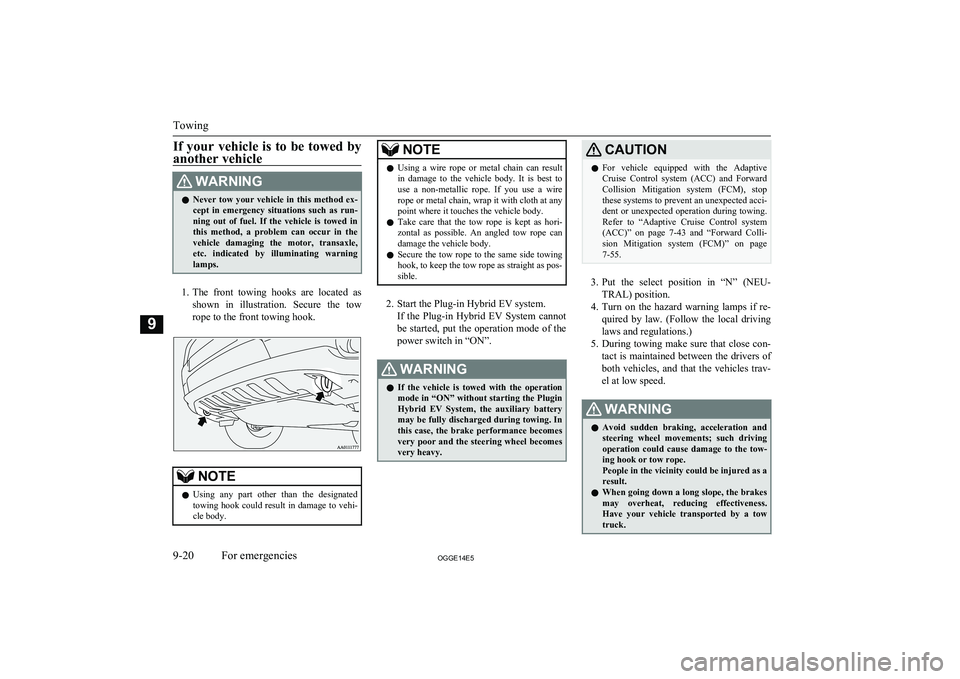
1. The front towing hooks are located as
shown in illustration. Secure the tow rope to the front towing hook.
NOTEl Using any part other than the designated
towing hook could result in damage to vehi-cle body.NOTEl Using a wire rope or metal chain can result
in damage to the vehicle body. It is best to use a non-metallic rope. If you use a wire
rope or metal chain, wrap it with cloth at any
point where it touches the vehicle body.
l Take care that the tow rope is kept as hori-
zontal as possible. An angled tow rope can
damage the vehicle body.
l Secure the tow rope to the same side towing
hook, to keep the tow rope as straight as pos-
sible.
2. Start the Plug-in Hybrid EV system.
If the Plug-in Hybrid EV System cannotbe started, put the operation mode of the
power switch in “ON”.
WARNINGl If the vehicle is towed with the operation
mode in “ON” without starting the Plugin
Hybrid EV System, the auxiliary battery may be fully discharged during towing. In
this case, the brake performance becomes very poor and the steering wheel becomes
very heavy.CAUTIONl For vehicle equipped with the Adaptive
Cruise Control system (ACC) and Forward Collision Mitigation system (FCM), stopthese systems to prevent an unexpected acci-
dent or unexpected operation during towing. Refer to “Adaptive Cruise Control system
(ACC)” on page 7-43 and “Forward Colli-
sion Mitigation system (FCM)” on page 7-55.
3. Put the select position in “N” (NEU-
TRAL) position.
4. Turn on the hazard warning lamps if re-
quired by law. (Follow the local driving
laws and regulations.)
5. During towing make sure that close con-
tact is maintained between the drivers of
both vehicles, and that the vehicles trav-
el at low speed.
WARNINGl Avoid sudden braking, acceleration and
steering wheel movements; such driving
operation could cause damage to the tow- ing hook or tow rope.
People in the vicinity could be injured as a
result.
l When going down a long slope, the brakes
may overheat, reducing effectiveness.
Have your vehicle transported by a tow truck.
Towing
9-20OGGE14E5For emergencies9
Page 368 of 442

WARNINGlWhen trying to rock your vehicle out of a
stuck position, make sure that there are
no people nearby. The rocking motion can make your vehicle suddenly lurch for-
ward or backward, and injure any by- standers.
On a flooded road
l Do not drive on a flooded road. If you
drive on a flooded road, not only does the Plugin Hybrid EV System stop but
there may be a failure like electric leak- age or short circuit.
If you inevitably had to run on a flooded
road and the vehicle was exposed to wa- ter, be sure to have your vehicle inspec-
ted by a MITSUBISHI MOTORS Au-
thorized Service Point.
l If there is water on the brakes after driv-
ing through puddles or washing the vehi- cle, resulting in temporarily ineffective
brakes. In such cases, lightly depress the brake pedal to see if the brakes operate
properly. If they do not, lightly depress the pedal several times while driving in
order to dry the brake pads.
l When driving in rain or on a road with
many puddles a layer of water may form
between the tyres and the road surface.
This reduces a tyre’s frictional resistance
on the road, resulting in loss of steering stability and braking capability.
To cope with this, observe the following
items: A- Drive your vehicle at slow speed.B- Do not drive on worn tyres.
C- Always maintain the specified tyre
inflation pressures.
On a snow-covered or frozen road
l When driving on a snow-covered or fro-
zen road, it is recommended that you use snow tyres or snow traction device (tyre chains).
Refer to the “Snow tyres” and “Snow
traction device (tyre chains)” sections.
l Avoid high-speed operation, sudden ac-
celeration, abrupt brake application and
sharp cornering.
l Depressing the brake pedal during travel
on snowy or icy roads may cause tyre
slippage and skidding. When traction be-
tween the tyres and the road is reduced the wheels may skid and the vehicle can-
not readily be brought to a stop by con- ventional braking techniques. Brakingwill differ, depending upon whether you
have anti-lock brake system (ABS). As your vehicle is equipped with ABS,brake by pressing the brake pedal hard,
and keeping it pressed.
l Allow extra distance between your vehi-
cle and the vehicle in front of you, and avoid sudden braking.
l Accumulation of ice on the braking sys-
tem can cause the wheels to lock. Pullaway from a standstill slowly after con-
firming safety around the vehicle.CAUTIONl Do not press the accelerator pedal rapidly. If
the wheels break free of the ice, the vehicle
could suddenly start moving and possibly cause an accident.
On a bumpy or rutted road
Drive as slow as possible when driving on
bumpy or rutted roads.
Operation under adverse driving conditions
9-22OGGE14E5For emergencies9
Page 373 of 442
2.Clean the carpeting with a vacuum
cleaner and remove any stains with car- pet cleaner. Oil and grease can be re- moved by lightly dabbing with a cleancolourfast cloth and stain remover.Genuine leather*
E00900600950
1. To clean, lightly wipe the leather with a
soft cloth soaked in a mild soap and wa-
ter solution.
2. Dip cloth in fresh water and wring it out
well. Using this cloth, wipe off the deter-
gent thoroughly.
3. Apply leather protecting agent to the
genuine leather surface.
NOTEl If genuine leather is wet with water or is
washed in water, wipe off water as quickly
as possible with a dry, soft cloth.
If left damp, mildew may grow.
l Organic solvents such as benzine, kerosene,
alcohol and petrol, acid or alkaline solvents
may discolour the genuine leather surface. Be sure to use neutral detergents.
l Remove dirty patches or oil substances
quickly as they can stain genuine leather.
l The genuine leather surface may harden and
shrink if it is exposed to direct sun for long
hours. When your vehicle is parked, place it in the shade as much as possible.NOTEl When the temperature of the vehicle interior
rises in summer, vinyl products left on the
genuine leather seat may deteriorate and stick to the seat.Cleaning the exterior of
your vehicle E00900700108
If the following is left on your vehicle, it maycause corrosion, discolouration and stains, wash the vehicle as soon as possible.
l Seawater, road deicing products.
l Soot and dust, iron powder from facto-
ries, chemical substance (acids, alkalis, coaltar, etc.).
l Droppings from birds, carcasses of in-
sects, tree sap, etc.
Washing
E00900903606
Chemicals contained in the dirt and dustpicked up from the road surface can damagethe paint coat and body of your vehicle if left
in prolonged contact.
Frequent washing and waxing is the best way to protect your vehicle from this damage.
This will also be effective in protecting it from environmental elements such as rain,snow, salt air, etc.
Do not wash the vehicle in direct sunlight.
Park the vehicle in the shade and spray it
with water to remove dust. Next, using an ample amount of clean water and a car wash- ing brush or sponge, wash the vehicle from
top to bottom.
Use a mild car washing soap if necessary.
Rinse thoroughly and wipe dry with a soft
cloth. After washing the vehicle, carefully clean the joints and flanges of the doors, bon-
net and other sections where dirt is likely to remain.WARNINGl Do not wash the vehicle while charging
the traction battery.
Doing so could cause fire or an electric shock.
l Before washing the vehicle, make sure
that the charging lid and the inner lid are completely closed.
If the lid is open, the charging unit is ex- posed to water, resulting in fire or an elec-
tric shock.CAUTIONl When washing the under side of your vehi-
cle or wheel, be careful not to injure your hands.
Cleaning the exterior of your vehicle
10-03OGGE14E5Vehicle care10
Page 378 of 442

Service precautionsE01000102058
Adequate care of your vehicle at regular in- tervals serves to preserve the value and ap-
pearance as long as possible.
Maintenance items as described in this own- er’s manual can be performed by the owner.We recommend you to have the periodic in-
spection and maintenance performed by a MITSUBISHI MOTORS Authorized Service
Point or another specialist.In the event a malfunction or a problem is discovered, we recommend you to have it
checked and repaired. This section contains information on inspection maintenance pro- cedures that you can do yourself. Follow theinstructions and cautions for each of the vari-
ous procedures.
A- Cooling fans B- Caution label
C- Radiator cap
D- EV cooling reserve tank cap
*: Front of the vehicleWARNINGlBefore performing inspection or mainte-
nance, be sure to disconnect the normal charge connector from the vehicle andconfirm that the operation mode of the power switch is set to “OFF”.
l Never touch the high-voltage parts in the
engine compartment. Never remove or disassemble the high-voltage components,
cables (orange) or connectors. Also, never disassemble normal charging cables, nor-
mal charge connector, plugs or outlet. Failure to observe this instruction could
cause an electric shock which can result in
a serious injury or death. These parts have labels that indicate handling precau-
tions. Follow the instruction on these la- bels. Contact a MITSUBISHI MOTORS
Authorized Service Point for any necessa-
ry maintenance.
Refer to “High-Voltage components” on page 2-07.
l When checking or servicing the inside of
the engine compartment, make sure the
plug-in hybrid EV system is switched off and has had a chance to cool down.
Service precautions
11-02OGGE14E5Maintenance11
Page 379 of 442

WARNINGlIf it is necessary to do work in the engine
compartment with the plug-in hybrid EV
system starting, be especially careful that
your clothing, hair, etc., does not become caught by the cooling fans, drive belts, orother moving parts.
l The cooling fans can turn on automatical-
ly even if the plug-in hybrid EV system is
stopping. Put the operation mode of the
power switch in OFF to be safe while you work in the engine compartment.
l Make sure that the engine and Plug-in
Hybrid EV system has cooled down be- fore removing the radiator cap and EV
cooling system reserve tank cap, because hot steam or boiling water will otherwise
gush from the filler port and may scald you.
l Do not smoke, cause sparks or allow open
flames around fuel or auxiliary battery.
The fumes are flammable.
l Be extremely cautious when working
around the auxiliary battery. It contains
poisonous and corrosive sulphuric acid.
l Do not get under your vehicle with just
the body jack supporting it. Always use automotive jack stands.
l Improper handling of components and
materials used in the vehicle can endangeryour personal safety. We recommend you to consult a specialist for necessary infor-
mation.WARNINGl The components inside the engine room
might be very hot to the touch.
To avoid being burnt, make sure all com- ponents have sufficiently cooled before beginning an inspection. These compo-
nents are affixed with the label indicating precautions for handling. Follow the in-structions on the label.
1- Brake fluid reservoir (RHD)
2- Engine oil level gauge
3- Engine oil cap
4- Brake fluid reservoir (LHD)
5- Washer fluid reservoir
6- EV cooling system reservoir
7- Engine coolant reservoir
Catalytic converter
E01000202495
The exhaust gas scavenging devices used with the catalytic converter are extremely ef- ficient for the reduction of noxious gases.
The catalytic converter is installed in the ex- haust system.
It is important to keep the engine properly
tuned to ensure proper catalyst operation and prevent possible catalyst damage.WARNINGl As with any vehicle, do not park or oper-
ate this vehicle in areas where combusti- ble materials such as dry grass or leaves
can come in contact with a hot exhaust
since a fire could occur.
l Paint should not be applied to the catalyt-
ic converter.NOTEl Use fuel of the type recommended in
“Fuel
selection” on page 2-12.
Catalytic converter
11-03OGGE14E5Maintenance11
Page 381 of 442

NOTElIf this does not close the bonnet, release it
from a slightly higher position.
l Do not press down firmly on the bonnet as
doing so could damage it.
l For vehicles equipped with the security
alarm system, if you drive with the bonnet left open, a warning display is displayed on the information screen in the multi informa-tion display.Engine oil
E01000404068
To check and refill engine oil
The engine oil used has a significant effect on the engine’s performance, service life and
startability. Be sure to use oil of the recom- mended quality and appropriate viscosity.
All engines consume a certain amount of oil during normal operation. Therefore, it is im-portant to check the oil level at regular inter-
vals or before starting a long trip. 1. Park the car on a horizontal surface.
2. Switch off the engine.
3. Wait a few minutes.
4. Remove the dipstick and wipe it with a
clean cloth.
5. Reinsert the dipstick as far as it goes.
6. Remove the dipstick and read the oil lev-
el, which should always be within the
range indicated.
7. If the oil level is below the specified
limit, remove the cap located on the cyl-inder head cover and add enough oil to
raise the level to within the specified
range. Do not overfill to avoid engine
damage. Be sure to use the specified en- gine oil and do not mix various types of
oil.
8. After adding oil, close the cap securely.
9. Confirm the oil level by repeating step 4
to 6.NOTEl The engine oil will deteriorate rapidly if the
vehicle is subjected to severe conditions, re-
quiring earlier oil replacement.
Please refer to the maintenance schedule.
l For information on how to dispose of used
engine oil, refer to page 2-15.
Engine oil
11-05OGGE14E5Maintenance11 FULL LOW
Page 383 of 442

To add coolant
The cooling system is a closed system andnormally the loss of coolant should be very
slight. A noticeable drop in the coolant level
could indicate leakage. If this occurs, we rec- ommend you to have the system checked as
soon as possible.
If the level should drop below the “LOW” level on the reserve tank, open the lid and
add coolant.
Also, if the reserve tank is completely empty, remove the radiator cap (C) or the reservetank cap (D) and add coolant until the level reaches the filler neck.
WARNINGl Do not open the radiator cap (C) and the
reserve tank cap (D) while the engine andthe plug-in hybrid EV system are hot. The
coolant system is under pressure and any hot coolant escaping could cause severe burns.Anti-freeze
The engine coolant and the plug-in hybrid
EV system coolant contains an ethylene gly-col anti-corrosion agent. Some parts of the
engine and the plug-in hybrid EV system are
cast aluminium alloy, and periodic changing of the engine coolant and the plug-in hybridEV system coolant are necessary to prevent
corrosion of these parts.
Use “ MITSUBISHI MOTORS GENUINE
SUPER LONG LIFE COOLANT PREMI-
UM” or equivalent*.
*:similar high quality ethylene glycol
based non-silicate, non-amine, non-ni-
trate and non-borate coolant with long life hybrid organic acid technology
MITSUBISHI MOTORS GENUINE Coolant
has excellent protection against corrosion and
rust formation of all metals including alumi-
nium and can avoid blockages in the radiator, heater, cylinder head, engine block, etc.
Because of the necessity of this anti-corro-
sion agent, the coolant must not be replaced with plain water even in summer. The re-
quired concentration of anti-freeze differs de- pending on the expected ambient tempera-
ture.
Above -35 °C: 50 % concentration of anti-
freeze
Below -35 °C: 60 % concentration of anti- freezeCAUTIONl Do not use alcohol or methanol anti-freeze
or any engine coolants mixed with alcohol
or methanol anti-freeze. The use of an im- proper anti-freeze can cause corrosion of thealuminium components.
l Do not use water to adjust the concentration
of coolant.
l Concentrations exceeding 60 % will result in
a reduction of both the anti-freeze and cool-
ing performance thus adversely affecting the engine.
l Do not top up with water only.
Water by itself reduces the rust-protective
and anti-freeze qualities of the coolant and has a lower boiling point. It can also causedamage to the cooling system if it should freeze. Do not use tapwater, as it can cause
corrosion and rust formation.
During cold weather
If the temperatures in your area drop below
freezing, there is the danger that the coolant
in the engine, plug-in hybrid EV system or radiator could freeze and cause severe dam-age to the engine and/or radiator. Add a suffi-
cient amount of anti-freeze to the coolant to prevent it from freezing.
Engine coolant/Plug-in hybrid EV system coolant
11-07OGGE14E5Maintenance11
Page 384 of 442

The concentration should be checked beforethe start of cold weather and anti-freeze add-
ed to the system if necessary.Washer fluid
E01000700890
Open the washer fluid reservoir cap andcheck the level of washer fluid with the dip- stick.
If the level is low, replenish the container with washer fluid.
NOTEl The washer fluid container serves the wind-
screen, rear window and headlamps (if soequipped).During cold weather
To ensure proper operation of the washers at
low temperatures, use a fluid containing ananti-freezing agent.
Brake fluid
E01000801696
To check the fluid level
The fluid level must be between the “MAX”
and “MIN” marks on the reservoir.The fluid level is monitored by a float. When
the fluid level falls below the “MIN” mark, the brake fluid warning lamp lights up.The fluid level falls slightly with wear of the brake pads, but this does not indicate any ab-
normality.
The fluid in the master cylinder should be checked when doing other work under thebonnet. The brake system should also be checked for leakage at the same time.
If the fluid level falls markedly in a short length of time, it indicates leaks from the
brake system.
If this occurs, we recommend you to have the
vehicle checked.
Washer fluid
11-08OGGE14E5Maintenance11FULLEMPTY