Page 3 of 460
Overview
Audio (if so equipped) P.5-30
Mitsubishi Multi Entertainment
System (if so equipped)
Refer to the separate “Mitsubishi
Multi Entertainment System
owner’s manual”
Clock (if so equipped) P.5-39Center vents P.5-2 Supplemental restraint system
(SRS)-airbag (for front passenger)
P.2-35, 2-45
Side vents P.5-2
Engine hood release lever
P. 7 - 5
Fuel tank filler door release
lever P.1-4Cup holder (for the
front seat) P.3-165
Gearshift lever (if so equipped)
P.3-59
Selector lever (if so equipped)
P.3-61
Cup holder (for the rear seat)
P. 3 - 1 6 5Parking brake lever P.3-48Key slot (if so
equipped) P.3-2912 V power outlets
P.3-161Compartment
P. 3 - 1 6 5
Electric rear window defogger
switch P.3-125 Automatic air conditioning (if so
equipped) P.5-17 Heater (if so equipped) P.5-6
Manual air conditioning (if so
equipped) P.5-11
Electric rear window defogger
switch P.3-125
BK0162600US.book 2 ページ 2013年3月22日 金曜日 午後2時41分
Page 4 of 460
Overview
Interior
N00100301245
Power window lock switch P.3-44
Power window switch P.3-43
Seat belts P.2-14
Supplemental restraint system
(SRS)-curtain airbags P.2-53
Manual window control
(if so equipped) P.3-43
Cargo room light
P.3-164, 7-45
Rear shelf panel (if so equipped)
P. 3 - 1 6 7
Rear seats P.2-8Jack (if so equipped) P.6-7Supplemental restraint system
(SRS)-side airbag (for front
seat) P.2-52Front seats P.2-2Heated seats (if so
equipped) P.2-7 USB input terminal
(if so equipped)
P. 3 - 1 5 3Head restraints
P. 2 - 1 1 Inside rearview mirror P.3-50 Dome light P.3-162, 7-45 Microphone P.3-129 Bottle holders P.3-166
Sun visors P.3-160
Vanity mirror P.3-160
Card holder P.3-160 Power door lock switch
(if so equipped) P.3-38
BK0162600US.book 3 ページ 2013年3月22日 金曜日 午後2時41分
Page 6 of 460
Overview
Outside
N00100601365
Antenna P.5-64Power window (if so equipped) P.3-43
Outside rearview mirrors P.3-52
Fuel ta nk filler P.1-4
F.A.S.T.-key (Free-hand
Advanced Security Transmitter)
( if so e q u ipp ed) P.3 -13
Keyless entry sysetm (if
soe qu ip ped) P.3- 8
Locking and unlocking P.3-35
Side turn signal lights
P.3-118, 7-44
Front side- marker lights
P.3-114, 7-44, 7-47
Headlights/Daytime running lights (if so equipped)
P.3-114, 7-44, 7-46
Parking lights
P.3-114, 7-44, 7-49
Front turn signal lights
P.3-118, 7-44, 7-48
Front fog lights (if so
equipped)
P.3-120, 7-44, 7-50 Engine hood P.7-5
Windshield wipers P.3-121
BK0162600US.book 5
\bM\bo\b+ 2013年3月22日 金曜日 午後2時41\f
Page 11 of 460

Quick index
3
Anti-lock braking system warning
light�When this light comes on, the anti-lock braking system is not functioning and
only the ordinary braking system is functioning.
�Park your vehicle in a safe place and stop the engine.
Test the system as described on page 3-73.
�If the light does not go out after the test, or if it comes on again, we recom-
mend that you have the system checked at an authorized Mitsubishi Motors
dealer or a repair facility of your choice as soon as possible.P. 3 - 7 3
SRS warning light�Immediately have the airbag and the pre-tensioner seat belt system checked at
an authorized Mitsubishi Motors dealer.P. 2 - 4 4
Selector lever position indicator in
the instrument cluster flasher slowly
(every 2 seconds)�Have your continuously variable transmission (CVT) checked at an autho-
rized Mitsubishi Motors dealer or a repair facility of your choice as soon as
possible.P. 3 - 6 5
and
ASC indicator and ASC OFF indica-
tor�Park your vehicle in a safe place and stop the engine.
Restart the engine and check whether the indicator goes out.
�If the indicator does not go out, or if it comes on again, have your vehicle
inspected by an authorized Mitsubishi Motors dealer or a repair facility of
your choice as soon as possible.
�When this indicator comes on, the active stability control is not functioning.P. 3 - 7 9
Warning lights
Do this
Ref. Page
BK0162600US.book 3 ページ 2013年3月22日 金曜日 午後2時41分
Page 13 of 460

Quick index5
If this problem occurs...
N00200900870
Problem
Do this
Ref. Page
Unable to turn the key.
(except for vehicles equipped
with the F.A.S.T.-key) From “ACC” to “OFF”
Vehicles with continuously variable transmission (CVT):
Check the position of the selector lever.
The key cannot be removed unless the selector lever is set to the “P” (PARK) position. P. 3-55
The engine does not start when
the engine switch is pressed.
(for vehicles equipped with the
F. A . S . T. - k e y ) Make sure the F.A.S.T.-key is in the vehicle.
Vehicles with manual transaxle:
Press and hold the clutch pedal all the way down, and then press the engine switch while
depressing the brake pedal.
Vehicles with continuously variable transmission (CVT):
Make sure the selector lever is in the “P” (PARK) position, and then press the engine
switch while depressing the brake pedal.
P. 3-24
The F.A.S.T.-key does not
operate.
(for vehicles equipped with the
F. A . S . T. - k e y ) Use the emergency key to lock and unlock the door.
Insert the F.A.S.T.-key into the key slot of the floor console, and then start the engine or
change the operation mode.
P. 3-26, 3-27
BK0162600US.book 5
\bM\bo\b+ 2013年3月22日 金曜日 午後2時41\f
Page 21 of 460
General information
1-5
1
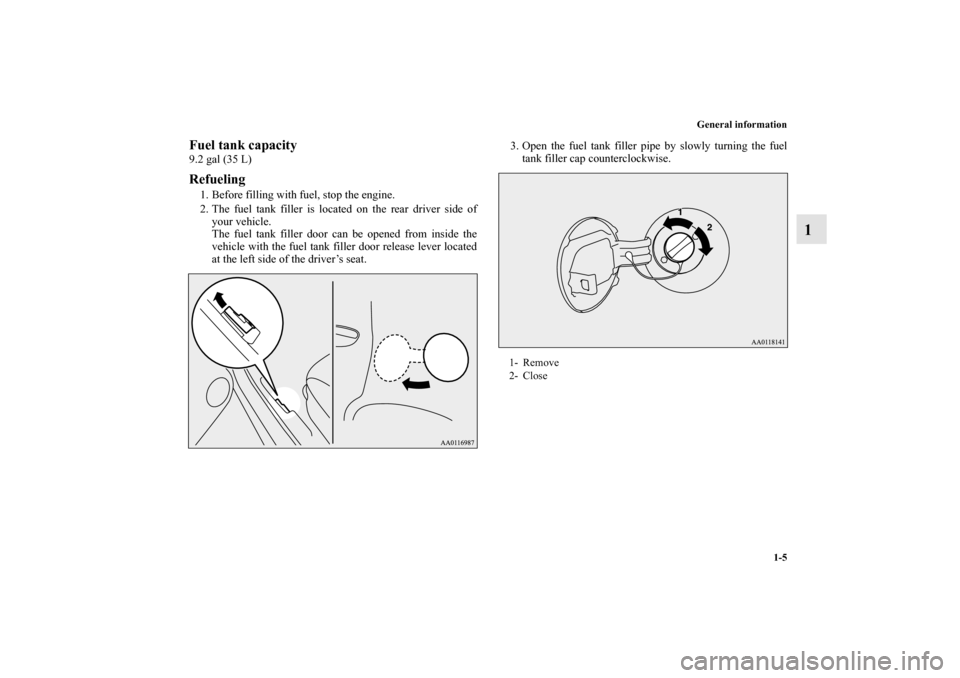
Fuel tank capacity9.2 gal (35 L)Refueling1. Before filling with fuel, stop the engine.
2. The fuel tank filler is located on the rear driver side of
your vehicle.
The fuel tank filler door can be opened from inside the
vehicle with the fuel tank filler door release lever located
at the left side of the driver’s seat.3. Open the fuel tank filler pipe by slowly turning the fuel
tank filler cap counterclockwise.
1- Remove
2- Close
BK0162600US.book 5 ページ 2013年3月22日 金曜日 午後2時41分
Page 22 of 460
1-6 General information
1
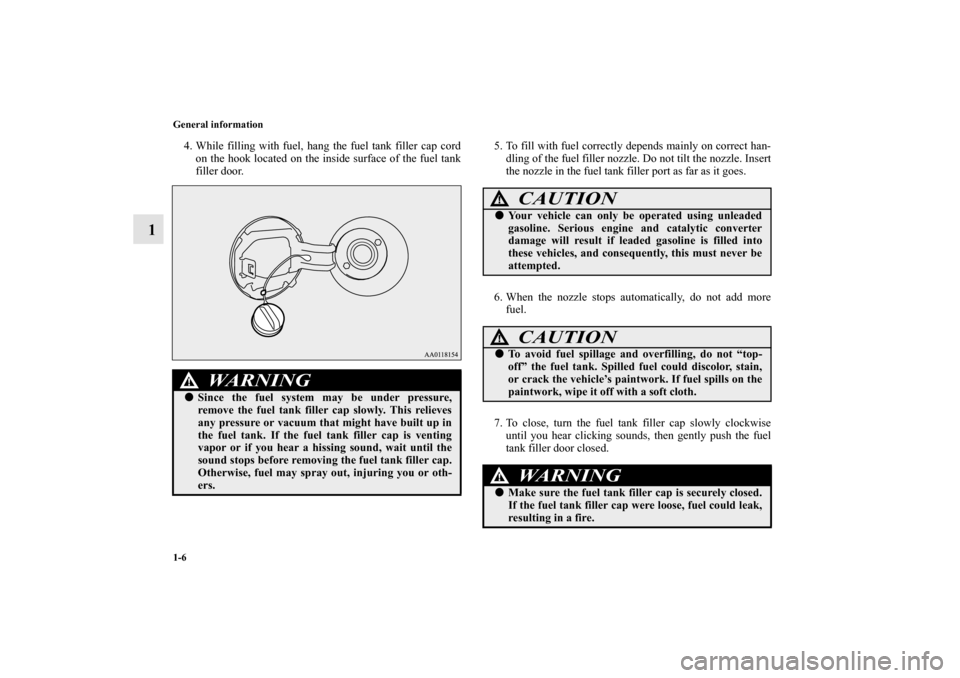
4. While filling with fuel, hang the fuel tank filler cap cord
on the hook located on the inside surface of the fuel tank
filler door.5. To fill with fuel correctly depends mainly on correct han-
dling of the fuel filler nozzle. Do not tilt the nozzle. Insert
the nozzle in the fuel tank filler port as far as it goes.
6. When the nozzle stops automatically, do not add more
fuel.
7. To close, turn the fuel tank filler cap slowly clockwise
until you hear clicking sounds, then gently push the fuel
tank filler door closed.
WA R N I N G
!�Since the fuel system may be under pressure,
remove the fuel tank filler cap slowly. This relieves
any pressure or vacuum that might have built up in
the fuel tank. If the fuel tank filler cap is venting
vapor or if you hear a hissing sound, wait until the
sound stops before removing the fuel tank filler cap.
Otherwise, fuel may spray out, injuring you or oth-
ers.
CAUTION
!�Your vehicle can only be operated using unleaded
gasoline. Serious engine and catalytic converter
damage will result if leaded gasoline is filled into
these vehicles, and consequently, this must never be
attempted.
CAUTION
!�To avoid fuel spillage and overfilling, do not “top-
off” the fuel tank. Spilled fuel could discolor, stain,
or crack the vehicle’s paintwork. If fuel spills on the
paintwork, wipe it off with a soft cloth.
WA R N I N G
!�Make sure the fuel tank filler cap is securely closed.
If the fuel tank filler cap were loose, fuel could leak,
resulting in a fire.
BK0162600US.book 6 ページ 2013年3月22日 金曜日 午後2時41分
Page 29 of 460
Seat and restraint systems
2-3
2 Seats and restraint systems
N00401600212
Your vehicle has seat belts and other safety features that help
protect you and your passengers in an accident.
Seat belts are the most important safety device. When worn
properly, seat belts can reduce the chance of serious injury or
death in various types of crashes. For added protection during a
severe frontal collision, your vehicle has a Supplemental
Restraint System (SRS) with airbags for the driver and passen-
gers. The seats, head restraints, and door locks also are safety
equipment, which must be used correctly.
Always check the following before you drive:
�That everyone in your vehicle is properly wearing their
seat belt.
�That infants and small children are properly secured in an
appropriate child restraint system in the rear seat.
�That all doors are fully closed and locked.
�That seatbacks are upright, with head restraints properly
adjusted.
Safety equipment cannot prevent injury or death in all motor
vehicle accidents. However, you can help reduce the risk of
injury or death by following the instructions in this manual.
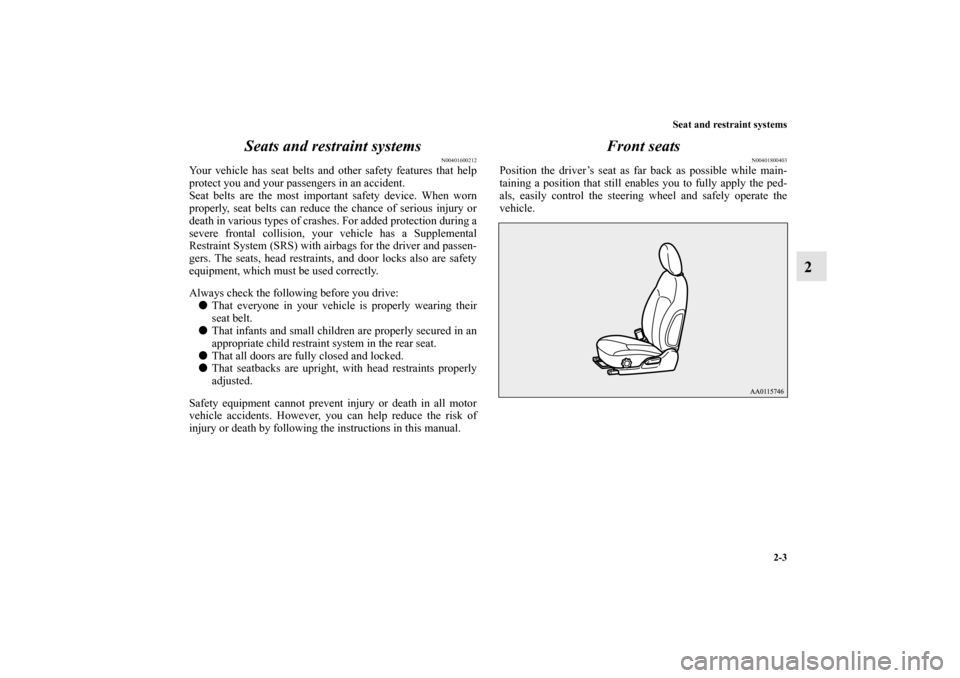
Front seats
N00401800403
Position the driver’s seat as far back as possible while main-
taining a position that still enables you to fully apply the ped-
als, easily control the steering wheel and safely operate the
vehicle.
BK0162600US.book 3 ページ 2013年3月22日 金曜日 午後2時41分