Page 263 of 460

Driving safety
4-5
4 Vehicle preparation before driving
N00629000702
For a safer and more enjoyable trip, always check for the fol-
lowing:Seat belts and seats�Before starting the vehicle, make certain that you and all
passengers are seated and wearing their seat belts properly
(with children in the rear seat, in appropriate restraints),
and that all the doors and the liftgate are locked.
�Move the driver’s seat as far backward as possible, while
keeping good visibility, and good control of the steering
wheel, brakes, accelerator, and controls. Check the instru-
ment panel indicators and multi-information display for
any possible problem.
�Similarly, the front passenger seat should also be moved
as far back as possible.
�Make sure that infants and small children are properly
restrained in accordance with all laws and regulations.DefrostersCheck these by selecting the defroster mode, and set the blower
switch on high. You should be able to feel the air blowing
against the windshield.
Refer to “Defrosting or defogging (windshield, door win-
dows)” on page 5-15, 5-26.
TiresCheck all the tires for heavy tread wear or uneven wear pat-
terns. Look for stones, nails, glass, or other objects stuck in the
tread. Look for any tread cuts or sidewall cracks. Check the
wheel nuts for tightness, and the tires (including spare tire) for
proper pressure. Replace your tires before they are heavily
worn out.
On vehicles equipped with a tire pressure monitoring system,
there is a risk of damage to the tire inflation pressure sensors
when the tire is replaced on the rim. Tire replacement should,
only be performed by an authorized Mitsubishi Motors dealer.LightsHave someone watch while you turn all the exterior lights on
and off. Also check the turn signal indicators and high-beam
indicators on the instrument panel.Fluid leaksCheck the ground under the vehicle after parking overnight, for
fuel, water, oil, or other leaks. Make sure all the fluid levels are
correct. Also, if you can smell fuel, you need to find out why
immediately and have it fixed.
BK0162600US.book 5 ページ 2013年3月22日 金曜日 午後2時41分
Page 343 of 460
For emergencies
6-3
6
3. You could be injured if the vehicles move. Set the parking
brake firmly on each vehicle. Put an automatic transaxle
or CVT in “P” (PARK) or a manual transaxle in “N”
(Neutral).
4. Turn the ignition switch to the “OFF” position or put the
operation mode in OFF.NOTE�Turn off all lights, heater, and other electrical loads. This
will avoid sparks and help save both batteries.
5. Make sure your battery electrolyte is at the proper level.
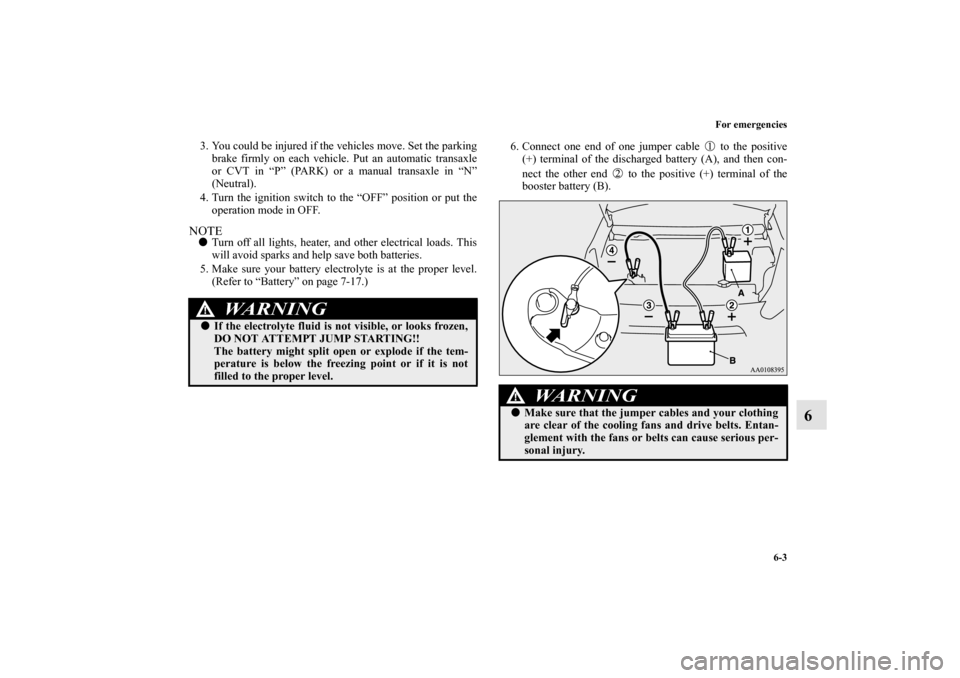
(Refer to “Battery” on page 7-17.)6. Connect one end of one jumper cable to the positive
(+) terminal of the discharged battery (A), and then con-
nect the other end to the positive (+) terminal of the
booster battery (B).
WA R N I N G
!�If the electrolyte fluid is not visible, or looks frozen,
DO NOT ATTEMPT JUMP STARTING!!
The battery might split open or explode if the tem-
perature is below the freezing point or if it is not
filled to the proper level.
WA R N I N G
!�Make sure that the jumper cables and your clothing
are clear of the cooling fans and drive belts. Entan-
glement with the fans or belts can cause serious per-
sonal injury.
BK0162600US.book 3 ページ 2013年3月22日 金曜日 午後2時41分
Page 376 of 460

7-2 Vehicle care and maintenance
7Service precautions
N00937300387
Taking regular care of your vehicle will preserve its value and
appearance as long as possible.
You can do some of the maintenance work yourself, and the
rest should only be performed by an authorized Mitsubishi
Motors dealer or a repair facility of your choice.
If you discover a malfunction or other problem, have it cor-
rected by an authorized Mitsubishi Motors dealer or a repair
facility of your choice.
This section describes the maintenance inspections that you
can do yourself, if you so desire. Follow the instructions and
precautions for each procedure.
Have you purchased the Mitsubishi Motors Diamond Care Pro-
tection Plan? The Plan supplements your new vehicle warran-
ties. See your authorized Mitsubishi Motors dealer for details.
WA R N I N G
!�When checking or servicing the inside of the engine
compartment, be sure the engine is stopped and has
had a chance to cool down.�If you need to work in the engine compartment with
the engine running, be especially careful that your
clothing, hair, etc. does not get caught in the fan,
drive belts, or other moving parts.�The fan can turn on automatically even if the engine
is not running. Turn the ignition switch to the
“OFF” position or put the operation mode in OFF to
be safe while you work in the engine compartment.�Do not smoke or allow open flames around fuel or
the battery. The fumes are flammable.
�Be extremely careful when working around the bat-
tery. It contains poisonous and corrosive sulfuric
acid.�Do not get under your vehicle while it is on a jack.
Always use properly rated automotive jack stands.�Handling your vehicle’s parts and materials in the
wrong way can injure you. Ask an authorized
Mitsubishi Motors dealer or a repair facility of your
choice if you have questions.
WA R N I N G
!
BK0162600US.book 2 ページ 2013年3月22日 金曜日 午後2時41分
Page 444 of 460
9-2 Specifications
9Vehicle labeling
N01147400742
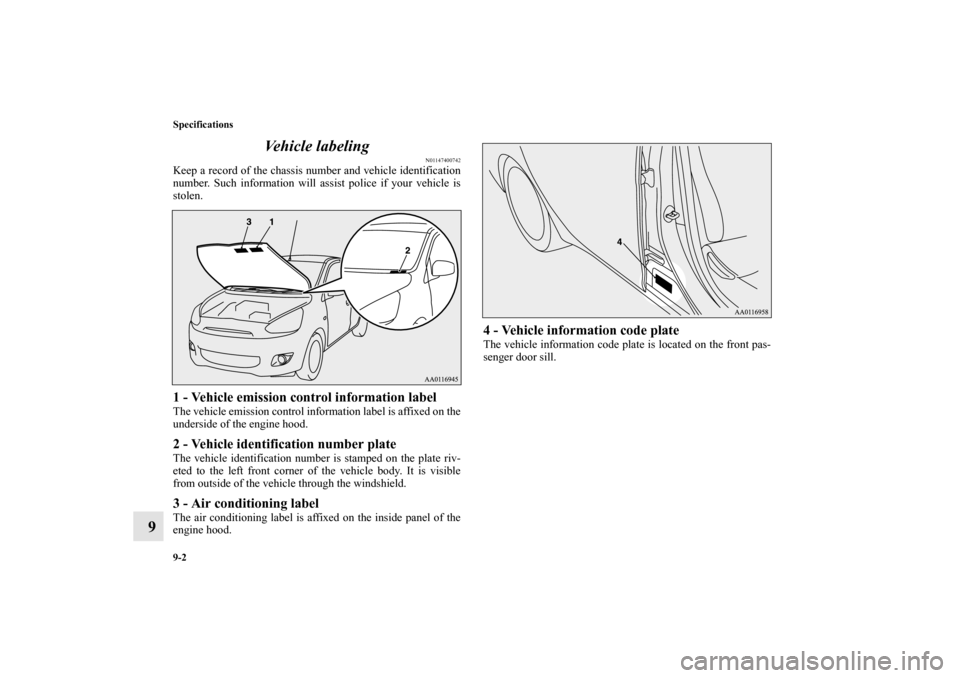
Keep a record of the chassis number and vehicle identification
number. Such information will assist police if your vehicle is
stolen.1 - Vehicle emission control information labelThe vehicle emission control information label is affixed on the
underside of the engine hood.2 - Vehicle identification number plateThe vehicle identification number is stamped on the plate riv-
eted to the left front corner of the vehicle body. It is visible
from outside of the vehicle through the windshield.3 - Air conditioning labelThe air conditioning label is affixed on the inside panel of the
engine hood.
4 - Vehicle information code plateThe vehicle information code plate is located on the front pas-
senger door sill.
BK0162600US.book 2 ページ 2013年3月22日 金曜日 午後2時41分
Page 457 of 460

Alphabetical index
5
Parking brake lever stroke 7-29
Parking brake 3-48
,7-29
Parking lights
Bulb capacity 7-44
Replacement 7-49
Polishing 7-60
Power brakes 3-68
Power outlet 3-161
Power windows 3-43
Puncture (Tire changing) 6-18
R
Radio
AM/FM electronically tuned radio with CD player 5-30
General information about your radio 5-65
Rear combination lights
Bulb capacity 7-44
Replacement 7-51
Rear seats 2-8
Rear shelf panel 3-167
Rear side-marker lights
Bulb capacity 7-44
Replacement 7-51
Rear turn signal light
Bulb capacity 7-44
Replacement 7-51
Rear-view camera 3-93
Rearview mirror
Inside rearview mirror 3-50Outside rearview mirrors 3-52
Replacement of light bulbs 7-43
Replacing tires and wheels 7-24
Reporting Safety Defects 8-3
Roof antenna 5-64
S
Safe driving techniques 4-6
Seat belts 2-14
Adjustable seat belt shoulder anchor 2-20
Child restraint systems 2-24
Front passenger seat belt warning light 2-19
Maintenance and inspection 2-35
Seat belt extender 2-21
Seat belt force limitter system 2-24
Seat belt instructions 2-15
Seat belt pre-tensioners 2-22
Seat belt use during pregnancy 2-22
Seats 2-2
Front seats 2-3
Head restraints 2-11
Heated seats 2-7
Seats and restraint systems 2-3
Service brake 3-68
Service precautions 7-2
Side turn signal light
Bulb capacity 7-44
Snow tires 7-28
Spark plugs 7-31
BK0162600US.book 5 ページ 2013年3月22日 金曜日 午後2時41分