2014 MITSUBISHI LANCER lights
[x] Cancel search: lightsPage 343 of 434

If the vehicle breaks down 8-2 For emergencies
8
N00836300161
If your vehicle breaks down on the road, move to the shoulder and turn on the hazardwarning flashers. If there is no shoulder, or the shoulder is not safe, drive in the right lane slowly, with the hazard lights flashing, untilyou come to a safe stopping place. Keep the flashers flashing. If the engine stops, there will be no power assist to the steering and brakes, making these difficult to use. The brake booster will not work, so the brakes will not grip well. The brake pedalwill be harder to press than usual. Since there is no power steering assist, the steering wheel will be hard to turn.
Get help from your passengers, bystanders, etc. to push the vehicl
e and move it to a safe
zone.
N00836400713
If the engine cannot be started because the battery is weak or dead, you can start it withthe battery from another vehicle using jumper cables. 1. Take off any metal jewelry such as watch bands or bracelets that might make an accidental electrical contact.
2. Position the vehicles close enough together so that the jumper cables can reach, but be sure the vehicles aren’t touching each other. 3. You could be injured if the vehicles move. Set the parking brake firmly on each vehi- cle. Put an automatic transaxle, CVT or Twin Clutch SST in “P” (PARK) or amanual transaxle in “N” (Neutral). Turn the ignition key to the “LOCK” position.
If the vehicle breaks down If the engine stops/fails When the engine fails at the intersection
Jump-starting the engine
WA R N I N G When using jumper cables to start a vehi- cle, follow the procedures and be very cau- tious. CAUTION Do not try to start your vehicle by pushing or towing. Vehicles with continuously variable transmission (CVT) or Twin Clutch SST cannot be started this way. Pushing or towinga vehicle that has a manual transaxle may overheat and damage the catalytic converter. Also, there is more ri
sk of an accident when
a vehicle is being pushed or towed.
CAUTION Check the other vehicle. It must have a 12- volt battery. If the other system isn’t 12-volt, both systems can be damaged.WA R N I N G Turn the ignition key to the “LOCK” posi- tion on both vehicles. Make sure that the cables or your clothes cannot be caught by the fan or drive belt. Personal injurycould result. NOTE
Turn off all lights, heater, and other electrical loads. This will avoid sparks and help save both batteries.
Page 389 of 434

Fuses 9-30 Vehicle care and maintenance
9
* - Fusible link Some fuses may not be installed on your vehicle, depending on the vehicle model or specifications. The table above shows the main equip- ment corresponding to each fuse.
Passenger compartment fuse loca- tion table No.
Sym- bol
Electrical system
Capacity
1 Heater 30 A
*
2
Stop lights (Brake lights)
15 A
3 Rear fog light 10 A
Main fuse block
Sub fuse block
Passenger compartme
nt fuse location
4 Windshield wiper 30 A 5 Optional 10 A 6 Door locks 20 A 7 Radio 15 A8 Control unit relay 7.5 A 9
Interior lights (Dome lights)
15 A
10
Hazard warning
flasher
15 A
11 Rear window wiper 15 A 12 Gauges 7.5 A 13
Cigarette
lighter/Accessory
socket
15 A
14 Ignition switch 10 A 15 Sunroof 20 A 16
Outside rearview mir-
rors
10 A
17
All-wheel drive sys-
tem
10 A
18 Back-up lights 7.5 A 19 Accessory socket 15 ANo.
Sym- bol
Electrical system
Capacity
20
Power window con-
trol
30 A
*
21 Defogger 30 A
*
22
Heated
outside rearview mir-
rors
7.5 A
23 115V Power outlet 15 A 24 Power seats
25 (20) A
25 Heated seats 30 ANo.
Sym- bol
Electrical system
Capacity
Page 390 of 434

Fuses
Vehicle care and maintenance 9-31
9
Engine compartment fuse location table * - Front of the vehicle
No.
Sym- bol
Electrical system
Capacity
1 Front fog lights 15 A 2 Engine 7.5 AEngine compartment fuse location
* Behind the fuse
block cover
*
3 Automatic transaxle 20 A 4 Horn 10 A 5 Alternator 7.5 A 6 Headlight washer 20 A 7 Air conditioning 10 A 8
/
ETV/Oil cooler fan (Twin Clutch SST)
Except for vehi- cles with turbo- charger
15 A
ETV
Vehicles with tur-bocharger
9 Security horn 20 A 10 Wiper deicer 15 A 11 — — — 12 Power gate 30 A 13
Daytime running
lights
10 A
14
Headlight
(high beam) (left)
10 A
15
Headlight
(high beam) (right)
10 A
No.
Sym- bol
Electrical system
Capacity
16
Headlight
(low/high beam) (left)
Discharge 20 A
17
Headlight
(low/high beam) (right)
Discharge 20 A
18
Headlight (low beam) (left)
Halogen 10 A
19
Headlight (low beam) (right)
Halogen 10 A
20
ENG/PO WER
Except for vehi- cles with turbo- charger
10 A
I/C SPRAY
Vehicles with tur-bocharger
21 Ignition coil 10 ANo.
Sym- bol
Electrical system
Capacity
Page 393 of 434

Replacement of light bulbs 9-34 Vehicle care and maintenance
9
N00943000099
The bulb should only be replaced with a new bulb with the same ra
ting and type. The type
and rating are listed on the base of the bulb.
N00950300805
[Except for vehicles with high intensity dis-charge headlights] [For vehicles with high intensity discharge headlights]
When it rains, or when the vehicle has been washed, the inside of the lens sometimes becomes temporarily foggy. This is the same phenomenon as when window glass mists up on a humid day, and does not indicate a func-tional problem. When the light is switched on, the heat will remove the fog. However, if water gathersinside the light, please have it checked by an authorized Mitsubishi Motors dealer or a repair facility of your choice.
Bulb capacity Outside
NOTE
Front
Description
Wattage
ANSI Trade No. or Bulb type
1-
Front turn sig- nal light
21 W WY21W
2-
Head light, high beam
60 W
9005 HB3
3-
Head light, low beam (Halogen bulb)
51 W
9006 HB4
4-
Front fog light (if so equipped)
55 W H11
5-
Front side- marker and parking light
5 W W5W
6- Side turn signal
light
5 W —
Description
Wattage or Can- dle power
ANSI Trade No. or Bulb type
1-
Front turn sig- nal light
21 W WY21W
2-
Daytime run- ning light
27 W
1156
32 cp
3-
Head light, low/high beam (Discharge bulb)
35 W —
4- Front fog light 55 W H11 5-
Front side- marker and parking light
5 W WY5W
6- Side turn signal
light
5 W —
WA R N I N G Check with an authorized Mitsubishi Motors dealer or a repair facility of yourchoice when it is necessary to repair a dis- charge headlight or to replace the bulb. The power circuit, bulb and electrodesgenerate high voltages that may cause a severe electrical shock.
Page 395 of 434

Replacement of light bulbs 9-36 Vehicle care and maintenance
9
N00943100872
1. For vehicles equipped with turbocharger, when replacing the bulb on the driver’s side, remove the bolt (A) holding downthe relay box and move the relay box toward the rear of the vehicle.
2. For vehicles equipped with turbocharger, when replacing the bulb on the passen- ger’s side, lift up the engine coolant reser- voir (B). 3. Turn the bulb (C) counterclockwise, and then remove the headlight bulb with holder.
4. While holding down
the tab (D), pull out
the bulb (E). 5. To install the bulb, perform the removal steps in reverse.
Headlights (low beam, except for vehicles with high intensity discharge headlights) * - Front of the vehicle
*- Front of the vehicle * - Front of the vehicle
CAUTIONHandle halogen light bulb with care. The gas inside a halogen light bulb is highly pressur- ized, so dropping, knocking, or scratching ahalogen light bulb can cause it to shatter. Never hold the halogen light bulb with a bare hand, dirty glove, etc. The oil from your hand could cause the bulb to break the next time the headlights are used. If the glass surface is dirty, clean it with alcohol and let it dry completely before installing the bulb.
Page 396 of 434

Replacement of light bulbs
Vehicle care and maintenance 9-37
9
N00943100885
1. When replacing the bulb on the front pas- senger’s side, remove the bolt (A) holdingdown the washer tank spout and move thespout toward the rear of the vehicle.
2. Turn the cap (B) counterclockwise to remove it. 3. Turn the bulb (C) counterclockwise to remove it.
4. While holding down
the tab (D), pull out
the bulb (E). 5. To install the bulb, perform the removal steps in reverse.
Headlights (high beam, except for vehicles with high intensity discharge headlights) * - Front of the vehicle
*- Front of the vehicle * - Front of the vehicle
CAUTIONHandle halogen light bulb with care. The gas inside a halogen light bulb is highly pressur- ized, so dropping, knocking, or scratching ahalogen light bulb can cause it to shatter. Never hold the halogen light bulb with a bare hand, dirty glove, etc. The oil from your hand could cause the bulb to break the next time the headlights areused. If the glass surface is dirty, clean it with alcohol and let it dry completely beforeinstalling the bulb.
Page 397 of 434
Replacement of light bulbs 9-38 Vehicle care and maintenance
9
N00900300103
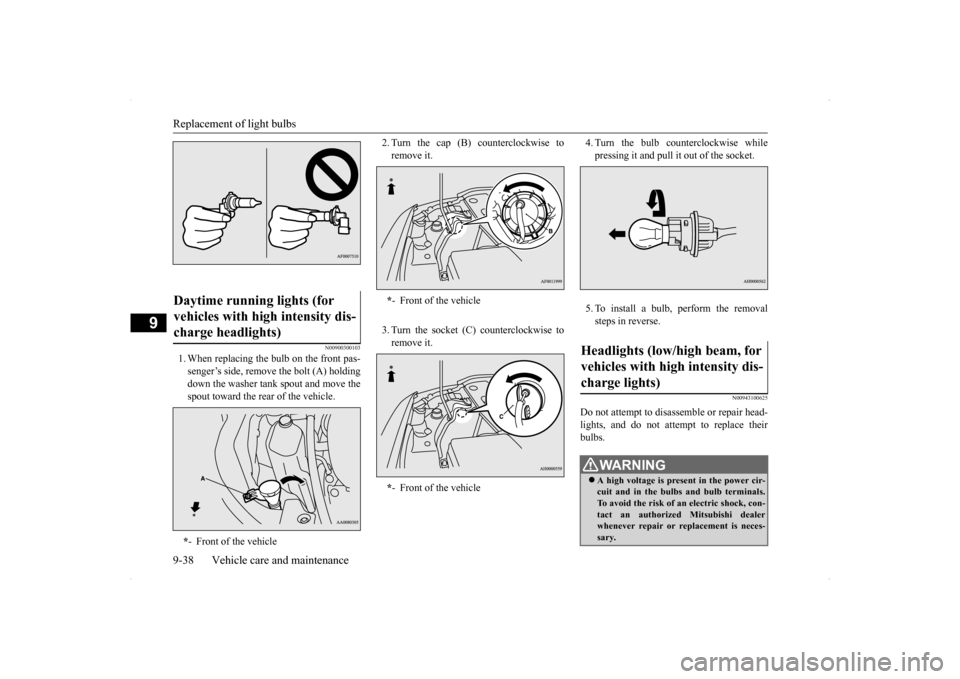
1. When replacing the bulb on the front pas- senger’s side, remove the bolt (A) holdingdown the washer tank spout and move thespout toward the rear of the vehicle.
2. Turn the cap (B) counterclockwise to remove it. 3. Turn the socket (C) counterclockwise to remove it.
4. Turn the bulb counterclockwise while pressing it and pull it out of the socket. 5. To install a bulb, perform the removal steps in reverse.
N00943100625
Do not attempt to disassemble or repair head- lights, and do not attempt to replace their bulbs.
Daytime running lights (for vehicles with high intensity dis- charge headlights) * - Front of the vehicle
*- Front of the vehicle * - Front of the vehicle
Headlights (low/high beam, for vehicles with high intensity dis- charge lights)
WA R N I N G A high voltage is present in the power cir- cuit and in the bulbs and bulb terminals. To avoid the risk of an electric shock, con-tact an authorized Mitsubishi dealer whenever repair or replacement is neces- sary.
Page 398 of 434

Replacement of light bulbs
Vehicle care and maintenance 9-39
9
N00943200121
The alignment of the headlights should be checked by an authorized Mitsubishi Motorsdealer or a repair facility of your choice.
N00917300512
1. For vehicles equipped with turbocharger, when replacing the bulb on the driver’s side, remove the bolt (A) holding downthe relay box and move the relay box toward the rear of the vehicle.
2. For vehicles equipped with turbocharger, when replacing the bulb on the passen- ger’s side, lift up the engine coolant reser- voir (B). 3. Turn the socket (C) counterclockwise to remove it.
4. Pull the bulb out of the socket. 5. To install the bulb, perform the removal steps in reverse.
N00917300538
1. To create enough work space, turn the steering wheel all the way in the direction opposite to the side you wish to replace.
Adjustment of headlight aim Parking and side-marker lights (except for vehicles with high intensity discharge headlights) * - Front of the vehicle
*- Front of the vehicle * - Front of the vehicle
Parking and side-marker lights (for vehicles with high intensity discharge headlights)