2014 MITSUBISHI LANCER lights
[x] Cancel search: lightsPage 119 of 434

Inside day/night rearview mirror 5-52 Features and controls
5
It is possible to move
the mirror up and down
to adjust its position. It is possible to move the mirror up/down and left/right to adjust its position.
The day/night knob (A) at the bottom of the mirror can be used to adjust the mirror toreduce the glare from the headlights of vehi-cles behind you during night driving.
To adjust the vertical mirror position To adjust the mirror position
To reduce the glare Ty p e 1
1- Daytime position 2- Night position
Page 120 of 434

Outside rearview mirrors
Features and controls 5-53
5
When the headlights of the vehicles behind you are very bright, the reflection factor ofthe rearview mirror is automatically changed to reduce the glare. Normally, use the automatic mode. When the ignition switch is turned to the “ON” posi-tion, the reflection fact
or of the mirror is
automatically changed.
N00512200192
Adjust the outside rearview mirrors only after making any seat adjustments so you have aclear view to the rear of the vehicle.
The outside rearview mirrors can be adjusted when the ignition switch is in the “ON” or “ACC” position.Move the lever (A) to the same side as the mirror you wish to adjust. Press the switch (B) to adjust the mirror posi- tion.
Ty p e 2
NOTE
Do not hang items on, or spray glass cleaner on the sensor (1), as reduced sensitivitycould result.
Outside rearview mirrors
WA R N I N G Do not attempt to adjust the outside rear- view mirrors while driving. This can be dangerous.Be sure to adjust the mirrors before driv- ing. Your passenger’s side mirror is convex. The objects you see in the mirror will look smaller and farther away than theyappear in a regular flat mirror. Do not use this mirror to estimate the dis- tance of vehicles following you whenchanging lanes.
To adjust the mirror position L- Left outside mirror adjustment R- Right outside mirror adjustment 1- Up 2- Down 3- Right4- Left
Page 125 of 434

Starting and stopping the engine 5-58 Features and controls
5
6. On vehicles with manual transaxle, place the gearshift lever in the “N” (Neutral) position. On vehicles with continuously variabletransmission (CVT) or Twin Clutch SST, make sure the selector lever (CVT) or gearshift lever (Twin Clutch SST) is in the“P” (PARK) position. 7. Turn the ignition switch to the “ON” posi- tion and make certain that all warning lights are functioning properly beforestarting the engine. 8. Turn the ignition switch to the “START” position without pressing the acceleratorpedal. Release the key when the engine starts.
After several attempts, you may experience that the engine still does not start. 1. Make sure that all electric devices, such as lights, air conditioning blower and rear window defogger, are turned off. 2. While depressing the brake pedal on vehi-cles equipped with continuously variable transmission (CVT) or Twin Clutch SST or the clutch pedal on the vehiclesequipped with manual transaxle, press the accelerator pedal halfway and hold it there, then crank the engine. Release theaccelerator pedal, immediately after the engine starts.
3. If the engine still will not start, the engine could be flooded with too much gasoline. While depressing the brake pedal on vehi- cles equipped with CVT or Twin ClutchSST or the clutch pedal on the vehicles equipped with manual transaxle, push the accelerator pedal all the way down andhold it there, then crank the engine for 5 to 6 seconds. Return the ignition switch to the “LOCK” position and release theaccelerator pedal. Wait a few seconds, andthen crank the engine again for 5 to 6 sec- onds while depressing the brake pedal or the clutch pedal, but do not push theaccelerator pedal. Release the ignition key if the engine starts. If the engine fails to start, repeat these procedures. If theengine still will not start, contact your local Mitsubishi Motors dealer or a repair facility of your choice for assistance.
When the ambient temperature is -4 °F (-20 °C) or lower on vehicles with CVT, or -22 °F (-30 °C) or lower on vehicles with TwinClutch SST, it may not be possible to start
NOTE
On vehicles with CVT, the starter will not operate unless the selector lever is in the “P”(PARK) or “N” (NEUTRAL) position. On vehicles with Twin Clutch SST, the starter will not operate unless the gearshiftlever is in the “P” (PARK) position or the gearshift lever is in the “N” (NEUTRAL) position with the brake pedal depressed.For safety reasons, start the engine in the “P” (PARK) position so that the wheels are locked.
NOTE
Minor noises may be heard on engine start- up. These will disappear as the engine warms up.
When the engine is hard to start
Startability of continuously vari- able transmission (CVT) vehicles or Twin Clutch SST vehicles at extremely cold ambient tempera- ture
Page 137 of 434
Continuously variable transm
ission (CVT) (if so equipped)
5-70 Features and controls
5
N00514500287
N00514900063
To gain extra acceleration in “D” (DRIVE) position (when passing another vehicle) push the accelerator to the floor if it is safe to do so in traffic conditions. The CVT will automati-cally downshift.
N00515000074
For short waiting periods, such as at traffic lights, the vehicle can be left in selector lever position and held stationary with the servicebrake.
For longer waiting periods with the engine running, the selector lever should be placed in the “N” (NEUTRAL) position.
N00515100062
To park the vehicle, first bring it to a com- plete stop, fully engage the parking brake,and then move the selector lever to the “P” (PARK) position. If you are going to l
eave the vehicle unat-
tended, always switch off the engine and carry the key.
Operation of the CVT
CAUTION Before selecting a position with the engine running and the vehicle stationary, fully depress the brake pedal to prevent the vehi- cle from creeping.Do not release the brakes until you are ready to drive away. The vehicle will begin to move as soon as the CVT is engaged, espe-cially when the engine speed is high (fast idle or air conditioning on). Depress the brake pedal with the right foot. Using the left foot could cause driver move- ment delay in case of an emergency. To prevent sudden acceleration, never run the engine at high rpms when shifting fromthe “P” (PARK) or “N” (NEUTRAL) posi- tion. Operating the accelerator pedal while the other foot is resting on the brake pedal will affect braking efficiency and may cause pre-mature wear of brake pads. Use the selector lever in the correct shift position in accordance with driving condi- tions. Never coast downhill backward in the driv- ing shift position { “D” (DRIVE), “L” (LOW) or sports mode} or coast forward inthe “R” (REVERSE) position. Engine stopping and increased brake pedal and steering effort could lead to an accident.
Do not rev the engine with the brake pedal pressed when the vehicle is stationary. This can damage the CVT. Also, when you depress the accelerator pedal while holding down the brake pedal with theselector lever in the “D” (DRIVE) position, the engine revolutions may not rise as high as when performing the same operation withthe selector lever in the “N” (NEUTRAL) position.
Passing acceleration
NOTE
In sports mode, downshifts do not take place when the accelerator is depressed all the way to the floor.
Wa i t i n g
CAUTION
CAUTION To avoid transmission overheating, never try to keep your vehicle stationary on a hill by using the accelerator pedal. Always apply the parking brake and/or service brake. Unexpected acceleration may occur if the selector lever is in a position other than “P”(PARK) or “N” (NEUTRAL). Before driving off from a stop, make sure that the selector lever is in “D” (DRIVE)position or “Sports mode” position.
Parking
Page 148 of 434

Twin Clutch SST (Sportronic Shif
t Transmission) (if so equipped) Features and controls 5-81
5
N00540900019
To gain extra acceleration in “D” (DRIVE) position (when passing another vehicle) pushthe accelerator to the floor
if it is safe to do so
in traffic conditions. The Twin Clutch SST will automatically downshift.
N00541600039
The Twin Clutch SST may not upshift to a higher shift position if the computer deter- mines the current speed
cannot be maintained
once a higher shift position is engaged. For smoother vehicle performance, if you release the throttle while climbing a steep grade, the Twin Clutch SST may not upshift.This is normal, as the
computer is temporarily
preventing shifting. After reaching the top of the hill, normal shift function will resume.
When traveling down steep grades, the com- puter may automatically select a lower shift position. This function assists engine brakingefforts, reducing the need for using the ser- vice brakes.
N00541000033
For short waiting periods, such as at trafficlights, the vehicle can be left in gearshift
Do not rev the engine with the brake pedal pressed when the vehicle is stationary. This can cause sudden acceleration and dam- age the Twin Clutch SST. Also, when you depress the accelerator pedalwhile holding down the brake pedal with the gearshift lever in th
e “D” (DRIVE) position,
the engine revolutions may not rise as highas when performing the same operation with the gearshift lever in the “N” (NEUTRAL) position.
Passing acceleration
NOTE
In manual shift, downshifts do not take place when the accelerator is depressed all the way to the floor.CAUTION
Uphill/downhill driving
DRIVING UPHILL
CAUTION Do not use the tendency of the vehicle to creep forward in order to drive at low speedsup hills. The transmission may be damaged and an accident may occur due to the following con-ditions.• The Twin Clutch SST fluid temperaturewill rise and can cause transmission dam- age.
• If the vehicle is continuously driven at lowspeeds using the tendency of the vehicle to creep forward, the vehicle will vibrate or the warning display will appear on the information screen in the multi-information display to alert the driver that the Twin Clutch SST fluid temperature has risen.After that, if the Twin Clutch SST fluid temperature rises even higher, the transmis- sion protection control will operate.If this occurs, the vehicle may suddenly reverse as if the gearshift lever was in the “N” (NEUTRAL) position and cause an accident. If the warning display appears or the transmission protection control operates, refer to “When warning display is showing” on page 5-74.
DRIVING DOWNHILLWaiting
CAUTION
Page 165 of 434

Power steering system 5-98 Features and controls
5
N00546300015 N00518000310
The power steering system operates while the engine is running. It helps reduce the effort needed to turn the steering wheel. The power steering system has mechanicalsteering capability in case the power assist is lost. If the power assist is lost for some rea- son, you will still be able to steer your vehi-cle, but you will notice it takes much more effort to steer. If this happens, have your vehi- cle inspected at an authorized MitsubishiMotors dealer or a repair facility of your choice.
N00547100052
N00547200053
Ty p e 1
To w i n g
CAUTION When towing the vehicle with only the front wheels or only the rear wheels raised off the ground, do not place the ignition switch in the “ON” position. Placing the ignitionswitch in the “ON” position could cause the ASC to operate, resulting in an accident. Note that the correct towing method dependson the transmission type and the vehicle’s drive configuration. For details, refer to
“Towing” on page 8-14.
Power steering system
WA R N I N GDo not stop the engine while the vehicle is moving. Stopping the engine would make the steering wheel extremely hard to turn, possibly resulting in an accident.
Hydraulic power steering sys- tem (HPS)
(if so equipped)
CAUTION Do not leave the steering wheel turned all the way in one direction. This can cause damage to the power steering system.
Electric power steering system (EPS)
(if so equipped)NOTE
During repeated full-lock turning of the steering wheel (for example, while you are manoeuvring the vehicle into a parkingspace), a protection function may be acti- vated to prevent overheating of the power steering system. This function will make thesteering wheel gradually harder to turn. In this event, limit your
turning of the steering
wheel for a while. When the system hascooled down, the steering effort will return to normal. If you turn the steering wheel while the vehi- cle is stationary with the headlights on, the headlights may become dim. This behavioris not abnormal. The headlights will return to their original brightness after a short while.
Electronic power steering system warning display
Page 177 of 434

Instrument cluster 5-110 Features and controls
5
N00519000333
N00519100190
The speedometer shows the vehicle speed in miles per hour (mph) or kilometers per hour (km/h).
CAUTION The reference lines for distance and vehicle width are intended to indicate the distance to a flat object such as a level, flat road surface. They may not indicate correct distance depending on the shape of an obstacle.For example, when there is an object behind the vehicle that has upper sections projecting in the direction of the vehicle, the referencelines on the screen will indicate that point A is the farthest point a
nd point B is the closest
point to the vehicle. In reality, point A and Bare actually the same distance from the vehi- cle, and point C is farther off than point A and B.NOTE
Monitor brightness is adjusted automatically by sensors.
On vehicles equipped with Mitsubishi Multi- Communication System, it is possible to change the display language of the screen. For details, please refer to the separate owner’s manual. Under certain circumstances, it may become difficult to see an image on the screen, evenwhen the system is functioning correctly. • In a dark area, such as at night. • When water drops or condensation are on the lens. • When sun light or headlights shine directly into the lens.
Instrument cluster 1- Tachometer
P.5-111
2- Multi-information display
P.5-112
Information screen display list P.5-134NOTE
3- Speedometer
P.5-110
4- Rheostat meter illumination button
P.5-111
Speedometer Type 1Type 2
Page 178 of 434
Instrument cluster
Features and controls 5-111
5
N00519200276
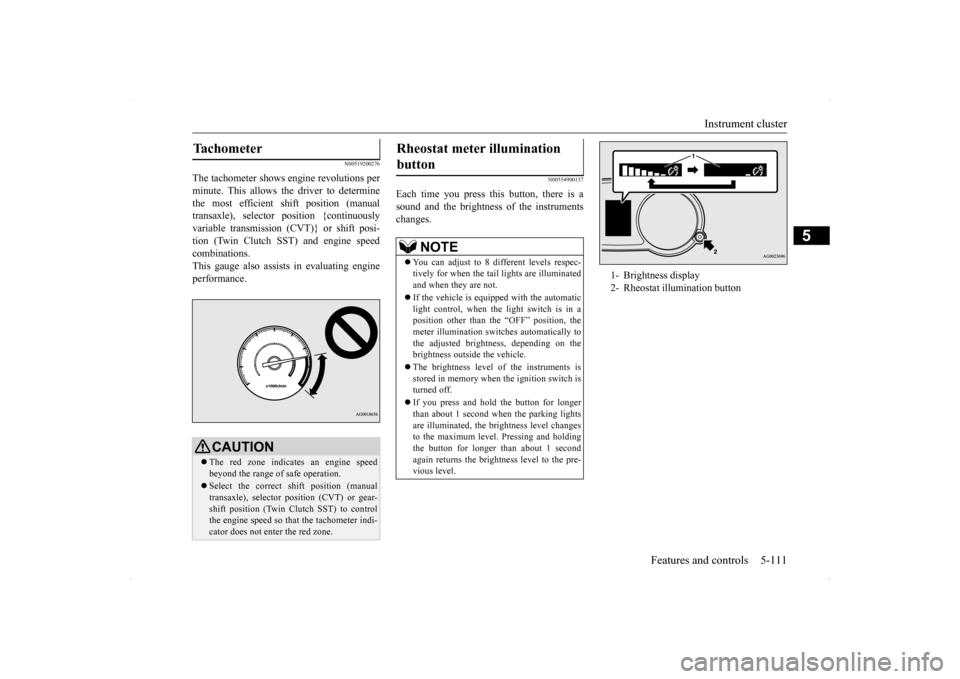
The tachometer shows engine revolutions per minute. This allows the driver to determinethe most efficient shift position (manual transaxle), selector position {continuously variable transmission (CVT)} or shift posi-tion (Twin Clutch SST) and engine speed combinations. This gauge also assists in evaluating engineperformance.
N00554900137
Each time you press this button, there is asound and the brightness of the instruments changes.
Tachometer
CAUTION The red zone indicates an engine speed beyond the range of safe operation. Select the correct shift position (manual transaxle), selector position (CVT) or gear- shift position (Twin Clutch SST) to control the engine speed so that the tachometer indi-cator does not enter the red zone.
Rheostat meter illumination button
NOTE
You can adjust to 8 different levels respec- tively for when the tail
lights are illuminated
and when they are not. If the vehicle is equipped with the automatic light control, when the light switch is in a position other than the “OFF” position, themeter illumination switches automatically to the adjusted brightness, depending on the brightness outside the vehicle. The brightness level of the instruments is stored in memory when the ignition switch isturned off. If you press and hold the button for longer than about 1 second when the parking lights are illuminated, the brightness level changes to the maximum level. Pressing and holdingthe button for longer than about 1 second again returns the brightness level to the pre- vious level.
1- Brightness display 2- Rheostat illumination button