2014 MITSUBISHI LANCER EVOLUTION lock
[x] Cancel search: lockPage 113 of 338
![MITSUBISHI LANCER EVOLUTION 2014 10.G Owners Manual Steering wheel lock 5-52 Features and controls
5
N00512500010
[For vehicles equipped with the F.A.S.T.- key]For information on operations for vehiclesequipped with the F.A.S.T.-key, refer to “F.A.S.](/manual-img/19/7475/w960_7475-112.png "MITSUBISHI LANCER EVOLUTION 2014 10.G Owners Manual Steering wheel lock 5-52 Features and controls
5
N00512500010
[For vehicles equipped with the F.A.S.T.- key]For information on operations for vehiclesequipped with the F.A.S.T.-key, refer to “F.A.S.")
Steering wheel lock 5-52 Features and controls
5
N00512500010
[For vehicles equipped with the F.A.S.T.- key]For information on operations for vehiclesequipped with the F.A.S.T.-key, refer to “F.A.S.T.-key: Steering wheel lock” on page 5-19. [Except for vehicles equipped with the F. A . S . T. - k e y ]
Remove the key at the “LOCK” position. Turn the steering wheel until it is locked. Turn the key to the “ACC” position while moving the steering wheel slightly.
NOTE
For vehicles with a Twin Clutch SST, the key cannot be removed unless the gearshift lever is set to the “P” (PARK) position, whichallows the ignition switch to turn to the “LOCK” position.CAUTION Do not remove the ignition key from the ignition switch while driving. The steering wheel will lock, causing loss of control. If the engine is turned off while driving, the power brake booster will stop functioning and braking efficiency will be reduced. Also,the power steering system will not function and it will require greater effort to manually steer the vehicle. Do not leave the key in the “ON” position for a long time when the engine is not running.This will cause the battery to run down.Twin Clutch SST
Do not turn the key to the “START” position when the engine is running. It will damage the starter motor.
Steering wheel lock
CAUTION
To l o c k To u n l o c k
CAUTION Remove the key when leaving the vehicle.NOTE
If the front wheels are turned, the anti-theft lock may sometimes make it difficult to turn the key from “LOCK” position to “ACC” position. Firmly turn the steering wheel tothe left or to the right as you turn the key.
BK0200800US.bo
ok 52 ページ 2013年2月14日 木曜日 午後2時28分
Page 114 of 338

Starting and stopping the engine Features and controls 5-53
5
N00542100073
Do not operate the starter motor continu- ously for longer than
15 seconds as this
could run the battery down or damage thestarter motor. If the engine does not start,turn the ignition switch back to the “LOCK” position, wait a few seconds, and then try again. Trying repeatedly withthe engine or starter motor still turning will damage the starter mechanism. If the engine will not start because the bat- tery is weak or discharged, refer to “Jump-starting the engine” (on page 8-2) for instructions. The engine is warmed up enough for driv- ing when the bar graph of engine coolant temperature display starts to move. Driv-ing before the bar graph moves may cause deterioration of turbocharger performance and driveability. A longer warm up periodwill only consume extra fuel. On vehicles equipped with the Twin Clutch SST, the following may occur afterthe engine is started, but they do not indi- cate an abnormality.
• You may hear operational sounds of the Twin Clutch SST and you may feel vibration in the vehicle body. • If you shift the gearshift lever into the“N” (NEUTRAL) position and depress the accelerator pedal, increases in the engine speed will be limited.
N00542200133
[For vehicles equipped with the F.A.S.T.-key]
For information on operation for vehicles equipped with the F.A.S.T.-key, refer to “F.A.S.T.-key: Starting the engine” on page 5-19. [Except for vehicles equipped with the F. A . S . T. - k e y ] Your vehicle is equipped with an electroni- cally controlled fuel injection system, whichautomatically controls the release of fuel. There is usually no need to depress the accel- erator pedal when starting the engine.The starter should not be run for more than 15seconds at a time. To prevent battery drain, wait a few seconds between attempts to restart the engine. 1. Make sure all occupants are properly seated with seat belts fastened. 2. Insert the ignition key. 3. Make sure the parking brake is applied.4. Press and hold the brake pedal down with your right foot. 5. Press and hold the clutch pedal all the waydown (manual transaxle).
Starting and stopping the engine Tips for starting
WA R N I N G Never run the engine in a closed or poorly ventilated area any longer than is neededto move your vehicle out of the area. Car- bon monoxide gas, which is odorless and extremely poisonous, could build up andcause serious injury or death.CAUTION Do not push-start the vehicle.Do not run the engine
at high rpms or drive
at high speeds until the engine has had a chance to warm up. Release the ignition switch as soon as the engine starts. Otherwise, the starter motorwill be damaged.
Starting the engine
NOTE
For models equipped with a manual trans- axle, the starter will not operate unless the clutch pedal is fully depressed (Clutch inter-lock). This is a safety feature.
BK0200800US.bo
ok 53 ページ 2013年2月14日 木曜日 午後2時28分
Page 115 of 338

Starting and stopping the engine 5-54 Features and controls
5
6. On vehicles with manual transaxle, place the gearshift lever in the “N” (Neutral) position. On vehicles with Twin Clutch SST, makesure the gearshift lever is in the “P” (PARK) position. 7. Turn the ignition switch to the “ON” posi- tion and make certain that all warninglights are functioning properly before starting the engine. 8. Turn the ignition switch to the “START”position without pressing the accelerator pedal. Release the key when the engine starts.
After several attempts, you may experience that the engine still does not start.
1. Make sure that all electric devices, such as lights, air conditioning blower and rear window defogger, are turned off. 2. While depressing the brake pedal on vehi-cles equipped with Twin Clutch SST or the clutch pedal on the vehicles equipped with manual transaxle, press the accelera-tor pedal halfway and hold it there, then crank the engine. Release the accelerator pedal, immediately after the engine starts.3. If the engine still will not start, the enginecould be flooded with too much gasoline. While depressing the brake pedal on vehi- cles equipped with Twin Clutch SST orthe clutch pedal on the vehicles equipped with manual transaxle, push the accelera- tor pedal all the way down and hold itthere, then crank the engine for 5 to 6 sec- onds. Return the ignition switch to the “LOCK” position and release the acceler-ator pedal. Wait a few seconds, and then crank the engine again for 5 to 6 seconds while depressing the brake pedal or theclutch pedal, but do not push the accelera- tor pedal. Release the ignition key if the engine starts. If the engine fails to start,repeat these procedures. If the engine still will not start, contact your local Mitsubi- shi Motors dealer or a repair facility ofyour choice for assistance.
When the ambient temperature is -22 °F (-30 °C) or lower, it may not be possible to start from a standstill even with the gearshift lever in the “D” (DRIVE) position.This phenomenon occurs because the trans- mission has not warmed up sufficiently; it does not indicate a problem. If it occurs,place the gearshift lever in the “P” (PARK)position and let the engine idle for at least 10 minutes. The transmission will warm up, and you willbe able to start normally. Do not leave the vehicle during warm-up operation.
N00547600031
At high altitude locations, the idle speed maybe higher. This is done in order to stabilizethe idle speed when the power steering sys- tem and other systems operate. It does not indicate a malfunction.
N00542300075
1. Bring the vehicle to a complete stop.
NOTE
On vehicles with Twin Clutch SST, the starter will not operate unless the gearshift lever is in the “P” (PARK) position or thegearshift lever is in the “N” (NEUTRAL) position with the brake pedal depressed. For safety reasons, start the engine in the “P”(PARK) position so that the wheels are locked.
When the engine is hard to start
Startability of Twin Clutch SST vehicle with ambient temperature of -22 °F (-30 °C) or lower Idle speed in high altitude area Stopping the engine
BK0200800US.bo
ok 54 ページ 2013年2月14日 木曜日 午後2時28分
Page 116 of 338

Turbocharger operation
Features and controls 5-55
5
2. Fully engage the parking brake while depressing the brake pedal. 3. For vehicles with a manual transaxle, turn the ignition switch to the “LOCK” posi-tion to stop the engine, and then move the gearshift lever to the 1st (on a uphill) or “R” (Reverse) (on a downhill) position.For vehicles with Twin Clutch SST, place the gearshift lever in the “P” (PARK) position, and then turn the ignition switchto the “LOCK” position to stop theengine.
N00537300077
NOTE
For vehicles with Twin Clutch SST, the engine will stop and the vehicle power will turn off approximately 1 second after the ignition switch is turned to the “LOCK” position. The reason for this is that, in the time from when the ignition switch is turned to the“LOCK” position until the engine stops, the gears inside the Twin Clutch SST disengage so that the engine will start smoothly thenext time it is started. Two clutches installed in the Twin Clutch SST alternately engage and disengage toachieve smooth shifting. In addition, the gear on the side with the free clutch is engaged, therefore, quick shifting isperformed. If the engine was stopped with the gear engaged like this, it would provide resistancethe next time the engine is started. Therefore, the gear disengages in the approximately 1- second period until the engine stops. For vehicles with Twin Clutch SST, do not operate the gearshift lever or the acceleratorpedal for approximately 1 second until the engine stops.
If the temperature inside the engine compart- ment is high, the cooling fans (A) will con- tinue to operate for some time even if the engine is stopped. Therefore, the operation sound of the coolingfans may be heard even after the engine is stopped. This sound is normal and does not indicate a malfunction.After operating for a period of time, the cool- ing fans will stop automatically.
Turbocharger operation
CAUTION Do not run the engine at high speeds (for example, by revving it or by accelerating rapidly) immediately after starting it.NOTE
BK0200800US.bo
ok 55 ページ 2013年2月14日 木曜日 午後2時28分
Page 119 of 338
Twin Clutch SST (Sportronic Shif
t Transmission) (if so equipped)
5-58 Features and controls
5
N00513100156
The table below shows the maximum rec- ommended driving speed for in each gear.Do not drive near or at these speeds forprolonged periods of time. Do not use the gearshift lever as a han- drest. This can result in premature wear of the transaxle shift forks.
N00539700017
The Twin Clutch SST is a transmission that, through integrated control of the engine and transmission, is able to achieve both the smooth shifting of an automatic transaxle andthe acceleration and fuel economy close to amanual transaxle. In addition, the control mode can be selected from three types to suit the driving conditions.Together with manual shifting, the transmis- sion is capable of responding to a variety of driving circumstances. Twin Clutch SST control mode
P.5-62
Manual shift
P.5-64
N00539800063
As an additional safety precaution, models equipped with a Twin Clutch SST have a shift-lock device that holds the gearshift lever in the “P” (PARK) position. To move thegearshift lever from the “P” (PARK) position to another position, follow the steps below. 1. Press and hold the brake pedal down.
2. Move the gearshift lever to the desired position.
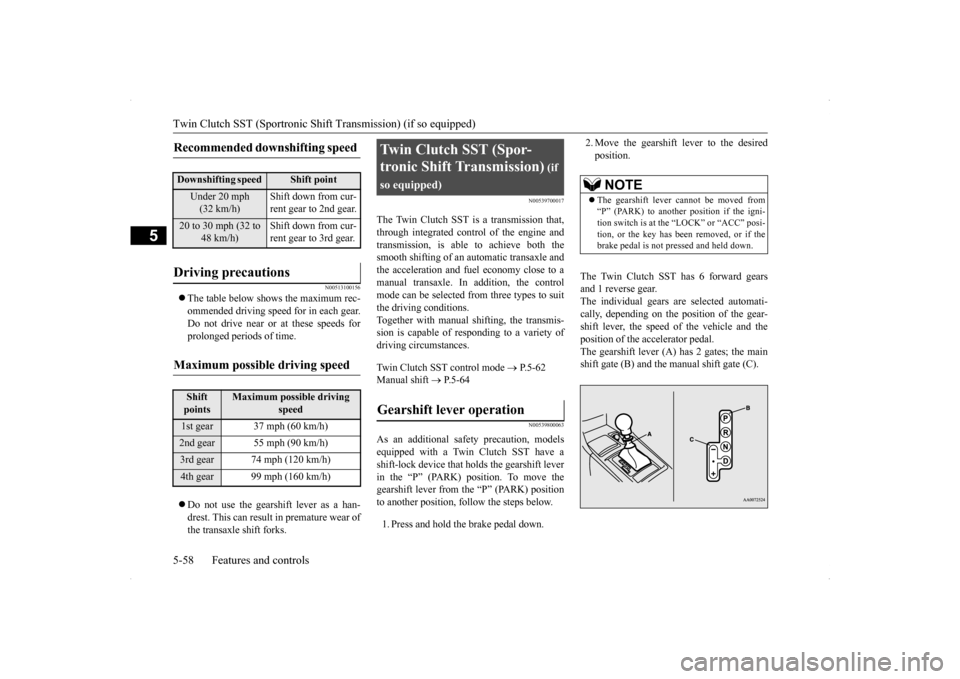
The Twin Clutch SST has 6 forward gears and 1 reverse gear.The individual gears are selected automati- cally, depending on the position of the gear- shift lever, the speed of the vehicle and theposition of the accelerator pedal. The gearshift lever (A) has 2 gates; the main shift gate (B) and the manual shift gate (C).
Recommended downshifting speed
Downshifting speed
Shift point
Under 20 mph (32 km/h)
Shift down from cur- rent gear to 2nd gear.
20 to 30 mph (32 to
48 km/h)
Shift down from cur- rent gear to 3rd gear.
Driving precautions
Maximum possible driving speed
Shift points
Maximum possible driving
speed
1st gear 37 mph (60 km/h)2nd gear 55 mph (90 km/h)3rd gear 74 mph (120 km/h)4th gear 99 mph (160 km/h)
Twin Clutch SST (Spor- tronic Shift Transmission)
(if
so equipped)Gearshift lever operation
NOTE
The gearshift lever cannot be moved from “P” (PARK) to another position if the igni- tion switch is at the “LOCK” or “ACC” posi-tion, or the key has been removed, or if the brake pedal is not pressed and held down.
BK0200800US.bo
ok 58 ページ 2013年2月14日 木曜日 午後2時28分
Page 123 of 338

Twin Clutch SST (Sportronic Shif
t Transmission) (if so equipped)
5-62 Features and controls
5
N00540100040
This position locks the transmission to pre- vent the vehicle from moving. The engine can be started from the “PARK” position. Move the lever to this position only after the vehicle has come to a complete stop. At this position, the transmission is disen- gaged. It is the same as the neutral position on a manual transaxle and should be used whenthe vehicle is not moving for an extended
length of time during driving, such as in a traffic jam. This position is used for most city and high- way driving. Engine shifting and braking are done automatically as needed, depending onroad conditions.
N00540200083
Select the control mode from the following three types to suit the driving conditions.
Gearshift lever positions (Main shift gate)
“P” PARK
“R” REVERSE
CAUTION Never shift into the “P” (PARK) or “R” (REVERSE) position while
the vehicle is in
motion. If the lever is shifted into the “P” (PARK) or “R” (REVERSE) position whilethe vehicle is in motion, the transmission may be damaged.
“N” NEUTRAL
WA R N I N G Never move the gearshift lever to the “N” (NEUTRAL) position while driving since you could accidentally slip it into the “P”(PARK) or “R”(REVERSE) position and the engine speed could rise, damaging the transmission. To prevent the vehicle from rolling when stopped on a slope, the engine should bestarted in the “P” (PARK) position. Although the engine can be started when the vehicle is in the “N” (NEUTRAL) posi-tion, for safety reasons, do not start the engine in the “N” (NEUTRAL) position. Always keep your foot on the brake pedal when the vehicle is in “N” (NEUTRAL) position, or when shifting into or out of“N” (NEUTRAL) position, to prevent roll- ing.
“D” DRIVE
CAUTION Never shift into the “D” (DRIVE) position from the “R” (REVERSE) position while the vehicle is in motion. If the lever is shifted into the “D” (DRIVE) from the “R” (REVERSE) position while thevehicle is in motion, the transmission may be damaged.NOTE
For information on manual shift gate opera- tion, please refer to “Manual shift” on page 5-64. When the engine is cold, upshifts occur at a higher vehicle speed than when the engine is warm.This control is performed to quickly warm up the engine. It does not indicate a malfunc- tion. After the vehicle
has been driven for a
while, upshifts will occur at the regular engine speeds.
Twin Clutch SST control mode
BK0200800US.bo
ok 62 ページ 2013年2月14日 木曜日 午後2時28分
Page 125 of 338

Twin Clutch SST (Sportronic Shif
t Transmission) (if so equipped)
5-64 Features and controls
5
N00540300013
When the ignition switch is set to the “ON” position, operate the Twin Clutch SST control mode switch (A) to change the control mode. When the engine is started, the control mode is automatically set to the “Normal” mode. Use the following procedures to change the control mode. While the vehicle is stopped or being driven, push the Twin Clutch SST control modeswitch forward.
While the vehicle is stopped, push the Twin Clutch SST control mode switch forward and hold it for 3 seconds or more. While the vehicle is stopped or being driven, push the Twin Clutch SST control modeswitch rearward.
N00540400098
When the ignition switch is set to the “ON” position, the currently selected control mode is displayed on the multi-information display.
N00540500057
Using the gearshift lever (A) or the sportronic steering wheel shifters (B), shifting can be performed manually.
Twin Clutch SST control mode switch
To shift from “Normal” mode to “Sport” mode
To shift from “Sport” mode to “S-Sport” mode
CAUTION For safety reasons, shift from the “Sport” mode to the “S-Sport”
mode only when the
vehicle is stopped.
To shift from “S-Sport” mode to “Sport” mode or To shift from “Sport” mode to “Normal” mode
NOTE
If the Twin Clutch SST control mode switch is continuously pressed after a control mode has been selected, an erroneous operation prevention function operates and the control mode is automatically set to the “Normal” mode.If you would like to select a control mode again, return the ignition switch to the “ACC” or “LOCK” position and restart theengine. Then, push the Twin Clutch SST control mode switch.
Twin Clutch SST control mode display
Manual shift
BK0200800US.bo
ok 64 ページ 2013年2月14日 木曜日 午後2時28分
Page 132 of 338
S-AWC (Super-All Wheel Control)
Features and controls 5-71
5
N00541300036
S-AWC is an integrated vehicle dynamics control system that helps enhance drivingperformance, cornering performance, and vehicle stability over a wide range of driving conditions through integrated management ofthe ACD, the AYC, the anti-lock braking sys- tem, and the active stability control (ASC).
Please read this section in conjunction with the following sections. ACD (Active center differential system)
P.5-71AYC (Active yaw control system)
P.5-72
Anti-lock braking system
P.5-74
Active stability control (ASC)
P.5-76
N00541400011
The ACD is a system
that improves accelera-
tion performance and straight-ahead stabilityby regulating the differential limiting action
CAUTION Always use tires of the same size, same type, and same brand, and which have no wear dif- ferences. Using tires that differ in size, type, brands or the degree of wear, will increase the differential oil temperature, resulting inpossible damage to the driving system. Fur- ther, the drive train will be subjected to excessive loading, possibly leading to oilleakage, component seizure, or other serious problems.
To w i n g
CAUTION Do not tow all-wheel dr
ive vehicles with the
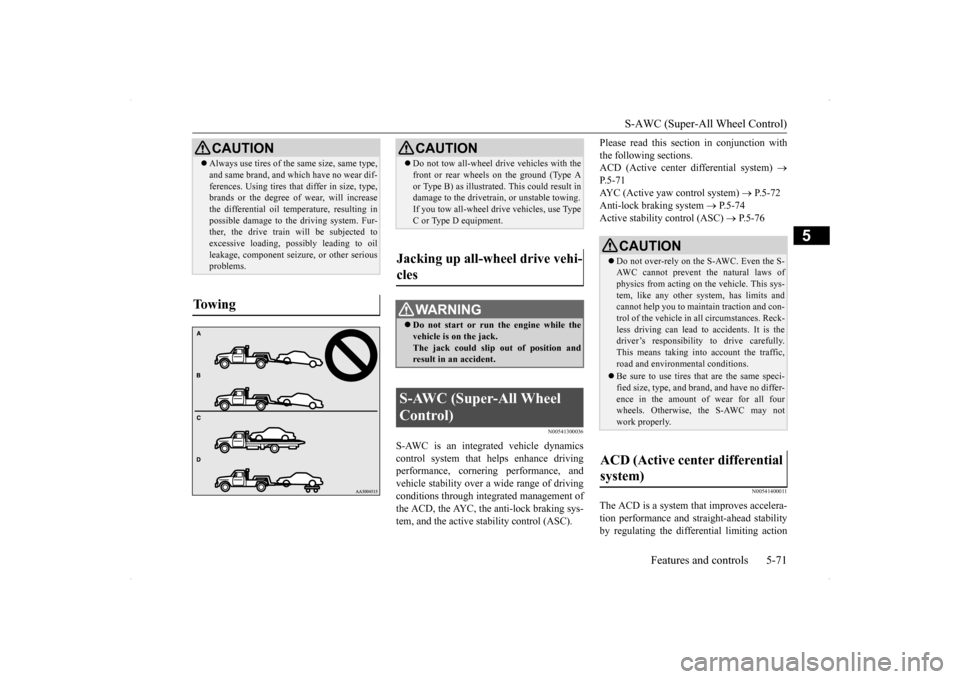
front or rear wheels on the ground (Type A or Type B) as illustrated. This could result in damage to the drivetrain, or unstable towing. If you tow all-wheel drive vehicles, use TypeC or Type D equipment.
Jacking up all-wheel drive vehi- cles
WA R N I N G Do not start or run the engine while the vehicle is on the jack. The jack could slip out of position andresult in an accident.
S-AWC (Super-All Wheel Control)
CAUTION Do not over-rely on the S-AWC. Even the S- AWC cannot prevent the natural laws ofphysics from acting on the vehicle. This sys- tem, like any other system, has limits and cannot help you to maintain traction and con-trol of the vehicle in all circumstances. Reck- less driving can lead to accidents. It is the driver’s responsibility to drive carefully.This means taking into account the traffic, road and environmental conditions. Be sure to use tires that are the same speci- fied size, type, and brand, and have no differ- ence in the amount of wear for all fourwheels. Otherwise,
the S-AWC may not
work properly.
ACD (Active center differential system)
BK0200800US.bo
ok 71 ページ 2013年2月14日 木曜日 午後2時28分