2014 MITSUBISHI LANCER EVOLUTION door lock
[x] Cancel search: door lockPage 263 of 338

How to change a tire 8-6 For emergencies
8
N00836900763
Before changing a tire, first stop your vehicle in a safe, flat location. 1. Park the vehicle on level and stable ground. 2. Set the parking brake firmly.3. On vehicles with manual transaxle, turn the ignition switch to the “LOCK” posi- tion, and move the gearshift lever to the“R” (Reverse) position. On vehicles with Twin Clutch SST, move the gearshift lever to the “P” (PARK)position, and turn the ignition switch to the “LOCK” position. 4. Turn on the hazard flashers and set up awarning triangle, flashing signal light, etc., at an adequate distance from the vehicle, and have all your passengersleave the vehicle.
5. To prevent the vehicle from rolling when it is raised on the jack, place chocks or blocks (A) at the tire that is diagonally opposite from the tire (B) you are chang-ing.
6. Get the jack, bar and wheel nut wrench ready. Refer to “Tools and jack” on page 8-5.
N00849600328
The compact spare tire is designed to save space in the trunk. Its lighter weight makes it easier to use if a flat tire occurs.
How to change a tire
WA R N I N G The jack should not be used for any pur- pose other than to change a tire. Never get under the vehicle or put any portion of your body under the vehicle while it is supported by the jack.
WA R N I N G Be sure to apply chocks or blocks to the correct tire when jacking up the vehicle. Ifthe vehicle moves while jacked up, the jack could slip out of position, leading to an accident.NOTE
The chocks shown in the illustration do not come with your vehicle. It is recommended that you purchase chocks or blocks and keepthem in the vehicle for use if needed. If chocks or blocks are not available, use stones or any other objects that are large enough to hold the wheel in position.
Spare tire information Compact spare tire
WA R N I N G Tires, including spare tire, degrade over time with age even when they are notbeing used. It is recommended that tires over 6 years generally be replaced even if damage is not obvious.CAUTION While the compact spare tire is stowed, the inflation pressure should be checked at least once a month to assure that it remains at the recommended inflation pressure. See the tire and loading information placard attached tothe driver’s door sill. Refer to “Tire and loading information plac- ard” on page 11-3.
BK0200800US.bo
ok 6 ページ 2013年2月14日 木曜日 午後2時28分
Page 267 of 338

How to change a tire 8-10 For emergencies
8
8. Lower the vehicle slowly by rotating the wheel nut wrench counterclockwise until the tire touches the ground.
9. Tighten the nuts in the order shown in the illustration until each nut has been tight- ened to the torque listed here. 65 to 80 ft-lb (88 to 108 N•m)
10. Lower the jack all the way and remove it.
11. Check the tire inflation pressure. The rec-
ommended tire pressure for your vehicle is listed on the tire and loading informa- tion placard attached to the driver’s doorsill as shown in the illustration. Refer to “Tire inflation pressures” on page 9-16.
CAUTION Never apply oil to either the wheel bolts or the nuts or they will tighten too much.NOTE
Flange nuts can be temporarily used on the compact spare or steel wheel, but return them to the original wheel and tire as soon aspossible. If all four wheels are changed to steel wheels, use tapered nuts.
CAUTION Never use your foot or a pipe extension to apply added force to the wheel nut wrench when tightening the wheel nuts. If you do so, you can over-tighten the wheel nuts anddamage the wheel, wheel nuts and hub bolts.
CAUTION Driving with an improperly inflated tire can cause an accident. If
you have no choice but
to drive with an under-inflated tire, keep your speed down and avoid sudden steering or braking, if possible
. Inflate the tire to the
correct pressure as soon as possible. Refer to “Tire inflation pressures” on page 9-16. After changing the tire and driving the vehi- cle about 620 miles (1,000 km), retighten the wheel nuts to make sure that they have notcome loose.
BK0200800US.bo
ok 10 ページ 2013年2月14日 木曜日 午後2時28分
Page 274 of 338
Engine hood
Vehicle care and maintenance 9-3
9
To reduce the possibility of catalytic con- verter damage: Use UNLEADED GASOLINE ONLY of the type of recommended in “Fuel selec- tion”. Do not drive with an extremely low fuel level. Running out of gas could damage the catalytic converter. Do not try to start the engine by pushing or towing the vehicle. If the battery is weak or run down, use jumper cables to properly start the engine.
Do not idle the engine with any spark plug wires disconnected or removed, such as when performing diagnostic tests. Do not idle the engine for a long time if it is idling roughly or otherwise obviously malfunctioning. To prevent the catalytic converter from being damaged from unburned gas, do not race the engine when turning off the igni- tion switch. Stop driving the vehicle if you think the performance is noticeably low, or the engine has a malfunction. If you are not able to stop driving immediately, slowdown and drive for only a short time. Have an inspection made by an authorized Mitsubishi Motors dealer or a repair facil-ity of your choice as soon as possible. In unusual situations involving major engine problems, a burning odor mayindicate severe and abnormal catalytic converter overheating. If this occurs, stop in a safe place, shut the engine off and letthe vehicle cool. Once the engine is cool, immediately take your vehicle to an authorized Mitsubishi Motors dealer or arepair facility of your choice for service.
N00937500510
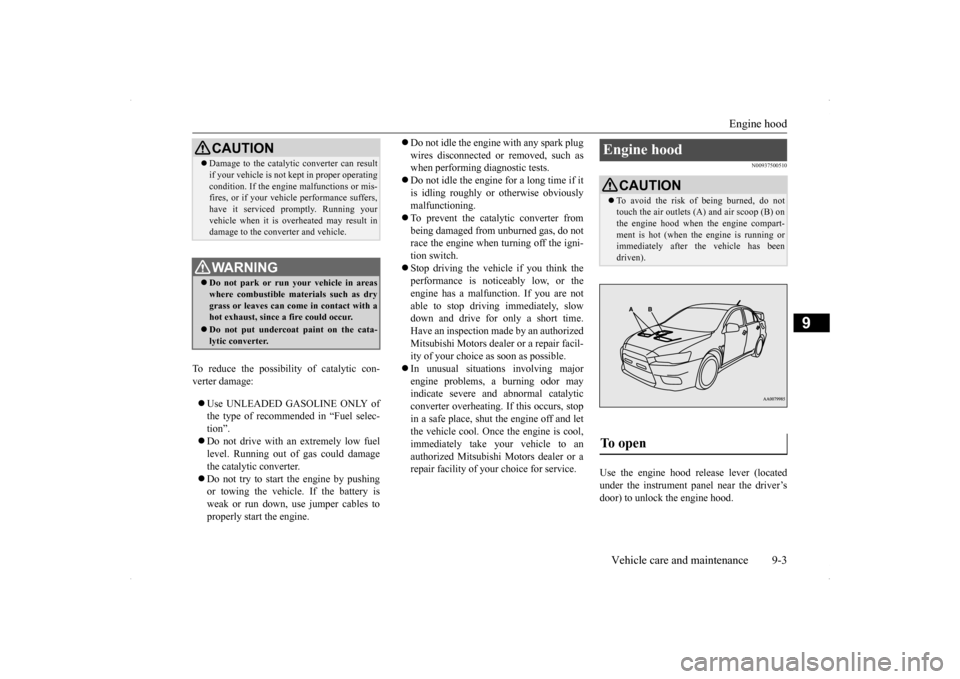
Use the engine hood release lever (locatedunder the instrument panel near the driver’sdoor) to unlock the engine hood.
CAUTION Damage to the catalytic converter can result if your vehicle is not kept in proper operating condition. If the engine malfunctions or mis- fires, or if your vehicle performance suffers, have it serviced promptly. Running yourvehicle when it is overheated may result in damage to the converter and vehicle.WA R N I N G Do not park or run your vehicle in areas where combustible materials such as dry grass or leaves can come in contact with a hot exhaust, since a fire could occur. Do not put undercoat paint on the cata- lytic converter.
Engine hood
CAUTION To avoid the risk of being burned, do not touch the air outlets (A) and air scoop (B) on the engine hood when the engine compart- ment is hot (when the engine is running orimmediately after the vehicle has been driven).
To open
BK0200800US.bo
ok 3 ページ 2013年2月14日 木曜日 午後2時28分
Page 294 of 338

For cold and snowy weather
Vehicle care and maintenance 9-23
9
Also, put a light coat of the same grease on the safety catch wherever moving parts touch.
N00942600102
The ventilation slots in front of the wind-shield should be brushed clear after a heavysnowfall so that the operation of the heating and ventilation systems will not be impaired. To prevent freezing of the weatherstripping on the doors, engine hood, etc., they should be treated with silicone grease. It is a good idea to carry a shovel or a short- handled spade in the vehicle during the win- ter so that you can clear away snow if you getstranded. A small hand-brush for sweeping snow off the vehicle and a plastic scraper for
the windshield, side and rear window are also useful.
N00942700275
The fusible links will melt
to prevent a fire if
a large current attempts to flow through cer- tain electrical systems. In case of a melted fusible link, see yourauthorized Mitsubishi Motors dealer or arepair facility of your choice for inspection and replacement. For the fusible links, please refer to “Fuseload capacities” on page 9-24.
N00942800263 N00901000077
To prevent damage to the electrical system from short-circuiting or overloading, eachindividual circuit is equipped with a fuse. The
fuse blocks are located in the passenger com- partment and in the engine compartment. The fuse blocks in the passenger compart- ment are located behind the fuse lid on the driver’s side as shown.
For cold and snowy weather Ventilation slots Weatherstripping Additional equipment (For regions where snow is encoun- tered)
Fusible links
WA R N I N G Fusible links must not be replaced by any other device. Failing to fit the correct fus- ible link may result in fire in the vehicle, property destruction and serious or fatalinjuries at any time.
Fuses Fuse block location
Passenger compartment A- Main fuse block B- Sub fuse block
BK0200800US.bo
ok 23 ページ 2013年2月14日 木曜日 午後2時28分
Page 296 of 338

Fuses
Vehicle care and maintenance 9-25
9
* - Fusible link Some fuses may not be installed on your vehicle, depending on the vehicle modelor specifications. The table above shows the main equip- ment corresponding to each fuse.
Passenger compartment fuse loca- tion table No.
Sym- bol
Electrical system
Capac-ity
1 Heater 30 A
*
2
Stop lights (Brake lights)
15 A
3 Rear fog light 10 APassenger compartment fuse location
Main fuse block
Sub fuse block
4 Windshield wiper 30 A 5 Optional 10 A 6 Door locks 20 A 7Radio15 A8 Control unit relay 7.5 A 9
Interior lights (Dome lights)
15 A
10
Hazard warning
flasher
15 A
11 Rear window wiper 15 A 12 Gauges 7.5 A 13
Cigarette
lighter/Accessory
socket
15 A
14 Ignition switch 10 A 15 Sunroof 20 A 16
Outside rearview
mirrors
10 A
17
All-wheel drive system
10 A
18 Back-up lights 7.5 A 19 Accessory socket 15 ANo.
Sym- bol
Electrical system
Capac-ity
20
Power window
control
30 A
*
21 Defogger 30 A
*
22
Heated outside rearview mirrors
7.5 A
23 115V Power outlet 15 A24 Power seats
25 (20) A
25 Heated seats 30 ANo.
Sym- bol
Electrical system
Capac-ity
BK0200800US.bo
ok 25 ページ 2013年2月14日 木曜日 午後2時28分
Page 325 of 338
Vehicle labeling 11-2 Specifications
11
N01147400713
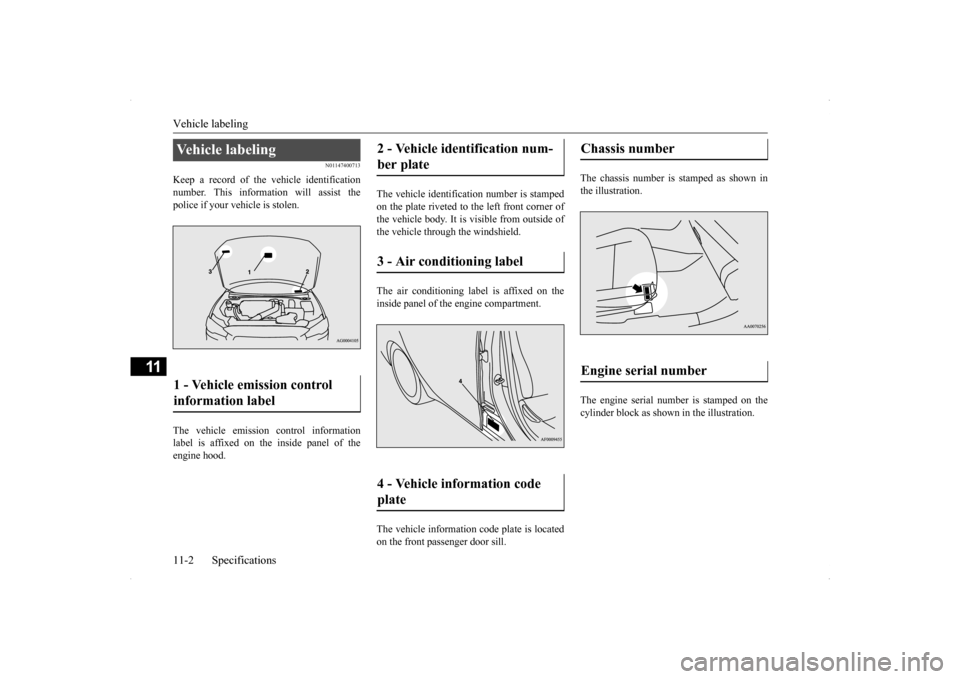
Keep a record of the vehicle identification number. This information will assist thepolice if your vehicle is stolen. The vehicle emission control information label is affixed on the inside panel of the engine hood.
The vehicle identification number is stamped on the plate riveted to the left front corner of the vehicle body. It is visible from outside of the vehicle through the windshield. The air conditioning label is affixed on the inside panel of the engine compartment. The vehicle information code plate is located on the front passenger door sill.
The chassis number is stamped as shown in the illustration. The engine serial number is stamped on the cylinder block as shown in the illustration.
Vehicle labeling 1 - Vehicle emission control information label
2 - Vehicle identification num- ber plate 3 - Air conditioning label 4 - Vehicle information code plate
Chassis number Engine serial number
BK0200800US.bo
ok 2 ページ 2013年2月14日 木曜日 午後2時28分
Page 330 of 338

Alphabetical index
12-1
12
A
Accessory (installation)
.........................
3-6
ACD (Active center differential system) 5-71Active stability control (ASC)
..............
5-76
ASC OFF indicator
.........................
5-78
ASC operation display
....................
5-78
ASC warning display
......................
5-78
Air cleaner filter
...................
................
9-8
Air conditioning
Automatic air conditioning
.........
7-4
, 7-9
Important air conditioning operating tips
..
7-14
Air purifier
....................
.....................
7-15
All-wheel drive system
........................
5-70
Aluminum wheels
...............................
9-44
Antenna
Roof antenna
.................
.................
7-15
Anti-lock braking system
.....................
5-74
Warning light / display
....................
5-75
Arm rest
........................
.......................
4-5
ASC
..........................
........................
5-76
Assist grip
.....................
...................
5-168
AWC Control fluid
Fluid
......................
........................
11-5
AWC control fluid
................
................
9-9
AYC (Active yaw control system)
........
5-72
AYC fluid
Fluid
.......................
......................
11-5
B
Back-up lights
Bulb capacity
..................
...............
9-28
Replacement
...................
...............
9-37
Ball joint, steering linkage seals and drive shaft boots
.....................
..................
9-22
Battery
........................
......................
9-11
Charging system warning light
.......
5-123
Disconection and connection
...........
9-12
During cold weather
.......................
9-11
Specification
...................
...............
11-5
Bluetooth 2.0 interface
.......................
5-137
Bottle holder
....................
.................
5-167
Brake
Anti-lock braking system
................
5-74
Braking
.......................
....................
6-5
Fluid
....................
.................
9-10
, 11-5
Hose
.......................
......................
9-22
Parking brake
..................
...............
5-47
Parking brake lever stroke
...............
9-19
Pedal
.......................
......................
5-79
Pedal free play
................
...............
9-19
Power brakes
..................
...............
5-79
Service brake
..................
...............
5-79
Brake assist
......................
..................
5-80
Braking
Warning lights
..............................
5-122
Break-in period
.....................
................
5-3
Bulb capacity
.....................
.................
9-28
C
California Perchlorate Materials Requirements
.....................
................
3-7
Capacities
.....................
.....................
11-5
Card holder
............................
5-162
, 5-165
Cargo loads
...................
.....................
6-10
Catalytic converter
................
................
9-2
Certification label
...............................
11-3
Charging system warning light
...........
5-123
Chassis number
..................
.................
11-2
Child restraints
..................
.................
4-12
Child safety locks for rear door
............
5-37
Cleaning
Inside of your vehicle
......................
9-40
Outside of your vehicle
...................
9-42
Clutch
Clutch pedal operation
.....................
5-56
Fluid
..................
...................
9-10
, 11-5
Pedal free play
...............
.................
9-19
Coat hooks
....................
...................
5-168
Combination headlights and dimmer switch
Headlight reminder buzzer
.............
5-128
Light auto-cutout function
.............
5-127
Consumer information
.........................
10-2
BK0200800US.bo
ok 1 ページ 2013年2月14日 木曜日 午後2時28分
Page 331 of 338

Alphabetical index 12-2
12
Coolant (engine)
..........................
9-7
, 11-5
Cruise control
....................
.................
5-81
Cup holder
....................
...................
5-167
D
Daytime running lights
Bulb capacity
................
.................
9-28
Replacement
.................
.................
9-33
Defogger (rear window)
....................
5-136
Defrosting or defogging (windshield, door windows)
.................
.................
7-8
, 7-13
Dimensions
...................
.....................
11-3
Dimmer (high/low beam change)
.......
5-128
Disc brake pads
.................
.................
9-22
Dome light (Rear)
Bulb capacity
................
.................
9-30
Replacement
.................
.................
9-39
Switch
......................
...................
5-163
Dome light/Reading lights
Bulb capacity
................
.................
9-30
Replacement
.................
.................
9-38
Switch
......................
...................
5-162
Doors
Lock
......................
........................
5-34
Power door locks
............................
5-36
Driving during cold weather
..................
6-4
Driving, alcohol and drugs
.....................
6-2
E
Electric rear window defogger switch
..5-136
Electronic immobilizer (Anti-theft starting system)
.....................
................
5-4
, 5-27
Emission-control system maintenance
...
9-20
Engine
Compartment
..................
.................
9-5
Coolant
...................
................
9-7
, 11-5
Hood
.......................
........................
9-3
Oil and oil filter
.......................
9-5
, 11-5
Overheating
....................
.................
8-4
Serial number
.................
................
11-2
Specifications
.................
................
11-4
Engine coolant temperature display
.......
5-97
Engine malfunction indicator
..............
5-122
Exhaust system
...................
................
9-22
F
Filling the fuel tank
..............................
3-4
Floor console box
..............................
5-166
Floor mat
.........................
....................
6-2
Fluid
AWC control fluid
...................
9-9
, 11-5
AYC fluid
...................
...................
11-5
Brake fluid
............................
9-10
, 11-5
Clutch fluid
...........................
9-10
, 11-5
Engine coolant
.........................
9-7
, 11-5
Power steering fluid
...............
9-11
, 11-5
Twin Clutch SST
............................
11-5
Twin Clutch SST fluid
.............
9-9
, 11-5
Washer fluid
.........................
9-10
, 11-5
Fluid capacities and lubricants
.............
11-5
Fog lights
Bulb capacity
................
.................
9-28
Free-hand advanced security transmitter (F.A.S.T.-key)
.................
.................
5-11
Front console boxes
..........................
5-166
Front console tray
.............................
5-165
Front fog lights
Bulb capacity
................
.................
9-28
Indicators
..................
...................
5-121
Replacement
.................
.................
9-36
Switch
......................
...................
5-131
Front seats
.........................
...................
4-3
Front side-marker and parking light
Bulb capacity
................
.................
9-28
Replacement
.........................
9-33
, 9-34
Front turn signal lights
Bulb capacity
................
.................
9-28
Replacement
.................
.................
9-35
Fuel
Fuel economy
...................
................
6-2
Fuel hoses
.....................
.................
9-21
Modification/alterations to the electrical orfuel systems
...................
................
3-6
Tank capacity
..........................
3-4
, 11-5
Fuel selection
....................
...................
3-2
BK0200800US.bo
ok 2 ページ 2013年2月14日 木曜日 午後2時28分