2014 MITSUBISHI ASX maintenance
[x] Cancel search: maintenancePage 322 of 418
WARNINGlIf there is none, make sure that the engine
has cooled down before removing the ra-
diator cap (D), because hot steam or boil- ing water otherwise will gush from the filler port and may scald you.
6. Fill the reserve tank with coolant as nee-
ded. (Refer to the “Maintenance” sec- tion.)
CAUTIONl Do not add coolant while the engine is hot.
Suddenly adding cold coolant could damage
the engine. Wait for the engine to cool
down, then add coolant a little at a time.
7. Examine the radiator hoses for coolant
leakage and the drive belt for looseness
or damage.
If there is anything wrong with the cool-
ing system or drive belt, we recommend
you to have it checked and repaired.
Tool and jack
E00800901500
Storage
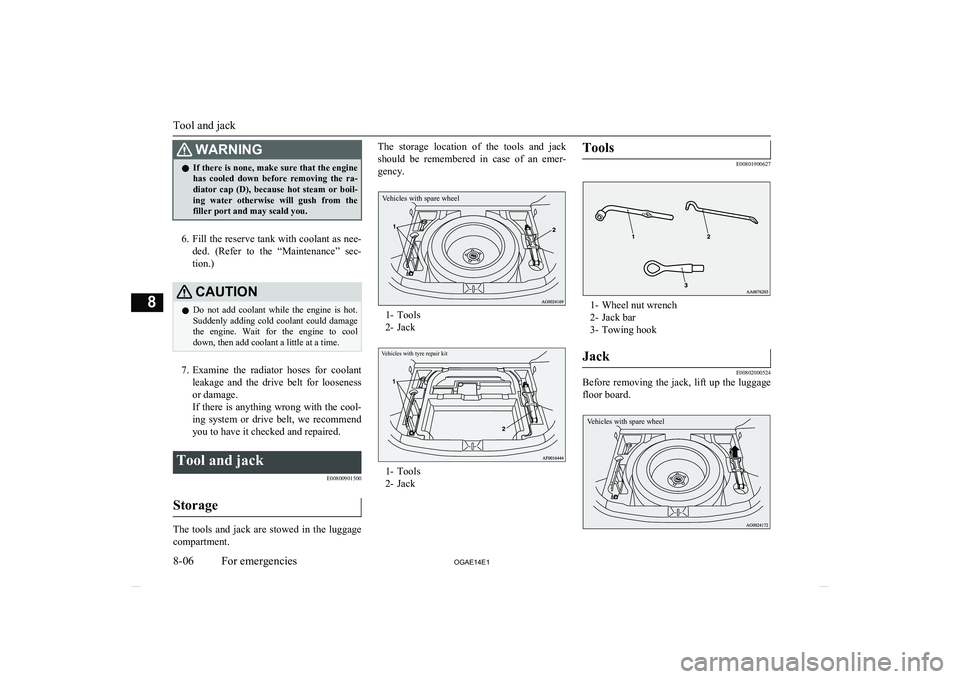
The tools and jack are stowed in the luggagecompartment.
The storage location of the tools and jack
should be remembered in case of an emer-
gency.Vehicles with spare wheel
1- Tools
2- Jack
1- Tools
2- Jack
Tools
E00801900627
1- Wheel nut wrench
2- Jack bar
3- Towing hook
Jack
E00802000524
Before removing the jack, lift up the luggage floor board.
Vehicles with spare wheel
Tool and jack
8-06 OGAE14E1For emergencies8 Vehicles with tyre repair kit
Page 349 of 418

Service precautions........................................................................... 10-02
Catalytic converter............................................................................ 10-02
Bonnet............................................................................................... 10-03
Engine oil.......................................................................................... 10-04 Engine coolant...................................................................................10-06
Washer fluid...................................................................................... 10-07
Brake fluid/Clutch fluid*.................................................................. 10-08
Battery............................................................................................... 10-08 Tyres..................................................................................................10-12Wiper blade rubber replacement....................................................... 10-16
General maintenance......................................................................... 10-18
For cold and snowy weather............................................................. 10-18
Fusible links...................................................................................... 10-19
Fuses..................................................................................................10-19
Replacement of lamp bulbs............................................................... 10-25Maintenance
OGAE14E110
Page 350 of 418

Service precautionsE01000102074
Adequate care of your vehicle at regular in- tervals serves to preserve the value and ap-
pearance as long as possible.
Maintenance items as described in this own- er’s manual can be performed by the owner.We recommend you to have the periodic in-
spection and maintenance performed by a MITSUBISHI MOTORS Authorized Service
Point or another specialist.In the event a malfunction or a problem is discovered, we recommend you to have it
checked and repaired. This section contains information on inspection maintenance pro- cedures that you can do yourself. Follow theinstructions and cautions for each of the vari-
ous procedures.
A- Cooling fans B- Caution label
*: Front of the vehicle
WARNINGl When checking or servicing the inside of
the engine compartment, make sure theengine is switched off and has had achance to cool down.WARNINGl If it is necessary to do work in the engine
compartment with the engine running, be
especially careful that your clothing, hair,
etc., does not become caught by the fan, drive belts, or other moving parts.
l The fan may turn on automatically even if
the engine is not running. Turn the igni-
tion switch to the “LOCK” position or put
the operation mode in OFF to be safe while you work in the engine compart-
ment.
l Do not smoke, cause sparks or allow open
flames around fuel or battery. The fumesare flammable.
l Be extremely cautious when working
around the battery. It contains poisonous
and corrosive sulphuric acid.
l Do not get under your vehicle with just
the body jack supporting it. Always use
automotive jack stands.
l Improper handling of components and
materials used in the vehicle can endangeryour personal safety. We recommend you to consult a specialist for necessary infor- mation.Catalytic converter
E01000200765
The exhaust gas scavenging devices usedwith the catalytic converter are extremely ef- ficient for the reduction of noxious gases.
The catalytic converter is installed in the ex- haust system.
Service precautions
10-02 OGAE14E1Maintenance10
Page 351 of 418

It is important to keep the engine properlytuned to ensure proper catalyst operation andprevent possible catalyst damage.WARNINGl As with any vehicle, do not park or oper-
ate this vehicle in areas where combusti-
ble materials such as dry grass or leaves can come in contact with a hot exhaust
since a fire could occur.
l Paint should not be applied to the catalyt-
ic converter.NOTEl Use fuel of the type recommended in
“Fuel
selection” on page 2-02.Bonnet
E01000302698
To open
1.Pull the release lever towards you to un-
lock the bonnet.
2. Raise the bonnet while pressing the safe-
ty lock.
NOTEl Only open the bonnet when the wipers are in
the parked position. In any other position,
the wipers could damage the paint or bonnet.
3. Support the bonnet by inserting the sup-
port bar in its slot.
Bonnet
10-03
OGAE14E1Maintenance10 LHD RHD
Page 352 of 418

CAUTIONlNote that the support bar may disengage the
bonnet if the open bonnet is lifted by astrong wind.
l After inserting the support bar into the slot,
make sure the bar supports the bonnet se-
curely from falling down on to your head or body.
To close
1. Unlatch the support bar and clip it in its
holder.
2. Slowly lower the bonnet to a position
about 20 cm above the closed position,
then let it drop.
3. Make sure the bonnet is securely locked
by softly lifting the centre of the bonnet.
CAUTIONl Be careful that hands or fingers are not trap-
ped when closing the bonnet.
l Before driving, make sure that the bonnet is
securely locked. An incompletely locked bonnet can suddenly open while driving.
This can be extremely dangerous.NOTEl If this does not close the bonnet, release it
from a slightly higher position.
l Do not press down the bonnet hard with a
hand as it may damage the bonnet.
l For vehicles equipped with the security
alarm system, if you drive with the bonnet left open, warning display is displayed on the information screen in the multi-informa-tion display.Type 1Type 2Engine oil
E01000404097
To check and refill engine oil
Petrol-powered vehicles
1600 modelsMAX.MIN.1800, 2000 modelsMAX.MIN.
Engine oil
10-04 OGAE14E1Maintenance10
Page 353 of 418

Diesel-powered vehicles
MAX.MIN.
The engine oil used has a significant effecton the engine’s performance, service life and
startability. Be sure to use oil of the recom- mended quality and appropriate viscosity.
All engines consume a certain amount of oil during normal operation. Therefore, it is im-portant to check the oil level at regular inter-
valk thes or before starting a long trip. 1. Park the car on a horizontal surface.
2. Switch off the engine.
3. Wait a few minutes.
4. Remove the dipstick and wipe it with a
clean cloth.
5. Reinsert the dipstick as far as it goes.
6. Remove the dipstick and read the oil lev- el, which should always be within therange indicated.
7. If the oil level is below the specified
limit, remove the cap located on the cyl- inder head cover and add enough oil to
raise the level to within the specified
range. Do not overfill to avoid engine damage. Be sure to use the specified en-
gine oil and do not mix various types of
oil.
8. After adding oil, close the cap securely.
9. Confirm the oil level by repeating step 4
to 6.CAUTIONl In diesel-powered vehicles, when burning
away and removing soot accumulated in the
DPF, fuel can mix with the engine oil and an increase in the engine oil level may occur. This does not indicate an abnormality.
However, if the engine oil level is at or over the “X” mark (B) on the engine oil dipstick
(A), change the engine oil.NOTEl The engine oil will deteriorate rapidly if the
vehicle is subjected to severe conditions, re-
quiring earlier oil replacement.
Please refer to the maintenance schedule.
l For information on how to dispose of used
engine oil, refer to page 2-05.
Recommended engine oil vis-
cosity
Petrol-powered vehicles
l Select engine oil of the proper SAE vis-
cosity number according to the atmos- pheric temperature.
SAE 0W-20, 0W-30, 5W-30 and 5W-40 engine oils can only be used if they meet
ACEA A3/B3, A3/B4 or A5/B5 and API
SM (or higher) specifications.
Engine oil
10-05
OGAE14E1Maintenance10
Page 354 of 418

lUse engine oil conforming to the follow-
ing classification: • API classification: “For service SM”
or higher
• ILSAC certificated oil
• ACEA classification: “For service A1/B1, A3/B3 , A3/B4 or
A5/B5”NOTEl Use of additives is not recommended since
they may reduce the effectiveness of addi-
tives already included in the engine oil. It may result in failure of the mechanical as-
sembly.
Diesel-powered vehicles
l Select engine oil of the proper SAE vis-
cosity number according to the atmos-pheric temperature.
l Use engine oil conforming to the follow-
ing classification: • ACEA classification: “For service C1, C2, C3 or C4”
• JASO classification: “For service DL-1”
If those classifications are not available,
contact a MITSUBISHI MOTORS Au-
thorized Service Point.NOTEl Use of additives is not recommended since
they may reduce the effectiveness of addi-
tives already included in the engine oil. It may result in failure of the mechanical as-
sembly.Engine coolant
E01000503150
To check the coolant level
A transparent coolant reserve tank (A) is lo-cated in the engine compartment.
The coolant level in this tank should be kept
between the “LOW” and “FULL” marks when measured while the engine is cold.
To add coolant
The cooling system is a closed system andnormally the loss of coolant should be very
slight. A noticeable drop in the coolant level
could indicate leakage. If this occurs, we rec- ommend you to have the system checked as
soon as possible.
If the level should drop below the “LOW” level on the reserve tank, open the lid and
add coolant.
Also, if the reserve tank is completely empty, remove the radiator cap (B) and add coolant until the level reaches the filler neck.
Engine coolant
10-06 OGAE14E1Maintenance10 FULLLOW
Page 355 of 418

WARNINGlDo not open the radiator cap (B) while the
engine is hot. The coolant system is under
pressure and any hot coolant escaping
could cause severe burns.
Anti-freeze
The engine coolant contains an ethylene gly-
col anti-corrosion agent. Some parts of the engine are cast aluminium alloy, and periodic
changing of the engine coolant is necessary to prevent corrosion of these parts.
Use “ MITSUBISHI MOTORS GENUINE
SUPER LONG LIFE COOLANT PREMI- UM” or equivalent*.
*: similar high quality ethylene glycol based
non-silicate, non-amine, non-nitrate and non- borate coolant with long life hybrid organic
acid technology.
MITSUBISHI MOTORS GENUINE Coolant
has excellent protection against corrosion and
rust formation of all metals including alumi- nium and can avoid blockages in the radiator,
heater, cylinder head, engine block, etc.
Because of the necessity of this anti-corro-
sion agent, the coolant must not be replaced with plain water even in summer. The re-
quired concentration of anti-freeze differs de- pending on the expected ambient tempera-
ture.
Above -35 °C: 50 % concentration of anti-
freeze
Below -35 °C: 60 % concentration of anti- freezeCAUTIONl Do not use alcohol or methanol anti-freeze
or any engine coolants mixed with alcoholor methanol anti-freeze. The use of an im-
proper anti-freeze can cause corrosion of the aluminium components.
l Do not use water to adjust the concentration
of coolant.
l Concentrations exceeding 60 % will result in
a reduction of both the anti-freeze and cool-
ing performance thus adversely affecting the engine.
l Do not top up with water only.
Water by itself reduces the rust-protective
and anti-freeze qualities of the coolant and has a lower boiling point. It can also causedamage to the cooling system if it should freeze. Do not use tapwater, as it can causecorrosion and rust formation.During cold weather
If the temperatures in your area drop below
freezing, there is the danger that the coolant
in the engine or radiator could freeze and cause severe damage to the engine and/or ra-diator. Add a sufficient amount of anti-freeze
to the coolant to prevent it from freezing. The concentration should be checked before the start of cold weather and anti-freeze add- ed to the system if necessary.
Washer fluid
E01000700832
Open the washer fluid reservoir cap andcheck the level of washer fluid with the dip- stick.
If the level is low, replenish the container with washer fluid.
EMPTYFULL
Washer fluid
10-07
OGAE14E1Maintenance10