2014 MERCEDES-BENZ SPRINTER light
[x] Cancel search: lightPage 31 of 338

ately to have the problem diagnosed and rec-
tified.
If the problem cannot be rectified to your sat-
isfaction there:
R please discuss the problem with a manage-
ment representative from the authorized
Sprinter Dealer.
R if necessary, contact the distributor named
on the inside of the front cover. Limited Warranty
! Follow the instructions in this Operator's
Manual about the proper operation of your
vehicle as well as about possible vehicle
damage. Damage to your vehicle that
arises from culpable contravention of these
instructions is not covered by the Limited
Warranty of the distributor named on the
inside of the front cover. Data stored in the vehicle
A wide range of electronic components in
your vehicle contain data memories.
These data memories temporarily or perma-
nently store technical information about:
R The vehicle's operating state
R Incidents
R Malfunctions
In general, this technical information docu-
ments the state of a component, a module, a
system or the surroundings.
These include, for example:
R operating conditions of system compo-
nents, e.g. fluid levels
R the vehicle's status messages and those of
its individual components, e.g. number of
wheel revolutions/speed, deceleration in
movement, lateral acceleration, accelera-
tor pedal position
R malfunctions and defects in important sys-
tem components, e.g. lights, brakes R
vehicle reactions and operating conditions
in special driving situations, e.g. air bag
deployment, intervention of stability
control systems
R ambient conditions, e.g. outside tempera-
ture
This data is of an exclusively technical nature
and can be used to:
R assist in recognizing and rectifying mal-
functions and defects
R analyze vehicle functions, e.g. after an acci-
dent
R optimize vehicle function
The data cannot be used to trace the vehicle's
movements.
When your vehicle is serviced, technical infor-
mation can be read from the event data mem-
ory and malfunction data memory.
Services include, for example:
R repair services
R service processes
R warranties
R quality assurance
It is read by employees of the service network
(including manufacturers) using special diag-
nostic devices. More detailed information is
obtained from it, if required.
After a malfunction has been rectified, the
information is deleted from the malfunction
memory or is continually overwritten.
When operating the vehicle, situations are
conceivable in which this technical data, in
connection with other information (if neces-
sary, under consultation with an authorized
expert), could be traced to a person.
Examples include:
R accident reports
R damages to the vehicle
R witness statements
Further additional functions that have been
contractually agreed upon with the customer
allow certain vehicle data to be conveyed by
the vehicle as well. The additional functions Introduction
29 Z
Page 34 of 338
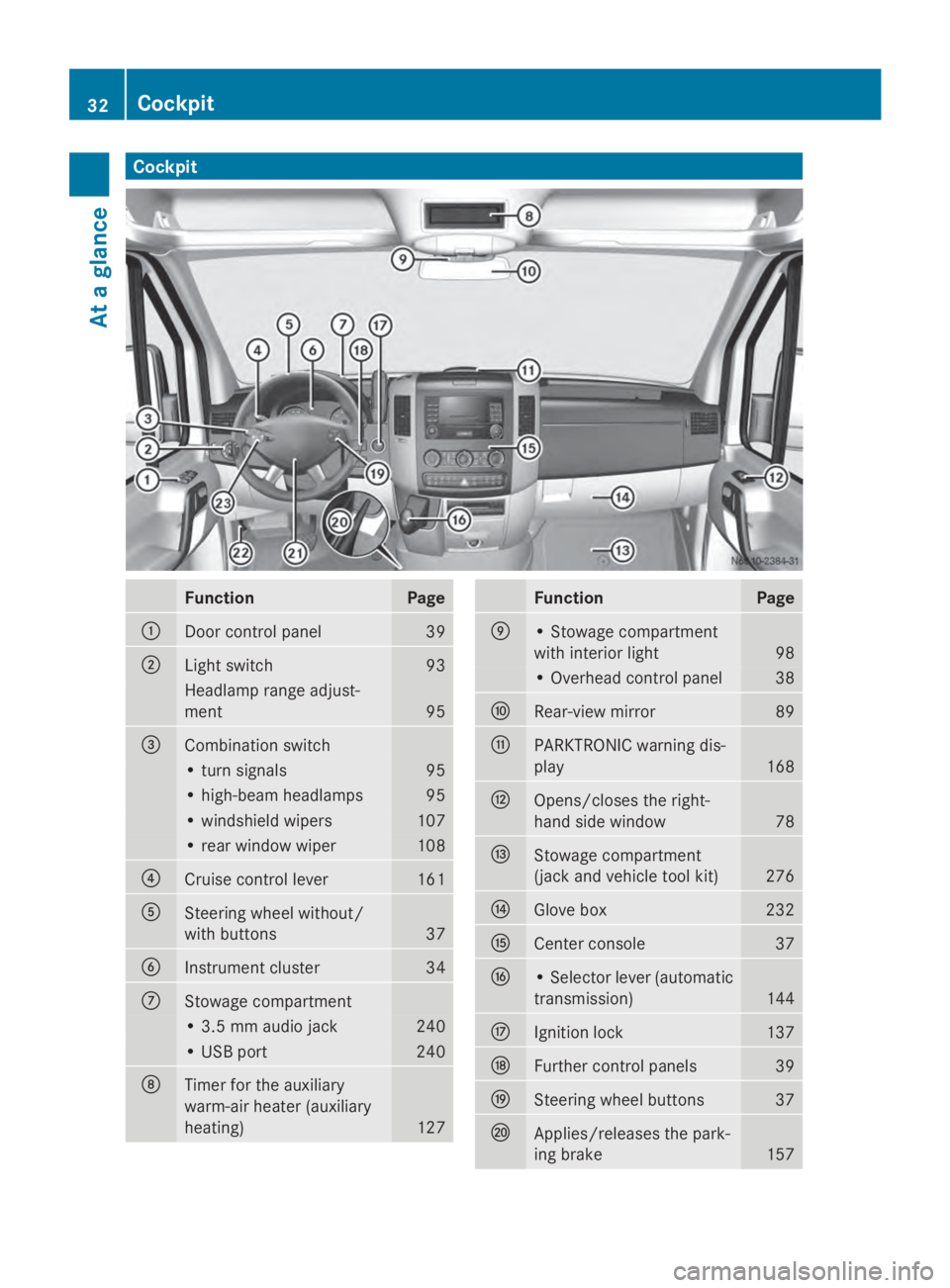
Cockpit
Function Page
0043
Door control panel 39
0044
Light switch 93
Headlamp range adjust-
ment 95
0087
Combination switch
• turn signals 95
• high-beam headlamps 95
• windshield wipers 107
• rear window wiper 108
0085
Cruise control lever 161
0083
Steering wheel without/
with buttons
37
0084
Instrument cluster 34
006B
Stowage compartment
• 3.5 mm audio jack 240
• USB port 240
006C
Timer for the auxiliary
warm-air heater (auxiliary
heating)
127 Function Page
006D
• Stowage compartment
with interior light
98
• Overhead control panel 38
006E
Rear-view mirror 89
006F
PARKTRONIC warning dis-
play
168
0070
Opens/closes the right-
hand side window
78
0071
Stowage compartment
(jack and vehicle tool kit)
276
0072
Glove box 232
0073
Center console 37
0074
• Selector lever (automatic
transmission)
144
0075
Ignition lock 137
0076
Further control panels 39
0077
Steering wheel buttons 37
0078
Applies/releases the park-
ing brake
15732
CockpitAt a glance
Page 36 of 338

Instrument cluster
Displays and controls
Instrument cluster on vehicles without steering wheel buttons
Instrument cluster in vehicles with steering-wheel buttons
Function Page
0043
Speedometer 183
0044
Tachometer 183
0087
0074,
0075Brightens/dims the
instrument cluster lighting 183
0085
Fuel gage with fuel filler flap
location indicator
183
0083
Display
Vehicles without steering
wheel buttons
184
Vehicles with steering
wheel buttons 186 Function Page
0084
Reset button
0045 34
006B
Menu button
0079 • changes standard display 184
• selects menus 185
006C
Service button
0098 Checks the engine oil level 25234
Instrument clusterAt a glance
Page 40 of 338

Function Page
002F
Switches the hazard warn-
ing lamps on/off
96
00E3
Activates/deactivates ASR 60
00BF
00C0
Central locking, interior/
rear compartment
71
00D4
Activating/deactivating
the distance warning func-
tion
59
00B0
Activates/deactivates
Lane Keeping Assist
167
006C
Activates/deacti-
vates Blind Spot Assist 164
0083
• Stowage compartment or
• CD changer, see separate
operating instructions or
0084
Cup holder with: 236
• ashtray 237
• cigarette lighter 238
006B
12 V socket 238 Overhead control panel
Function Page
0043
Microphone for the mobile
phone 239
0044
Switches the reading lamp
on/off, right 98
0087
Switches the automatic
interior lighting on/off 98
0085
• Eyeglasses compartment
or
233
• Anti-Theft Alarm system
(ATA)
62
0083
Switches the interior light-
ing on/off 98
0084
Switches the reading lamp
on/off, left 9838
Overhead control panelAt a glance
Page 41 of 338

Door control panel
Function Page
0043
Adjusts the exterior mirrors 89
0044
Selects an exterior mirror 89
0087
Opens/closes the left-hand
side window
78
0085
Opens/closes the right-
hand side window 78 Further control panels
Control panel between the light
switch and the steering wheel
Function Page
0084
Switches the auxiliary heat-
ing on/off
124
00AB
Switches the heater boos-
ter function on/off
130
0091
0092
Sets the working speed
172
0091
Switches the working
speed governor (ADR) on/
off
172
00A8
00A7
Ventilates the cargo com-
partment
133Further cont
rol panels
39At a glance
Page 42 of 338

Control panel between the steering
wheel and the ignition lock Function Page
0039
0038
Switches the central rear
compartment lighting on/
off
9840
Further control panelsAt a glance
Page 45 of 338

When you switch on the ignition, the
007E
warning lamp in the instrument cluster lights
up for approximately 4 seconds.
A malfunction has occurred if the 007Ewarn-
ing lamp:
R does not light up when you switch on the
ignition, or
R does not go out within a few seconds of
switching on the ignition, or
R lights up again
Safety guidelines for seat belts, Emer-
gency Tensioning Devices (ETDs) and
air bags G
WARNING
R Damaged seat belts or seat belts that have
been subjected to stress in an accident
must be replaced and their anchoring
points must also be checked. Only use seat
belts which have been installed or supplied
by a qualified specialist workshop.
R Air bags and pyrotechnic Emergency Ten-
sioning Devices (ETDs) contain perchlorate
material, which may require special han-
dling and regard for the environment.
Check with your local government's dis-
posal guidelines. California residents, see
www.dtsc.ca.gov/HazardousWaste/
Perchlorate/index.cfm.
R Air bags and ETDs are designed to function
on a one-time-only basis. An air bag or ETD
that has deployed must be replaced.
R Do not pass seat belts over sharp edges.
They could tear.
R Do not make any modification that could
change the effectiveness of the seat belts.
R Do not bleach or dye seat belts as this may
severely weaken them. In a crash they may
not be able to provide adequate protection.
R No modifications of any kind may be made
to any components or wiring of the SRS.
R Do not change or remove any component
or part of the SRS. R
Do not install additional paneling, seat cov-
ers, badges etc. over the steering wheel
hub, co-driver's front air bag cover, out-
board sides of the seat backrests, door trim
panels, or door frame trims.
R Do not install additional electrical/elec-
tronic equipment on or near SRS compo-
nents and wiring.
R Keep the area between air bags and occu-
pants free of objects (e.g. packages,
purses, umbrellas etc.).
R Do not hang items such as coat hangers
from the coat hooks or handles over the
door. These items may be thrown around in
the vehicle and cause head and other inju-
ries when the window curtain air bag is
deployed.
R Air bag system components will be hot after
an air bag has inflated. Do not touch them.
R Never place your feet on the instrument
panel or on the seat. Always keep both feet
on the floor in front of the seat.
R Improper repair work creates a risk of ren-
dering the SRS inoperative or causing unin-
tended air bag deployment. Work on the
SRS must therefore only be performed by
qualified technicians. Please contact a
qualified specialist workshop.
R For your protection and the protection of
others, when scrapping the air bag unit or
ETD, our safety instructions must be fol-
lowed. These instructions are available
from any authorized Sprinter Dealer.
R Given the considerable deployment speed,
required inflation volume, and the material
of the air bags, there is the possibility of
abrasions or other, potentially more serious
injuries resulting from air bag deployment.
If you sell your vehicle, we strongly recom-
mend that you inform the subsequent owner
that the vehicle is equipped with SRS. Also
refer them to the applicable section in the
Operator's Manual. Occupant safety
43Safety Z
Page 47 of 338

The air bag installation locations are identi-
fied by the label SRS/AIRBAG or AIRBAG.
R Front air bags (Y page 45)
R Thoraxbags (Y page 45)
R Window curtain air bags (Y page 46)
The air bags are deployed if the air bag control
unit detects the need for deployment. Only in
the event of such a situation will they provide
their supplemental protection.
If the driver and co-driver do not wear their
seat belts, it is not possible for the air bags to
provide their supplemental protection.
In the event of other types of impacts and
impacts below air bag deployment thresh-
olds, the air bags will not deploy. The driver
and passengers will then be protected to the
extent possible by a properly fastened seat
belt. A properly fastened seat belt is also
needed to provide the best possible protec-
tion in a rollover.
Air bags provide additional protection, but are
not a substitute for the seat belts. All vehicle
occupants must fasten their seat belts
regardless of whether your vehicle is equip-
ped with air bags or not.
If an air bag is deployed, you will hear a bang
and a small amount of powder is released
briefly. Only in rare cases will the bang affect
your hearing. The powder emitted is not gen-
erally hazardous to health. The 007Ewarning
lamp lights up. If it is safe to do so:
X Exit the vehicle immediately.
If you are unable to leave the vehicle:
X Open a window.
You will be able to breathe in fresh air and
avoid respiratory problems.
It is important for your safety and that of any
passengers to have deployed air bags
replaced and to have any malfunctioning air
bags repaired. This will help to make sure the
air bags continue to perform their protective
function for the vehicle occupants in the
event of a crash. Front air bags
Driver's air bag
0043inflates in front of the
steering wheel; co-driver's front air bag 0044
inflates in front of and above the glove box
and center console.
The front air bags increase the degree of pro-
tection afforded to the driver and co-driver
against head and chest injuries.
They are deployed:
R in certain frontal collision situations
R if the system determines that air bag
deployment can offer additional protection
to that provided by the seat belt
R if the respective seat belt is fastened
R independently of other air bags in the vehi-
cle
If the vehicle rolls over, the front air bags are
generally not deployed. The front air bags are
deployed if it is detected that the vehicle is
decelerating rapidly in the longitudinal direc-
tion.
In collision situations with low predicted
impact severity the front air bags are not
deployed. You will then be protected by the
seat belt, provided that it is fastened.
Thoraxbags G
WARNING
Only use seat covers which have been tested
and approved for your vehicle type by the dis-
tributor named on the inside of the front
cover. The use of seat covers or other seat
coverings may cause a malfunction when the Occupant safety
45Safety
Z