2014 MERCEDES-BENZ S-Class steering wheel
[x] Cancel search: steering wheelPage 82 of 434

system checked at a qualified specialist
workshop.
Function X
To activate/deactivate: activate or
deactivate PRE-SAFE ®
Brake in the on-
board computer (Y page 260).
If the PRE-SAFE ®
Brake is not activated, the
00D4 symbol appears in the multifunction
display.
Starting at a speed of around 4 mph
(7 km/h), this function warns you if you
rapidly approach a vehicle in front. An
intermittent warning tone will then sound and
the 00BA distance warning lamp will light up
in the instrument cluster.
X Brake immediately to defuse the situation.
or
X Take evasive action provided it is safe to do
so.
i If there is an increased risk of collision,
preventive passenger protection measures
(PRE-SAFE ®
) are activated.
If the risk of collision with the vehicle in front
remains and you do not brake, take evasive
action or accelerate significantly, the vehicle
may perform automatic emergency braking,
up to the point of full brake application.
Automatic emergency braking is not
performed until immediately prior to an
imminent accident.
You can prevent the intervention of the PRE-
SAFE ®
Brake at any time by:
R depressing the accelerator pedal further
R activating kickdown.
R releasing the brake pedal
The braking action of PRE-SAFE ®
Brake is
ended automatically if:
R you maneuver to avoid the obstacle.
R there is no longer a risk of collision.
R there is no longer an obstacle detected in
front of your vehicle. STEER CONTROL
General information STEER CONTROL helps you by transmitting a
noticeable steering force to the steering
wheel in the direction required for vehicle
stabilization.
This steering assistance is provided in
particular if:
R
both right wheels or both left wheels are on
a wet or slippery road surface when you
brake.
R the vehicle starts to skid.
Important safety notes i
Observe the "Important safety notes"
section (Y page 70).
No steering support is provided from STEER
CONTROL, if:
R ESP ®
is malfunctioning.
R the steering is malfunctioning.
Power steering will, however, continue to
function. Theft deterrent locking system
Immobilizer
The immobilizer prevents your vehicle from
being started without the correct SmartKey.
X To activate with the SmartKey: remove
the SmartKey from the ignition lock.
X To activate with KEYLESS-GO: switch the
ignition off and open the driver's door.
X To deactivate: switch on the ignition.
When leaving the vehicle, always take the
SmartKey with you and lock the vehicle.
Anyone can start the engine if a valid
SmartKey has been left inside the vehicle.
i The immobilizer is always deactivated
when you start the engine.
In the event that the engine cannot be
started when the starter battery is fully 80
Theft deterrent locking systemSafety
Page 111 of 434
Useful information
............................110
Correct driver's seat position ..........110
Seats .................................................. 111
Steering wheel .................................. 127
Mirrors ............................................... 130
Memory function .............................. 133
Memory function in the rear com-
partment ............................................ 134 109Seats, steering wheel and mirrors
Page 112 of 434

Useful information
i This Operator's Manual describes all
models and all standard and optional
equipment of your vehicle available at the
time of publication of the Operator's
Manual. Country-specific differences are
possible. Please note that your vehicle may
not be equipped with all features
described. This also applies to safety-
related systems and functions.
i Read the information on qualified
specialist workshops: (Y page 27).Correct driver's seat position
G
WARNING
You could lose control of your vehicle if you
do the following while driving:
R adjust the driver's seat, head restraint,
steering wheel or mirrors
R fasten the seat belt
There is a risk of an accident.
Adjust the driver's seat, head restraint,
steering wheel and mirror and fasten your
seat belt before starting the engine. X
Observe the safety guidelines on seat
adjustment (Y page 111).
X Check whether you have adjusted seat 0087
properly (Y page 112).
When adjusting the seat, make sure that:
R you are as far away from the driver's air bag
as possible.
R you are sitting in a normal upright position.
R you can fasten the seat belt properly.
R you have moved the backrest to an almost
vertical position.
R you have set the seat cushion angle so that
your thighs are gently supported.
R you can depress the pedals properly.
X Check whether the head restraint is
adjusted properly.
When doing so, make sure that you have
adjusted the head restraint so that the back
of your head is supported at eye level by
the center of the head restraint.
X Observe the safety guidelines on steering
wheel adjustment (Y page 127).
X Make sure that steering wheel 0043is
adjusted properly (Y page 127).
When adjusting the steering wheel, make
sure that:
R you can hold the steering wheel with your
arms slightly bent.
R you can move your legs freely.
R you can see all the displays in the
instrument cluster clearly.
X Observe the safety guidelines for seat belts
(Y page 57).
X Check whether you have fastened seat
belt 0044properly (Y page 59).
The seat belt should:
R fit snugly across your body
R be routed across the middle of your
shoulder
R be routed in your pelvic area across the hip
joints 110
Correct driver's seat positionSeats, steering wheel and mirrors
Page 113 of 434

X
Before starting off, adjust the rear-view
mirror and the exterior mirrors in such a
way that you have a good view of road and
traffic conditions (Y page 131).
X Vehicles with a memory function: save
the seat, steering wheel and exterior mirror
settings with the memory function
(Y page 133). Seats
Important safety notes
G
WARNING
Children could become trapped if they adjust
the seats, particularly when unattended.
There is a risk of injury.
When leaving the vehicle, always take the
SmartKey with you and lock the vehicle. Never
leave children unsupervised in the vehicle. G
WARNING
You could lose control of your vehicle if you
do the following while driving:
R adjust the driver's seat, head restraint,
steering wheel or mirrors
R fasten the seat belt
There is a risk of an accident.
Adjust the driver's seat, head restraint,
steering wheel and mirror and fasten your
seat belt before starting the engine. G
WARNING
If you adjust the seat height carelessly, you or
other vehicle occupants could be trapped and
thereby injured. Children in particular could
accidentally press the electrical seat
adjustment buttons and become trapped.
There is a risk of injury.
While moving the seats, make sure that your
hands or other body parts do not get under
the lever assembly of the seat adjustment
system. G
WARNING
When you adjust a seat, you or other vehicle
occupants could become trapped, e.g. on the
seat guide rail. There is a risk of injury.
Make sure when adjusting a seat that no one
has any body parts in the sweep of the seat. G
WARNING
If head restraints are not installed and
adjusted correctly, they cannot provide
protection as intended. There is an increased
risk of injury in the head and neck area, e.g.
in the event of an accident or when braking.
Always drive with the head restraints
installed. Before driving off, make sure for
every vehicle occupant that the center of the
head restraint supports the back of the head
at about eye level. G
WARNING
The seat belt does not offer the intended level
of protection if you have not moved the
backrest to an almost vertical position. When
braking or in the event of an accident, you
could slide underneath the seat belt and
sustain abdomen or neck injuries, for
example. This poses an increased risk of
injury or even fatal injury.
Adjust the seat properly before beginning
your journey. Always ensure that the backrest
is in an almost vertical position and that the
shoulder section of your seat belt is routed
across the center of your shoulder.
! To avoid damage to the seats and the seat
heating, observe the following information:
R keep liquids from spilling on the seats. If
liquid is spilled on the seats, dry them as
soon as possible.
R if the seat covers are damp or wet, do not
switch on the seat heating. The seat
heating should also not be used to dry
the seats.
R clean the seat covers as recommended;
see "Interior care". Seats
111Seats, steering wheel and mirrors Z
Page 114 of 434

R
do not transport heavy loads on the
seats. Do not place sharp objects on the
seat cushions, e.g. knives, nails or tools.
The seats should only be occupied by
passengers, if possible.
R when the seat heating is in operation, do
not cover the seats with insulating
materials, e.g. blankets, coats, bags,
seat covers, child seats or booster seats.
! Make sure that there are no objects in the
footwell or behind the seats when resetting
the seats. There is a risk that the seats
and/or the objects could be damaged. Adjusting the seats
Vehicles with standard head restraints
or luxury head restraints 0043
Head restraint height
0044 Head restraint height
0087 Seat height
0085 Seat cushion angle
0083 seat cushion length
0084 Seat fore-and-aft adjustment
006B Backrest angle
i If PRE-SAFE ®
is triggered, the front-
passenger seat will be moved to a better
position if it was previously in an
unfavorable position (Y page 78).
i You can store the seat settings using the
memory function (Y page 133). i
To ensure the largest possible range of
seat settings, certain seat adjustment
functions will automatically activate other
seat adjustment functions.
i The head restraint height is adjusted
automatically when you adjust the seat
height or the seat fore-and-aft position.
Vehicles with an EASY ADJUST luxury
head restraint 0043
Head restraint height
0044 Head restraint fore-and-aft position
0087 Seat height
0085 Seat cushion angle
0083 seat cushion length
0084 Seat fore-and-aft adjustment
006B Backrest angle
i If PRE-SAFE ®
is triggered, the front-
passenger seat will be moved to a better
position if it was previously in an
unfavorable position (Y page 78).
i You can store the seat settings using the
memory function (Y page 133).
i To ensure the largest possible range of
seat settings, certain seat adjustment
functions will automatically activate other
seat adjustment functions.
i The head restraint height is adjusted
automatically when you adjust the seat
height or the seat fore-and-aft position. 112
SeatsSeats, steering wheel and mirrors
Page 115 of 434
i
The fore-and-aft position of the head
restraint is adjusted automatically when
you adjust the backrest. Adjusting the rear seat
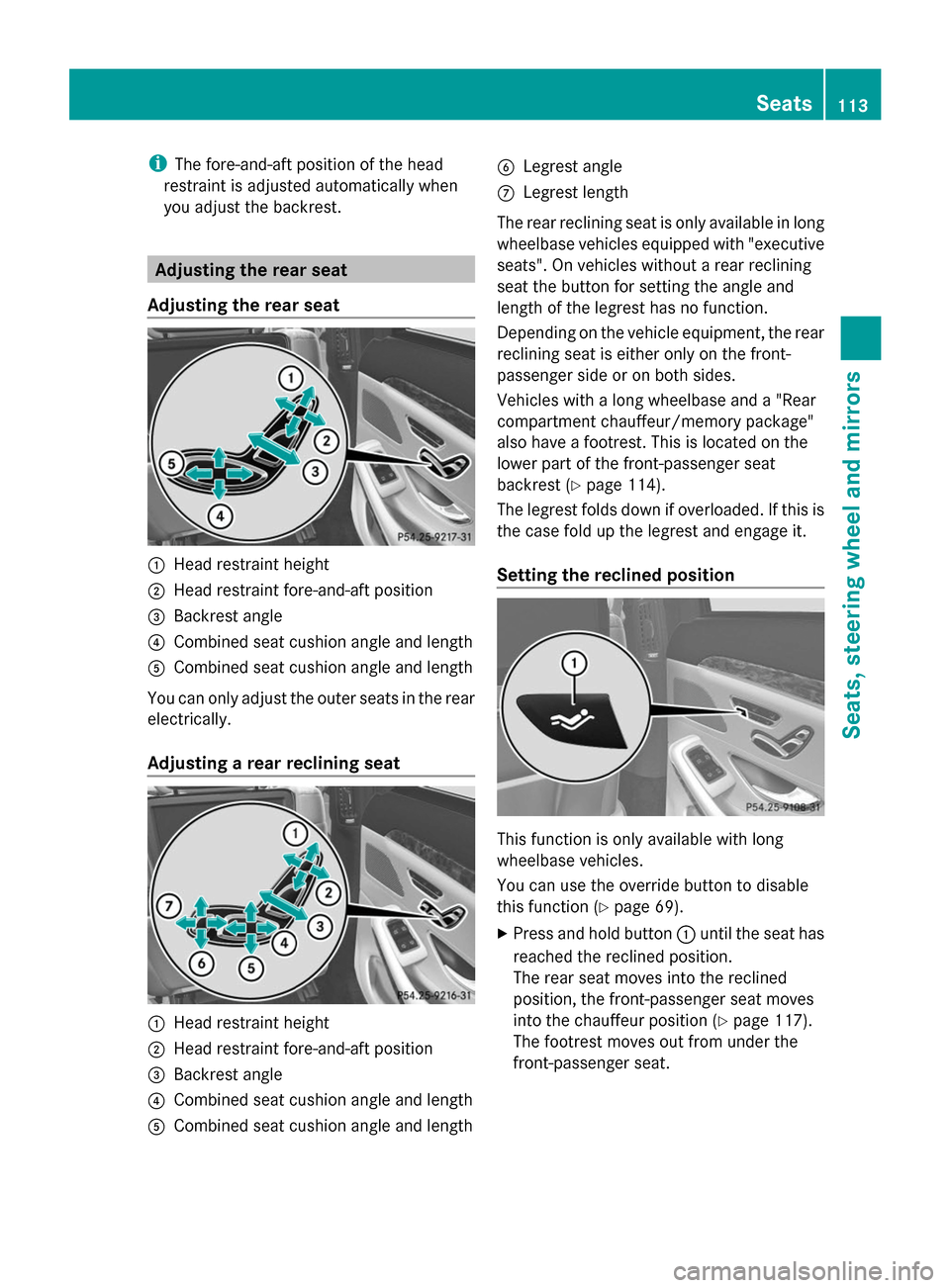
Adjusting the rear seat 0043
Head restraint height
0044 Head restraint fore-and-aft position
0087 Backrest angle
0085 Combined seat cushion angle and length
0083 Combined seat cushion angle and length
You can only adjust the outer seats in the rear
electrically.
Adjusting a rear reclining seat 0043
Head restraint height
0044 Head restraint fore-and-aft position
0087 Backrest angle
0085 Combined seat cushion angle and length
0083 Combined seat cushion angle and length 0084
Legrest angle
006B Legrest length
The rear reclining seat is only available in long
wheelbase vehicles equipped with "executive
seats". On vehicles without a rear reclining
seat the button for setting the angle and
length of the legrest has no function.
Depending on the vehicle equipment, the rear
reclining seat is either only on the front-
passenger side or on both sides.
Vehicles with a long wheelbase and a "Rear
compartment chauffeur/memory package"
also have a footrest. This is located on the
lower part of the front-passenger seat
backrest (Y page 114).
The legrest folds down if overloaded. If this is
the case fold up the legrest and engage it.
Setting the reclined position This function is only available with long
wheelbase vehicles.
You can use the override button to disable
this function (Y
page 69).
X Press and hold button 0043until the seat has
reached the reclined position.
The rear seat moves into the reclined
position, the front-passenger seat moves
into the chauffeur position (Y page 117).
The footrest moves out from under the
front-passenger seat. Seats
113Seats, steering wheel and mirrors Z
Page 116 of 434

You can exit the reclined position and
adjust the seat position by:
R calling up a stored position using
memory buttons 1or 2(Y page 134)
R manually adjusting the seat to the
desired position ( Ypage 112).
i The steps for setting the reclined position
are not always carried out simultaneously.
The legrest folds down if overloaded. If this is
the case fold up the legrest and engage it. Adjusting the front-passenger seat
from the driver’s seat
Important safety notes G
WARNING
The front-air bags for could also injure the
vehicle occupants in the front If the front
seats are positioned too close to the
dashboard or steering wheel. This poses an
increased risk of injury or even fatal injury.
Always adjust the front seats so that they are
as far from the front air bags as possible. Also
observe the notes on the correct adjustment
of the seats. G
WARNING
Children could become trapped if they adjust
the seats, particularly when unattended.
There is a risk of injury.
When leaving the vehicle, always take the
SmartKey with you and lock the vehicle. Never
leave children unsupervised in the vehicle. G
WARNING
When you adjust a seat, you or other vehicle
occupants could become trapped, e.g. on the
seat guide rail. There is a risk of injury.
Make sure when adjusting a seat that no one
has any body parts in the sweep of the seat.
! Do not move the front-passenger seat
fully forwards if there are objects in the parcel net in the front-passenger footwell.
The objects could otherwise be damaged.
Adjusting the front-passenger seat X
To select the front-passenger seat:
press button 0043repeatedly until the
indicator lamp in the button lights up.
When the indicator lamp in button 0043lights
up, for the front-passenger seat you can
adjust:
R adjust the seat (Y page 112)
R seat heating/ventilation
R the memory function to call up or save
settings (Y page 133). Adjusting the front-passenger seat
from the rear
Important safety notes G
WARNING
The front-air bags for could also injure the
vehicle occupants in the front If the front
seats are positioned too close to the
dashboard or steering wheel. This poses an
increased risk of injury or even fatal injury.
Always adjust the front seats so that they are
as far from the front air bags as possible. Also
observe the notes on the correct adjustment
of the seats. 114
SeatsSeats, steering wheel and mirrors
Page 117 of 434

G
WARNING
Children could become trapped if they adjust
the seats, particularly when unattended.
There is a risk of injury.
When leaving the vehicle, always take the
SmartKey with you and lock the vehicle. Never
leave children unsupervised in the vehicle. G
WARNING
When you adjust a seat, you or other vehicle
occupants could become trapped, e.g. on the
seat guide rail. There is a risk of injury.
Make sure when adjusting a seat that no one
has any body parts in the sweep of the seat.
! Do not move the front-passenger seat
fully forwards if there are objects in the
parcel net in the front-passenger footwell.
The objects could otherwise be damaged.
i You can use the rear-compartment
override button to disable the setting of the
front-passenger seat from the rear
(Y page 69).
Adjusting the rear seat 0043
Selects rear-compartment seat
0044 Head restraint height
0087 Head restraint fore-and-aft position
0085 Backrest angle
0083 Combined seat cushion angle and length
0084 Combined seat cushion angle and length X
To select the rear seat: press button0043
repeatedly until the indicator lamp in the
button is not lit.
The rear-compartment seat is selected if
the indicator lamp in the button is not lit.
X Adjust the rear seats with buttons 0044to
0084.
Adjusting the front-passenger seat 0043
Selects the front-passenger seat
0044 Head restraint height
0087 Backrest angle
0085 Seat height
0083 Seat fore-and-aft adjustment
X To select the front-passenger seat:
press button 0043repeatedly until the
indicator lamp in the button lights up.
The front-passenger seat is selected if the
indicator lamp in the button lights up.
X Adjust the front-passenger seat with
buttons 0044to0083. Seats
115Seats, steering wheel and mirrors Z