2014 MERCEDES-BENZ S-CLASS COUPE child restraint
[x] Cancel search: child restraintPage 10 of 413

Care
360° camera ................................ .348
Automatic car wash ....................... 343
Carpets .......................................... 351
Display .......................................... .349
Exhaust pipe .................................. 348
Exterior lighting ............................ .347
Gear or selector lever .................... 350
High-pressure cleaner .................... 345
Interior .......................................... .349
Matt paintwork .............................. 346
Night View Assist Plus ................... 349
Notes ............................................. 343
Paint .............................................. 345
Plastic trim ................................... .349
Reversing camera .......................... 347
Roof lining ...................................... 351
Seat belt ........................................ 351
Seat cover ..................................... 350
Sensors ......................................... 347
Steering wheel ............................... 350
Trim pieces ................................... .350
Washing by hand ........................... 345
Wheels .......................................... .346
Windows ........................................ 346
Wiper blades .................................. 347
Wooden trim .................................. 350
CD player/CD changer(on-board
computer) .......................................... 253
Central locking
Locking/unlocking (key ).................. 85
Centre console
Overview .......................................... 36
Stowage space .............................. 315
Centre console in the rear com-
partment
Stowage compartment .................. 317
Child seat
Forward-facing restraint system ...... 64
ISOFIX .............................................. 62
On the front-passenger sea t............ 63
Rearward-facing restraint system .... 64
Recommendations ........................... 67
Suitable positions ............................ 65
Top Tether ....................................... 62
Children
In the vehicle ................................... 60
Restraint systems ............................ 61 Cigarette lighter
................................ 322
Cleaning
Mirror turn signal ........................... 347
Climate control
Automatic air conditioning ............. 137
Auxiliary heating/ventilation .......... 148
Controlling automaticall y............... 141
Convenience opening/closing
(air-recirculation mode) ................. 145
Cooling with air dehumidification .. 139
Demisting the windows .................. 143
Demisting the windscreen ............. 143
ECO start/stop function ................ 138
Important safety notes .................. 136
Indicator lamp ................................ 141
Ionisation ....................................... 148
Notes on using the automatic cli-
mate control .................................. 138
Overview of systems ...................... 136
Perfume atomizer .......................... 146
Problem with the rear window
heating .......................................... 145
Problems with cooling with air
dehumidification ............................ 141
Setting the air distribution ............. 142
Setting the air vents ...................... 154
Setting the airflow ......................... 143
Setting the climate mod e............... 142
Setting the temperature ................ 142
Switching air-recirculation mode
on/of f............................................ 145
Switching on/of f........................... 139
Switching residual heat on/off ...... 146
Switching the rear window heat-
ing on/of f...................................... 144
Switching the synchronisation
function on and off ........................ 143
Cockpit
Overview .......................................... 30
COLLISION PREVENTION ASSIST
PLUS
Activating/deactivating ................. 258
Display message ............................ 273
Operation/note s.............................. 72
COMAND display
Cleaning ......................................... 349
Combination switch .......................... 126 Index
7
Page 15 of 413

Opening/closing the garage door .. 330
Programming (button in the rear-
view mirror) ................................... 328
Gear indicator (on-board com-
puter) .................................................. 263
Gearshift program
SETUP (on-board computer) ..........2 64
Genuine Mercedes-Benz parts ........... 22
Glove compartment .......................... 315H
Handbrake see Parking brake
HANDS-FREE ACCESS .......................... 96
Hazard warning lamps ......................126
Head restraints
Adjusting ....................................... 109
Adjusting (manually) ..................... .109
Adjusting (rear) .............................. 110
Head-up display
Adjusting the brightness ................ 260
Function/notes ............................ .245
Important safety notes .................. 245
Setting the position ....................... 260
Storing settings (memory func-
tion) ............................................... 120
Switching on or off ......................... 245
Switching the display on/off ......... 259
Headbag
Display message ............................ 276
Headlamp flasher .............................. 126
Headlamps
Misting up ...................................... 130
see Automatic headlamp mode
Heater booster function ................... 152
Heating
see Climate control
High-pressure cleaners .................... 345
Hill start assist .................................. 162
HOLD function
Activating ....................................... 203
Deactivating ................................... 203
Display message ............................ 289
Function/notes ............................ .202
Horn ...................................................... 30 I
Ignition lock see Key positions
Immobiliser .......................................... 80
Indicator and warning lamp
Restraint system ............................ 306
Indicator and warning lamps
COLLISION PREVENTION ASSIST
PLUS .............................................. 309
Coolant .......................................... 307
Engine diagnostics ......................... 307
Indicator lamps
Display message ............................ 279
see Warning and indicator lamps
Indicators
see Turn signals
Insect protection on the radiator .... 338
Instrument cluster
Overview .......................................... 32
Warning and indicator lamps ........... 33
Instrument cluster lighting ................ 34
Intelligent Light System
Activating/deactivating ................. 260
Display message ............................ 281
Overview ........................................ 127
Setting the dipped-beam head-
lamps for driving on the right/left .. 261
Interior lighting
Control .......................................... .130
Emergency lighting ........................ 131
Overview ........................................ 130
Reading lamp ................................. 130
Interior motion sensor
Deactivating ..................................... 82
Function .......................................... .81
Priming ............................................ 81
Switching off .................................... 82
ISOFIX child seat securing system ....62 J
Jack Storage location ............................3 55
Using ............................................. 387
Jump starting (engine) ......................364 12
Index
Page 20 of 413

Restraint system
Display messag e............................ 275
Introduction ..................................... 42
Warning lamp ................................. 306
Warning lamp (function) ................... 43
Rev counter ........................................ 242
Reversing camera
Cleaning instructions ..................... 347
Function/note s............................. 217
Switching on/of f........................... 218
Reversing feature
Side windows ................................... 99
Reversing function
Boot lid ............................................ 94
Roller sunblind ............................... 102
Reversing lamp (display message) .. 281
ROAD SURFACE SCAN ....................... 206
Roller sunblind
Panorama roof ............................... 102
Rear window .................................. 322
Roller sunblind of the panorama
roof
Opening and closing ...................... 103
Operating ....................................... 102
Resetting ....................................... 103
Roof lining and carpets (cleaning
instructions) ...................................... 351
Roof load (maximum) ........................ 408S
Safety Automatic front-passenger front
airbag deactivation system .............. 51
Child restraint systems .................... 61
Children in the vehicle ..................... 60
see Operating safety
Safety system
see Driving safety systems
Seat
Seat backrest display message ..... 297
Seat belt
Correct usage .................................. 45
Seat belts
Adjusting the driver's and front-
passenger seat belt ......................... 47
Cleaning ......................................... 351
Display message ............................ 274 Fastening ......................................... 46
Important safety guidelines ............. 44
Introduction ..................................... 44
Rear seat belt status indicator ......... 48
Releasing ......................................... 47
Warning lamp ................................. 300
Warning lamp (function) ................... 47
Seating
Seating comfort packag e............... 111
Seating comfort package ................. 111
Seats
Active multicontour seat ................ 111
Adjusting (electrically) ................... 108
Adjusting the 4-way lumbar sup-
port ................................................ 111
Adjusting the head restraint .......... 109
Cleaning the cover ......................... 350
Correct driver's seat position ........ 106
EASY-ENTRY/EXIT system ............. 116
Folding the backrests forward/
back ............................................... 110
Important safety notes .................. 107
Seat heating .................................. 111
Seat heating problem .................... 113
Seat ventilation .............................. 113
Seat ventilation problem ................ 114
Storing settings (memory func-
tion) ............................................... 120
Switching seat heating on/of f....... 111
Switching the seat ventilation on/ off .................................................. 113
Section
Wheels and tyres ........................... 376
Selector lever
Cleaning ......................................... 350
see Automatic transmission
Sensors (cleaning instructions) ....... 347
Service
see ASSYST PLUS
Service Centre
see Qualified specialist workshop
Service menu (on-board com-
puter) .................................................. 256
Service products
Brake fluid ..................................... 406
Coolant (engine) ............................ 406
Engine oil ....................................... 405
Fuel ................................................ 403 Index
17
Page 45 of 413
Useful information
i This Owner's Manual describes all mod-
els, series and optional equipment for your
vehicle that were available at the time of
going to press. National variations are pos- sible. Note that your vehicle may not be
equipped with all of the functions descri-
bed. This is also the case for systems and
functions relevant to safety.
i Read the information on qualified special-
ist workshops: (Y page 25). Panic alarm
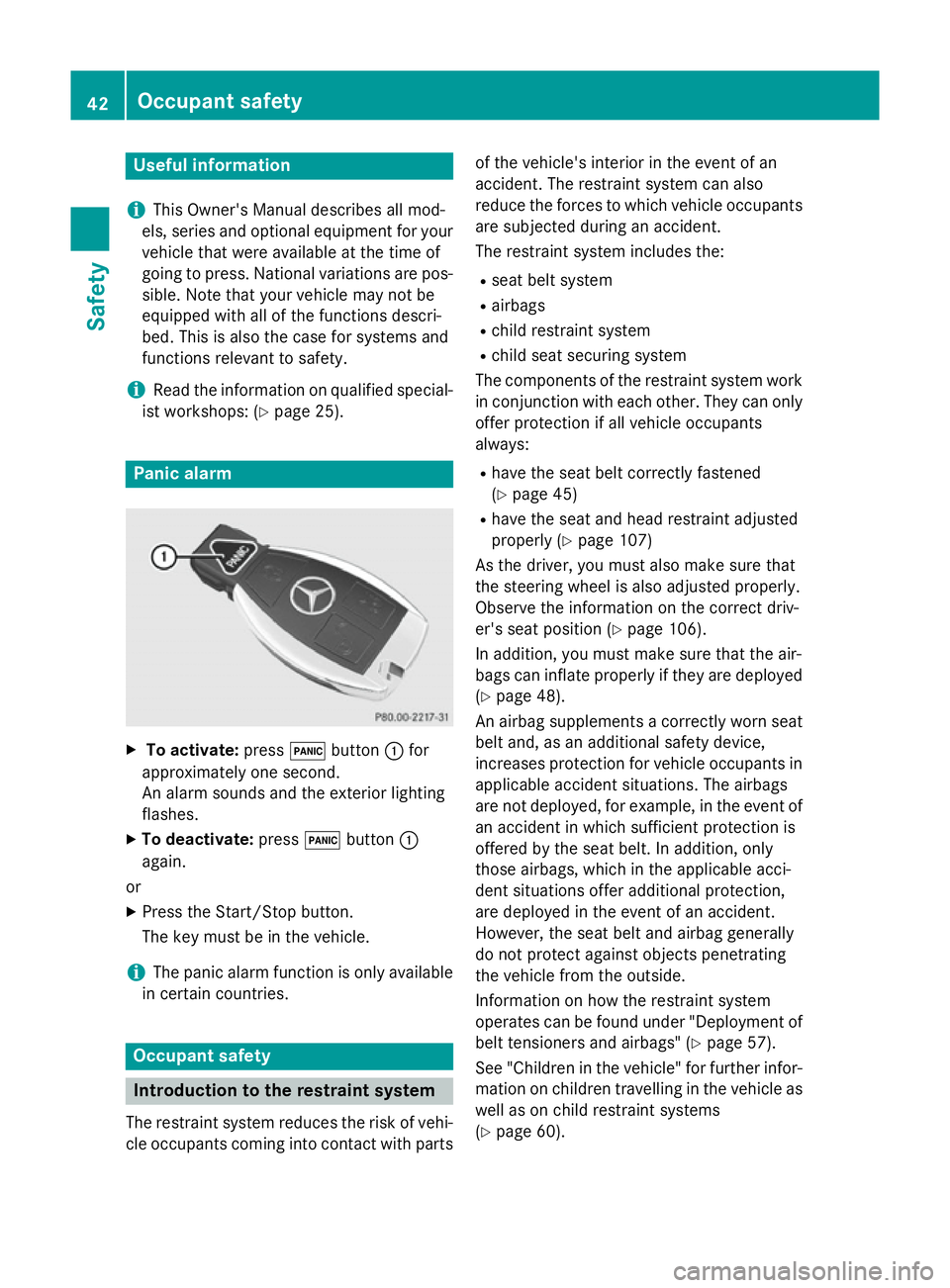
X
To activate: press!button :for
approximately one second.
An alarm sounds and the exterior lighting
flashes.
X To deactivate: press!button :
again.
or
X Press the Start/Stop button.
The key must be in the vehicle.
i The panic alarm function is only available
in certain countries. Occupant safety
Introduction to the restraint system
The restraint system reduces the risk of vehi-
cle occupants coming into contact with parts of the vehicle's interior in the event of an
accident. The restraint system can also
reduce the forces to which vehicle occupants
are subjected during an accident.
The restraint system includes the:
R seat belt system
R airbags
R child restraint system
R child seat securing system
The components of the restraint system work
in conjunction with each other. They can only
offer protection if all vehicle occupants
always:
R have the seat belt correctly fastened
(Y page 45)
R have the seat and head restraint adjusted
properly (Y page 107)
As the driver, you must also make sure that
the steering wheel is also adjusted properly.
Observe the information on the correct driv-
er's seat position (Y page 106).
In addition, you must make sure that the air-
bags can inflate properly if they are deployed (Y page 48).
An airbag supplements a correctly worn seat
belt and, as an additional safety device,
increases protection for vehicle occupants in
applicable accident situations. The airbags
are not deployed, for example, in the event of an accident in which sufficient protection is
offered by the seat belt. In addition, only
those airbags, which in the applicable acci-
dent situations offer additional protection,
are deployed in the event of an accident.
However, the seat belt and airbag generally
do not protect against objects penetrating
the vehicle from the outside.
Information on how the restraint system
operates can be found under "Deployment of
belt tensioners and airbags" (Y page 57).
See "Children in the vehicle" for further infor- mation on children travelling in the vehicle as
well as on child restraint systems
(Y page 60). 42
Occupant safetySafety
Page 46 of 413
Important safety notes
G
WARNING
If the restraint system is modified, it may no
longer work as intended. The restraint system
may then not perform its intended protective function by failing in an accident or triggering
unexpectedly, for example. There is an
increased risk of injury, possibly even fatal.
Never modify parts of the restraint system. Do not attempt to modify the wiring as well as
electronic components or their software.
If it is necessary to modify an airbag system to
accommodate a person with disabilities, con- tact an authorised Mercedes-Benz Centre. Restraint system warning lamp
The functions of the restraint system are
checked after the ignition is switched on and at regular intervals while the engine is run-
ning. Therefore, malfunctions can be detec-
ted in good time.
The 6 restraint system warning lamp in
the instrument cluster lights up when the igni- tion is switched on. It goes out no later than afew seconds after the engine is started. The
components of the restraint system are in
operational readiness.
A malfunction has occurred if the 6
restraint system warning lamp:
R does not light up after the ignition is
switched on
R does not go out after a few seconds with
the engine running
R lights up again while the engine is running G
WARNING
If the restraint system is malfunctioning,
restraint system components may be trig-
gered unintentionally or might not be trig-
gered at all in the event of an accident with a high rate of vehicle deceleration. This can
effect belt tensioners or airbags, for example. There is an increased risk of serious or even
fatal injuries.
Have the restraint system checked and
repaired immediately at a qualified specialist
workshop.
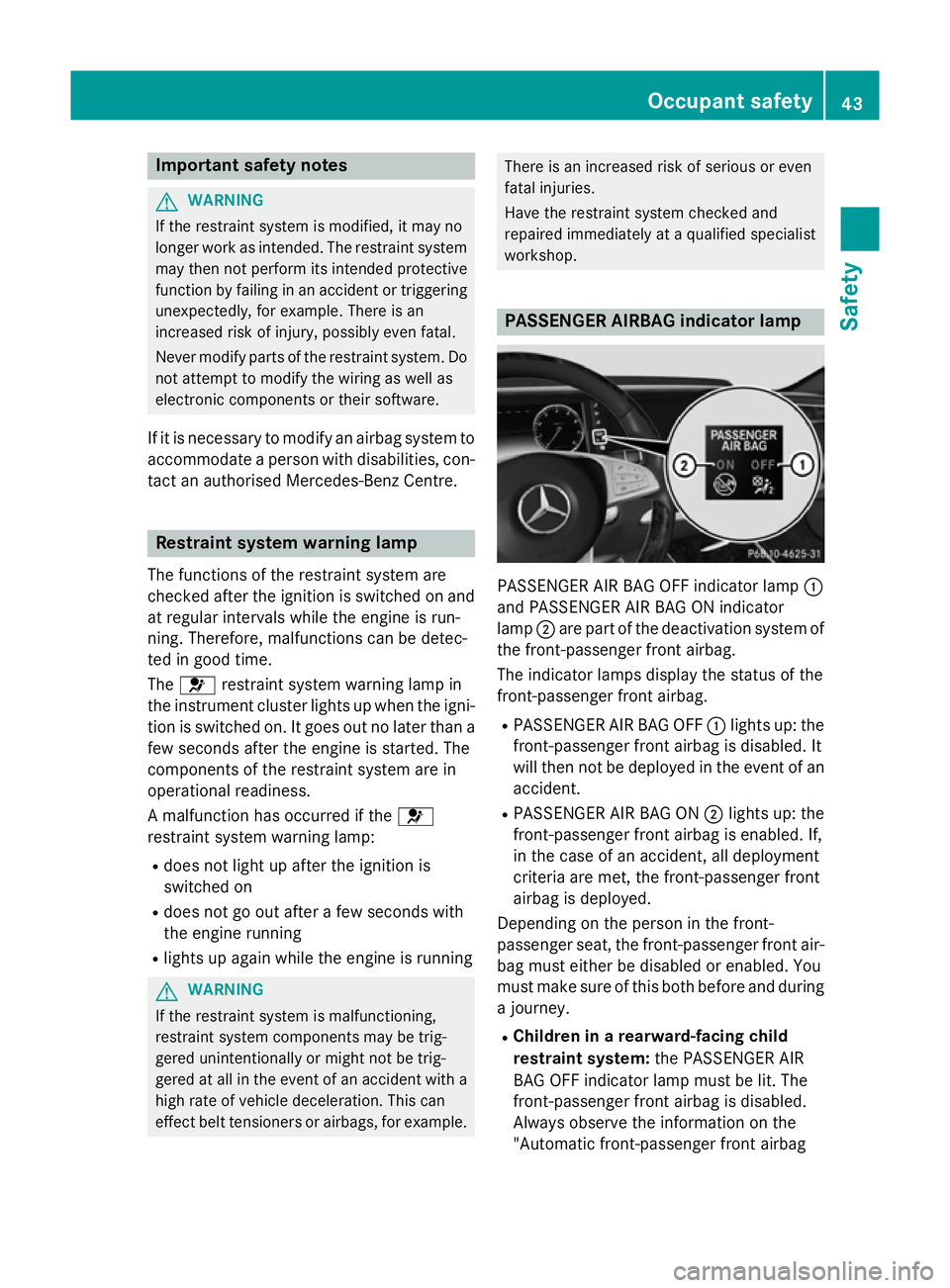
PASSENGER AIRBAG indicator lamp
PASSENGER AIR BAG OFF indicator lamp
:
and PASSENGER AIR BAG ON indicator
lamp ;are part of the deactivation system of
the front-passenger front airbag.
The indicator lamps display the status of the
front-passenger front airbag.
R PASSENGER AIR BAG OFF :lights up: the
front-passenger front airbag is disabled. It
will then not be deployed in the event of an
accident.
R PASSENGER AIR BAG ON ;lights up: the
front-passenger front airbag is enabled. If,
in the case of an accident, all deployment
criteria are met, the front-passenger front
airbag is deployed.
Depending on the person in the front-
passenger seat, the front-passenger front air-
bag must either be disabled or enabled. You
must make sure of this both before and during a journey.
R Children in a rearward-facing child
restraint system: the PASSENGER AIR
BAG OFF indicator lamp must be lit. The
front-passenger front airbag is disabled.
Always observe the information on the
"Automatic front-passenger front airbag Occupant safety
43Safety Z
Page 47 of 413
deactivation system" (Y
page 51) and on
"Children in the vehicle" (Y page 60).
R Children in a forward-facing child
restraint system: depending on the instal-
led child restraint system, the age and size of the child the front-passenger front airbag
is either disabled or enabled. Therefore,
always observe the information on the
"Automatic front-passenger front airbag
deactivation system" (Y page 51) and on
"Children in the vehicle" (Y page 60).
R All other persons: the PASSENGER AIR
BAG ON indicator lamp must be lit. The
front-passenger front airbag is enabled.
Depending on the build of the person on the front-passenger seat, the PASSENGER AIR
BAG OFF indicator lamp may light up. The
front-passenger front airbag is disabled. It
will then not be deployed in the event of an
accident. In this case, the front-passenger
seat should not be used.
Always observe the information on the
"Automatic front-passenger front airbag
deactivation system" (Y page 51) as well
as on "Seat belts" (Y page 44) and "Air-
bags" (Y page 48). There you can also find
information on the correct seat position. Seat belts
Introduction A correctly fastened seat belt is the most
effective means of limiting the movement of a
vehicle occupant during a collision or in the
event that the vehicle overturns. This reduces
the risk of vehicle occupants coming into con- tact with parts of the vehicle interior or beingejected from it. Furthermore, the seat belt
helps to keep the vehicle occupant in the best
position in relation to a deployed airbag.
The seat belt system consists of:
R seat belts
R belt tensioners and belt force limiters If the seat belt is pulled quickly or suddenly on
the seat-belt extender, the inertia reel locks.
The belt strap cannot be pulled out further.
In an impact, the belt tensioner tightens the
belt to pull it close to the body. It does not pull
the vehicle occupant back in the direction of
the seat backrest, however.
In addition, the belt tensioner cannot com-
pensate for the seat position being incorrect
or for an incorrectly worn seat belt.
When triggered, seat belt force limiters help
to reduce the peak force exerted by the seat
belt on the vehicle occupant.
The belt force limiters on the front seats are
synchronised with the front airbags, which
take on a part of the deceleration force. This
helps to reduce the forces to which vehicle
occupants are subjected during an accident.
! If the co-driver's seat is not occupied, do
not engage the seat belt tongue in the
buckle on the co-driver's seat. Otherwise,
the belt tensioner could be triggered in the
event of an accident and would have to be
replaced.
Important safety notes G
WARNING
The seat belt cannot perform its intended pro- tective function if it is not fastened correctly. Also, an improperly fastened seat belt can
cause additional injuries in the event of an
accident, sudden braking or abrupt changes
of direction. There is an increased risk of
injury, possibly even fatal.
Always make sure that all vehicle occupants
are wearing their seat belt properly and are
seated correctly. G
WARNING
The seat belt does not offer the intended level of protection if you have not moved the back-
rest to an almost vertical position. When brak-
ing or in the event of an accident, you could
slide underneath the seat belt and sustain
abdomen or neck injuries, for example. This 44
Occupant safetySafety
Page 48 of 413

poses an increased risk of injury or even fatal
injury.
Adjust the seat properly before beginning
your journey. Always ensure that the backrestis in an almost vertical position and that the
shoulder section of your seatbelt is routed
across the centre of your shoulder. G
WARNING
Persons under 1.50 mtall cannot wear the
seat belts correctly without a suitable, addi-
tional restraint system. The seat belt cannot
perform its intended protective function if it is not fastened correctly. Also, an improperly
fastened seat belt can cause additional inju-
ries in the event of an accident, sudden brak-
ing or abrupt changes of direction. There is an increased risk of injury, possibly even fatal.
Secure persons less than 1.50 mtall in a suit-
able restraint system.
If a child younger than 12 years old and under 1.50 m in height is travelling in the vehicle:
R always secure the child in a child restraint
system suitable for this Mercedes-Benz
vehicle. The child restraint system must be appropriate to the age, weight and size of
the child
R be sure to observe the instructions and
safety notes on the automatic front-
passenger front airbag deactivation system
(Y page 51)
R always observe the instructions and safety
notes on "Children in the vehicle" in this
Owner's Manual (Y page 60) in addition
to the child restraint system manufactur-
er's installation instructions G
WARNING
Seat belts cannot protect as intended, if:
R they are damaged, have been modified, are
extremely dirty, bleached or dyed
R the seat belt buckle is damaged or
extremely dirty
R modifications have been made to the belt
tensioners, belt anchorages or inertia reels Seat belts may sustain non-visible damage in
an accident, e.g. due to glass splinters. Modi-
fied or damaged seat belts can tear or fail, for example in the event of an accident. Modified
seat belt tensioners may be deployed unin-
tentionally or fail to be deployed when
required. There is an increased risk of injury,
possibly even fatal.
Never modify safety belts, seat belt tension-
ers, seat belt anchorages and inertia reels.
Ensure that seat belts are not damaged or
worn and are clean. After an accident, have
the seat belts checked immediately at a quali- fied specialist workshop.
Mercedes-Benz recommends that you only
use seat belts which have been approved
specifically for your vehicle by Mercedes-
Benz.
Correct seat belt use Observe the safety notes on the seat belt
(Y page 44).
All vehicle occupants must be wearing the
seat belt correctly before beginning the jour-
ney. Also make sure that all vehicle occu-
pants are always wearing the seat belt cor-
rectly while the vehicle is in motion.
When fastening the seat belt, always make
sure that:
R the seat belt tongue is only inserted to the
belt buckle belonging to that seat.
R the seat belt is tight across your body.
Avoid wearing bulky clothing, e.g. a winter
coat.
R the seat belt is not twisted.
Only then can the forces which occur be
distributed over the area of the belt.
R the shoulder section of the belt is always
routed across the centre of your shoulder.
The shoulder section of the belt must not
come into contact with your neck or be
routed under your arm.
R the lap belt passes across your lap as
tightly and as low down as possible. Occupant safety
45Safety Z
Page 52 of 413

R
Only hold the steering wheel on the out-
side. This allows the airbag to be fully
deployed.
R Always lean against the backrest while driv-
ing. Do not lean forwards or lean against
the door or side window. You may other-
wise be in the deployment area of the air-
bags.
R Always keep your feet in the footwell in
front of the seat. Do not put your feet on the
dashboard, for example. Your feet may oth-
erwise be in the deployment area of the
airbag.
R For this reason, always secure persons less
than 1.50 m tall in suitable restraint sys-
tems. Up to this height, the seat belt cannot
be worn correctly.
If a child is travelling in your vehicle, also
observe the following notes:
R Always secure children under 12 years of
age and less than 1.50 m tall in suitable
child restraint systems.
R Child restraint systems should be fitted to
the rear seats.
R Only secure a child to the front-passenger
seat when the front-passenger front airbag
is disabled, and only then in a rearward-
facing child restraint system. If the
PASSENGER AIR BAG OFF indicator lamp is permanently lit, the front-passenger front
airbag is disabled (Y page 43).
R Always observe the instructions and safety
notes on the automatic front-passenger
front airbag deactivation system
(Y page 51) and on "Children in the vehi-
cle" (Y page 60) in addition to the child
restraint system manufacturer's installa-
tion instructions. Objects in the vehicle interior may pre-
vent the airbag from functioning cor-
rectly.
Before starting your journey and to
avoid risks resulting from the speed of the
airbag as it deploys, make sure that:
R there are no people, animals or objects
between the vehicle occupants and an air-
bag.
Do not place any objects on the dashboard
e.g. above the front-passenger front airbag.
R there are no objects between the seat, door
and B-pillar.
R no hard objects, e.g. coat hangers, hang on
the grab handles or coat hooks.
R no accessories, such as cup holders, are
attached to the vehicle within the deploy-
ment area of an airbag, e.g. to doors, side
windows, rear side trim or side walls.
R no heavy, sharp-edged or fragile objects
are in the pockets of your clothing. Store
such objects in a suitable place. G
WARNING
If you modify an airbag cover or affix objects
such as stickers to it, the airbag can no longer function correctly. There is an increased risk
of injury.
Never modify an airbag cover or affix objects
to it. G
WARNING
Sensors to control the airbags are located in
the doors. Modifications or work not per-
formed correctly to the doors or door panel-
ling, as well as damaged doors, can lead to the function of the sensors being impaired. The
airbags might therefore not function properly any more. Consequently, the airbags cannot
protect vehicle occupants as they are
designed to do. This poses an increased risk
of injury.
Never modify the doors or parts of the doors.
Always have work on the doors or door pan-
elling carried out at a qualified specialist
workshop. Occupant safety
49Safety Z