2014 MERCEDES-BENZ GL ECU
[x] Cancel search: ECUPage 89 of 462
Unlocking and opening doors from
the inside
You can open a door from inside the vehicle
even if it has been locked. You can only open
the rear doors from inside the vehicle if they
are not secured by the child-proof locks
(Ypage 66).
If the vehicle has been locked with the
SmartKey or with KEYLESS-GO, opening a
door from the inside will trigger the anti-theft
alarm system. Switch off the alarm
(Ypage 77).
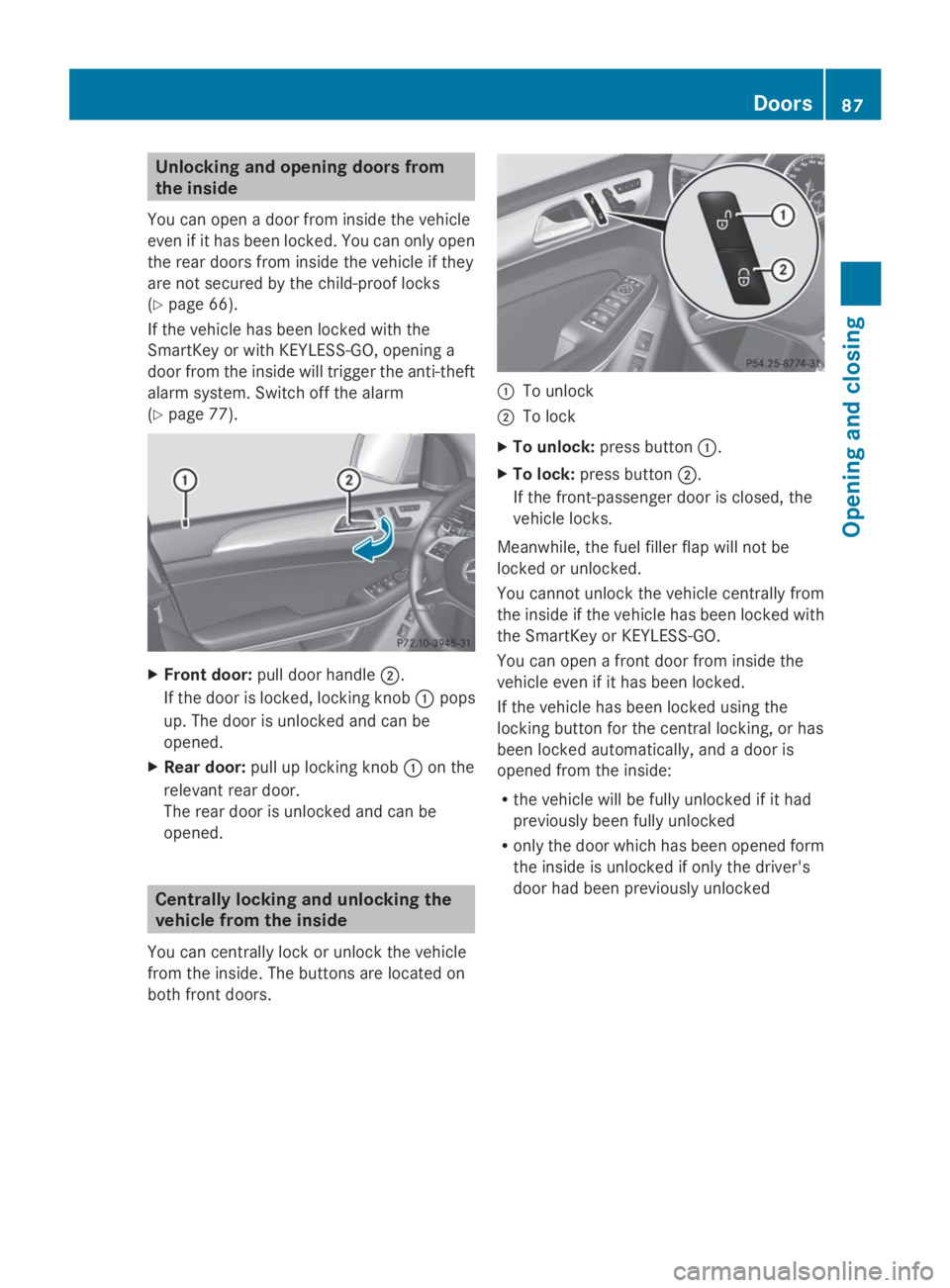
XFront door:pull door handleD.
If the door is locked, locking knobCpops
up. The door is unlocked and can be
opened.
XRear door:pull up locking knobCon the
relevant rear door.
The rear door is unlocked and can be
opened.
Centrally locking and unlocking the
vehicle from the inside
You can centrally lock or unlock the vehicle
from the inside. The buttons are located on
both front doors.
CTo unlock
DTo lock
XTo unlock:press buttonC.
XTo lock:press buttonD.
If the front-passenger door is closed, the
vehicle locks.
Meanwhile, the fuel filler flap will not be
locked or unlocked.
You cannot unlock the vehicle centrally from
the inside if the vehicle has been locked with
the SmartKey or KEYLESS-GO.
You can open a front door from inside the
vehicle even if it has been locked.
If the vehicle has been locked using the
locking button for the central locking, or has
been locked automatically, and a door is
opened from the inside:
Rthe vehicle will be fully unlocked if it had
previously been fully unlocked
Ronly the door which has been opened form
the inside is unlocked if only the driver's
door had been previously unlocked
Doors87
Opening and closing
Z
Page 91 of 462
XTake the mechanical key out of the
SmartKey (Ypage 82).
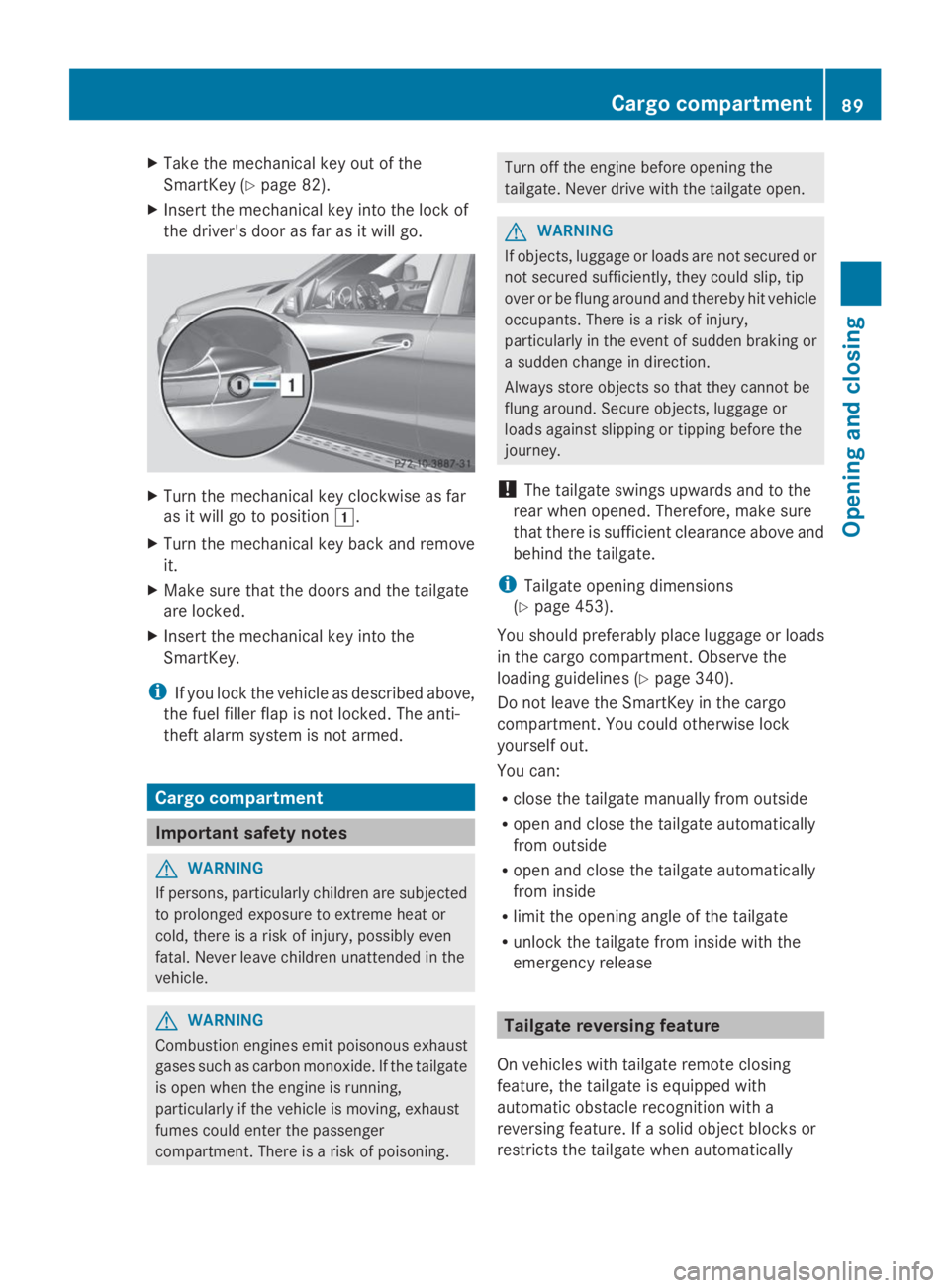
XInsert the mechanical key into the lock of
the driver's door as far as it will go.
XTurn the mechanical key clockwise as far
as it will go to positionG.
XTurn the mechanical key back and remove
it.
XMake sure that the doors and the tailgate
are locked.
XInsert the mechanical key into the
SmartKey.
iIf you lock the vehicle as described above,
the fuel filler flap is not locked. The anti-
theft alarm system is not armed.
Cargo compartment
Important safety notes
GWARNING
If persons, particularly children are subjected
to prolonged exposure to extreme heat or
cold, there is a risk of injury, possibly even
fatal. Never leave children unattended in the
vehicle.
GWARNING
Combustion engines emit poisonous exhaust
gases such as carbon monoxide. If the tailgate
is open when the engine is running,
particularly if the vehicle is moving, exhaust
fumes could enter the passenger
compartment. There is a risk of poisoning.
Turn off the engine before opening the
tailgate. Never drive with the tailgate open.
GWARNING
If objects, luggage or loads are not secured or
not secured sufficiently, they could slip, tip
over or be flung around and thereby hit vehicle
occupants. There is a risk of injury,
particularly in the event of sudden braking or
a sudden change in direction.
Always store objects so that they cannot be
flung around. Secure objects, luggage or
loads against slipping or tipping before the
journey.
!The tailgate swings upwards and to the
rear when opened. Therefore, make sure
that there is sufficient clearance above and
behind the tailgate.
iTailgate opening dimensions
(Ypage 453).
You should preferably place luggage or loads
in the cargo compartment. Observe the
loading guidelines (Ypage 340).
Do not leave the SmartKey in the cargo
compartment. You could otherwise lock
yourself out.
You can:
Rclose the tailgate manually from outside
Ropen and close the tailgate automatically
from outside
Ropen and close the tailgate automatically
from inside
Rlimit the opening angle of the tailgate
Runlock the tailgate from inside with the
emergency release
Tailgate reversing feature
On vehicles with tailgate remote closing
feature, the tailgate is equipped with
automatic obstacle recognition with a
reversing feature. If a solid object blocks or
restricts the tailgate when automatically
Cargo compartment89
Opening and closing
Z
Page 110 of 462
we strongly recommend that children be
placed in the rear seat whenever possible.
Regardless of seating position, children 12
years old and under must be seated and
properly secured in an appropriately sized
child restraint system or booster seat
recommended for the size and weight of the
child. For additional information, see the
"Children in the vehicle" section.
A child's risk of serious or fatal injuries is
significantly increased if the child restraints
are not properly secured in the vehicle and/
or the child is not properly secured in the child
restraint.
!To avoid damage to the seats and the seat
heating, observe the following information:
Rkeep liquids from spilling on the seats. If
liquid is spilled on the seats, dry them as
soon as possible.
Rif the seat covers are damp or wet, do not
switch on the seat heating. The seat
heating should also not be used to dry
the seats.
Rclean the seat covers as recommended;
see "Interior care".
Rdo not transport heavy loads on the
seats. Do not place sharp objects on the
seat cushions, e.g. knives, nails or tools.
The seats should only be occupied by
passengers, if possible.
Rwhen the seat heating is in operation, do
not cover the seats with insulating
materials, e.g. blankets, coats, bags,
seat covers, child seats or booster seats.
!Make sure that there are no objects in the
footwell or behind the seats when resetting
the seats. There is a risk that the seats
and/or the objects could be damaged.
iIt is not possible to remove the head
restraints from the front seats. The rear-
compartment head restraints, however,
can be removed (Ypage 110).
For more information, contact a qualified
specialist workshop.
iFurther related subjects:
RImportant safety notes on air bags
(Ypage 44)
RCargo compartment enlargement
(folding down the rear bench seat)
(Ypage 344)
RSecuring children in the vehicle
(Ypage 60)
Adjusting the seats electrically
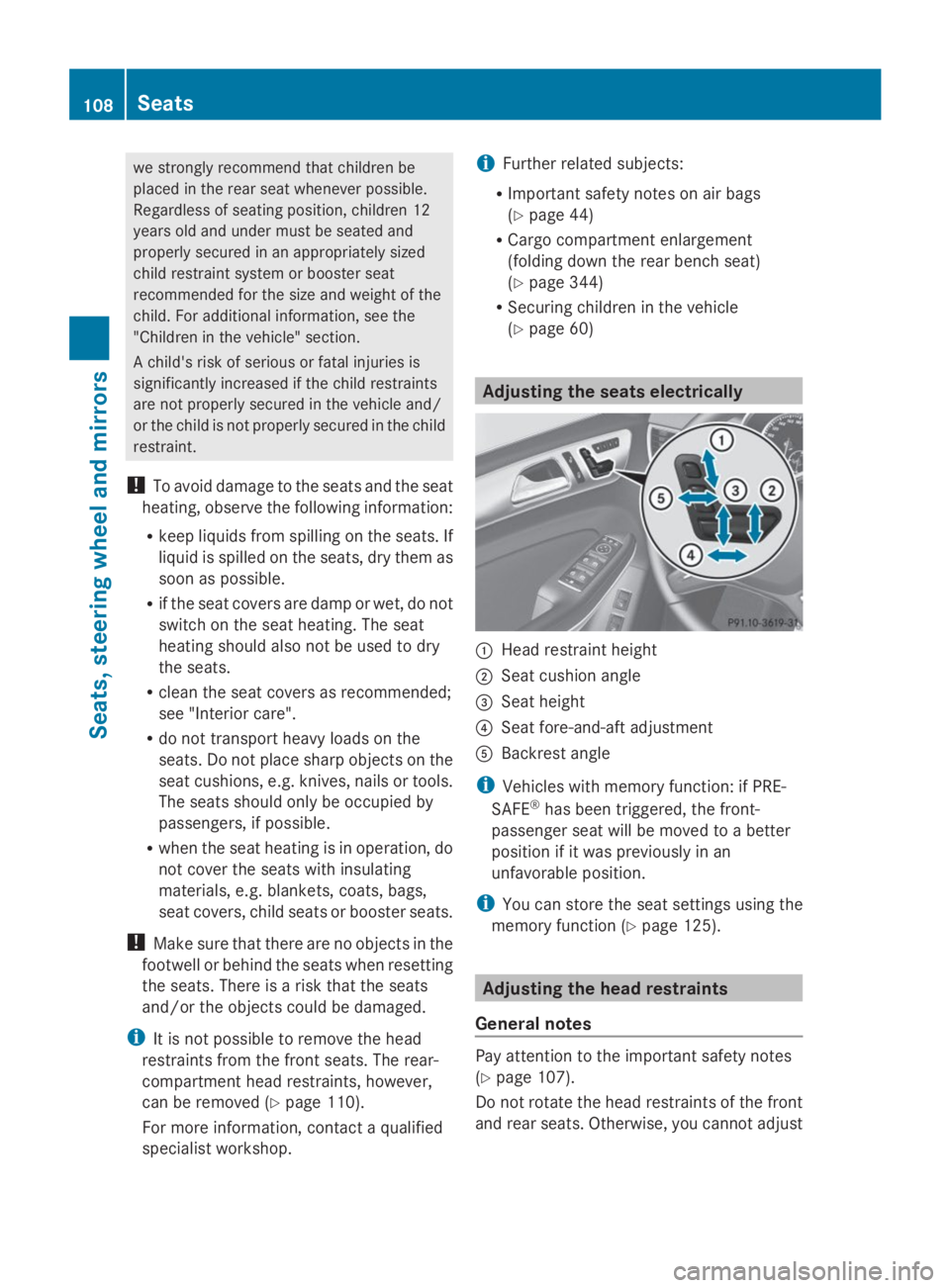
CHead restraint height
DSeat cushion angle
Page 116 of 462
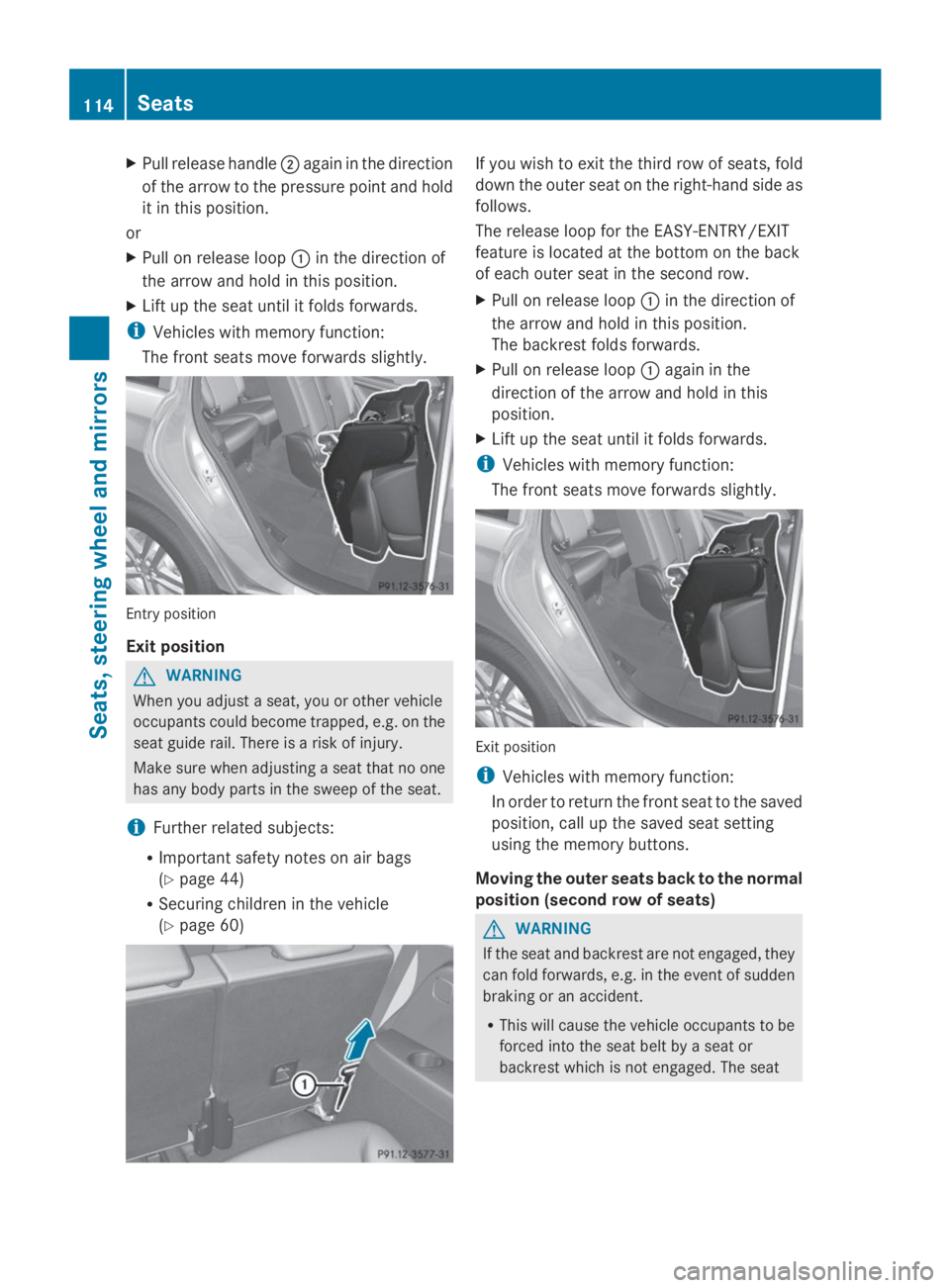
XPull release handleDagain in the direction
of the arrow to the pressure point and hold
it in this position.
or
XPull on release loopCin the direction of
the arrow and hold in this position.
XLift up the seat until it folds forwards.
iVehicles with memory function:
The front seats move forwards slightly.
Entry position
Exit position
GWARNING
When you adjust a seat, you or other vehicle
occupants could become trapped, e.g. on the
seat guide rail. There is a risk of injury.
Make sure when adjusting a seat that no one
has any body parts in the sweep of the seat.
iFurther related subjects:
RImportant safety notes on air bags
(Ypage 44)
RSecuring children in the vehicle
(Ypage 60)
If you wish to exit the third row of seats, fold
down the outer seat on the right-hand side as
follows.
The release loop for the EASY-ENTRY/EXIT
feature is located at the bottom on the back
of each outer seat in the second row.
XPull on release loopCin the direction of
the arrow and hold in this position.
The backrest folds forwards.
XPull on release loopCagain in the
direction of the arrow and hold in this
position.
XLift up the seat until it folds forwards.
iVehicles with memory function:
The front seats move forwards slightly.
Exit position
iVehicles with memory function:
In order to return the front seat to the saved
position, call up the saved seat setting
using the memory buttons.
Moving the outer seats back to the normal
position (second row of seats)
GWARNING
If the seat and backrest are not engaged, they
can fold forwards, e.g. in the event of sudden
braking or an accident.
RThis will cause the vehicle occupants to be
forced into the seat belt by a seat or
backrest which is not engaged. The seat
114Seats
Seats, steering wheel and mirrors
Page 140 of 462
Overview: changing bulbs/bulb types
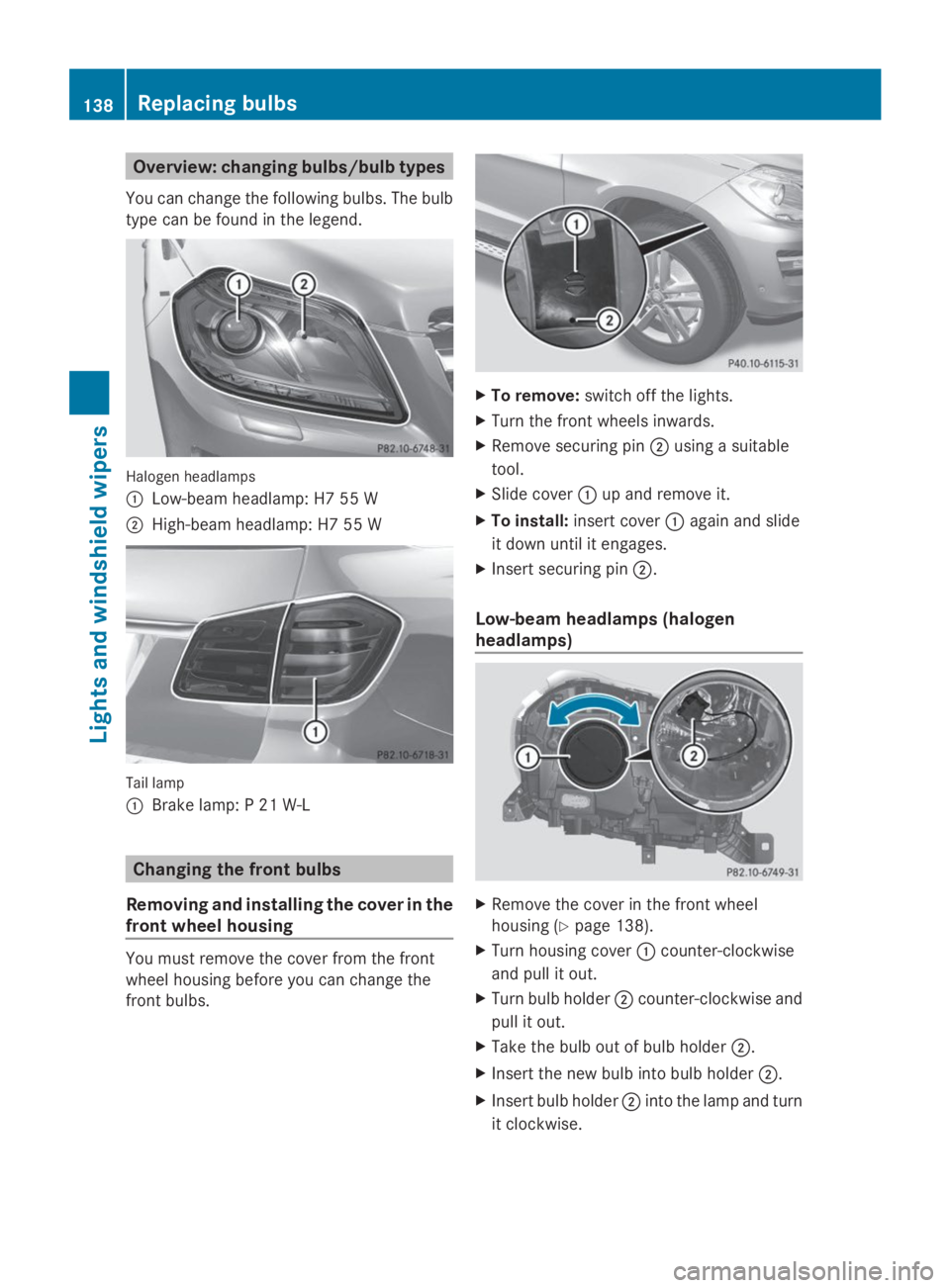
You can change the following bulbs. The bulb
type can be found in the legend.
Halogen headlamps
CLow-beam headlamp: H7 55 W
DHigh-beam headlamp: H7 55 W
Tail lamp
CBrake lamp: P 21 W-L
Changing the front bulbs
Removing and installing the cover in the
front wheel housing
You must remove the cover from the front
wheel housing before you can change the
front bulbs.
XTo remove:switch off the lights.
XTurn the front wheels inwards.
XRemove securing pinDusing a suitable
tool.
XSlide coverCup and remove it.
XTo install:insert coverCagain and slide
it down until it engages.
XInsert securing pinD.
Low-beam headlamps (halogen
headlamps)
XRemove the cover in the front wheel
housing (Ypage 138).
XTurn housing coverCcounter-clockwise
and pull it out.
XTurn bulb holderDcounter-clockwise and
pull it out.
XTake the bulb out of bulb holderD.
XInsert the new bulb into bulb holderD.
XInsert bulb holderDinto the lamp and turn
it clockwise.
138Replacing bulbs
Lights and windshield wipers
Page 177 of 462
Using the SmartKey:
RMake sure that the ignition is switched on.
RWhen the vehicle is stationary, depress the
brake pedal and keep it depressed.
RShift to neutralN.
RRelease the brake pedal.
RIf the electric parking brake is engaged,
release it.
RSwitch off the ignition and leave the
SmartKey in the ignition lock.
Using KEYLESS-GO:
RMake sure that the ignition is switched on.
RWhen the vehicle is stationary, depress the
brake pedal and keep it depressed.
REngage park positionP.
RRelease the brake pedal.
RRemove the Start/Stop button from the
ignition lock.
RInsert the SmartKey into the ignition lock.
RSwitch on the ignition.
RDepress the brake pedal and keep it
depressed.
RShift to neutralN.
RRelease the brake pedal.
RIf the electric parking brake is engaged,
release it.
RSwitch off the ignition and leave the
SmartKey in the ignition lock.
Engaging drive position D
XWhen the vehicle is stationary, depress the
brake pedal.
XPush the DIRECT SELECT lever down past
the first point of resistance.
Transmission positions
EPark position
Do not shift the transmission into
positionP(Ypage 188) unless the
vehicle is stationary. The parking
lock should not be used as a brake
when parking. Always apply the
electronic parking brake in
addition to the parking lock in order
to secure the vehicle.
If the vehicle electronics are
malfunctioning, the transmission
may be locked in positionP. Have
the vehicle electronics checked
immediately at a qualified
specialist workshop.
The automatic transmission shifts
toPautomatically if you:
Rremove the SmartKey
Rswitch off the engine when inR
orDand open one of the front
doors
FReverse gear
Only shift the transmission toR
when the vehicle is stationary.
Automatic transmission175
Driving and parking
Z
Page 189 of 462
water. Seek medical assistance without
delay.
RChange out of clothing contaminated with
DEF immediately.
!Only use DEF in accordance with
ISO 22241. Do not mix any additives with
DEF, and do not dilute DEF with water. This
may destroy the BlueTEC exhaust gas
aftertreatment system.
!The vehicle must be parked on level
ground to fill the DEF tank. The DEF tank
can only be filled as intended with the
vehicle parked on a level surface. This
avoids false level readings. Filling the tank
is not permitted if the vehicle is not parked
on a level surface. There is a danger of
overfilling, which could result in damage to
components of the BlueTEC exhaust gas
aftertreatment.
!Rinse surfaces that have come into
contact with DEF immediately with water or
remove DEF using a damp cloth and cold
water. If the DEF has already crystallized,
use a sponge and cold water to clean it. DEF
residues crystallize after time and
contaminate the affected surfaces.
!DEF is not a fuel additive and must not be
added to the fuel tank. If DEF is added to
the fuel tank, this can lead to engine
damage.
For further information on DEF, see
(Ypage 448).
You will find further information on DEF in the
printed Operator's Manual under "Technical
data".
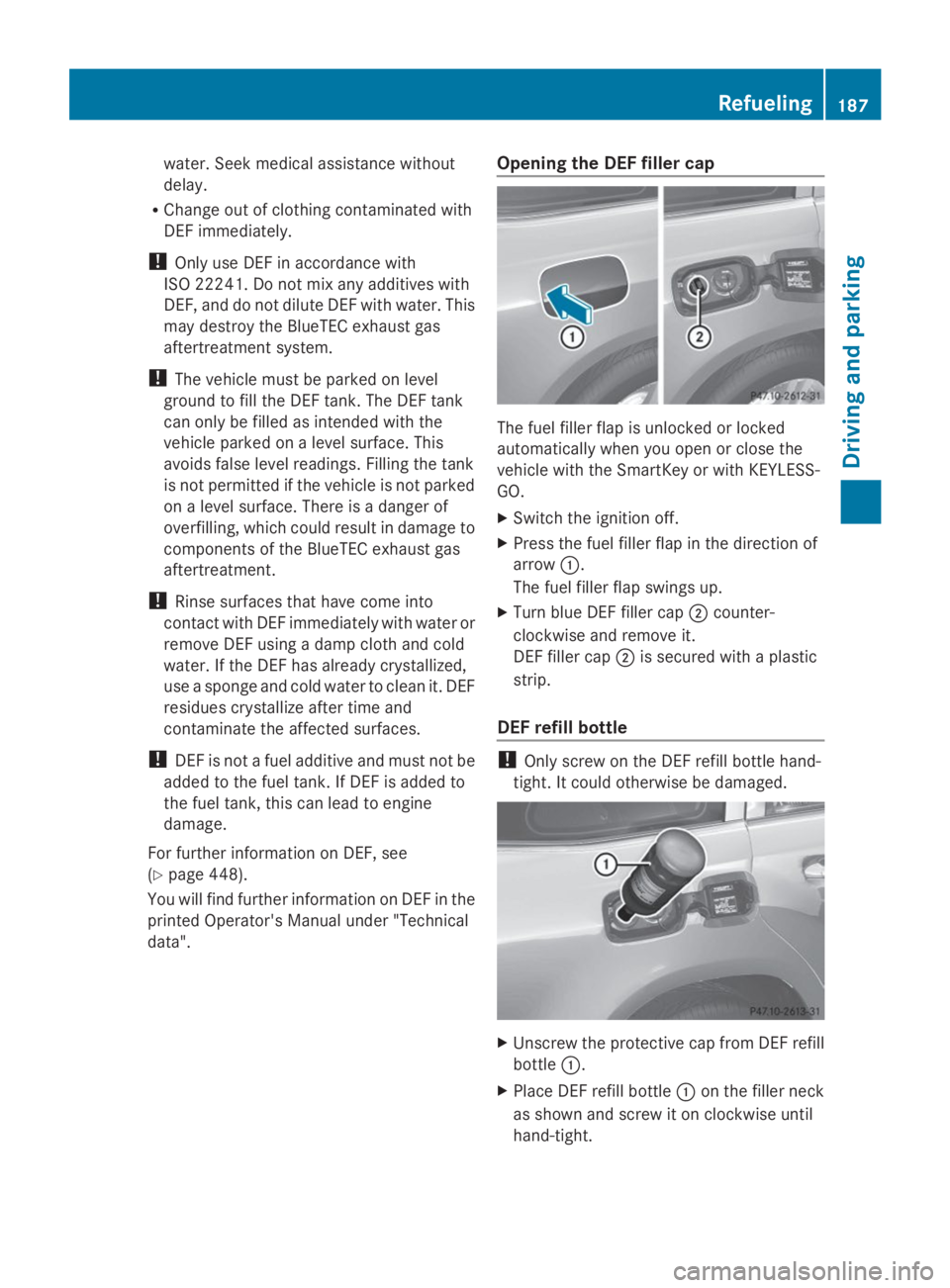
Opening the DEF filler cap
The fuel filler flap is unlocked or locked
automatically when you open or close the
vehicle with the SmartKey or with KEYLESS-
GO.
XSwitch the ignition off.
XPress the fuel filler flap in the direction of
arrowC.
The fuel filler flap swings up.
XTurn blue DEF filler capDcounter-
clockwise and remove it.
DEF filler capDis secured with a plastic
strip.
DEF refill bottle
!Only screw on the DEF refill bottle hand-
tight. It could otherwise be damaged.
XUnscrew the protective cap from DEF refill
bottleC.
XPlace DEF refill bottleCon the filler neck
as shown and screw it on clockwise until
hand-tight.
Refueling187
Driving and parking
Z
Page 190 of 462
XPress DEF refill bottleCtowards the filler
neck.
The DEF tank is filled. This may take up to
one minute.
iWhen DEF refill bottleCis no longer
pressed, filling stops and the bottle may be
taken off again after being only partially
emptied.
XRelease DEF refill bottleC.
XTurn DEF refill bottleCcounter-clockwise
and remove it.
XScrew the protective cap onto DEF refill
bottleCagain.
DEF refill bottles can be obtained at many gas
stations or at an authorized Mercedes-Benz
Center. Refill bottles without a threaded cap
do not provide overfill protection. DEF may
leak if overfilled. Mercedes Benz offers
special refill bottles with a threaded seal.
These are available at any authorized
Mercedes-Benz Center.
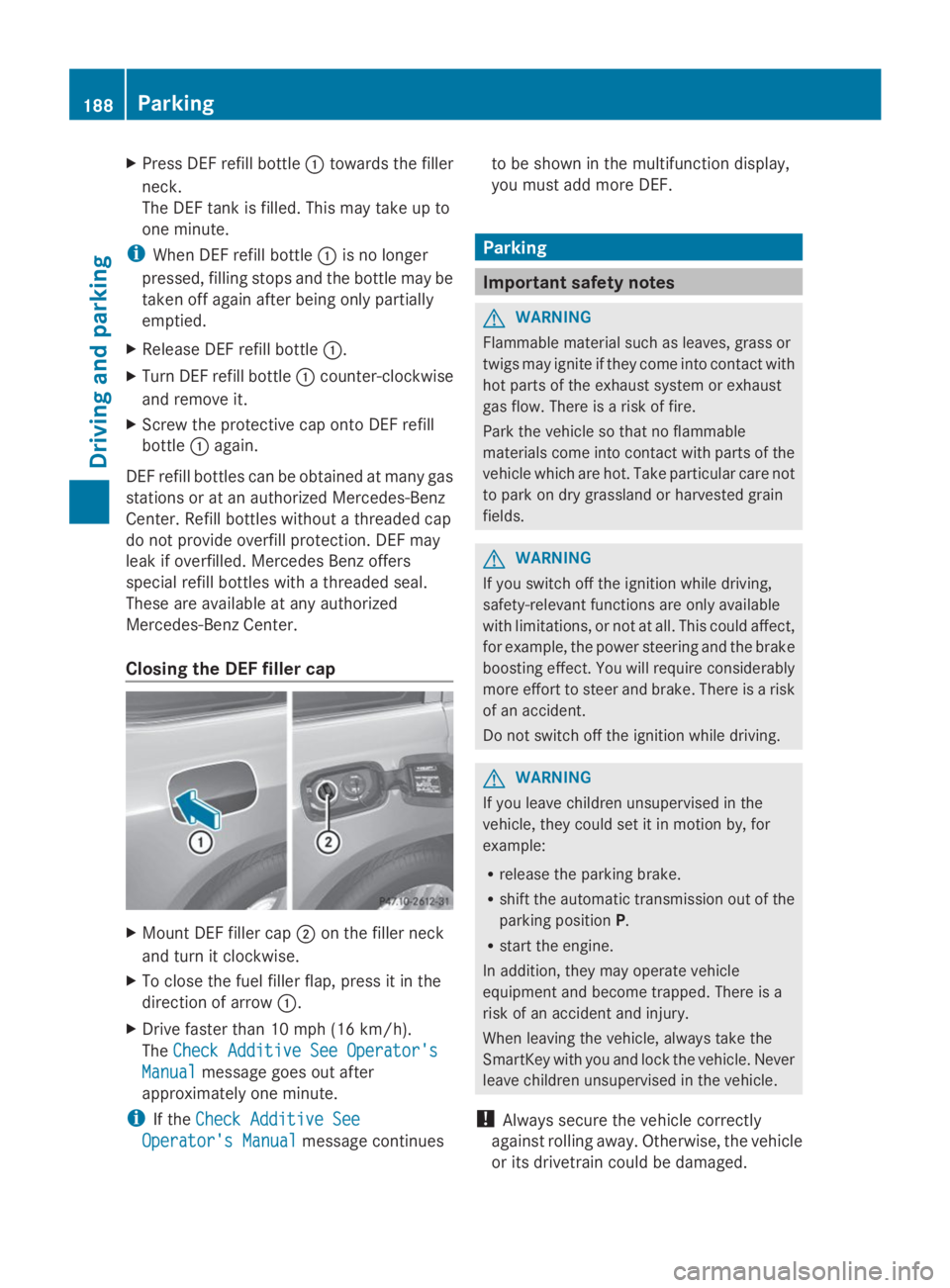
Closing the DEF filler cap
XMount DEF filler capDon the filler neck
and turn it clockwise.
XTo close the fuel filler flap, press it in the
direction of arrowC.
XDrive faster than 10 mph (16 km/h).
TheCheck Additive See Operator'sCheck Additive See Operator's
ManualManualmessage goes out after
approximately one minute.
iIf theCheck Additive SeeCheck Additive See
Operator's ManualOperator's Manualmessage continues
to be shown in the multifunction display,
you must add more DEF.
Parking
Important safety notes
GWARNING
Flammable material such as leaves, grass or
twigs may ignite if they come into contact with
hot parts of the exhaust system or exhaust
gas flow. There is a risk of fire.
Park the vehicle so that no flammable
materials come into contact with parts of the
vehicle which are hot. Take particular care not
to park on dry grassland or harvested grain
fields.
GWARNING
If you switch off the ignition while driving,
safety-relevant functions are only available
with limitations, or not at all. This could affect,
for example, the power steering and the brake
boosting effect. You will require considerably
more effort to steer and brake. There is a risk
of an accident.
Do not switch off the ignition while driving.
GWARNING
If you leave children unsupervised in the
vehicle, they could set it in motion by, for
example:
Rrelease the parking brake.
Rshift the automatic transmission out of the
parking positionP.
Rstart the engine.
In addition, they may operate vehicle
equipment and become trapped. There is a
risk of an accident and injury.
When leaving the vehicle, always take the
SmartKey with you and lock the vehicle. Never
leave children unsupervised in the vehicle.
!Always secure the vehicle correctly
against rolling away. Otherwise, the vehicle
or its drivetrain could be damaged.
188Parking
Driving and parking