Page 414 of 588

4147-3. Do-it-yourself maintenance
IS250_EE(OM53C51E)
CAUTION
The engine compartment contains many mechanisms and fluids that may move suddenly,
become hot, or become electrically energized. To avoid death or serious injury, observe
the following precautions.
■When working on the engine compartment
●Keep hands, clothing and tools away from the moving fan and engine drive belt.
●Be careful not to touch the engine, radiator, exhaust manifold, etc. right after driving
as they may be hot. Oil and other fluids may also be hot.
●Do not leave anything that may burn easily, such as paper and rags, in the engine
compartment.
●Do not smoke, cause sparks or expose an open flame to fuel or the battery. Fuel and
battery fumes are flammable.
●Be extremely cautious when working on the battery. It contains poisonous and corro-
sive sulfuric acid.
●Take care because brake fluid can harm your hands or eyes and damage painted sur-
faces. If fluid gets on your hands or in your eyes, flush the affected area with clean
water immediately.
If you still experience discomfort, consult a doctor.
■When working near the electric cooling fans or radiator grille
Be sure the engine switch is off.
With the engine switch in IGNITION ON mode, the electric cooling fans may auto-
matically start to run if the air conditioning is on and/or the coolant temperature is high.
(→P. 4 2 2 )
■Safety glasses
Wear safety glasses to prevent flying or falling material, fluid spray, etc. from getting in
your eyes.
NOTICE
■If you remove the air cleaner filter
Driving with the air cleaner filter removed may cause excessive engine wear due to dirt
in the air.
■If the fluid level is low or high
It is normal for the brake fluid level to go down slightly as the brake pads wear or when
the fluid level in the accumulator is high.
If the reservoir needs frequent refilling, it may indicate a serious problem.
Page 417 of 588
4177-3. Do-it-yourself maintenance
7
Maintenance and care
IS250_EE(OM53C51E)For right-hand drive vehicles:
The battery and the fuse box in front of the battery are located on the opposite side of the
engine compartment.
Engine compartment
Fuse boxes (→P. 4 4 5 )
Battery (→P. 422)
Engine oil level dipstick
(→P. 4 1 8 )
Engine coolant reservoir
(→P. 4 2 1 )
Engine oil filler cap (→P. 4 1 9 )Wa s h e r f l u i d t a n k (→P. 4 2 6 )
Electric cooling fans
Condenser (→P. 422)
Radiator (→P. 422)1
2
3
4
5
6
7
8
9
Page 428 of 588

4287-3. Do-it-yourself maintenance
IS250_EE(OM53C51E)
Your vehicle is equipped with a tire pressure warning system that uses tire pres-
sure warning valves and transmitters to detect low tire inflation pressure before
serious problems arise.
If the tire pressure drops below a predetermined level, the driver is warned by a
warning light. (→P. 4 7 8 )
◆Installing tire pressure warning valves and transmitters
When replacing tires or wheels, tire pressure warning valves and transmitters
must also be installed.
When new tire pressure warning valves and transmitters are installed, new ID
codes must be registered in the tire pressure warning computer and the tire
pressure warning system must be initialized. Have tire pressure warning valve
and transmitter ID codes registered by any authorized Lexus dealer or
repairer, or another duly qualified and equipped professional. (→P. 4 2 9 )
◆Initializing the tire pressure warning system
■The tire pressure warning system must be initialized in the following circum-
stances:
●When rotating the tires.
●When the tire inflation pressure is changed such as when changing travel-
ing speed or load weight.
●When changing the tire size.
When the tire pressure warning system is initialized, the current tire inflation
pressure is set as the benchmark pressure.
Tire pressure warning system (if equipped)
Page 430 of 588

4307-3. Do-it-yourself maintenance
IS250_EE(OM53C51E)
■When to replace your vehicle’s tires
Tires should be replaced if:
●You have tire damage such as cuts, splits, cracks deep enough to expose the fabric, and
bulges indicating internal damage
●A tire goes flat repeatedly or cannot be properly repaired due to the size or location of
a cut or other damage
If you are not sure, consult any authorized Lexus dealer or repairer, or another duly qual-
ified and equipped professional.
■Replacing tires and wheels (vehicles with a tire pressure warning system)
If the ID code of the tire pressure warning valve and transmitter is not registered, the tire
pressure warning system will not work properly. After driving for about 10 minutes, the
tire pressure warning light blinks for 1 minute and stays on to indicate a system malfunc-
tion.
■Tire life
Any tire over 6 years old must be checked by a qualified technician even if it has seldom
or never been used or damage is not obvious.
■Routine tire inflation pressure checks
The tire pressure warning system does not replace routine tire inflation pressure checks.
Make sure to check tire inflation pressure as part of your routine of daily vehicle checks.
■Low profile tires (except 16-inch tires)
Generally, low profile tires will wear more rapidly and tire grip performance will be
reduced on snowy and/or icy roads when compared to standard tires. Be sure to use
snow tires or tire chains
* on snowy and/or icy roads and drive carefully at a speed appro-
priate for road and weather conditions.
*: Tire chains cannot be mounted on the 18-inch tires. Snow tires should be used instead.
■If the tread on snow tires wears down below 4 mm (0.16 in.)
The effectiveness of the tires as snow tires is lost.
Page 434 of 588

4347-3. Do-it-yourself maintenance
IS250_EE(OM53C51E)
CAUTION
■When inspecting or replacing tires
Observe the following precautions to prevent accidents.
Failure to do so may cause damage to parts of the drivetrain as well as dangerous han-
dling characteristics, which may lead to an accident resulting in death or serious injury.
●Do not mix tires of different makes, models or tread patterns.
Also, do not mix tires of remarkably different treadwear.
●Do not use tire sizes other than those recommended by Lexus.
●Do not mix differently constructed tires (radial, bias-belted or bias-ply tires).
●Do not mix summer, all season and snow tires.
●Do not use tires that have been used on another vehicle.
Do not use tires if you do not know how they were used previously.
●Vehicles with a compact spare tire: Do not tow if your vehicle has a compact spare
tire installed.
●Vehicles with an emergency tire puncture repair kit: Do not tow anything if a tire that
has been repaired using the emergency tire puncture repair kit is installed. The load
on the tire may cause unexpected damage to the tire.
■When initializing the tire pressure warning system (vehicles with a tire pressure
warning system)
Do not operate the tire pressure warning reset switch without first adjusting the tire
inflation pressure to the specified level. Otherwise, the tire pressure warning light may
not come on even if the tire inflation pressure is low, or it may come on when the tire
inflation pressure is actually normal.
Page 436 of 588

4367-3. Do-it-yourself maintenance
IS250_EE(OM53C51E)
■Effects of incorrect tire inflation pressure
Driving with incorrect tire inflation pressure may result in the following:
●Reduced fuel economy
●Reduced driving comfort and poor handling
●Reduced tire life due to wear
●Reduced safety
●Damage to the drivetrain
If a tire needs frequent inflating, have it checked by any authorized Lexus dealer or
repairer, or another duly qualified and equipped professional.
■Instructions for checking tire inflation pressure
When checking tire inflation pressure, observe the following:
●Check only when the tires are cold.
If your vehicle has been parked for at least 3 hours or has not been driven for more than
1.5 km or 1 mile, you will get an accurate cold tire inflation pressure reading.
●Always use a tire pressure gauge.
It is difficult to judge if a tire is properly inflated based only on its appearance.
●It is normal for the tire inflation pressure to be higher after driving as heat is generated
in the tire. Do not reduce tire inflation pressure after driving.
●Passengers and luggage weight should be placed so that the vehicle is balanced.
Tire inflation pressure
Make sure to maintain proper tire inflation pressure. Tire inflation pressure
should be checked at least once per month. However, Lexus recommends
that tire inflation pressure be checked once every two weeks. (→P. 5 4 6 )
Page 442 of 588
4427-3. Do-it-yourself maintenance
IS250_EE(OM53C51E)
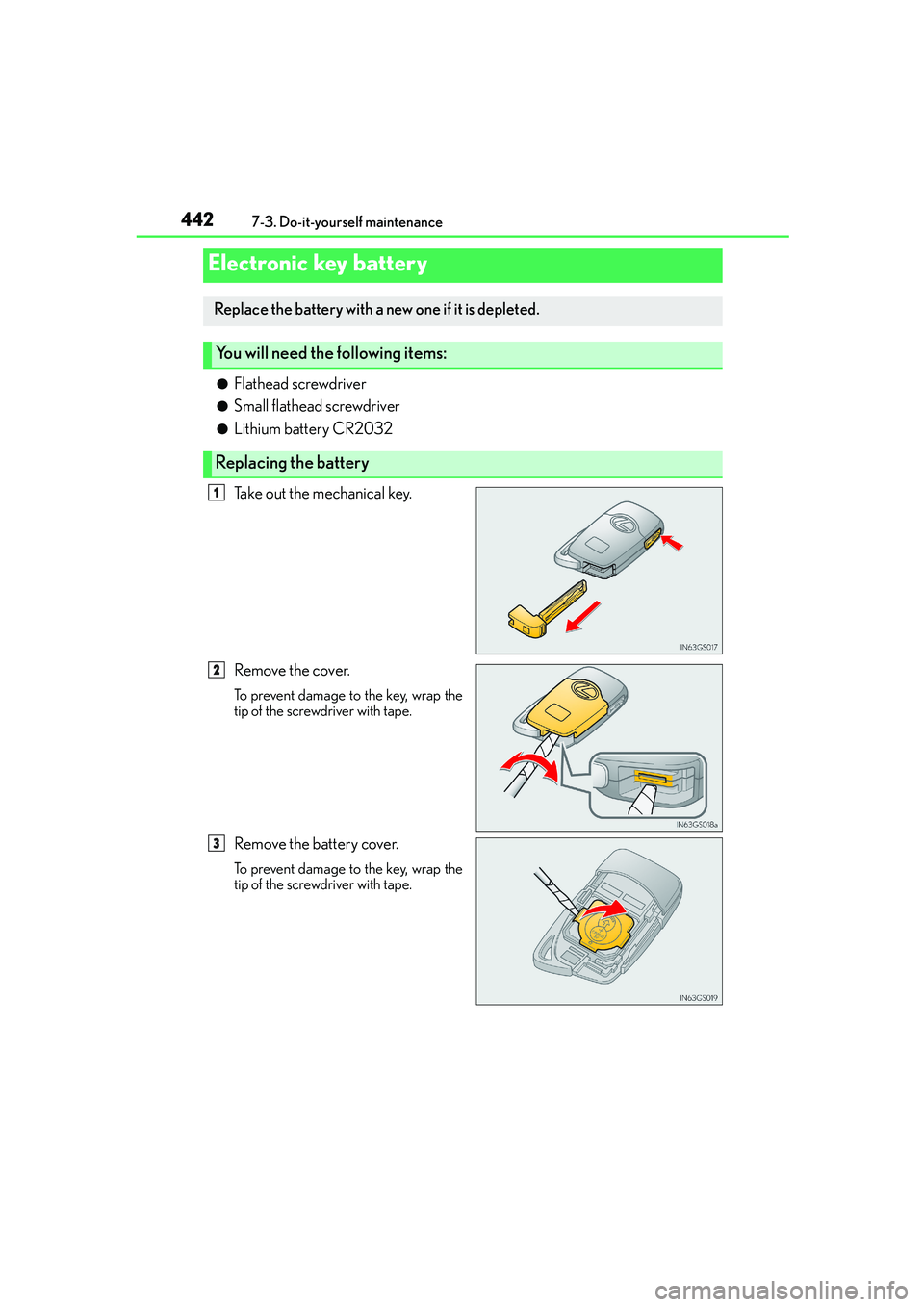
●Flathead screwdriver
●Small flathead screwdriver
●Lithium battery CR2032
Take out the mechanical key.
Remove the cover.
To prevent damage to the key, wrap the
tip of the screwdriver with tape.
Remove the battery cover.
To prevent damage to the key, wrap the
tip of the screwdriver with tape.
Electronic key battery
Replace the battery with a new one if it is depleted.
You will need the following items:
Replacing the battery
1
2
3
Page 445 of 588
4457-3. Do-it-yourself maintenance
7
Maintenance and care
IS250_EE(OM53C51E)
Turn the engine switch off.
Open the fuse box cover.
XEngine compartment: type A fuse box (left-hand drive vehicles)
Push the tab in and lift the lid off.
XEngine compartment: type A fuse box (right-hand drive vehicles)
Push the tab in and lift the lid off.
XEngine compartment: type B fuse box
Push the tab in and lift the lid off.
Checking and replacing fuses
If any of the electrical components do not operate, a fuse may have blown. If
this happens, check and replace the fuses as necessary.
1
2