2014 KIA Sportage light
[x] Cancel search: lightPage 49 of 457
Safety features of your vehicle
34
3
✽
✽
NOTICE
Because the sensor that activates the
SRS air bag is connected with the
pre-tensioner seat belt, the SRS air
bag warning light ( ) on the
instrument panel will illuminate for
approximately 6 seconds after the
ignition switch has been turned to
the ON position, and then it should
turn off.
CAUTION
If the pre-tensioner seat belt is
not working properly, this warn-ing light will illuminate even ifthere is no malfunction of theSRS air bag. If the SRS air bagwarning light does not illumi-nate when the ignition switch isturned ON, or if it remains illu-minated after illuminating forapproximately 6 seconds, or if itilluminates while the vehicle isbeing driven, please have anauthorized Kia dealer inspectthe pre-tensioner seat belt andSRS air bag system as soon aspossible.
WARNING
Pre-tensioners are designed to operate only one time. After
activation, pre-tensioner seat
belts must be replaced. All
seat belts, of any type, should
always be replaced after they
have been worn during a colli-
sion.
The pre-tensioner seat belt assembly mechanisms
become hot during activation.
Do not touch the pre-tension-
er seat belt assemblies for
several minutes after they
have been activated.
Do not attempt to inspect or replace the pre-tensioner seat
belts yourself. This must be
done by an authorized Kia
dealer.
Do not strike the pre-tension- er seat belt assemblies.
Do not attempt to service or repair the pre-tensioner seat
belt system in any manner.
(Continued)
(Continued)
Do not put anything near thebuckle. Placing objects near
the buckle can adversely
affect the buckle pretensioner
and may increase the risk of
personal injury in the event of
a collision.
Improper handling of the pre- tensioner seat belt assem-
blies, and failure to heed the
warnings not to strike, modify,
inspect, replace, service or
repair the pre-tensioner seat
belt assemblies may lead to
improper operation or inad-
vertent activation and serious
injury.
Always wear the seat belts when driving or riding in a
motor vehicle.
If the vehicle or pre-tensioner seat belt must be discarded,
contact an authorized Kia
dealer.
Page 51 of 457
Safety features of your vehicle
36
3
C020301AHM
Larger children
Children who are too large for child
restraint systems should always
occupy the rear seat and use the
available lap/shoulder belts. The lap
portion should be fastened and
snugged on the hips and as low as
possible. Check if the belt fits period-
ically. A child's squirming could put
the belt out of position. Children are
given the most safety in the event of
an accident when they are restrained
by a proper restraint system in the
rear seat. If a larger child (over age
12) must be seated in the front seat,
the child should be securely
restrained by the available lap/shoul-
der belt and the seat should be
placed in the rearmost position.
Children age 12 and under should be
restrained securely in the rear seat.
NEVER place a child age 12 and
under in the front seat. NEVER place
a rear facing child seat in the front
seat of a vehicle. If the shoulder belt portion slightly
touches the child’s neck or face, try
placing the child closer to the center
of the vehicle. If the shoulder belt still
touches their face or neck they need
to be returned to a child restraint sys-
tem.
C020302AKM
Restraint of pregnant women
Pregnant women should wear
lap/shoulder belt assemblies when-
ever possible according to specific
recommendations by their doctors.
The lap portion of the belt should be
worn AS SECURELY AND LOW AS
POSSIBLE.
WARNING- Shoulder
belts on small children
Never allow a shoulder belt to
be in contact with a child’s
neck or face while the vehicle
is in motion.
If seat belts are not properly worn and adjusted on chil-
dren, there is a risk of death or
serious injury.WARNING - Pregnantwomen
Pregnant women must never
place the lap portion of the
safety belt over the area of the
abdomen where the fetus is
located or above the abdomen
where the belt could crush the
fetus during an impact.
Page 55 of 457
Safety features of your vehicle
40
3
WARNING
To reduce the chance of serious
or fatal injuries:
Children of all ages are safer
when restrained in the rear
seat. A child riding in the front
passenger seat can be force-
fully struck by an inflating air
bag resulting in serious or
fatal injuries.
Always follow the child restraint system manufactur-
er’s instructions for installa-
tion and use of the child
restraint.
Always make sure the child seat is secured properly in the
car and your child is securely
restrained in the child seat.
Never hold a child in your arms or lap when riding in a
vehicle. The violent forces cre-
ated during a crash will tear
the child from your arms and
throw the child against the
car’s interior.
(Continued)
(Continued)
Never put a seat belt overyourself and a child. During a
crash, the belt could press
deep into the child causing
serious internal injuries.
Never leave children unat- tended in a vehicle – not even
for a short time. The car can
heat up very quickly, resulting
in serious injuries to children
inside. Even very young chil-
dren may inadvertently cause
the vehicle to move, entangle
themselves in the windows, or
lock themselves or others
inside the vehicle.
Never allow two children, or any two persons, to use the
same seat belt.
Children often squirm and reposition themselves
improperly. Never let a child
ride with the shoulder belt
under their arm or behind
their back. Always properly
position and secure children
in the rear seat.
(Continued)(Continued)
Never allow a child to stand-up or kneel on the seat or floor
of a moving vehicle. During a
collision or sudden stop, the
child can be violently thrown
against the vehicle’s interior,
resulting in serious injury.
Never use an infant carrier or a child safety seat that "hooks"
over a seatback, it may not
provide adequate security in
an accident.
Seat belts can become very hot, especially when the car is
parked in direct sunlight.
Always check the seat belt
buckles before fastening them
over a child.
After an accident, have an authorized Kia dealer check
the child restraint system, seat
belt, tether anchor and lower
anchor.
If there is not enough space to place the child restraint sys-
tem because of the driver's
seat, install the child restraint
system in the rear right seat.
Page 66 of 457
351
Safety features of your vehicle
C040903AEN
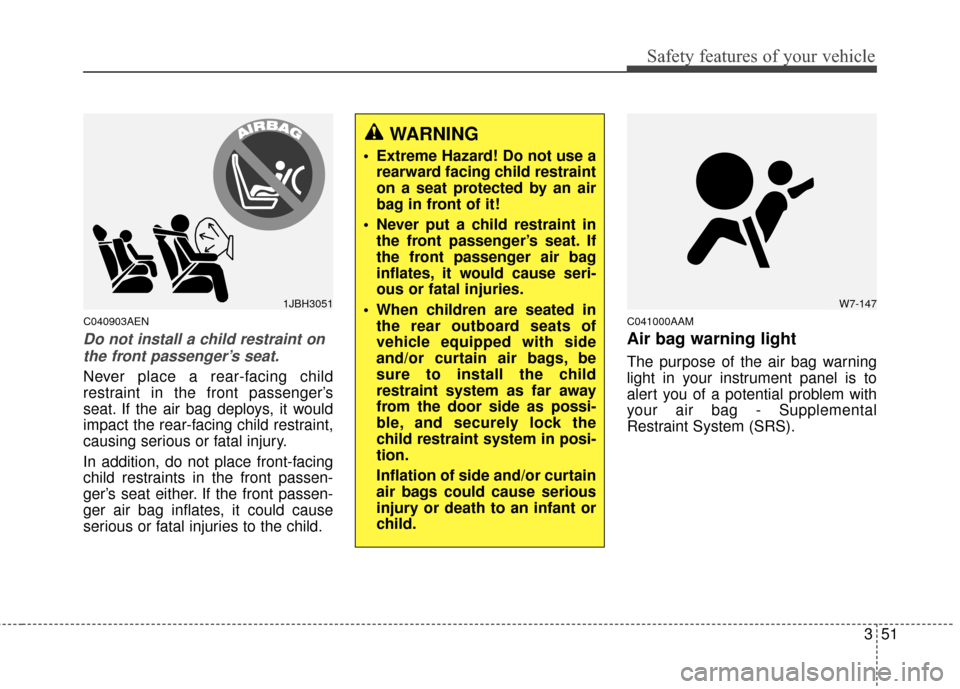
Do not install a child restraint onthe front passenger’s seat.
Never place a rear-facing child
restraint in the front passenger’s
seat. If the air bag deploys, it would
impact the rear-facing child restraint,
causing serious or fatal injury.
In addition, do not place front-facing
child restraints in the front passen-
ger’s seat either. If the front passen-
ger air bag inflates, it could cause
serious or fatal injuries to the child.
C041000AAM
Air bag warning light
The purpose of the air bag warning
light in your instrument panel is to
alert you of a potential problem with
your air bag - Supplemental
Restraint System (SRS).
WARNING
Extreme Hazard! Do not use a rearward facing child restraint
on a seat protected by an air
bag in front of it!
Never put a child restraint in the front passenger’s seat. If
the front passenger air bag
inflates, it would cause seri-
ous or fatal injuries.
When children are seated in the rear outboard seats of
vehicle equipped with side
and/or curtain air bags, be
sure to install the child
restraint system as far away
from the door side as possi-
ble, and securely lock the
child restraint system in posi-
tion.
Inflation of side and/or curtain
air bags could cause serious
injury or death to an infant or
child.
W7-1471JBH3051
Page 67 of 457
Safety features of your vehicle
52
3
When the ignition switch is turned
ON, the warning light should illumi-
nate for approximately 6 seconds,
then go off.
Have the system checked if:
The light does not turn on briefly
when you turn the ignition ON.
The light stays on after illuminating for approximately 6 seconds.
The light comes on while the vehi- cle is in motion.
The light blinks when the ignition switch is in ON position.
C040100AHM-EU
SRS components and func-
tions
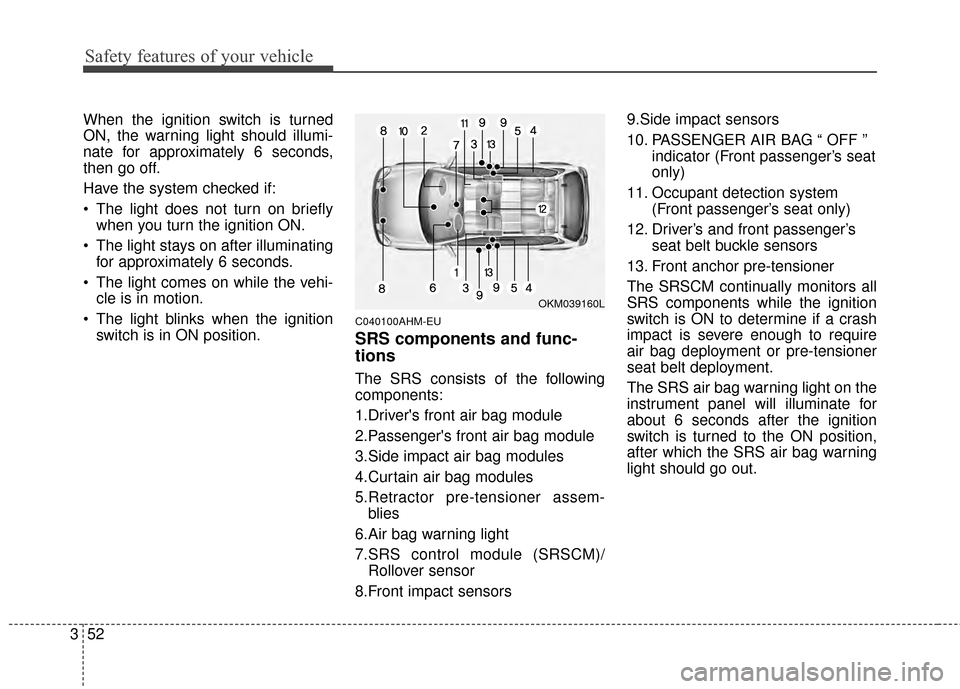
The SRS consists of the following
components:
1.Driver's front air bag module
2.Passenger's front air bag module
3.Side impact air bag modules
4.Curtain air bag modules
5.Retractor pre-tensioner assem-blies
6.Air bag warning light
7.SRS control module (SRSCM)/ Rollover sensor
8.Front impact sensors 9.Side impact sensors
10. PASSENGER AIR BAG “ OFF ”
indicator (Front passenger’s seat
only)
11. Occupant detection system (Front passenger’s seat only)
12. Driver’s and front passenger’s seat belt buckle sensors
13. Front anchor pre-tensioner
The SRSCM continually monitors all
SRS components while the ignition
switch is ON to determine if a crash
impact is severe enough to require
air bag deployment or pre-tensioner
seat belt deployment.
The SRS air bag warning light on the
instrument panel will illuminate for
about 6 seconds after the ignition
switch is turned to the ON position,
after which the SRS air bag warning
light should go out.
OKM039160L
Page 68 of 457
353
Safety features of your vehicle
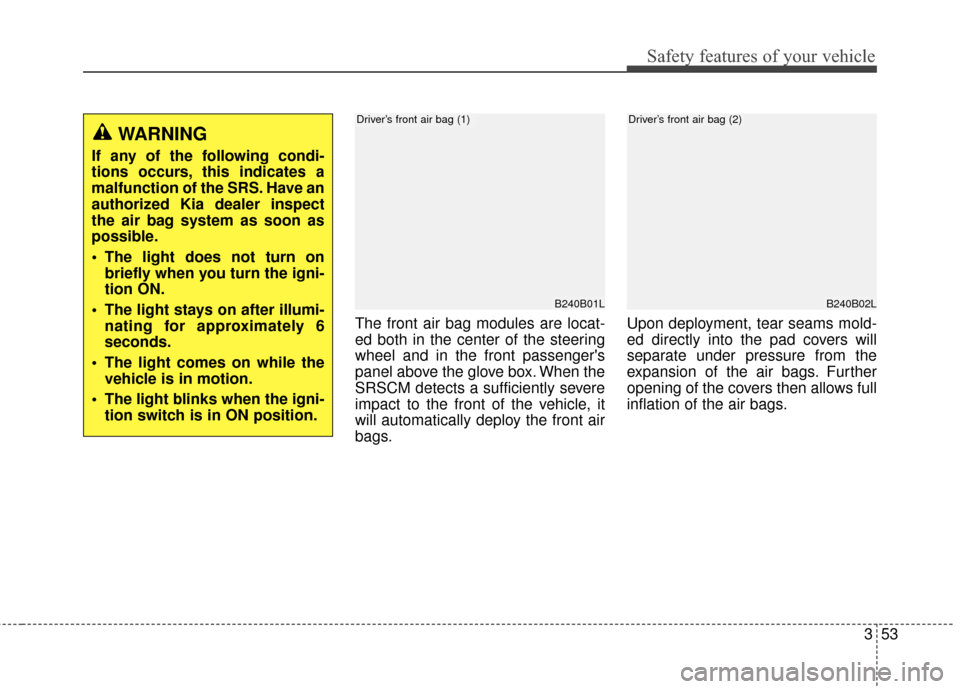
The front air bag modules are locat-
ed both in the center of the steering
wheel and in the front passenger's
panel above the glove box. When the
SRSCM detects a sufficiently severe
impact to the front of the vehicle, it
will automatically deploy the front air
bags.Upon deployment, tear seams mold-
ed directly into the pad covers will
separate under pressure from the
expansion of the air bags. Further
opening of the covers then allows full
inflation of the air bags.
B240B01L
Driver’s front air bag (1)
WARNING
If any of the following condi-
tions occurs, this indicates a
malfunction of the SRS. Have an
authorized Kia dealer inspect
the air bag system as soon as
possible.
The light does not turn on
briefly when you turn the igni-
tion ON.
The light stays on after illumi- nating for approximately 6
seconds.
The light comes on while the vehicle is in motion.
The light blinks when the igni- tion switch is in ON position.
B240B02L
Driver’s front air bag (2)
Page 70 of 457
355
Safety features of your vehicle
C040300AAM
Occupant Detection System
(ODS)
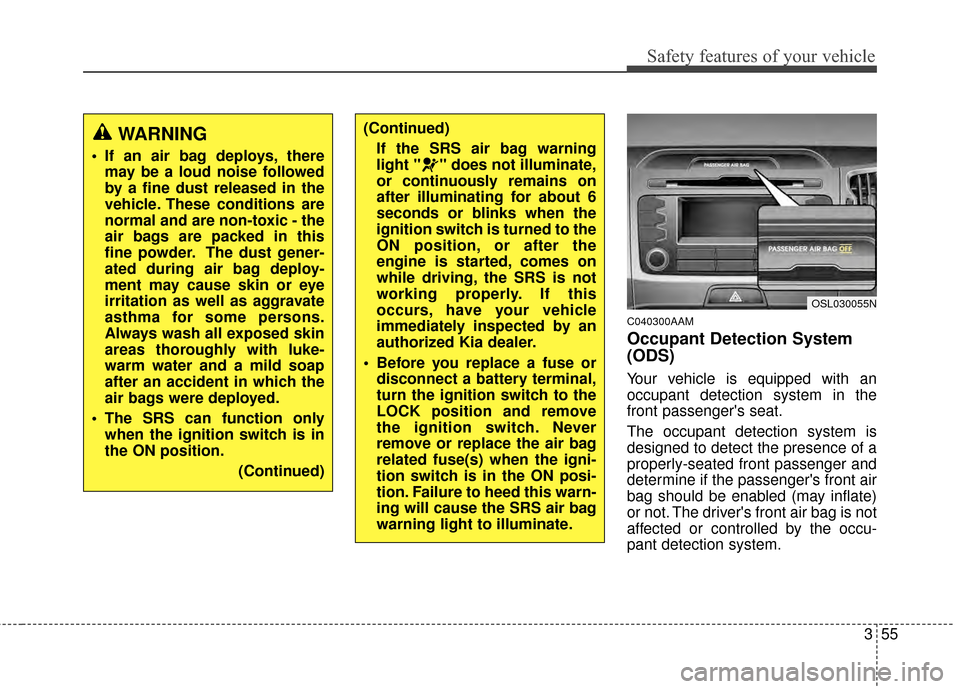
Your vehicle is equipped with an
occupant detection system in the
front passenger's seat.
The occupant detection system is
designed to detect the presence of a
properly-seated front passenger and
determine if the passenger's front air
bag should be enabled (may inflate)
or not. The driver's front air bag is not
affected or controlled by the occu-
pant detection system.
WARNING
If an air bag deploys, theremay be a loud noise followed
by a fine dust released in the
vehicle. These conditions are
normal and are non-toxic - the
air bags are packed in this
fine powder. The dust gener-
ated during air bag deploy-
ment may cause skin or eye
irritation as well as aggravate
asthma for some persons.
Always wash all exposed skin
areas thoroughly with luke-
warm water and a mild soap
after an accident in which the
air bags were deployed.
The SRS can function only when the ignition switch is in
the ON position.
(Continued)
(Continued)If the SRS air bag warning
light " " does not illuminate,
or continuously remains on
after illuminating for about 6
seconds or blinks when the
ignition switch is turned to the
ON position, or after the
engine is started, comes on
while driving, the SRS is not
working properly. If this
occurs, have your vehicle
immediately inspected by an
authorized Kia dealer.
Before you replace a fuse or disconnect a battery terminal,
turn the ignition switch to the
LOCK position and remove
the ignition switch. Never
remove or replace the air bag
related fuse(s) when the igni-
tion switch is in the ON posi-
tion. Failure to heed this warn-
ing will cause the SRS air bag
warning light to illuminate.
OSL030055N
Page 71 of 457
Safety features of your vehicle
56
3
Main components of the occu-
pant detection system
A detection device located within the front passenger seat cushion.
An electronic system which deter- mines whether the passenger air
bag systems should be activated
or deactivated.
A indicator light located on the instrument panel which illuminates
the words PASSENGER AIR BAG
“OFF” indicating the front passen-
ger air bag system is deactivated.
The instrument panel air bag warn- ing light is interconnected with the
occupant detection system. If the front passenger seat is occu-
pied by a person that the system
determines to be of appropriate size,
and he/she sits properly (sitting
upright with the seatback in an
upright position, centered on the
seat cushion with their seat belt on,
legs comfortably extended and their
feet on the floor), the PASSENGER
AIR BAG “OFF” indicator will turn off
and the front passenger's air bag will
be able to inflate, if necessary, in
frontal crashes.
You will find the PASSENGER AIR
BAG “OFF” indicator on the center
facia panel. This system detects the
conditions 1~4 in the following table
and activates or deactivates the front
passenger air bag based on these
conditions.
Always be sure that you and all vehi-
cle occupants are seated and
restrained properly (sitting upright
with the seat in an upright position,
centered on the seat cushion, with
the person’s legs comfortably
extended, feet on the floor, and wear-
ing the safety belt properly) for the
most effective protection by the air
bag and the safety belt.
The ODS (Occupant Detection
System) may not function properly
if the passenger takes actions
which can defeat the detection sys-
tem. These include:
(1) Failing to sit in an upright posi- tion.
(2) Leaning against the door or cen- ter console.
(3) Sitting towards the sides or the front of the seat.
(4) Putting legs on the dashboard or resting them on other locations
which reduce the passenger
weight on the front seat.
(5) Improperly wearing the safety belt.
(6) Reclining the seat back.
WARNING
Do not put anything in front of
the passenger air bag indi-
cator.