Page 89 of 212

SUITABILITY OF
PASSENGER SEATS FOR
i-Size CHILD RESTRAINT
SYSTEM USE
The rear side seats of the vehicle are
type-approved to house the state-
of-the-art i-Size child restraint systems.
These child restraint systems, built
and type-approved according to the
i-Size (ECE R129) standard, ensure
better safety conditions to carry
children on board a vehicle:
❒the child must be transported
rearward facing until 15 months;
❒child restraint system protection is
increased in the event of a side
collision;
❒the use of the ISOFIX system is
promoted to avoid faulty installation of
the child restraint system;
❒efficiency in the choice of the child
restraint system, which isn't made
according to weight anymore but
according to the child's height,
is increased;
❒compatibility between the vehicle
seats and the child restraint systems is
better: the i-Size child restraint systems
can be considered as "Super ISOFIX",
this means that they can be perfectly
fitted in the type-approved i-Size seats,
but can also be fitted in the ISOFIX
(ECE R44) type-approved seats.NOTE The vehicle seats, i-Size
type-approved, are marked by the
symbol shown in fig. 79.
79J0A0450C
87
Page 90 of 212
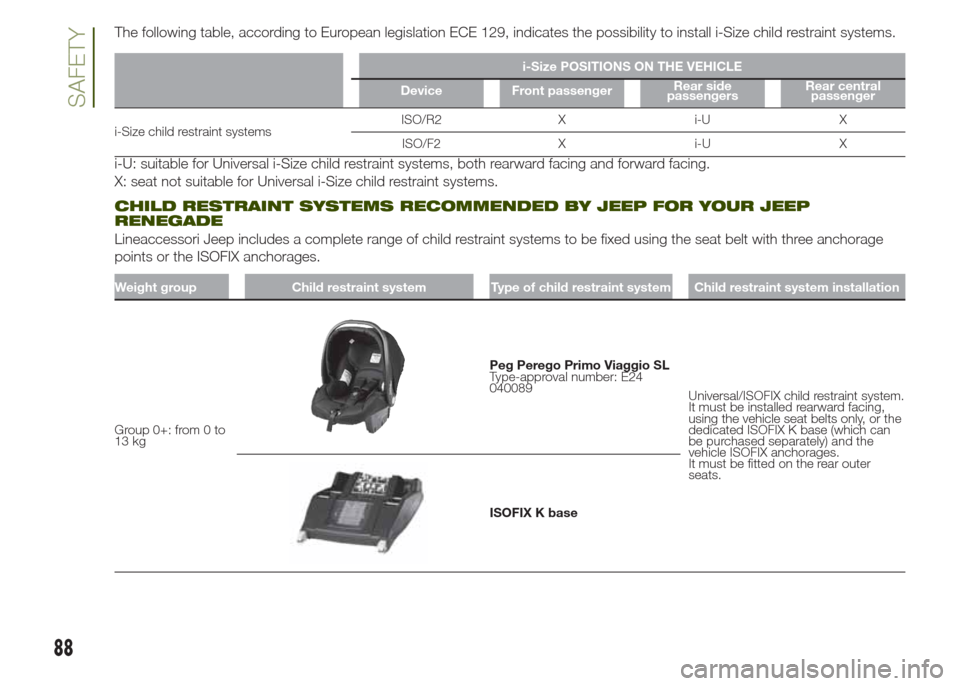
The following table, according to European legislation ECE 129, indicates the possibility to install i-Size child restraint systems.
i-Size POSITIONS ON THE VEHICLE
Device Front passengerRear side
passengersRear central
passenger
i-Size child restraint systemsISO/R2 X i-U X
ISO/F2 X i-U X
i-U: suitable for Universal i-Size child restraint systems, both rearward facing and forward facing.
X: seat not suitable for Universal i-Size child restraint systems.
CHILD RESTRAINT SYSTEMS RECOMMENDED BY JEEP FOR YOUR JEEP
RENEGADE
Lineaccessori Jeep includes a complete range of child restraint systems to be fixed using the seat belt with three anchorage
points or the ISOFIX anchorages.
Weight group Child restraint system Type of child restraint system Child restraint system installation
Group 0+: from 0 to
13 kg
Peg Perego Primo Viaggio SL
Type-approval number: E24
040089
Universal/ISOFIX child restraint system.
It must be installed rearward facing,
using the vehicle seat belts only, or the
dedicated ISOFIX K base (which can
be purchased separately) and the
vehicle ISOFIX anchorages.
It must be fitted on the rear outer
seats.
ISOFIX K base
88
SAFETY
Page 91 of 212
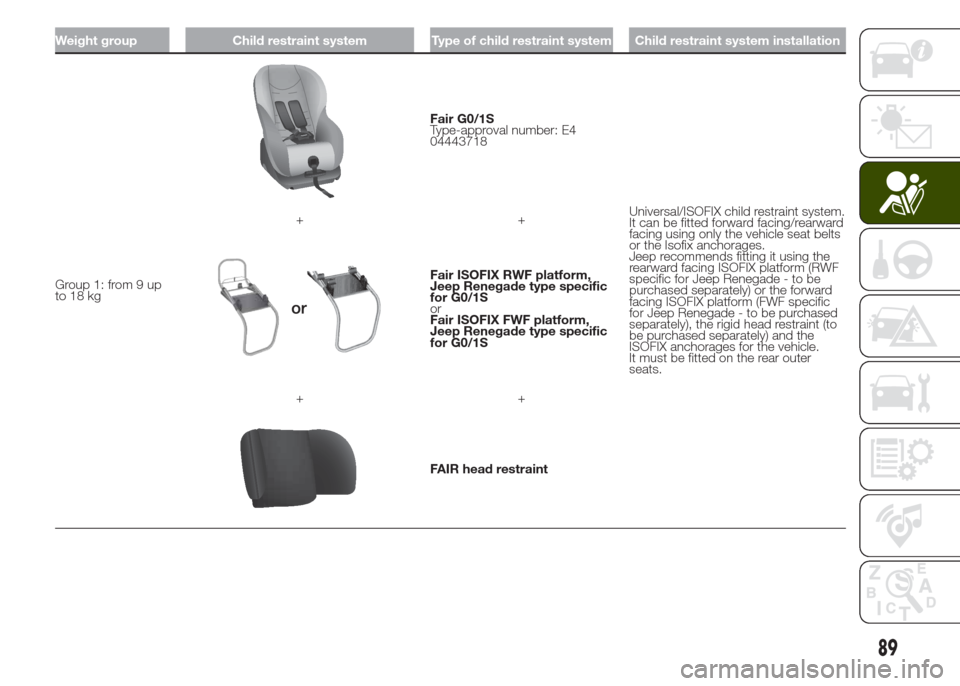
Weight group Child restraint system Type of child restraint system Child restraint system installation
Group 1: from 9 up
to 18 kg
Fair G0/1S
Type-approval number: E4
04443718
Universal/ISOFIX child restraint system.
It can be fitted forward facing/rearward
facing using only the vehicle seat belts
or the Isofix anchorages.
Jeep recommends fitting it using the
rearward facing ISOFIX platform (RWF
specific for Jeep Renegade - to be
purchased separately) or the forward
facing ISOFIX platform (FWF specific
for Jeep Renegade - to be purchased
separately), the rigid head restraint (to
be purchased separately) and the
ISOFIX anchorages for the vehicle.
It must be fitted on the rear outer
seats. ++
Fair ISOFIX RWF platform,
Jeep Renegade type specific
for G0/1S
or
Fair ISOFIX FWF platform,
Jeep Renegade type specific
for G0/1S
++
FAIR head restraint
89
Page 92 of 212

Weight group Child restraint system Type of child restraint system Child restraint system installation
Group 2: from 15 kg
to 36 kgFair Junior Fix
Type-approval number: E4
04443721It can only be fitted facing forwards,
using the three-point seat belt and the
ISOFIX anchorages of the vehicle, if
present.
IMPORTANT Jeep recommends fitting the child restraint system according to the instructions, which must be included.
Main recommendations to carry
children safely
❒Install the child restraint systems on
the rear seat, which is the most
protected position in the event of an
impact.
❒Keep children in rearward facing child
restraint systems for as long as
possible, until 3–4 years old if possible.
❒If the passenger's front airbag is
deactivated always check the
dedicated warning light on the panel
located on the dashboard to make sure
that it has actually been deactivated.❒Carefully follow the child restraint
manufacturer's instruction supplied with
the child restraint system. Keep the
instructions in the vehicle along with the
other documents and this handbook.
Do not use second-hand child restraint
systems without instructions.
❒Only one child is to be strapped into
each restraint system; never carry
two children using one child restraint
system.
❒Always check that the seat belts do
not rest on the child’s neck.
❒Always check that the seat belt is
well fastened by pulling on it.
❒While travelling, do not let the child sit
incorrectly or unfasten the belts.
❒Never allow a child to put the belt's
diagonal section under an arm or
behind their back.❒Never carry children on your lap,
even newborns. No-one could restrain
them in the event of an accident.
❒In the event of an accident, replace
the child restraint system with a new
one.
WARNING
83)SEVERE DANGER When a front
passenger airbag is fitted, do not install
rearward facing child restraint systems on
the front passenger seat. Deployment of
the airbag in an accident could cause fatal
injuries to the baby regardless of the
severity of the collision. It is advisable to
always carry children in a child restraint
system on the rear seat, which is the most
protected position in the event of an
impact.
90
SAFETY
Page 138 of 212

❒remove the fixing device for the jack
and the spare wheel;
❒remove the wheel chock;
❒remove the jack unit and the key for
removing the bolts from the spare
wheel. Turn the screw of the jack to
loosen the key and separate it from the
jack assembly;
❒take the spare wheel out of the
luggage compartment.
Tool box (where provided)
On versions with spare wheel there
is also, inside the luggage compartment
(right side), a tool box secured to the
luggage compartment carpet with
dedicated fastenings.
Inside the tool box are fig. 133:
❒A: the jack;
❒B: the screwdriver;
❒C: the emergency refuelling adaptor;
❒D: the wheel locating pin (where
provided, to use during the spare wheel
fitting operation);
❒E: special anti-theft nut (where
provided, to use during the wheel bolt
fitting/removal operation);
❒F: a chock for locking the wheels;
❒G: the tow hook;
❒H: the key for removing/tightening the
wheel bolts and operating the jack;❒I: the Allen key for emergency sun
roof operation (where provided).
Important information about
the jack
Please note that:
❒the weight of the jack is 2.8 kg;
❒the jack requires no adjustment;
❒the jack cannot be repaired: in the
event of a fault it must be replaced by
another original one;❒no tool other than its cranking device
may be fitted on the jack.
Then proceed as follows:
❒should it be necessary to stop the
vehicle on a road with a gradient,
especially a very high one, or on an
unstable surface, take chock A and fold
it out, as shown in the diagram in fig.
134;
❒alert any bystander that the vehicle is
about to be raised: all persons should
be kept away from the vehicle and
nobody must touch it until it has been
lowered. Nor should any occupant
remain in the vehicle;
❒if the vehicle has alloy wheels, where
the hub cap covers the bolts, use the
key with great care to remove the
hub cap before raising the vehicle;
A
C
B
D
E
I
F
G
H
133J0A0226C
134J0A0157C
136
IN AN EMERGENCY
Page 167 of 212
TECHNICAL SPECIFICATIONS
Everything you may find useful for
understanding how your vehicle
is made and works is contained in this
chapter and illustrated with data, tables
and graphics. For the enthusiasts and
the technician, but also just for those
who want to know every detail of their
vehicle.IDENTIFICATION DATA....................166
ENGINE ..........................................167
WHEELS .........................................169
DIMENSIONS ..................................171
WEIGHTS........................................174
SUPPLIES .......................................175
FLUIDS AND LUBRICANTS ............176
PERFORMANCE .............................178
FUEL CONSUMPTION ....................178
CO2 EMISSIONS ............................179
PRESCRIPTIONS FOR HANDLING
THE VEHICLE AT THE END OF ITS
LIFE ................................................179
165
Page 168 of 212
IDENTIFICATION
DATA
VEHICLE IDENTIFICATION
NUMBER
The Vehicle Identification Number (VIN)
is stamped on a plate on the front left
corner of the dashboard cover fig. 154,
which can be seen from outside the
vehicle, through the windscreen.
This number is also stamped on the
passenger compartment floor, next to
the front right seat.
Slide flap A fig. 155, operating as
shown in the figure, to access.
VIN PLATE
The plate is located on the left side
front door pillar fig. 156 and shows the
data about:
❒A: correct value of smoke coefficient
(for Diesel engines);
❒B: maximum permitted weights;
❒C: engine type, bodywork version
code, spare part number, colour code.
Z
FA520VP70P000016
ZFA520VP70P000016
154J0A0030C
155J0A0028C
156J0A0446C
166
TECHNICAL SPECIFICATIONS
Page 176 of 212

WEIGHTS
Weights (kg) 1.4 Turbo MultiAir 1.6 16V MultiJet 2.0 16V MultiJet 120 / 140 HP 2.0 16V MultiJet
Unladen weight (with all fluids, fuel tank filled to 90% and without optional equipment) 1320 1390 1430 / 1530(*)1535
Payload including the driver(**)545 515 580 / 550(*)545
Maximum permitted loads(***)
1050 1050 1150 1150 – front axle
– rear axle 900 900 1000 1000
– total: 1865 1905 2010 / 2080(*)2080
Towable loads 1000 1000 1500 1500 – braked trailer
– trailer without brakes 400 400 400 400
Maximum load on roof(****)70 70 70 70
Maximum load on tow hitch (trailer with brakes) 60 60 60 60
(*) Versions with automatic transmission
(**) If special equipment is fitted (sun roof, tow hitch, etc.) the unladen vehicle weight increases, thus reducing the specified payload in relation to the maximum permitted loads.
(***) Loads not to be exceeded. The user is responsible for arranging goods in the luggage compartment and/or load platform within the maximum permitt ed loads.
(****) Versions with roof bars
174
TECHNICAL SPECIFICATIONS
170HP