2014 JEEP RENEGADE seats
[x] Cancel search: seatsPage 81 of 212

If the rear seat belt is unfastened, an
acoustic warning (3 "beeps") will be
activated along with the relevant icon
lighting up in the display.
Furthermore the icons will light up again
for 90 seconds each time one of the
rear doors is closed.
The icon will turn green after the
corresponding seat has been fastened.
The rear seat icons will go out,
regardless of the state of the belt (red
icon or green icon), approximately
30 seconds after the last signal.
IMPORTANT
As far as the rear seats are concerned,
the SBR system will only indicate
whether the seat belts are unfastened
(red icon) or fastened (green icon),
not the presence of any passengers.
The warning lights/icons are all off if all
seat belts (front and rear) are fastened
when the ignition device is at MAR.
For the rear seats, the icons will
activate after a few seconds after the
ignition device has been turned to
MAR, regardless of the status of the
seat belts (even if the seat belts are all
fastened).
All the warning lights/icons will come on
when at least one belt changes from
fastened to unfastened status or vice
versa.
PRETENSIONERS
79) 80) 81) 82)33)
The vehicle is equipped with front seat
belt pretensioners, which draw back
the seat belts by several centimetres in
the event of a strong frontal impact.
This guarantees the perfect adherence
of the seat belts to the occupant's
bodies before the retention action
begins.
It is evident that the pretensioners have
been activated when the belt withdraws
toward the retractor.
This vehicle is also equipped with a
second pretensioner (fitted in the kick
plate area). Its activation is signalled by
the shortening of the metal cable.
A slight discharge of smoke may be
produced during the activation of the
pretensioner which is not harmful and
does not indicate any fire hazard.
The pretensioner does not require any
maintenance or lubrication: any
changes to its original conditions will
invalidate its efficiency.
If, due to unusual natural events (floods,
sea storms, etc.), the device has been
affected by water and/or mud, contact
a Jeep Dealership to have it replaced.IMPORTANT To obtain the highest
degree of protection from the action of
the pretensioner, wear the seat belt
tight to the torso and pelvis.
LOAD LIMITERS
To increase safety in the event of an
accident, the front seat belt retractors
contain a load limiter which controls the
force acting on the chest and
shoulders during the belt restraining
action in the event of a head-on
collision.
GENERAL
INSTRUCTIONS FOR
USING THE SEAT BELTS
Respect and ensure that all the other
occupants of the vehicle comply with
the local laws in force regarding the use
of seat belts. Always fasten the seat
belts before setting off.
Seat belts must also be worn by
pregnant women: the risk of injury in
the event of an accident is reduced for
them and the unborn child if they are
wearing a seat belt.
79
Page 83 of 212

WARNING
79)The pretensioner may be used only
once. Contact a Jeep Dealership to have it
replaced after it has been deployed.
80)Removing or otherwise tampering with
seat belt and pretensioner components
is strictly prohibited. Any operations on
these components must be performed by
qualified and authorised technicians.
Always contact a Jeep Dealership.
81)For maximum safety, keep the back of
your seat upright, lean back into it and
make sure the seat belt fits closely across
your torso and pelvis. Always fasten the
seat belts for both the front and rear seats!
Travelling without wearing seat belts will
increase the risk of serious injury and even
death in the event of an accident.
82)If the belt has been subjected to high
levels of stress, for example after an
accident, it should be changed completely
together with the attachments, attachment
fixing screws and the pretensioner. In
fact, even if the belt has no visible defects,
it may have lost its resilience.
WARNING
33)Operations which lead to impacts,
vibrations or localised heating (over 100°C
for a maximum of six hours) in the area
around the pretensioner may damage or
deploy it. Contact a Jeep Dealership
should intervention be necessary on these
components.
CHILD PROTECTION
SYSTEMS
CARRYING CHILDREN
SAFELY
83) 84) 85) 86)
For optimal protection in the event of an
impact, all occupants must be seated
and wearing adequate restraint
systems, including newborn and other
children! This prescription is
compulsory in all EC countries
according to EC Directive 2003/20/EC.
Children below the height of 1.50
metres and until 12 years, must be
protected with suitable restraint
systems and be seated on the rear
seats.
Statistics on accidents indicate that the
rear seats give a better performance
when protecting children safety.
Compared with an adult, a child's head
is larger and heavier in proportion to
their body and the child's muscular and
bone structures are not fully developed.
Therefore, correct restraint systems
other than adult seat belts are
necessary to reduce as much as
possible the risk of injuries in the event
of an accident, braking or sudden
manoeuvre.Children must be seated safely and
comfortably. Depending on the
characteristics of the child restraint
systems used, you are advised to keep
children in rearward facing child
restraint systems for as long as
possible (at least until 3–4 years old),
since this is the most protected position
in the event of an impact.
The choice of the most suitable child
restraint device depends on the weight
and size of the child. There are various
types of child restraint systems, which
can be secured to the vehicle by means
of the seat belts or with the ISOFIX/i-
Size anchorages.
It is recommended to always choose
the restraint system most suitable
for the child; for this reason always refer
to the Owner Handbook provided with
the child restraint system, to be sure
that it is of the right type for the children
it is intended for.
In Europe the characteristics of child
restraint systems are ruled by the
regulation ECE-R44, dividing them into
five weight groups:
Group Weight range
Group0 upto10kg
Group 0+ up to 13 kg
Group 1 9–18 kg
81
Group 2 15–25 kg
Group 3 22-36 kg
Page 84 of 212

The ECE-R44 standard was recently
paired with the ECE R-129 regulation,
which defines the characteristics of
the new i-Size child restraint systems
(see the "Suitability of passenger seats
for i-Size child restraint system use"
paragraph).
All restraint devices must bear the
certification data, together with the
control mark, on a label solidly fixed to
the child restraint system which must
never be removed.
Lineaccessori Jeep offers child restraint
systems for each weight group. These
devices are recommended, having
been specifically designed for Jeep
vehicles.
FITTING A CHILD
RESTRAINT SYSTEM
WITH SEAT BELTS
The Universal child restraint systems
installed with the seat belts only are
type-approved on the basis of the ECE
R44 standard and are divided into
various weight groups.
IMPORTANT The figures are indicative
and provided for assembly purposes
only. Fit the child restraint system
according to the instructions, which
must be included.
Group 0 and 0+
Infants up to 13 kg must be carried with
a rearward facing child restraint system
of a type as shown in fig. 72 which,
supporting the head, does not induce
stress on the neck in the event of
sudden decelerations.
The child restraint system is secured by
the car seat belts, as shown in fig. 72
and it must restrain the child in turn
with its own belts.
Group 1
Children of weight from 9 to 18 kg may
be carried in forward facing child
restraint systems fig. 73.
Group 2
Children from 15 to 25 kg may use the
vehicle seat belts directly fig. 74.
In this case, the child restraint system is
used to position the child correctly
with respect to the seat belts so that
the diagonal belt section crosses the
child’s chest and not the neck, and the
lower part is snug on the pelvis not
the abdomen.
72J0A0170C
73J0A0171C
74J0A0172C
82
SAFETY
Page 87 of 212

FITTING A ISOFIX CHILD
RESTRAINT SYSTEM
90) 91) 92) 93)
The rear side seats of the vehicle are
equipped with ISOFIX attachments, for
fitting child restraint systems quickly,
simply and safely.
The ISOFIX system allows the ISOFIX
child restraint systems to be fitted,
without using the vehicle's seat belt,
but directly securing the child restraint
system to three anchorages present on
the vehicle. Traditional child restraint
systems can be fitted alongside ISOFIX
child restraint systems on different
seats in the same vehicle.
To install an ISOFIX child restraint
system, attach the it to the two metal
anchorages A fig. 76 located where the
rear seat cushion meets the backrest,
then fix the upper strap (available
together with the restraint system) to
the dedicated anchorage B located at
the bottom behind the backrest.
fig. 77 shows an example of a Universal
ISOFIX child restraint system for weight
group 1.
IMPORTANT The fig. 77 is indicative
and for assembly purposes only. Fit the
child restraint system according to
the instructions, which must be
included.NOTE When a Universal ISOFIX child
restraint system is used, only ECE R44
"ISOFIX Universal” (R44/03 or further
upgrades) type-approved child restraint
systems can be used (see fig. 78).
The other weight groups are covered
by specific ISOFIX child restraint
systems, which can be used only if
specifically tested for this vehicle (see
list of vehicles provided with the child
restraint system).
76J0A0325C77J0A0174C
78J0A0326C
85
Page 88 of 212

SUITABILITY OF PASSENGER SEATS FOR ISOFIX CHILD RESTRAINT SYSTEM USE
The table below shows the various installation possibilities for ISOFIX child restraint systems on seats fitted with the specific
anchorages in accordance with European standard ECE 16.
ISOFIX POSITIONS ON THE VEHICLE
Weight categories Size category Device Front passengerRear side
passengersRear central
passenger
Group 0 (up to 10 kg) E ISO/R1XILX
Group 0+ (up to 13 kg)E ISO/R1
XILX
D ISO/R2XILX
C ISO/R3X IL (*) X
Group 1 (from 9 up to
18 kg)D ISO/R2
XILX
C ISO/R3X IL (*) X
B ISO/F2X IUF X
B1 ISO/F2XX IUF X
A ISO/F3X IUF X
X ISOFIX position not suitable for ISOFIX child protection systems for this weight and/or size category.
IL Suitable for ISOFIX child restraint systems of the "Specific for the vehicle", "Restricted", or "Semiuniversal" categories, approved for this type of vehicle.
IL (*) The ISOFIX child restraint system can be installed by adjusting the front seat.
IUF Suitable for forward facing ISOFIX child restraint systems in the Universal category and type-approved for the use in the weight group.
86
SAFETY
Page 89 of 212

SUITABILITY OF
PASSENGER SEATS FOR
i-Size CHILD RESTRAINT
SYSTEM USE
The rear side seats of the vehicle are
type-approved to house the state-
of-the-art i-Size child restraint systems.
These child restraint systems, built
and type-approved according to the
i-Size (ECE R129) standard, ensure
better safety conditions to carry
children on board a vehicle:
❒the child must be transported
rearward facing until 15 months;
❒child restraint system protection is
increased in the event of a side
collision;
❒the use of the ISOFIX system is
promoted to avoid faulty installation of
the child restraint system;
❒efficiency in the choice of the child
restraint system, which isn't made
according to weight anymore but
according to the child's height,
is increased;
❒compatibility between the vehicle
seats and the child restraint systems is
better: the i-Size child restraint systems
can be considered as "Super ISOFIX",
this means that they can be perfectly
fitted in the type-approved i-Size seats,
but can also be fitted in the ISOFIX
(ECE R44) type-approved seats.NOTE The vehicle seats, i-Size
type-approved, are marked by the
symbol shown in fig. 79.
79J0A0450C
87
Page 90 of 212
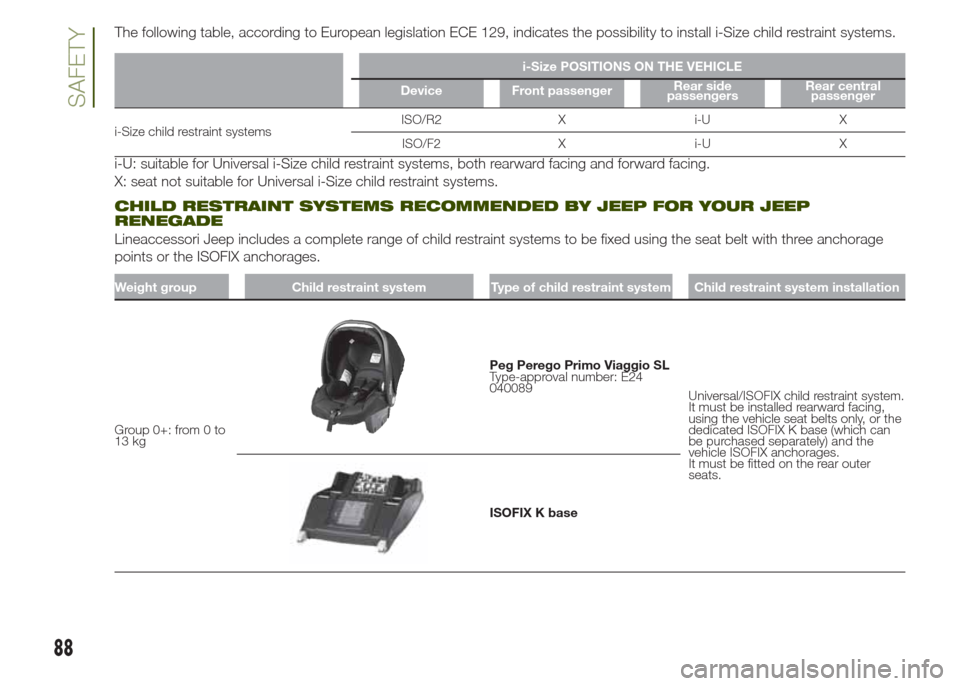
The following table, according to European legislation ECE 129, indicates the possibility to install i-Size child restraint systems.
i-Size POSITIONS ON THE VEHICLE
Device Front passengerRear side
passengersRear central
passenger
i-Size child restraint systemsISO/R2 X i-U X
ISO/F2 X i-U X
i-U: suitable for Universal i-Size child restraint systems, both rearward facing and forward facing.
X: seat not suitable for Universal i-Size child restraint systems.
CHILD RESTRAINT SYSTEMS RECOMMENDED BY JEEP FOR YOUR JEEP
RENEGADE
Lineaccessori Jeep includes a complete range of child restraint systems to be fixed using the seat belt with three anchorage
points or the ISOFIX anchorages.
Weight group Child restraint system Type of child restraint system Child restraint system installation
Group 0+: from 0 to
13 kg
Peg Perego Primo Viaggio SL
Type-approval number: E24
040089
Universal/ISOFIX child restraint system.
It must be installed rearward facing,
using the vehicle seat belts only, or the
dedicated ISOFIX K base (which can
be purchased separately) and the
vehicle ISOFIX anchorages.
It must be fitted on the rear outer
seats.
ISOFIX K base
88
SAFETY
Page 91 of 212
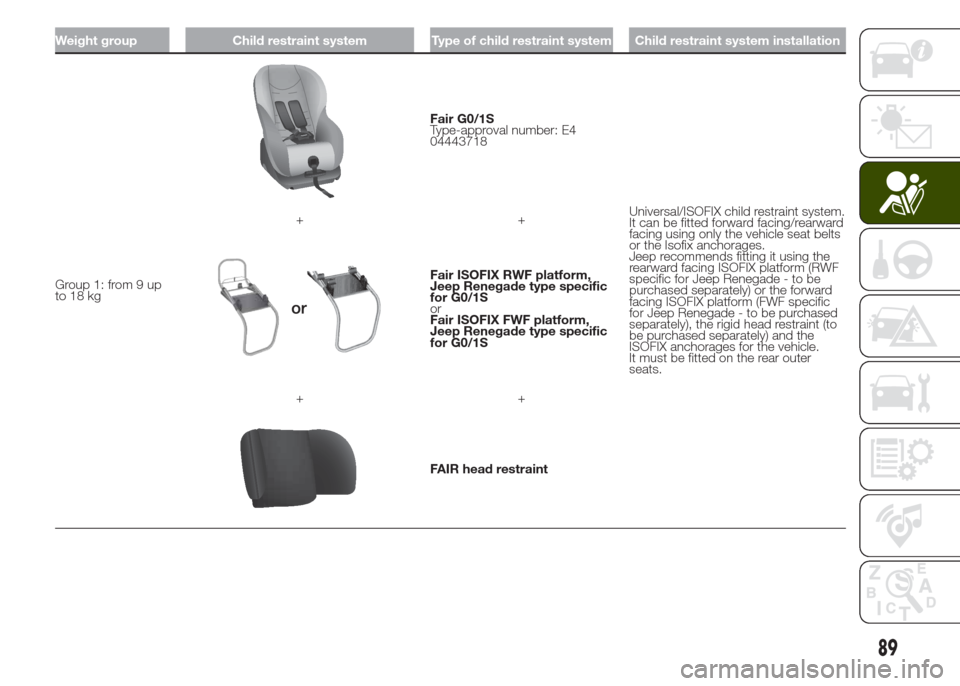
Weight group Child restraint system Type of child restraint system Child restraint system installation
Group 1: from 9 up
to 18 kg
Fair G0/1S
Type-approval number: E4
04443718
Universal/ISOFIX child restraint system.
It can be fitted forward facing/rearward
facing using only the vehicle seat belts
or the Isofix anchorages.
Jeep recommends fitting it using the
rearward facing ISOFIX platform (RWF
specific for Jeep Renegade - to be
purchased separately) or the forward
facing ISOFIX platform (FWF specific
for Jeep Renegade - to be purchased
separately), the rigid head restraint (to
be purchased separately) and the
ISOFIX anchorages for the vehicle.
It must be fitted on the rear outer
seats. ++
Fair ISOFIX RWF platform,
Jeep Renegade type specific
for G0/1S
or
Fair ISOFIX FWF platform,
Jeep Renegade type specific
for G0/1S
++
FAIR head restraint
89