Page 453 of 690

If the “SERVICE POWER STEERING” message
and a steering wheel icon are displayed on the
EVIC screen, it indicates that the vehicle needs
to be taken to the dealer for service. It is likely
the vehicle has lost power steering assistance. Refer to
“Electronic Vehicle Information (EVIC)” in “Understand-
ing Your Instrument Panel” for further information.
NOTE:
• Even if the power steering assistance is no longer
operational, it is still possible to steer the vehicle.
Under these conditions there will be a substantial
increase in steering effort, especially at low speeds and
during parking maneuvers.
• If the condition persists, see your authorized dealer for
service.ELECTRIC PARKING BRAKE (EPB)
Your vehicle is equipped with an Electric Parking Brake
System (EPB) that offers simple operation, and some
additional features that make the parking brake more
convenient and useful.
The parking brake is primarily intended to prevent the
vehicle from rolling while parked. Before leaving the
vehicle, make sure that the parking brake is applied.
Also, be certain to leave the transmission in PARK.
You can engage the parking brake in two ways;
• Manually, by applying the park brake switch.
• Automatically, by enabling the Auto Park Brake fea-
ture in the customer programmable features section of
the Uconnect® settings.
5
STARTING AND OPERATING 451
Page 454 of 690

The parking brake switch is located in the center console.
To apply the parking brake manually, pull up on the
switch momentarily. You may hear a slight whirring
sound from the back of the vehicle while the parking
brake engages. Once the parking brake is fully engaged,
the BRAKE warning lamp in the instrument cluster andan indicator on the switch will illuminate. If your foot is
on the brake pedal while you apply the parking brake,
you may notice a small amount of brake pedal move-
ment. The park brake can be applied even when the
ignition switch is OFF but the BRAKE warning lamp will
not illuminate, however, it can only be released when the
ignition switch is in the ON/RUN position.
NOTE:
The EPB fault lamp will illuminate if the EPB
switch is held for longer than 20 seconds in either the
released or applied position. The light will extinguish
upon releasing the switch.
If the Auto Park Brake feature is enabled, the parking
brake will automatically engage whenever the transmis-
sion is placed into PARK, or with a manual transmission,
when the ignition switch is turned OFF. Once the parking
brake is engaged, the BRAKE warning lamp in the
instrument cluster and the LED indicator on the switch
Electric Parking Brake Switch
452 STARTING AND OPERATING
Page 455 of 690

will illuminate. If your foot is on the brake pedal, you
may notice a small amount of brake pedal movement
while the parking brake is engaging.
The parking brake will release automatically when the
ignition switch is ON, the transmission is in Drive or
Reverse, the driver seat belt is buckled, and an attempt is
made to drive away.
To release the park brake manually, the ignition switch
must be in the ON/RUN position. Put your foot on the
brake pedal, then push the parking brake switch down
momentarily. You may hear a slight whirring sound from
the back of the car while the parking brake disengages.
You may also notice a small amount of movement in the
brake pedal. Once the parking brake is fully disengaged,
The BRAKE warning lamp in the instrument cluster and
the LED indicator on the switch will extinguish.NOTE:
When parking on a hill, it is important to turn the
front wheels toward the curb on a downhill grade and
away from the curb on an uphill grade. Apply the
parking brake before placing the shift lever in PARK,
otherwise the load on the transmission locking mecha-
nism may make it difficult to move the shift lever out of
PARK. The parking brake should always be applied
whenever the driver is not in the vehicle.
WARNING!
• Never use the PARK position as a substitute for the
parking brake. Always apply the parking brake
fully when parked to guard against vehicle move-
ment and possible injury or damage.
• When leaving the vehicle, always remove the Key
Fob from the ignition and lock your vehicle.
(Continued)
5
STARTING AND OPERATING 453
Page 457 of 690

will sound. The rear stop lamps will also be illuminated
automatically while the vehicle remains in motion.
To disengage the parking brake while the vehicle is in
motion, release the switch. If the vehicle is brought to a
complete stop using the parking brake, when the vehicle
reaches approximately 3 mph, (5 km/h) the parking
brake will remain engaged.
WARNING!
Driving the vehicle with the parking brake engaged, or
repeated use of the parking brake to slow the vehicle
may cause serious damage to the brake system.
In the unlikely event of a malfunction of the Electric Park
Brake system, a yellow EPB fault lamp will illuminate.This may be accompanied by the Brake warning lamp
flashing. In this event, urgent service of the electric park
brake system is required. Do not rely on the parking
brake to hold the vehicle stationary.
Auto Park Brake
The electric park brake can be programmed to be applied
automatically whenever the vehicle is at a standstill and
the automatic transmission is placed in PARK, or with a
manual transmission, whenever the ignition switch is
turned off. Auto Park Brake is enabled and disabled by
customer selection through the customer programmable
features section of the Uconnect® Settings.
Any single auto park brake application can be bypassed
by pressing the EPB switch to the release position while
the transmission is placed in PARK.
5
STARTING AND OPERATING 455
Page 458 of 690

Safehold
Safehold is a safety feature of the Electric Park Brake
System that will engage the park brake automatically if
the vehicle is left unsecured while the ignition switch is
in RUN.
For automatic transmissions, the park brake will auto-
matically engage if all of the following conditions are
met:
•The vehicle is at a standstill
• There is no attempt to depress the brake pedal or
accelerator pedal
• The seat belt is unbuckled
• The driver door is open For manual transmissions, the park brake will automati-
cally engage if all of the following conditions are met:
•
The vehicle is at a standstill
• There is no attempt to depress the brake pedal or
accelerator pedal
• The clutch pedal is not pressed
• The seat belt is unbuckled
• The driver door is open
Safehold can be temporarily bypassed by pressing the
Electric Park Brake Switch while the driver door is open.
Once manually bypassed, Safehold will be enabled again
once the vehicle reaches 12 mph (20 km/h) or the ignition
is turned to the OFF position and back to ON again.
456 STARTING AND OPERATING
Page 466 of 690

WARNING!(Continued)
rollovers, especially those that involve leaving the
roadway or striking objects or other vehicles. The
capabilities of an ERM-equipped vehicle must never
be exploited in a reckless or dangerous manner,
which could jeopardize the user’s safety or the safety
of others.
Hill Start Assist (HSA)
The HSA system is designed to help the driver accelerate
the vehicle from a complete stop while on an incline.
If the driver releases the brake while stopped on an
incline, HSA will continue to hold the brake pressure for
a short period. If the driver does not apply the throttle
before this time expires, the system will release brake
pressure and the vehicle will roll down the hill as normal.
The system will release brake pressure in proportion to
amount of throttle applied. The following conditions must be met in order for HSA to
activate:
•
The vehicle must be stopped.
• The vehicle must be on a 7% (approximate) grade or
greater hill.
• The gear selection must match vehicle uphill direction
(i.e., vehicle facing uphill is in forward gear; vehicle
backing uphill is in REVERSE gear).
• For vehicles equipped with an automatic transmission,
the HSA will work in REVERSE gear and all forward
gears. The system will not activate if the transmission
is in PARK.
464 STARTING AND OPERATING
Page 473 of 690
Activating SSC
Once SSC is enabled it will activate automatically once
the following conditions are met:
•Driver releases throttle
• Driver releases brake
• Transmission is in any selection other than P
• Vehicle speed is below 20 mph (32 km/h)
The set speed for SSC is selectable by the driver, and can
be adjusted by using the gear shift lever. Additionally, the
SSC set speed is automatically reduced when climbing a
grade and the level of set speed reduction depends on the
magnitude of grade. The following summarizes the SSC
set speeds: 4WD Low Range Set Speeds
•
1st = .6 mph (1 km/h)
• 2nd = 1.2 mph (2 km/h)
• 3rd = 4 mph (3 km/h)
• 4th = 2.5 mph (4 km/h)
• 5th = 3.1 mph (5 km/h)
• 6th = 3.7 mph (6 km/h)
• 7th = 4.3 mph (7 km/h)
• 8th = 5 mph (8 km/h)
• 9th = 5.6 mph (9 km/h)
• REVERSE = .6 mph (1 km/h)
• NEUTRAL = 1.2 mph (2 km/h)
• PARK = SSC remains enabled but not active
5
STARTING AND OPERATING 471
Page 537 of 690
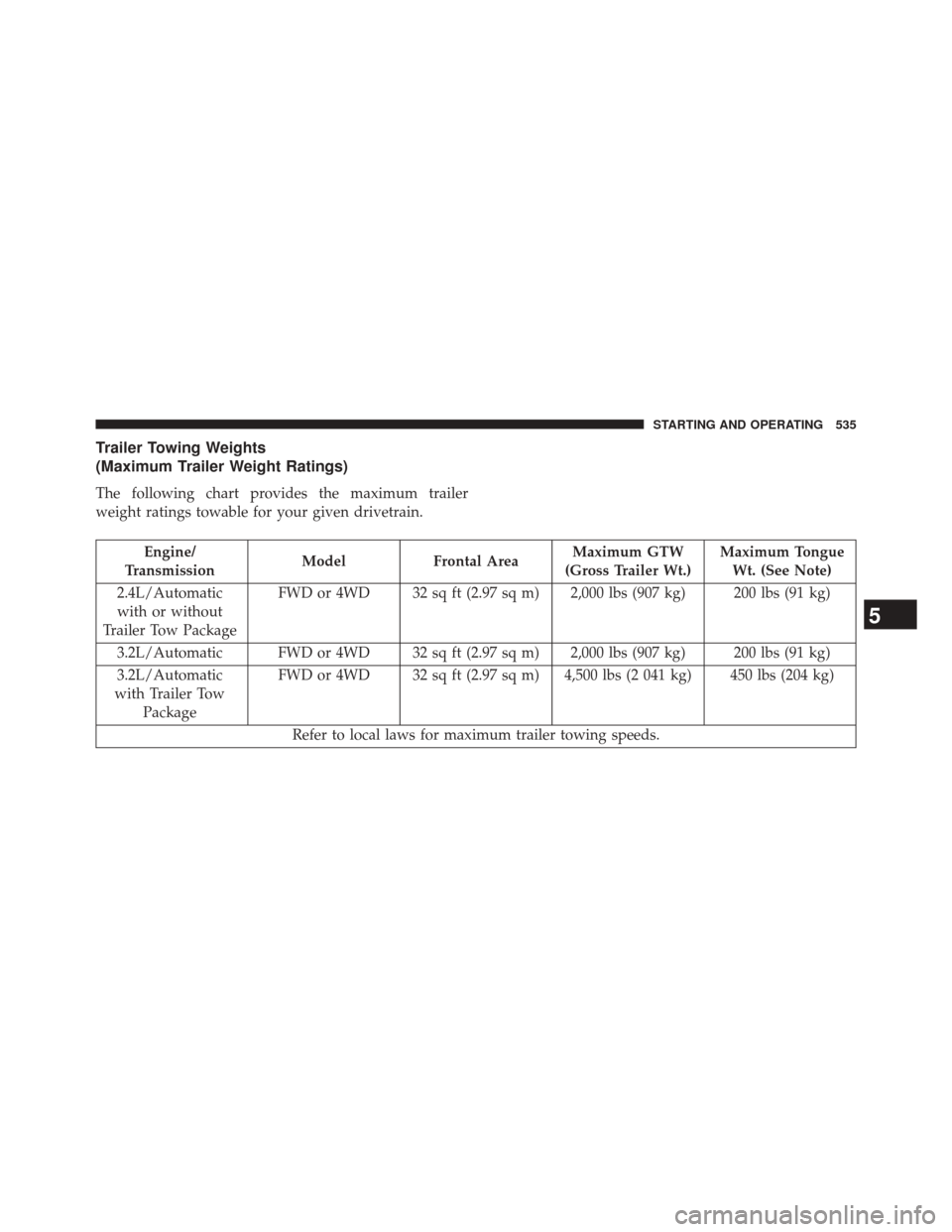
Trailer Towing Weights
(Maximum Trailer Weight Ratings)
The following chart provides the maximum trailer
weight ratings towable for your given drivetrain.
Engine/
Transmission Model
Frontal Area Maximum GTW
(Gross Trailer Wt.) Maximum Tongue
Wt. (See Note)
2.4L/Automatic with or without
Trailer Tow Package FWD or 4WD 32 sq ft (2.97 sq m) 2,000 lbs (907 kg) 200 lbs (91 kg)
3.2L/Automatic FWD or 4WD 32 sq ft (2.97 sq m) 2,000 lbs (907 kg) 200 lbs (91 kg)
3.2L/Automatic
with Trailer Tow Package FWD or 4WD 32 sq ft (2.97 sq m) 4,500 lbs (2 041 kg) 450 lbs (204 kg)
Refer to local laws for maximum trailer towing speeds.
5
STARTING AND OPERATING 535