7-87
7
Maintenance
APPEARANCE CARE
Exterior care
Exterior general caution
It is very important to follow the label
directions when using any chemical
cleaner or polish. Read all warning
and caution statements that appear
on the label.
Finish maintenance
Washing
To help protect your vehicle’s finish
from rust and deterioration, wash it
thoroughly and frequently at least
once a month with lukewarm or cold
water.
If you use your vehicle for off-road
driving, you should wash it after each
off-road trip. Pay special attention to
the removal of any accumulation of
salt, dirt, mud, and other foreign
materials. Make sure the drain holes
in the lower edges of the doors and
rocker panels are kept clear and
clean.
Insects, tar, tree sap, bird droppings,
industrial pollution and similar
deposits can damage your vehicle’s
finish if not removed immediately.
Even prompt washing with plain
water may not completely remove all
these deposits.
A mild soap, safe for use on painted
surfaces, may be used.
After washing, rinse the vehicle thor-
oughly with lukewarm or cold water.
Do not allow soap to dry on the fin-
ish.
•Do not use strong soap,
chemical detergents or hot
water, and do not wash the
vehicle in direct sunlight or
when the body of the vehicle
is warm.
•Be careful when washing the
side windows of your vehicle.
Especially, with high-pressure
water, water may leak through
the windows and wet the inte-
rior.
•To p r e v e n t d a m a g e t o t h e
plastic parts and lamps, do
not clean with chemical sol-
vents or strong detergents.
CAUTION
8-8
Specifications & Consumer information
Recommended SAE viscosity
number
Engine oil viscosity (thickness) has
an effect on fuel economy and cold
weather operating (engine start and
engine oil flowability). Lower viscosi-
ty engine oils can provide better fuel
economy and cold weather perform-
ance, however, higher viscosity
engine oils are required for satisfac-
tory lubrication in hot weather. Using
oils of any viscosity other than those
recommended could result in engine
damage.
Always be sure to clean the area
around any filler plug, drain
plug, or dipstick before check-
ing or draining any lubricant.
This is especially important in
dusty or sandy areas and when
the vehicle is used on unpaved
roads. Cleaning the plug and
dipstick areas will prevent dirt
and grit from entering the
engine and other mechanisms
that could be damaged.
CAUTIONTemperature Range for SAE Viscosity Numbers
Temperature
Gasoline Engine Oil(2.0 MPI/
2.4 MPI)
°C
(°F)
-30 -20 -10 0 10 20 30 40 50
-10 0 20 40 60 80 100 120
*1 :For better fuel economy, it is recommended to use the engine oil of a viscosity grade SAE 5W-20 (Except Middle East & Gasoline 2.0MPI/2.4 MPI).
*2 :For better fuel economy, it is recommended to use the engine oil of a viscosity grade SAE 5W-30 (For Middle East & Gasoline 2.0 MPI/2.4 MPI/2.4 GDI/2.0 T-GDI). However, if theengine oil is not available in your country, select the proper engine oil using the engine oil vis-cosity chart.
*3:Middle East includes Libya, Algeria, Morocco, Tunisia, Sudan, Egypt and Iran.
20W-50
10W-30
15W-40
5W-30*2,5W-40
Gasoline Engine Oil(2.0 T-GDI/2.4 GDI)
For
Middle
East,
Brazil *3
20W-50
10W-30
15W-40
5W-20*1,5W-30
Except
Middle
East
20W-50
10W-30
15W-40
5W-30*2,5W-40
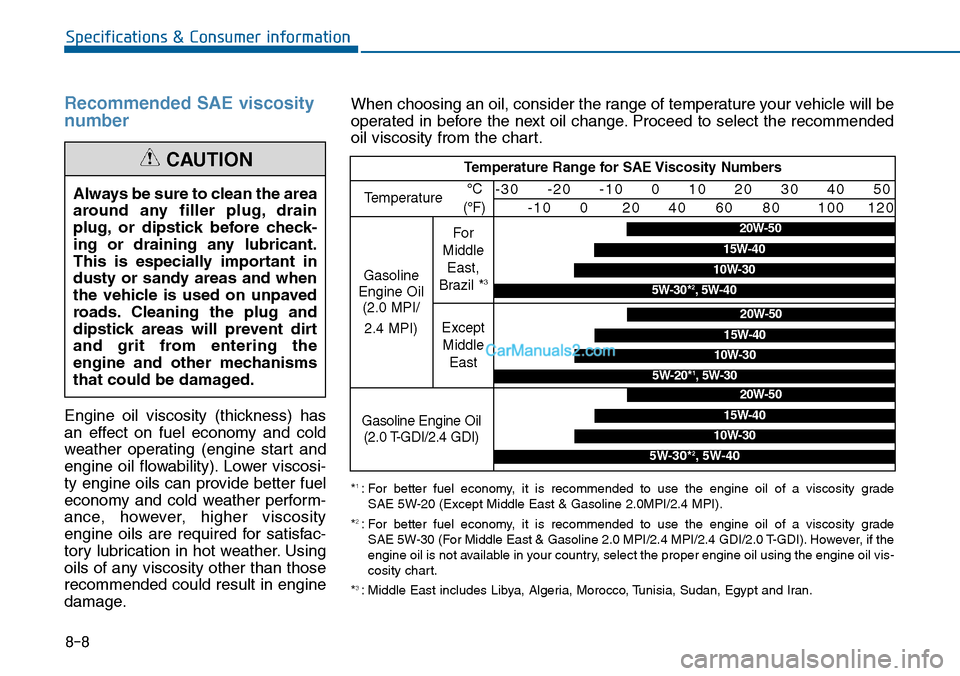
When choosing an oil, consider the range of temperature your vehicle will be
operated in before the next oil change. Proceed to select the recommended
oil viscosity from the chart.