Page 34 of 665
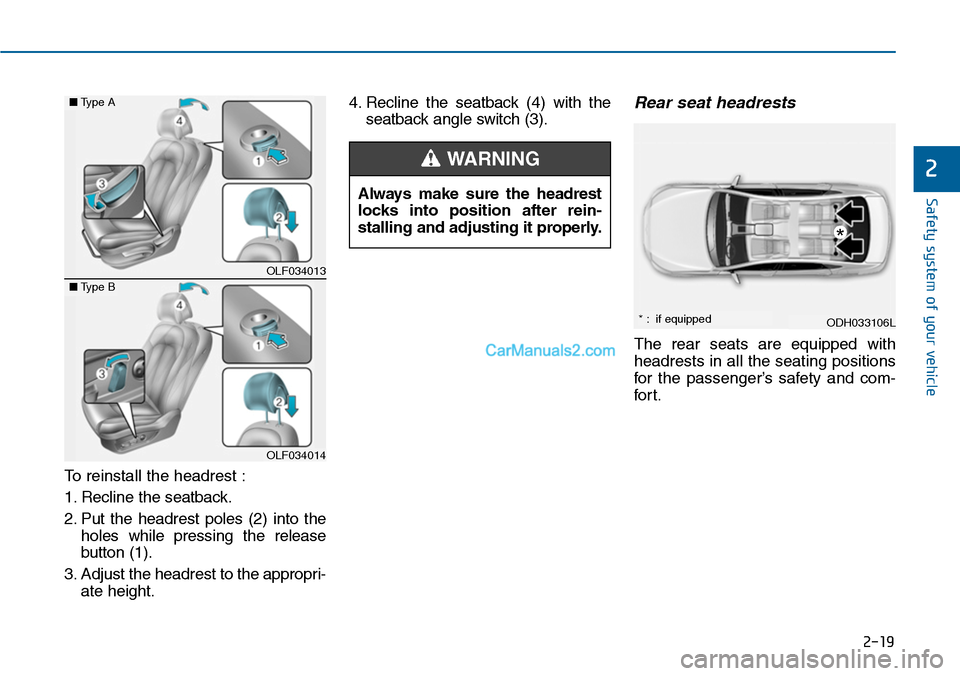
To reduce the risk of serious
injury or death from an inflating
air bag, take the following pre-
cautions:
•Adjust the driver’s seat as far
to the rear as possible while
maintaining the ability to main-
tain full control of the vehicle.
•Adjust the front passenger
seat as far to the rear as possi-
ble.
(Continued)
WARNING
(Continued)
•Hold the steering wheel by the
rim with hands at the 9 o’clock
and 3 o’clock positions to min-
imize the risk of injuries to
your hands and arms.
•NEVER place anything or any-
one between the air bag.
•Do not allow the front passen-
ger to place feet or legs on the
dashboard to minimize the risk
of leg injuries.
2-5
Safety system of your vehicle
2
Safety precautions
Adjusting the seats so that you are sit-
ting in a safe, comfortable position
plays an important role in driver and
passenger safety together with the
seat belts and air bags in an accident.
Air bags
Yo u c a n t a k e s t e p s t o r e d u c e t h e r i s k
of being injured by an inflating air
bag. Sitting too close to an air bag
greatly increases the risk of injury in
the event the air bag inflates. Move
your seat as far back as possible
from front air bags, while still main-
taining control of the vehicle.
Do not use a cushion that
reduces friction between the seat
and the passenger. The passen-
ger's hips may slide under the
lap portion of the seat belt during
an accident or a sudden stop.
Serious or fatal internal injuries
could result because the seat
belt cannot operate properly.
WARNING
Page 36 of 665
2-7
Safety system of your vehicle
Manual adjustment
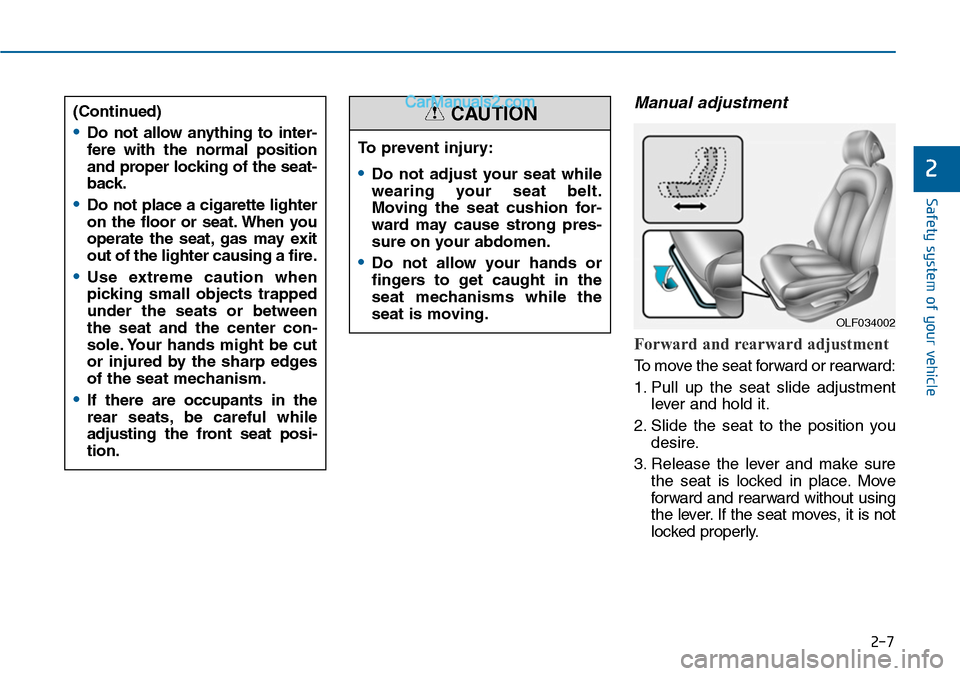
Forward and rearward adjustment
To m o v e t h e s e a t f o r w a r d o r r e a r w a r d :
1. Pull up the seat slide adjustment
lever and hold it.
2. Slide the seat to the position you
desire.
3. Release the lever and make sure
the seat is locked in place. Move
forward and rearward without using
the lever. If the seat moves, it is not
locked properly.
2
To prevent injury:
•Do not adjust your seat while
wearing your seat belt.
Moving the seat cushion for-
ward may cause strong pres-
sure on your abdomen.
•Do not allow your hands or
fingers to get caught in the
seat mechanisms while the
seat is moving.
CAUTION(Continued)
•Do not allow anything to inter-
fere with the normal position
and proper locking of the seat-
back.
•Do not place a cigarette lighter
on the floor or seat. When you
operate the seat, gas may exit
out of the lighter causing a fire.
•Use extreme caution when
picking small objects trapped
under the seats or between
the seat and the center con-
sole. Your hands might be cut
or injured by the sharp edges
of the seat mechanism.
•If there are occupants in the
rear seats, be careful while
adjusting the front seat posi-
tion.
OLF034002
Page 37 of 665
2-8
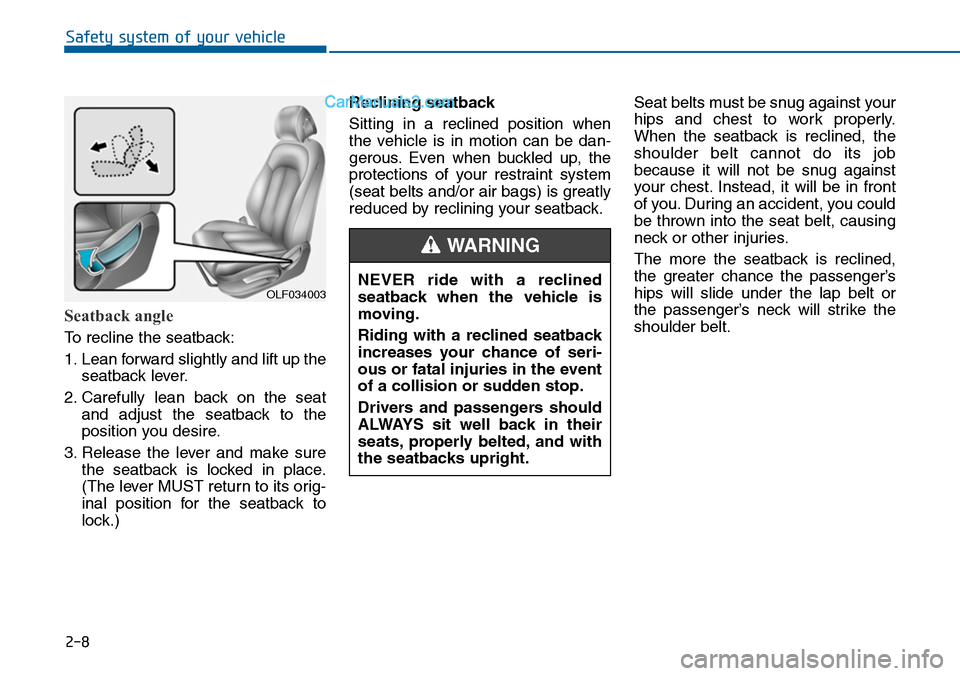
Seatback angle
To recline the seatback:
1. Lean forward slightly and lift up the
seatback lever.
2. Carefully lean back on the seat
and adjust the seatback to the
position you desire.
3. Release the lever and make sure
the seatback is locked in place.
(The lever MUST return to its orig-
inal position for the seatback to
lock.)
Reclining seatback
Sitting in a reclined position when
the vehicle is in motion can be dan-
gerous. Even when buckled up, the
protections of your restraint system
(seat belts and/or air bags) is greatly
reduced by reclining your seatback.
Seat belts must be snug against your
hips and chest to work properly.
When the seatback is reclined, the
shoulder belt cannot do its job
because it will not be snug against
your chest. Instead, it will be in front
of you. During an accident, you could
be thrown into the seat belt, causing
neck or other injuries.
The more the seatback is reclined,
the greater chance the passenger’s
hips will slide under the lap belt or
the passenger’s neck will strike the
shoulder belt.
Safety system of your vehicle
OLF034003NEVER ride with a reclined
seatback when the vehicle is
moving.
Riding with a reclined seatback
increases your chance of seri-
ous or fatal injuries in the event
of a collision or sudden stop.
Drivers and passengers should
ALWAYS sit well back in their
seats, properly belted, and with
the seatbacks upright.
WARNING
Page 42 of 665
2-13
Safety system of your vehicle
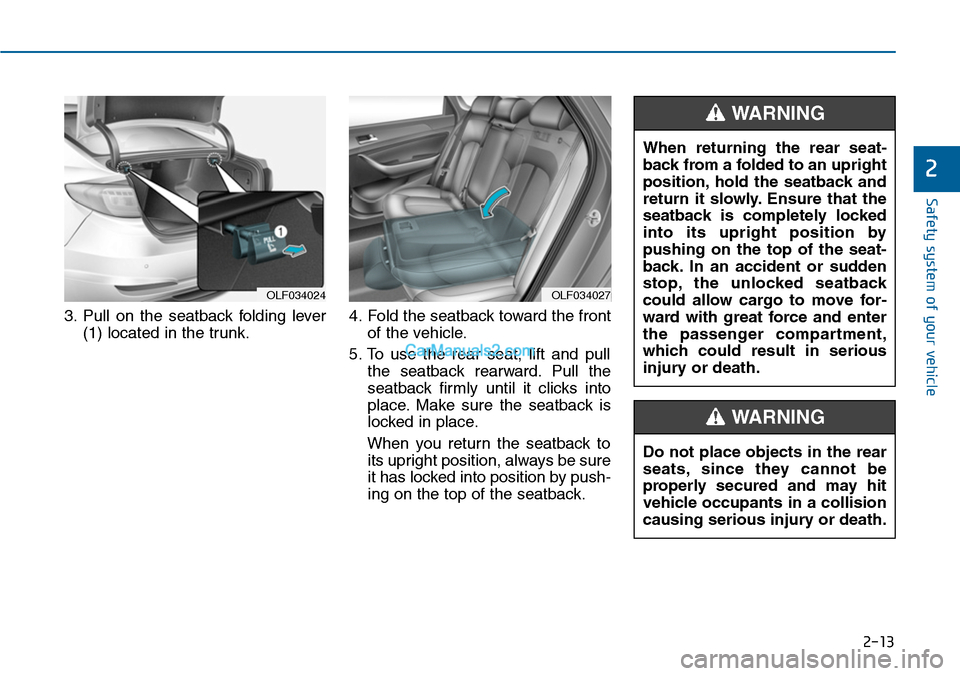
3. Pull on the seatback folding lever
(1) located in the trunk.
4. Fold the seatback toward the front
of the vehicle.
5. To use the rear seat, lift and pull
the seatback rearward. Pull the
seatback firmly until it clicks into
place. Make sure the seatback is
locked in place.
When you return the seatback to
its upright position, always be sure
it has locked into position by push-
ing on the top of the seatback.
2
OLF034024OLF034027
Do not place objects in the rear
seats, since they cannot be
properly secured and may hit
vehicle occupants in a collision
causing serious injury or death.
WARNING
When returning the rear seat-
back from a folded to an upright
position, hold the seatback and
return it slowly. Ensure that the
seatback is completely locked
into its upright position by
pushing on the top of the seat-
back. In an accident or sudden
stop, the unlocked seatback
could allow cargo to move for-
ward with great force and enter
the passenger compartment,
which could result in serious
injury or death.
WARNING
Page 45 of 665
2-16
Safety system of your vehicle
Headrest
The vehicle’s front and rear seats
have adjustable headrests. The head-
rests provide comfort for passengers,
but more impor tantly they are
designed to help protect passengers
from whiplash and other neck and
spinal injuries during an accident,
especially in a rear impact collision.
To prevent damage, NEVER hit or
pull on the headrests.
NOTICE
When there is no occupant in
the rear seats, adjust the height
of the headrest to the lowest
position. The rear seat headrest
can reduce the visibility of the
rear area.
CAUTION
To r e d u c e t h e r i s k o f s e r i o u s
injury or death in an accident,
take the following precautions
when adjusting your headrests:
•Always properly adjust the
headrests for all passengers
BEFORE starting the vehicle.
•NEVER let anyone ride in a seat
with the headrest removed.
(Continued)
(Continued)
•
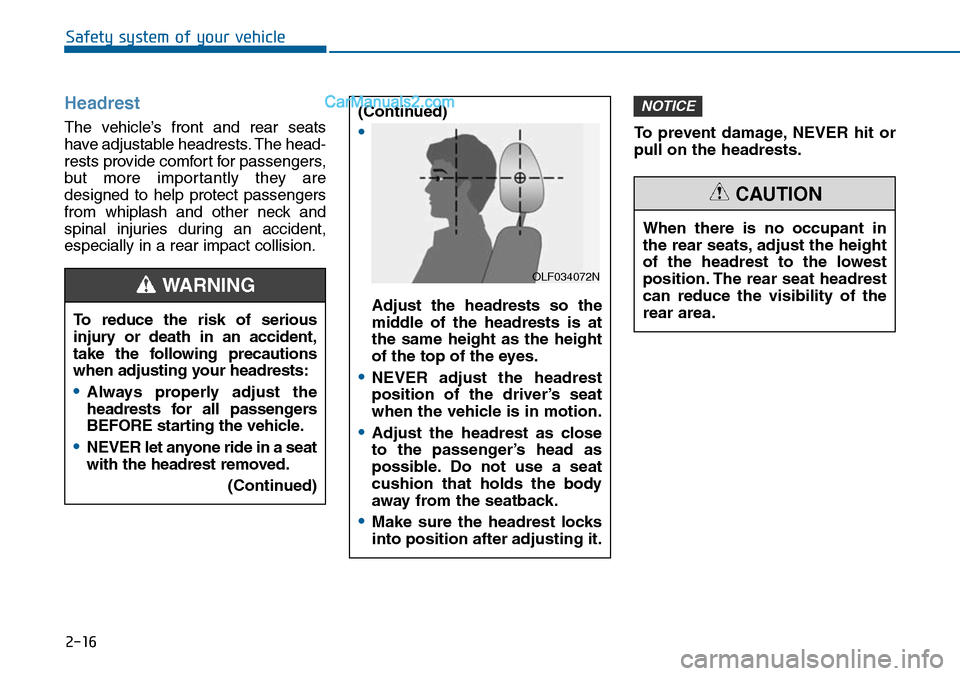
Adjust the headrests so the
middle of the headrests is at
the same height as the height
of the top of the eyes.
•NEVER adjust the headrest
position of the driver’s seat
when the vehicle is in motion.
•Adjust the headrest as close
to the passenger’s head as
possible. Do not use a seat
cushion that holds the body
away from the seatback.
•Make sure the headrest locks
into position after adjusting it.
WARNING OLF034072N
Page 48 of 665
2-19
Safety system of your vehicle
2
To reinstall the headrest :
1. Recline the seatback.
2. Put the headrest poles (2) into the
holes while pressing the release
button (1).
3. Adjust the headrest to the appropri-
ate height.
4. Recline the seatback (4) with the
seatback angle switch (3).
Rear seat headrests
The rear seats are equipped with
headrests in all the seating positions
for the passenger’s safety and com-
for t.
ODH033106L* : if equipped
*
Always make sure the headrest
locks into position after rein-
stalling and adjusting it properly.
WARNING
OLF034013
OLF034014
■Type A
■Type B
Page 52 of 665
2-23
Safety system of your vehicle
2
Information
With the seat warmer switch in the
ON position, the heating system in the
seat turns off or on automatically
depending on the seat temperature.
i(Continued)
•Avoid spilling liquids on the
surface of the front seats and
seatbacks; this may cause the
air vent holes to become
blocked and not work properly.
•Do not place materials such
as plastic bags or newspa-
pers under the seats. They
may block the air intake caus-
ing the air vents to not work
properly.
•Do not change the seat cov-
ers. It may damage the seat
warmer or air ventilation seat.
•If the air vents do not operate,
restart the vehicle. If there is
no change, we recommend
that you have your vehicle
inspected by an authorized
HYUNDAI dealer.
To prevent damage to the seat
warmer, air ventilation seat and
seats:
•Use the seat warmer and air
ventilation seat ONLY when
the climate control system is
on. Using the seat warmer and
air ventilation seat for pro-
longed periods of time with
the climate control system off
could cause the seat warmer
and air ventilation seat to mal-
function.
•Never use a solvent such as
paint thinner, benzene, alco-
hol or gasoline to clean the
seats.
(Continued)
CAUTION
Page 56 of 665
2-27
Safety system of your vehicle
2
Seat belt restraint system
Lap/shoulder belt
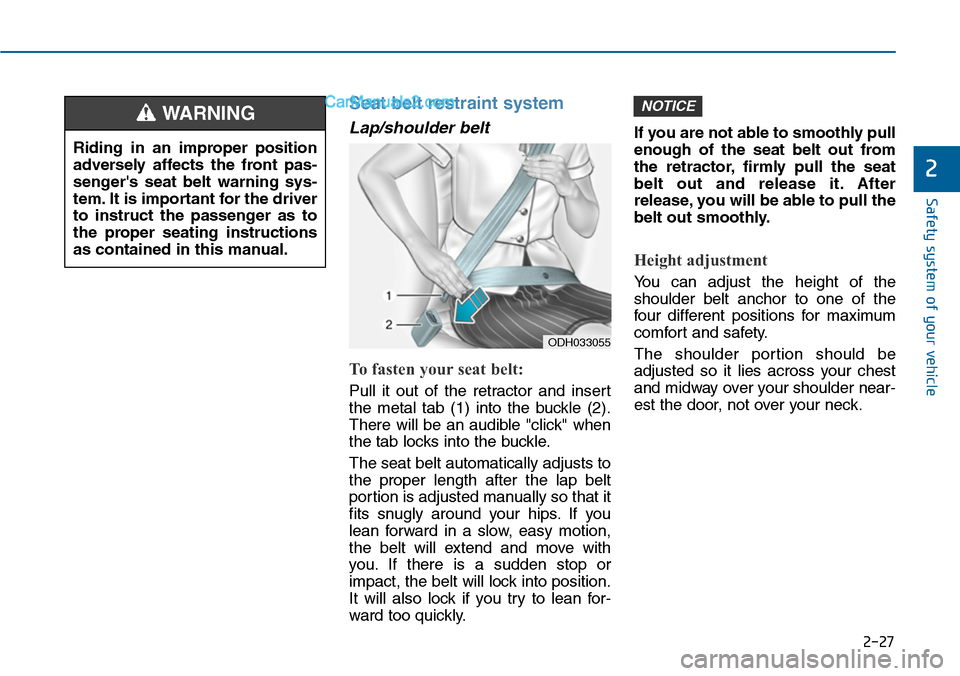
To fasten your seat belt:
Pull it out of the retractor and insert
the metal tab (1) into the buckle (2).
There will be an audible "click" when
the tab locks into the buckle.
The seat belt automatically adjusts to
the proper length after the lap belt
portion is adjusted manually so that it
fits snugly around your hips. If you
lean forward in a slow, easy motion,
the belt will extend and move with
you. If there is a sudden stop or
impact, the belt will lock into position.
It will also lock if you try to lean for-
ward too quickly.
If you are not able to smoothly pull
enough of the seat belt out from
the retractor, firmly pull the seat
belt out and release it. After
release, you will be able to pull the
belt out smoothly.
Height adjustment
Yo u c a n a d j u s t t h e h e i g h t o f t h e
shoulder belt anchor to one of the
four different positions for maximum
comfort and safety.
The shoulder portion should be
adjusted so it lies across your chest
and midway over your shoulder near-
est the door, not over your neck.
NOTICE
Riding in an improper position
adversely affects the front pas-
senger's seat belt warning sys-
tem. It is important for the driver
to instruct the passenger as to
the proper seating instructions
as contained in this manual.
WARNING
ODH033055