7-97
7
Maintenance
•Do not operate the engine in con-
fined or closed areas (such as
garages) any more than what is
necessary to move the vehicle in or
out of the area.
•When the vehicle is stopped in an
open area for more than a short
time with the engine running,
adjust the ventilation system (as
needed) to draw outside air into the
vehicle.
•Never sit in a parked or stopped
vehicle for any extended time with
the engine running.
•When the engine stalls or fails to
start, excessive attempts to restart
the engine may cause damage to
the emission control system.
Operating precautions for cat-
alytic converters (if equipped)
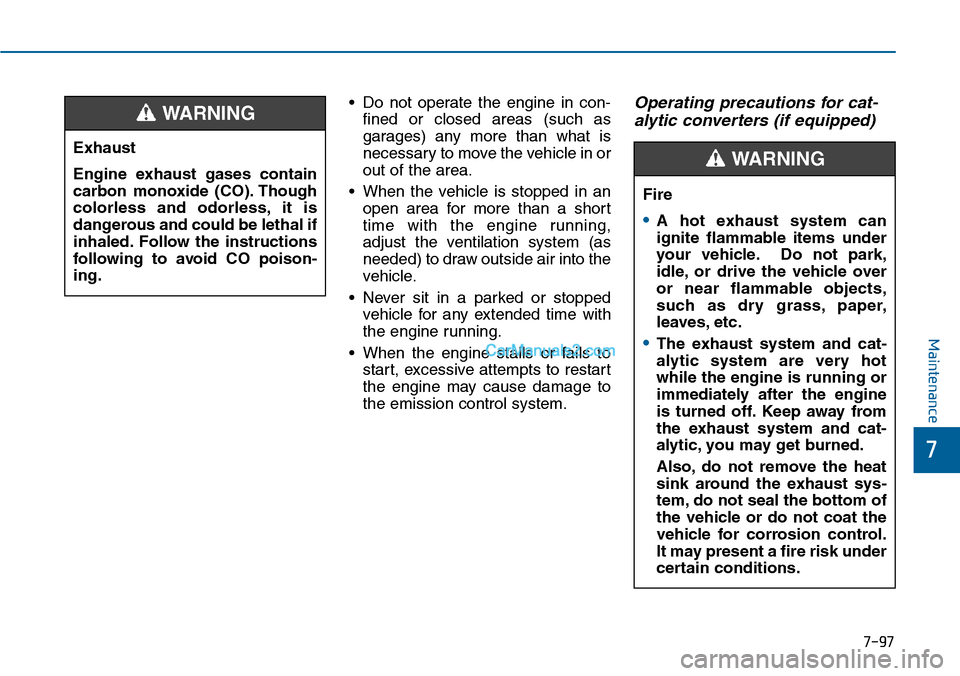
Exhaust
Engine exhaust gases contain
carbon monoxide (CO). Though
colorless and odorless, it is
dangerous and could be lethal if
inhaled. Follow the instructions
following to avoid CO poison-
ing.
WARNING
Fire
•A hot exhaust system can
ignite flammable items under
your vehicle. Do not park,
idle, or drive the vehicle over
or near flammable objects,
such as dry grass, paper,
leaves, etc.
•The exhaust system and cat-
alytic system are very hot
while the engine is running or
immediately after the engine
is turned off. Keep away from
the exhaust system and cat-
alytic, you may get burned.
Also, do not remove the heat
sink around the exhaust sys-
tem, do not seal the bottom of
the vehicle or do not coat the
vehicle for corrosion control.
It may present a fire risk under
certain conditions.
WARNING
8-8
Specifications & Consumer information
Recommended SAE viscosity
number
Engine oil viscosity (thickness) has
an effect on fuel economy and cold
weather operating (engine start and
engine oil flowability). Lower viscosi-
ty engine oils can provide better fuel
economy and cold weather perform-
ance, however, higher viscosity
engine oils are required for satisfac-
tory lubrication in hot weather. Using
oils of any viscosity other than those
recommended could result in engine
damage.
Always be sure to clean the area
around any filler plug, drain
plug, or dipstick before check-
ing or draining any lubricant.
This is especially important in
dusty or sandy areas and when
the vehicle is used on unpaved
roads. Cleaning the plug and
dipstick areas will prevent dirt
and grit from entering the
engine and other mechanisms
that could be damaged.
CAUTIONTemperature Range for SAE Viscosity Numbers
Temperature
Gasoline Engine Oil(2.0 MPI/
2.4 MPI)
°C
(°F)
-30 -20 -10 0 10 20 30 40 50
-10 0 20 40 60 80 100 120
*1 :For better fuel economy, it is recommended to use the engine oil of a viscosity grade SAE 5W-20 (Except Middle East & Gasoline 2.0MPI/2.4 MPI).
*2 :For better fuel economy, it is recommended to use the engine oil of a viscosity grade SAE 5W-30 (For Middle East & Gasoline 2.0 MPI/2.4 MPI/2.4 GDI/2.0 T-GDI). However, if theengine oil is not available in your country, select the proper engine oil using the engine oil vis-cosity chart.
*3:Middle East includes Libya, Algeria, Morocco, Tunisia, Sudan, Egypt and Iran.
20W-50
10W-30
15W-40
5W-30*2,5W-40
Gasoline Engine Oil(2.0 T-GDI/2.4 GDI)
For
Middle
East,
Brazil *3
20W-50
10W-30
15W-40
5W-20*1,5W-30
Except
Middle
East
20W-50
10W-30
15W-40
5W-30*2,5W-40
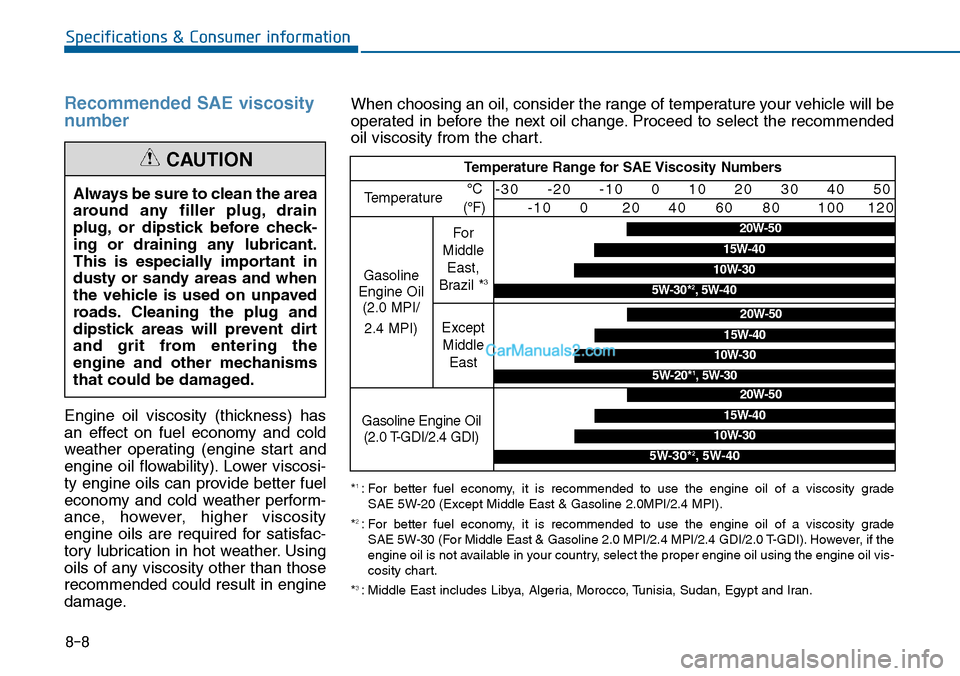
When choosing an oil, consider the range of temperature your vehicle will be
operated in before the next oil change. Proceed to select the recommended
oil viscosity from the chart.