2014 Hyundai Sonata Start engine
[x] Cancel search: Start enginePage 532 of 665
5-83
Driving your vehicle
5
6. Reapply the brakes and parking
brakes.
7. Move the shift lever to P (Park, for
automatic transaxle vehicle) or 1st
gear when the vehicle is parked
on a uphill grade and in R
(Reverse) on a downhill (for man-
ual transaxle vehicle).
8. Shut off the vehicle and release
the vehicle brakes but leave the
parking brake set.
Ready to leave after parking on
a hill
1. With the shift lever to P (Park, for
automatic transaxle vehicle) or
neutral (for manual transaxle vehi-
cle), apply your brakes and hold
the brake pedal down while you:
• Start your engine;
• Shift into gear; and
• Release the parking brake.
2. Slowly remove your foot from the
brake pedal.
3. Drive slowly until the trailer is clear
of the chocks.
4. Stop and have someone pick up
and store the chocks.
Maintenance when towing a
trailer
Yo u r v e h i c l e w i l l n e e d s e r v i c e m o r e
often when you regularly pull a trail-
er. Important items to pay particular
attention to include engine oil, auto-
matic transaxle fluid, axle lubricant
and cooling system fluid. Brake con-
dition is another important item to
frequently check. If you’re trailering,
it’s a good idea to review these items
before you start your trip. Don’t forget
to also maintain your trailer and
hitch. Follow the maintenance sched-
ule that accompanied your trailer and
check it periodically. Preferably, con-
duct the check at the start of each
day’s driving. Most importantly, all
hitch nuts and bolts should be tight.
To p r e v e n t s e r i o u s o r f a t a l
injury:
Do not get out of the vehicle
without the parking brake firmly
set. If you have left the engine
running, the vehicle can move
suddenly. You and others could
be seriously or fatally injured.
WARNING
Page 535 of 665
What to do in an emergency
Hazard warning flasher ........................................6-2
In case of an emergency while driving ..............6-2
If the engine stalls while driving ...................................6-2
If the engine stalls at a crossroad or crossing .........6-3
If you have a flat tire while driving..............................6-3
If the engine will not start ...................................6-4
If the engine doesn't turn over or turns over
slowly....................................................................................6-4
If the engine turns over normally but doesn't
start.......................................................................................6-4
Jump starting ..........................................................6-4
If the engine overheats ........................................6-8
If you have a flat tire............................................6-9
Jack and tools ..................................................................6-10
Changing tires ..................................................................6-11
Jack label ...........................................................................6-17
EC Declaration of conformity for Jack......................6-18
To w i n g . . . . . . . . . . . . . . . . . . . . . . . . . . . . . . . . . . . . . . . . . . . . . . . . . . . . . . . . . . . . . . . . . . . 6 - 1 9
To w i n g s e r v i c e . . . . . . . . . . . . . . . . . . . . . . . . . . . . . . . . . . . . . . . . . . . . . . . . . . . . . . . . . . . . . . . . . 6 - 1 9
Removable towing hook ................................................6-20
Emergency towing ..........................................................6-21
Emergency commodity ........................................6-23
Fire extinguisher .............................................................6-23
First aid kit ......................................................................6-23
Tr i a n g l e r e f l e c t o r . . . . . . . . . . . . . . . . . . . . . . . . . . . . . . . . . . . . . . . . . . . . . . . . . . . . . . . . . . . . 6 - 2 3
Tire pressure gauge .......................................................6-23
6
Page 536 of 665
6-2
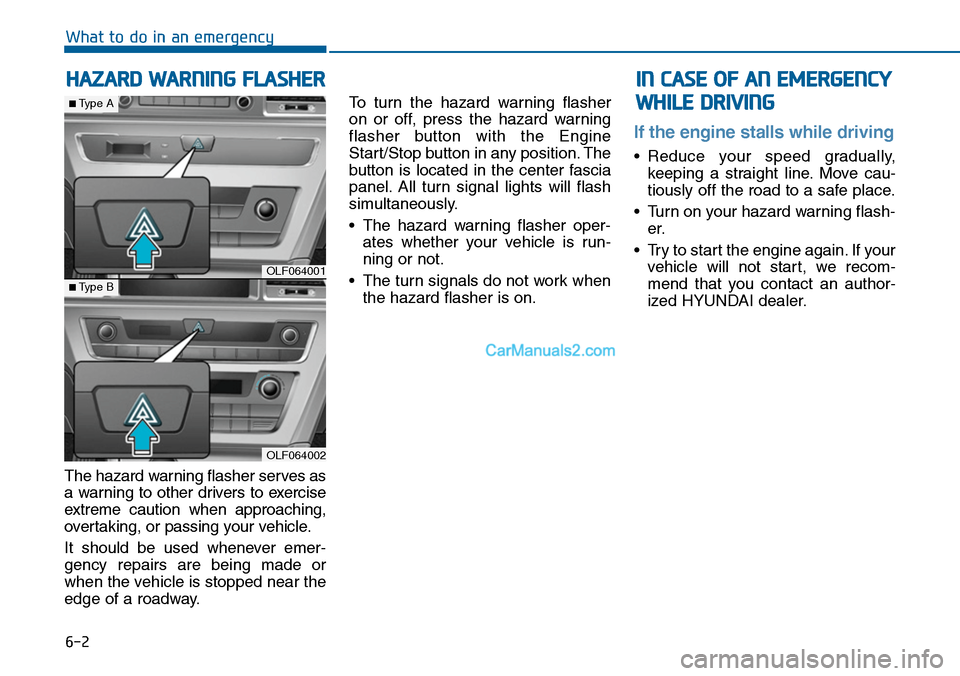
The hazard warning flasher serves as
a warning to other drivers to exercise
extreme caution when approaching,
over taking, or passing your vehicle.
It should be used whenever emer-
gency repairs are being made or
when the vehicle is stopped near the
edge of a roadway.
To turn the hazard warning flasher
on or off, press the hazard warning
flasher button with the Engine
Start/Stop button in any position. The
button is located in the center fascia
panel. All turn signal lights will flash
simultaneously.
•The hazard warning flasher oper-
ates whether your vehicle is run-
ning or not.
•The turn signals do not work when
the hazard flasher is on.
If the engine stalls while driving
•Reduce your speed gradually,
keeping a straight line. Move cau-
tiously off the road to a safe place.
•Turn on your hazard warning flash-
er.
•Try to start the engine again.If your
vehicle will not star t, we recom-
mend that you contact an author-
ized HYUNDAI dealer.
HAZARD WARNING FLASHER
What to do in an emergency
OLF064001
OLF064002
■Type A
■Type B
IN CASE OF AN EMERGENCY
WHILE DRIVING
Page 538 of 665
6-4
IF THE ENGINE WILL NOT START
What to do in an emergency
If the engine doesn't turn over
or turns over slowly
•Be sure the shift lever is in N
(Neutral) or P (Park) if it is an auto-
matic transaxle vehicle. The engine
starts only when the shift lever is in
N (Neutral) or P (Park).
•Check the battery connections to
be sure they are clean and tight.
•Turn on the interior light.If the light
dims or goes out when you operate
the starter, the battery is drained.
Do not push or pull the vehicle to
start it. This could cause damage to
your vehicle. See instructions for
"Jump Starting" provided in this
chapter.
If the engine turns over nor-
mally but doesn’t start
•Check the fuel level and add fuel if
necessary.
If the engine still does not start, we
recommend that you call an author-
ized HYUNDAI dealer for assistance.
Jump star ting can be dangerous if
done incorrectly. Follow the jump
starting procedure in this section to
avoid serious injury or damage to
your vehicle. If in doubt about how to
properly jump start your vehicle, we
strongly recommend that you have a
service technician or towing service
do it for you.
Push or pull starting the vehicle
may cause the catalytic con-
verter to overload which can
lead to damage to the emission
control system.
CAUTION
JUMP STARTING
Page 539 of 665
6-5
What to do in an emergency
6
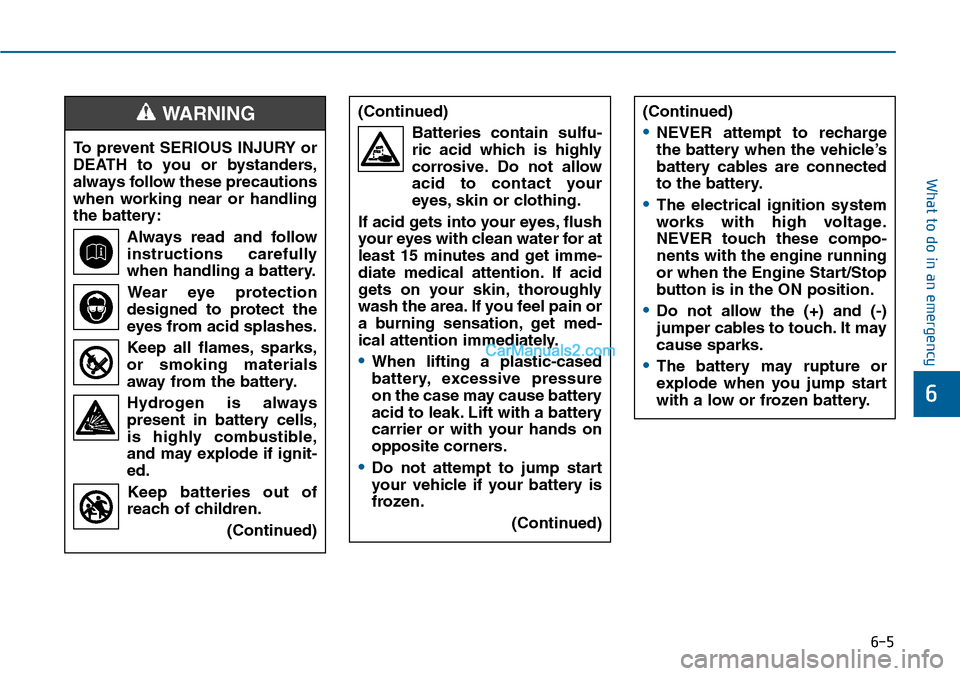
To prevent SERIOUS INJURY or
DEATH to you or bystanders,
always follow these precautions
when working near or handling
the battery:
Always read and follow
instructions carefully
when handling a battery.
Wear eye protection
designed to protect the
eyes from acid splashes.
Keep all flames, sparks,
or smoking materials
away from the battery.
Hydrogen is always
present in battery cells,
is highly combustible,
and may explode if ignit-
ed.
Keep batteries out of
reach of children.
(Continued)
(Continued)
Batteries contain sulfu-
ric acid which is highly
corrosive. Do not allow
acid to contact your
eyes, skin or clothing.
If acid gets into your eyes, flush
your eyes with clean water for at
least 15 minutes and get imme-
diate medical attention. If acid
gets on your skin, thoroughly
wash the area. If you feel pain or
a burning sensation, get med-
ical attention immediately.
•When lifting a plastic-cased
battery, excessive pressure
on the case may cause battery
acid to leak. Lift with a battery
carrier or with your hands on
opposite corners.
•Do not attempt to jump start
your vehicle if your battery is
frozen.
(Continued)
WARNING (Continued)
•NEVER attempt to recharge
the battery when the vehicle’s
battery cables are connected
to the battery.
•The electrical ignition system
works with high voltage.
NEVER touch these compo-
nents with the engine running
or when the Engine Start/Stop
button is in the ON position.
•Do not allow the (+) and (-)
jumper cables to touch. It may
cause sparks.
•The battery may rupture or
explode when you jump start
with a low or frozen battery.
Page 540 of 665
6-6
What to do in an emergency
To prevent damage to your vehi-
cle:
•Only use a 12-volt power supply
(battery or jumper system) to
jump start your vehicle.
•Do not attempt to jump start
your vehicle by push-starting.
Information
An inappropriately disposed
battery can be harmful to the
environment and human
health. Dispose the battery
according to your local law(s)
or regulations.
Jump starting procedure
1. Position the vehicles close enough
that the jumper cables will reach,
but do not allow the vehicles to
touch.
2. Avoid fans or any moving parts in
the engine compartment at all
times, even when the vehicles are
turned off.
3. Turn off all electrical devices such
as radios, lights, air conditioning,
etc. Put the vehicles in P (Park, for
automatic transaxle vehicle) or
neutral (for manual transaxle vehi-
cle), and set the parking brakes.
Turn both vehicles OFF.
iNOTICE
Pb
Page 541 of 665
6-7
What to do in an emergency
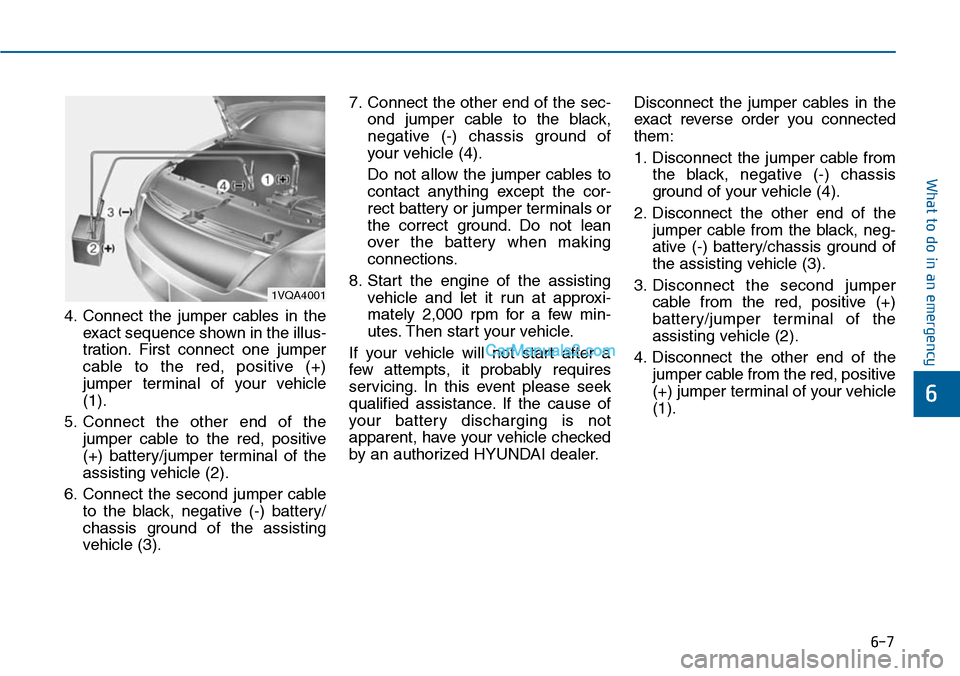
4. Connect the jumper cables in the
exact sequence shown in the illus-
tration. First connect one jumper
cable to the red, positive (+)
jumper terminal of your vehicle
(1).
5. Connect the other end of the
jumper cable to the red, positive
(+) battery/jumper terminal of the
assisting vehicle (2).
6. Connect the second jumper cable
to the black, negative (-) battery/
chassis ground of the assisting
vehicle (3).
7. Connect the other end of the sec-
ond jumper cable to the black,
negative (-) chassis ground of
your vehicle (4).
Do not allow the jumper cables to
contact anything except the cor-
rect battery or jumper terminals or
the correct ground. Do not lean
over the battery when making
connections.
8. Start the engine of the assisting
vehicle and let it run at approxi-
mately 2,000 rpm for a few min-
utes. Then start your vehicle.
If your vehicle will not start after a
few attempts, it probably requires
servicing. In this event please seek
qualified assistance. If the cause of
your battery discharging is not
apparent, have your vehicle checked
by an authorized HYUNDAI dealer.
Disconnect the jumper cables in the
exact reverse order you connected
them:
1. Disconnect the jumper cable from
the black, negative (-) chassis
ground of your vehicle (4).
2. Disconnect the other end of the
jumper cable from the black, neg-
ative (-) battery/chassis ground of
the assisting vehicle (3).
3. Disconnect the second jumper
cable from the red, positive (+)
battery/jumper terminal of the
assisting vehicle (2).
4. Disconnect the other end of the
jumper cable from the red, positive
(+) jumper terminal of your vehicle
(1).6
1VQA4001
Page 545 of 665
6-11
What to do in an emergency
6
Changing tiresFollow these steps to change your
vehicle’s tire:
1. Park on a level, firm surface.
2. Move the shift lever into P (Park,
for automatic transaxle vehicle) or
neutral (for manual transaxle
vehicle), apply the parking brake,
and place the ignition switch in the
LOCK/OFF position.
3. Press the hazard warning flasher
button.
4. Remove the wheel lug nut wrench,
jack, jack handle, and spare tire
from the vehicle.
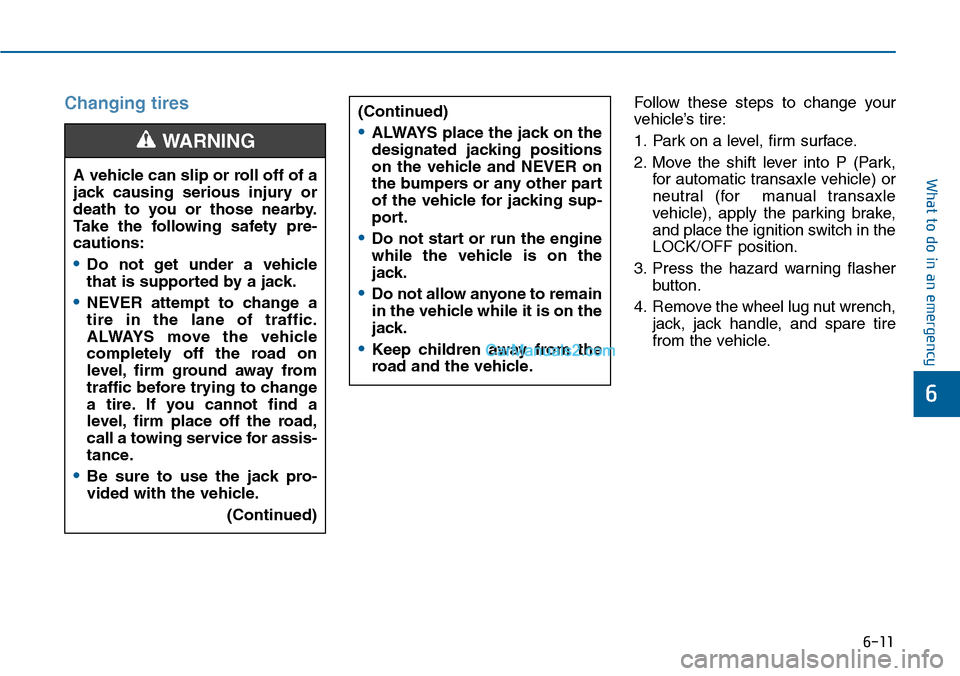
A vehicle can slip or roll off of a
jack causing serious injury or
death to you or those nearby.
Take the following safety pre-
cautions:
•Do not get under a vehicle
that is supported by a jack.
•NEVER attempt to change a
tire in the lane of traffic.
ALWAYS move the vehicle
completely off the road on
level, firm ground away from
traffic before trying to change
a tire. If you cannot find a
level, firm place off the road,
call a towing service for assis-
tance.
•Be sure to use the jack pro-
vided with the vehicle.
(Continued)
WARNING
(Continued)
•ALWAYS place the jack on the
designated jacking positions
on the vehicle and NEVER on
the bumpers or any other part
of the vehicle for jacking sup-
port.
•Do not start or run the engine
while the vehicle is on the
jack.
•Do not allow anyone to remain
in the vehicle while it is on the
jack.
•Keep children away from the
road and the vehicle.